1. Game Background
1.1 World Setting
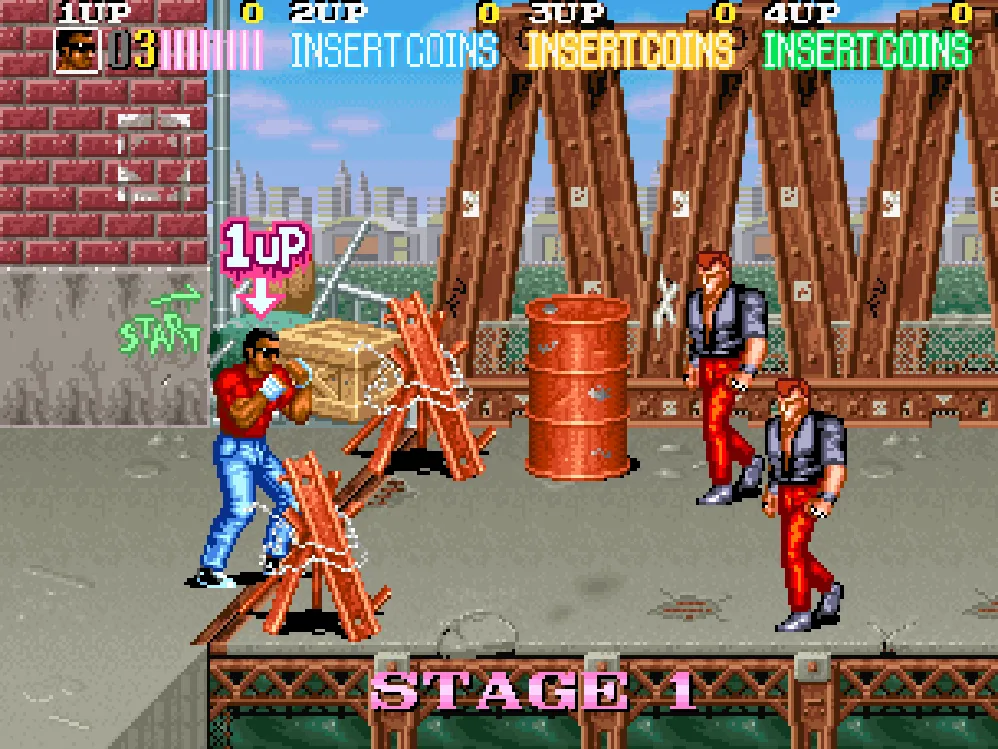
Vendetta is set in a crime-ridden city ruled by the Dead End Gang. This ruthless criminal organization controls the city's streets, docks, warehouses, and underground factories, leaving the police helpless. Five street fighters — Blood, Hawk, Boomer, Sledge, and Kate — form a self-defense group called The Cobras. When the Dead End Gang kidnaps Hawk's apprentice Kate, the Cobras stop waiting for the law — they pick up their fists, bats, knives, and shotguns, and set out on a violent path of revenge.
Vendetta is Konami's grittier, darker take on the then-popular "street brawler" genre. Compared to Capcom's Final Fight — which at least had a clear "rescue the mayor's daughter" heroic narrative — Vendetta's aesthetic is closer to 1970s American B-grade crime films. The enemies aren't ninjas or mutated monsters, but leather-jacket, sunglasses-wearing street thugs with chains — and some of those thugs' behavior... we'll get to that in the trivia section later.
1.2 Development History
Vendetta was first released by Konami in Japan in July 1991 under the title Crime Fighters 2 (クライムファイターズ2), as a sequel to Konami's 1989 beat 'em up Crime Fighters. However, the international market received a completely independent title and marketing campaign — the name "Vendetta" itself signaled that this game was more violent, more personal, and less suitable for children than its predecessor.
The game was directed by Satoru Okamoto, produced by S. Kido, and programmed by Okamoto, K. Ozaki, and Yuichi Kobayashi. The art team consisted of M. Yoshida, Kazuaki Nakanishi, and T. Nakazawa. The soundtrack was composed by Michiru Yamane and Hideaki Shikama — Yamane would later achieve legendary status for her work on Castlevania: Symphony of the Night, and Vendetta is one of the few arcade beat 'em ups in her career, with its raw electronic funk and industrial metallic percussion foreshadowing her later brilliance in gothic and orchestral composition.
Vendetta achieved respectable commercial success: Japan's Game Machine magazine ranked it third in popularity among table arcade units in July 1991; in North America, RePlay magazine listed it as the highest-grossing new game in September 1991. Sinclair User magazine awarded it the "Best Beat 'Em Up" of 1991 alongside WWF WrestleFest. In July 2021, Hamster Corporation ported Vendetta to Nintendo Switch and PlayStation 4 through the Arcade Archives series — Damien McFerran of Nintendo Life gave it a 9/10, calling it "one of the greatest beat 'em ups ever made, with deep gameplay." In 2023, Time Extension included it on its list of the greatest beat 'em ups of all time.
2. Character Introduction
Each of the four playable characters has a distinct fighting style and backstory:
Blood — Former Professional Boxer
| Attribute | Rating |
|---|---|
| Attack Power | ★★★★☆ |
| Speed | ★★★☆☆ |
| Combo Performance | ★★★☆☆ |
| Difficulty | ★★☆☆☆ |
- Overall Assessment: A balanced close-range fighter. Blood's boxing combos are fast with precise hit detection — he's the ideal starter character. As a boxer who lost his career in the ring, every hook he throws carries the anger of a stolen livelihood.
Hawk — Former Professional Wrestler
| Attribute | Rating |
|---|---|
| Attack Power | ★★★★★ |
| Speed | ★☆☆☆☆ |
| Combo Performance | ★★★☆☆ |
| Difficulty | ★★★★☆ |
- Overall Assessment: A heavy grappler. Hawk's wrestling background gives him the strongest grab moves in the game — front suplexes, back drops, corner slams — with damage output that tops the roster. However, his movement speed is extremely slow — you'll need precise spacing to land your grabs before enemies swarm you.
Boomer — Martial Artist
| Attribute | Rating |
|---|---|
| Attack Power | ★★★☆☆ |
| Speed | ★★★★★ |
| Combo Performance | ★★★★★ |
| Difficulty | ★★★★☆ |
- Overall Assessment: A speed-based combo character. Boomer has the shortest animation frames, the fastest attack speed, and the highest combo density — but low damage per hit. His tactic is "hit and run, never stand still" — in skilled hands, Boomer can chain combos from one end of the screen to the other while enemies never get a chance to counterattack.
Sledge — Ex-Military Criminal
| Attribute | Rating |
|---|---|
| Attack Power | ★★★★☆ |
| Speed | ★★☆☆☆ |
| Combo Performance | ★★☆☆☆ |
| Difficulty | ★★★☆☆ |
- Overall Assessment: A power-type character whose single-hit damage is second only to Hawk's grabs. Sledge's military background gives him the most straightforward fighting style — no flashy combos, just punch after punch until the enemy can't get back up.
3. Controls and Mechanics
3.1 Basic Controls
Vendetta uses a two-button system of Punch + Kick — there's no dedicated jump button:
| Button | Action | Description |
|---|---|---|
| A Button | Punch | Fast close-range combos, moderate damage |
| B Button | Kick | Mid-range pokes, low attacks |
| A+B Together | Special Move (Jump Kick) | The only aerial attack in the game — consumes one bar of stamina |
3.2 Innovative Mechanic: Grounded Opponent Attacks
Vendetta is one of the earliest beat 'em ups to allow "grounded attacks" — after an enemy falls, you can continue attacking their prone body. This is standard in modern action games, but in 1991, no one had systematically implemented this concept. It makes Vendetta's combat pace more brutal and relentless than its contemporaries — a downed enemy isn't a chance to catch your breath, but an opportunity to keep stomping.
3.3 Weapon System
Weapons are scattered throughout the stages — dropped by enemies or hidden — including shotguns (limited ammo), baseball bats, knives, and glass bottles. The shotgun is the most powerful crowd-clearing weapon in the game — a single shot can knock down every enemy in a straight line. But ammo is extremely scarce — usually only 2-3 rounds.
4. Stage Walkthrough and Boss Strategies
4.1 Stage 1: The Streets
| Item | Details |
|---|---|
| Setting | Gang-controlled city streets. Burning trash cans, shattered storefront windows, graffiti-covered walls — this city has given up fighting back. |
| Boss | The Dead End Gang's vanguard enforcer — a bulky brute wielding a chain for sweeping attacks. |
| Strategy | The chain's range is longer than you think — use kicks (B button) to probe the distance before entering his attack radius. Grabs (move toward the enemy + attack up close) are the safest way to initiate against large bosses. |
4.2 Stages 2-4: Docks → Warehouse → Underground Factory
| Item | Details |
|---|---|
| Setting | Each stage pushes deeper into Dead End Gang territory — the docks (shipping containers and cranes), the warehouse (piles of wooden crates), and the underground factory (drug processing and weapons manufacturing lines). |
| Boss | Each stage's boss represents a different division of the gang — the dock boss is a smuggling ringleader (using a ship's anchor as a weapon), the warehouse boss is an armed convoy captain, and the factory boss is Faust, the gang's second-in-command. |
| Strategy | Docks: Use destructible crates for weapon pickups — this stage has the most shotgun ammo. Warehouse: The boss summons minion reinforcements — clear the adds first, then focus on the boss. Factory: Faust is the strongest enemy before the final boss — don't get greedy; he has faster counterattacks than any previous boss. |
4.3 Final Stage: Dead End Gang HQ → Boss Rush
| Item | Details |
|---|---|
| Setting | After defeating Faust, the game enters its most unique endgame design — instead of a single final boss fight, all previously defeated bosses are revived, and you must defeat them consecutively in a gauntlet of battles. |
| Boss | All defeated bosses — revived → defeated again. Finally, the true leader of the Dead End Gang (Big Boss). |
| Strategy | The boss rush is Vendetta's most distinctive design choice — it completely subverts the convention of "beat the final boss and it's over." Your health does not recover between boss fights — this is the ultimate test of endurance. The A+B special jump kick is your only evasion tool in this marathon — but each use costs one stamina bar, and stamina is the scarcest resource in this gauntlet. After clearing the game, it loops back to Stage 1 — with increased difficulty — infinitely until your credits run out. |
5. Tips and Advanced Strategies
5.1 Basic Survival Tips
- Kicks (B button) are for spacing: Don't charge into crowds with punches — walk to the edge of enemy range, poke with kicks, and only move in for punch combos when it's safe.
- The A+B jump kick isn't for damage — it's for escape: When surrounded by 3+ enemies, the A+B jump kick costs one stamina bar to break out of the encirclement. It's the only move in the game with invincibility frames — don't waste it on offense.
- Don't waste shotgun ammo on minions: Once the ammo is gone, it's gone — save it for boss fights. A single shotgun blast can land all pellets on a boss as they're getting up — dealing the highest single-hit damage in the game.
- Grounded attacks — but don't overdo it: Grounded attacks drain your stamina (though not much). In the boss rush, prolonged grounded attacking will leave you short on stamina for later fights.
- Two-player "pincer" tactic: Player 1 draws the boss's attention from the front while Player 2 circles behind for backstabs. Backstab damage multiplier is higher than frontal attacks — this is a universal rule in all beat 'em ups.
5.2 Advanced Trivia
- Japanese title Crime Fighters 2: The Japanese version maintained the series connection to the original Crime Fighters. Konami had an ongoing investment in "crime series" arcade games in Japan at the time, but chose a more attention-grabbing standalone title for international markets.
- Michiru Yamane's early soundtrack: Yamane, who would later compose one of the most famous soundtracks in gaming history for Castlevania: Symphony of the Night, contributed raw electronic funk and industrial metal percussion to Vendetta — a striking contrast to her later elegant gothic orchestral style.
6. Trivia and Arcade Legends
6.1 The Most Notorious Enemy Animation
Vendetta holds a unique place in arcade game censorship history — because its enemy behavior includes animations that are still jaw-dropping today: a leather-jacket-wearing thug will grab the protagonist from behind and begin performing unspeakable grinding and licking motions. If two such enemies are on screen — one of them will even do the same to a lamppost until the light bulb falls and hits him on the head. This animation was heavily censored in all overseas versions (the American version removed these actions entirely), with only the Japanese, Argentine, and Brazilian releases retaining the full content.
Also censored was a Doberman enemy that performs similarly unspeakable actions. Konami in 1991 was clearly walking a tightrope of "how much weird stuff can we cram into an arcade game without getting fully banned."
6.2 The Golden Age of Four-Player Arcades
Vendetta supports 4-player simultaneous play — in 1991, a 4P beat 'em up arcade cabinet was over 1.2 meters wide. Four strangers playing side by side in cooperation — this was a unique social ritual in an era without online multiplayer. Konami's 4P beat 'em up lineup — Teenage Mutant Ninja Turtles (1989), Sunset Riders (1991), and Vendetta (1991) — formed the backbone of early 1990s arcade 4P cooperative experiences.
6.3 The Infinite Loop Ending
Vendetta doesn't end when you clear it — it restarts from Stage 1 with fully enhanced enemy attack power and speed, looping infinitely until all your lives are exhausted. This design stands in stark contrast to games like Warriors of Fate that show credits after completion — Konami chose the pure arcade logic of "it's not over until your coins run out." It makes Vendetta a game that "can never be finished" — and in the arcade, that means the machine's revenue stream is also "never-ending."