1.1 World Setting
The story of Double Dragon is set in "Bloody Town," a crime-ridden metropolis overrun by street gangs. The city is controlled by the criminal mastermind Koga Shuko. Shuko hosts an underground fighting tournament, ostensibly to recruit new talent, but his true motive is to lure the Lee brothers, Billy and Jimmy, into a trap. He possesses one half of the legendary Double Dragon medallion, while the brothers hold the other. Legend has it that whoever unites the two halves will gain infinite power.
After receiving a letter from their master, Billy and Jimmy return to the city where they grew up. Their home has been transformed into a shadow of its former self, with gangs lurking on every corner. To reclaim the stolen half of the medallion and stop Shuko’s quest for world domination, the brothers enter the deadly tournament. Joining them is their childhood friend, Marian—who, in this installment, is no longer a damsel in distress, but a formidable gang leader in her own right.
1.2 Development History
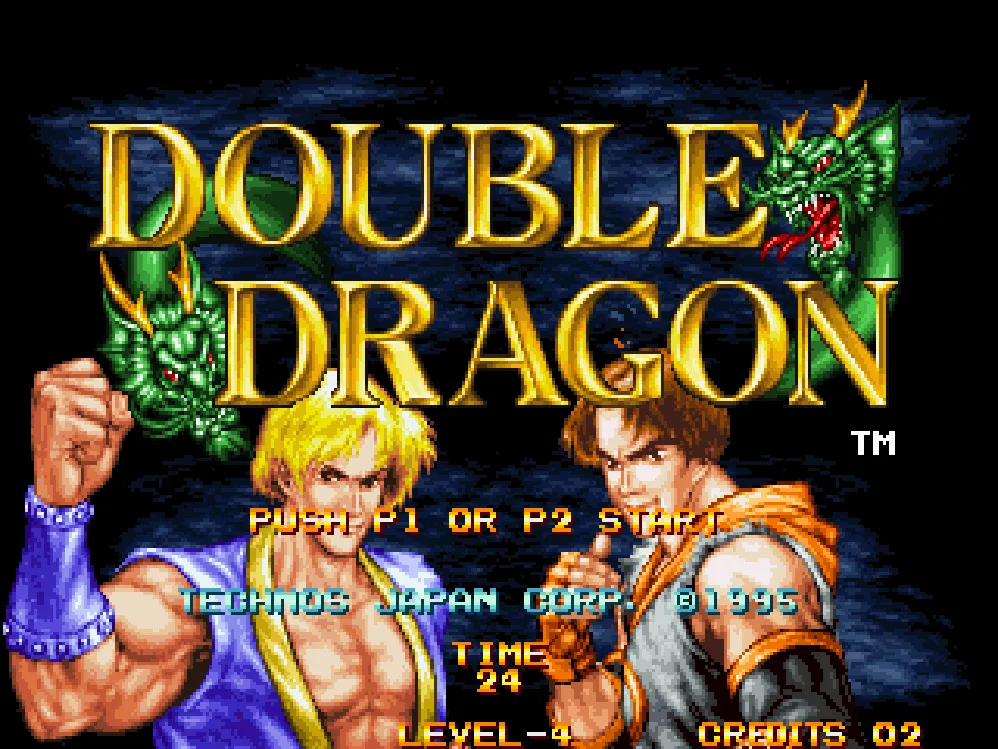
Developed by Technōs Japan and released in February 1995 for the Neo Geo MVS, Double Dragon was the final entry in the series produced by Technōs for arcades and one of only two fighting games in the franchise (the other being Double Dragon V: The Shadow Falls). The game was produced by Kazuyuki Kurata, with character designs by Minoru Yamaguchi and Muneki Ebinuma, and a soundtrack composed by Chiaki Iizuka, Fumio Suzuki, and Kiyomi Kataoka.
Its development came at a unique time. By the mid-90s, side-scrolling beat-'em-ups were fading, and fighting games dominated the arcades. Following the massive success of Street Fighter II, Technōs decided to bring the Double Dragon series into the 1-on-1 arena. The game also drew heavy inspiration from the 1994 live-action Double Dragon movie, incorporating elements like Shuko’s design, Abobo’s mutation, the brothers' "Super Saiyan"-style transformations, and the core lore of the dragon medallions.
However, Technōs Japan was struggling financially at the time. Double Dragon and the later Voltage Fighter Gowcaizer were the only two fighting games the company ever released for the Neo Geo. Technōs filed for bankruptcy in 1996, making Double Dragon one of the final titles released before the company’s dissolution—serving as the "swan song" for the arcade series.
The game was later ported to the Neo Geo CD (June 1995) and PlayStation (April 1996, handled by Urban Plant). The PS version added an "Over Drive" priority system and a humorous "Tiny 3D" mode, though it removed the high-impact Neo Geo intro animation, replacing it with live-action movie clips set to generic hard rock.
II. Character Profiles
Double Dragon features 10 playable characters and 2 bosses, blending movie-inspired designs with original Technōs creations in a gritty, realistic art style.
Billy Lee: The younger brother, master of Sou-Setsu-Ken. Power 3, Speed 4, Defense 2. A standard protagonist-style character. He features fireball-style and dragon-punch-style moves. His "Dragon Transformation" super move, activated by pressing ABCD simultaneously, cloaks him in golden light, enhances all his attacks with fire, and unlocks the "Double Dragon" ultimate—the game's most visually striking mechanic.
Jimmy Lee: The older brother. Power 4, Speed 3, Defense 3. His moveset is similar to Billy’s but favors raw power. He also possesses the "Dragon Transformation." Sou-Setsu-Ken emphasizes fluidity; the brothers play as balanced fighters before transforming, and as screen-clearing powerhouses afterward.
Marian: No longer a damsel, she is now a street-fighting gang leader. Power 1, Speed 5, Defense 1. The fastest character in the game. She uses street-fighting techniques and charge-based moves. While her defense is low, her high mobility and unpredictable rhythm make her a favorite for experts.
Abobo: A giant from New York. Power 5, Speed 1, Defense 5. The most extreme character in terms of stats. Standing 7'2" and weighing 336 lbs, he relies on command grabs and heavy strikes. His super moves include a triple-hammer punch and a "Giant Throw" where he temporarily grows in size to slam his opponent.
Burnov: A former wrestler from Detroit. Power 5, Speed 1, Defense 4. Weighing 495 lbs, he is Abobo’s rival. He specializes in wrestling moves and his signature "Nitro Slime" attack.
Eddie: A Muay Thai kickboxer from Venezuela. Power 4, Speed 2, Defense 3. Focused on discipline, he uses leg slashes and dragon knees.
Amon: A ninja from Japan (presumably). Power 2, Speed 4, Defense 2. Uses Dragon Fang ninjutsu. Features include aerial shuriken volleys and ground-based ninja bombs. His stage, set on the wing of an old plane flying through a canyon, is widely considered the most stunning in the game.
Cheng-Fu: A drunken master from Hong Kong. Power 3, Speed 3, Defense 3. He uses a unique grab where he sprays alcohol on opponents to stun them before following up with combos.
Dulton: A street fighter from Italy. Power 4, Speed 2, Defense 5. Uses the "Dalton Blaster" energy projectile, which can be charged to fire 1 to 4 shots.
Rebecca: A tonfa fighter from the Netherlands. Power 3, Speed 3, Defense 1. Her fireballs can hit opponents on the way out and again on the way back—a deadly surprise for unsuspecting novices.
Boss Characters:
- Duke: Shuko’s bodyguard. Power 4, Speed 5, Defense 4. Features a flashy martial arts style. He appears as the second-to-last opponent in single-player mode.
- Koga Shuko: The final boss. Power 4, Speed 4, Defense 4. Uses ancient martial arts and ninjutsu. In the second round, he unleashes terrifying abilities like teleportation, homing fireballs, and the "Shadow Attack."
III. Controls
3.1 Basic Controls
| Button | Function |
|---|---|
| A | Light Punch (LP) |
| B | Light Kick (LK) |
| C | Heavy Punch (HP) |
| D | Heavy Kick (HK) |
| Forward, Forward | Dash |
| Back, Back | Back Step |
| Near Opponent + B/C/D | Throw (varies by button) |
Double Dragon uses the standard four-button Neo Geo layout, consistent with The King of Fighters.
3.2 Charge System
This is the game’s core mechanic. Every character has a blue charge gauge over their health bar. Attacking or landing throws fills this gauge. When the blue gauge meets your current health (red portion), the screen flashes "CHARGE," allowing you to perform a Charge Move (Super).
Key Mechanic: The lower your health, the faster the gauge fills. This is a classic "comeback system" that keeps every match tense. After using a super, the gauge resets.
3.3 Other Core Systems
- Air Block: Hold the direction away from the opponent while in the air.
- Air Throw: Press the throw button while near an opponent in the air.
- Double Jump: Input the jump direction again while in mid-air.
- Ground Attack: Press "Down + any attack button" when an opponent is knocked down to stomp them.
- Stage Zoom: Similar to Samurai Shodown, the camera zooms in and out based on the distance between fighters.
IV. Boss Strategy
Boss 1: Duke
Duke is incredibly fast (SPD 5). Strategy: Don't let him control the pace. His teleport punch has a distinct sound cue—listen for it and block in the opposite direction. His "Flame Dragon Fist" leaves him vulnerable after use; punish him then.
Boss 2: Koga Shuko
Round 1: He plays conservatively. Save your charge and health for Round 2. Round 2: He unleashes his full arsenal. Strategy: Keep at mid-range. Use your Dash to pass through his homing fireballs. When he is low on health, use your Charge Move to secure the win.
V. Tips & Advanced Strategy
- Manage your Charge: Don't waste your super move immediately. The comeback potential when your health is below 1/3 is massive.
- Master Throws: Throws are very strong in this game; use them to break through defensive opponents.
- Don't ignore Air Blocking: It is essential for surviving aerial pressure.
- Dragon Transformation: Use it when you have a health advantage to snowball, rather than as a desperate gamble.
VI. Trivia & Arcade Legends
6.1 Technōs' "Last Dance"
Double Dragon was one of the final titles from Technōs Japan before their 1996 bankruptcy. It represents the end of an era for the company that defined the beat-'em-up genre.
6.2 Movie Adaptation
Unlike most movie-based games, Double Dragon is widely considered superior to the 1994 film it was based on. It took the lore and built a solid, original fighting system around it.
6.3 Visual Spectacle
Hardcore Gaming 101 famously called it "not the best fighting game, but one of the most visually impressive." The pixel art, stage transitions, and character sprites remain highlights of the Neo Geo era.