I. Game Background
1.1 Setting the Scene
Hook is based on the 1991 fantasy film directed by Steven Spielberg, starring Robin Williams as the adult Peter Pan and Dustin Hoffman as Captain Hook. The game faithfully adapts the film's premise: on the magical island of Neverland, the boy who never grows up, Peter Pan, lives with his "Lost Boys." Their eternal nemesis, the one-handed Captain Hook, leads his pirate army in a constant quest for revenge.
At the start of the game, Captain Hook kidnaps Peter's children once again. Peter must rediscover his dormant ability to fly and join forces with the Lost Boys to traverse Neverland's jungles, pirate ships, snowy mountains, and caves. Along the way, they must fight off Hook's pirate legion, culminating in a final, fateful sword duel on the deck of the Jolly Roger.
1.2 Development History
The arcade version of Hook was developed by the Japanese studio IREM and released globally in 1992. IREM was one of the most creative arcade developers of the 80s and 90s, known for masterpieces like the R-Type series (a milestone in side-scrolling shooters) and In the Hunt. Hook stands out as one of IREM's rare forays into the beat-'em-up genre.
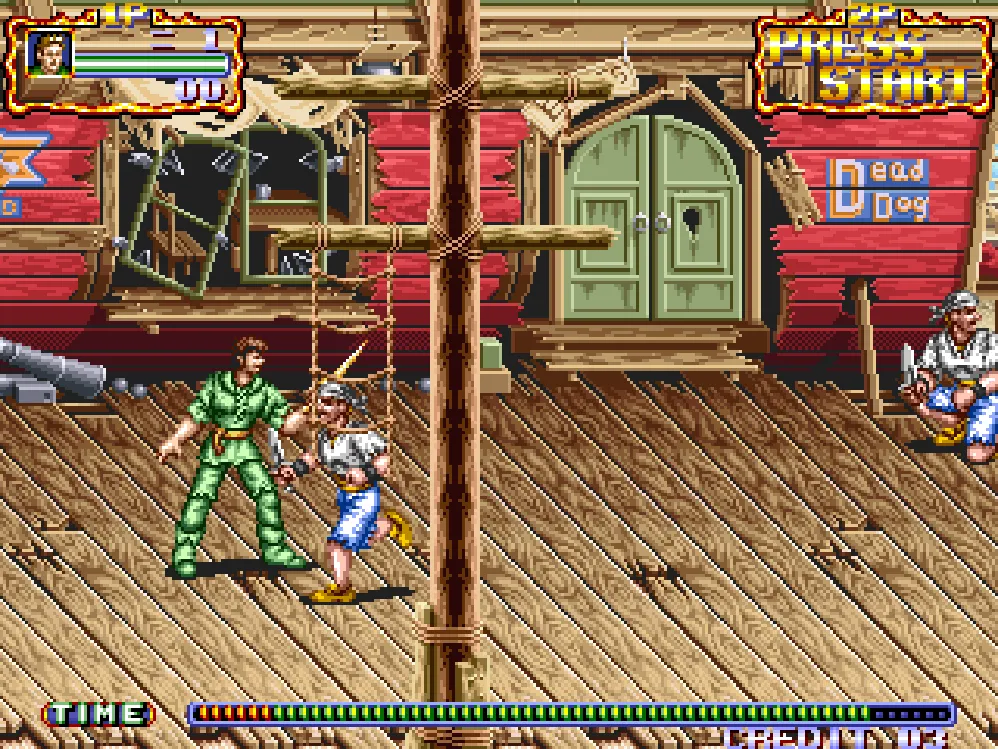
As a licensed movie tie-in, the most notable feature of the arcade version is its 4-player cooperative support—a highly competitive selling point in the 1992 arcade market. Much like other 4-player hits of the era such as Teenage Mutant Ninja Turtles and The Simpsons, Hook was a staple in arcades, often requiring players to wait in line for a turn.
The game features a unique top-down flight selection mode—between stages, Peter Pan flies over Neverland, allowing players to choose which area to enter next. This "flight-based" level selection was remarkably innovative for an arcade game in 1992.
II. Character Roster
There are 5 playable characters in the arcade version: Peter Pan and four of the Lost Boys. Each character possesses a unique fighting style.
2.1 Peter Pan — The Returning Hero
| Attribute | Rating |
|---|---|
| Strength | ★★★★ |
| Speed | ★★★★ |
| Skill | ★★★★ |
| Difficulty | ★★ |
- Weapon: Golden Short Sword. Fast attack speed with precise hit detection.
- Special Move: Spinning Slash—a short-range, all-directional attack perfect for breaking out of crowds; Dash Thrust—quickly closes the gap to enemies.
- Pros: Balanced stats across the board—range, damage, and speed are all above average, making him the most versatile character.
- Cons: No single stat reaches the extreme—in specific scenarios, he may be outperformed by specialized characters.
- Verdict: The quintessential all-rounder. If it's your first time playing Hook, you can never go wrong with Peter Pan.
2.2 Rufio — Leader of the Lost Boys
| Attribute | Rating |
|---|---|
| Strength | ★★★★ |
| Speed | ★★★★★ |
| Skill | ★★★ |
| Difficulty | ★★★ |
- Weapon: Dual Daggers. The fastest attack speed in the game.
- Pros: Highest speed and combo density; the rapid-fire dual daggers can keep enemies stun-locked until they are defeated.
- Cons: Lower damage per hit; shortest attack range—requires you to get up close and personal.
- Verdict: In the film, Rufio is the leader of the Lost Boys—his iconic red mohawk and the catchphrase "Bangerang!" make him unforgettable. In the game, he is the king of speed—perfect for players who love fast-paced, aggressive combos.
2.3 Ace — Steady Strength
| Attribute | Rating |
|---|---|
| Strength | ★★★★★ |
| Speed | ★★★ |
| Skill | ★★★ |
| Difficulty | ★★ |
- Weapon: Spear. The longest attack range in the game.
- Pros: The spear's reach allows Ace to safely damage enemies from outside their melee range; high single-hit damage.
- Cons: Slowest attack speed—the spear swing has a noticeable recovery animation, requiring precise timing.
- Verdict: There is nothing quite like clearing a dense crowd with one of Ace's sweeping spear strikes. Ideal for players who prefer controlling distance; very beginner-friendly.
2.4 Pockets — The Miniature Cyclone
| Attribute | Rating |
|---|---|
| Strength | ★★★ |
| Speed | ★★★★ |
| Skill | ★★★★ |
| Difficulty | ★★★★ |
- Weapon: Slingshot + Melee Club. The only character with a ranged attack.
- Pros: The slingshot allows for safe distance attacks—you can chip away at bosses from outside their danger zone.
- Cons: Limited ammo for the slingshot (must be replenished); lower melee damage.
- Verdict: Pockets' "ranged + melee" dual combat style makes him a favorite for skilled players. His slingshot is the safest way to deal damage during boss fights, but ammo management is key—don't waste your shots on minor enemies.
2.5 Thudbutt — The Heavy Tank
| Attribute | Rating |
|---|---|
| Strength | ★★★★★ |
| Speed | ★★ |
| Skill | ★★ |
| Difficulty | ★ |
- Weapon: Heavy Wooden Mallet. Highest attack power in the game with devastating single-hit damage.
- Pros: One swing sends all enemies in a fan-shaped area flying. The most "satisfying" character—every hit provides incredible visual and tactile feedback.
- Cons: Slowest movement and attack speed; largest hitbox—easiest to hit.
- Verdict: Thudbutt is the standard "heavy tank" archetype—slow, heavy, and brutal. The "thud" of his mallet is unmatched by any other character. Highly recommended for players who love to deliver heavy, decisive blows.
III. Controls
3.1 Basic Controls
Uses the standard IREM layout: 8-way joystick + 2 buttons:
| Action | Input | Description |
|---|---|---|
| Attack | Button A | Press repeatedly for combos |
| Jump | Button B | Standard jump |
| Jump Attack | B → A | Aerial attack |
| Run | →→ | Rapid dash |
| Dash Attack | Run + A | Charging attack |
| Grab | Auto-grab near enemy | Grab + A = Strike, Direction + A = Throw |
| Forward Throw | Grab + → + A | Throws enemy forward, knocking down others in their path |
| Special Move | A + B | Screen-clearing attack (costs health); use when surrounded |
| Pick Up Item | Stand on item + A | Pick up food for health, weapons, or ammo |
3.2 Throwing Mechanics
One of the most satisfying mechanics in Hook: grabbing an enemy and throwing them into others. The thrown enemy acts like a "human cannonball," knocking down everything in their path. In a dense crowd, a well-placed throw can trigger a chain reaction, clearing the screen efficiently. This is the core of the game's "visceral satisfaction."
IV. Stages and Boss Strategy
There are 6 stages in the arcade version, covering the most iconic locations in Neverland. The "flight selection" screen between stages, where Peter Pan flies over the island, remains a beloved visual design to this day.
| Stage | Location | Enemies | Boss | Strategy Tips |
|---|---|---|---|---|
| 1 | Lost Boys' Treehouse | Basic Pirates (knives/clubs) | Pirate Lieutenant (Heavy Scimitar) | Beginner stage—learn basic combos and throws. Boss has high damage but slow attacks; strike during his recovery window. |
| 2 | Neverland Jungle | Pirates + Wildlife (snakes/spiders) | Giant Jungle Guardian | Increased difficulty due to visual obstructions—watch for enemies jumping from behind trees. Use wooden crates to hit the boss. |
| 3 | Pirate Docks | Elite Pirates (muskets/scimitars) + Cannons | Pirate Gunner Captain | Explode gunpowder barrels for massive area damage—lure enemies near them first. |
| 4 | Snowy Ice Cave | Pirates + Sliding Traps | Snow Beast | Ice reduces friction—watch your movement. The boss's charge distance is extended on ice—jump early to dodge. |
| 5 | Pirate Underground Cave | Elite Pirate Legion (muskets/cannons) | Hook's First Mate | Highest enemy density in the game. Use "human cannonballs" to clear the screen. Pockets' slingshot is superior for mid-range boss fights. |
| 6 | Pirate Ship Deck (Final) | Pirate Royal Guard | Captain Hook—Dustin Hoffman-style swordplay | Two phases. Phase 1: Keep distance and strike after his sword swings. Phase 2 (below 50% HP): Hook enters a rage state—speed and range increase. Clear minions first, then strike during his recovery. The ultimate showdown—Peter's golden sword vs. Hook's silver hook. |
V. Tips and Advanced Strategy
5.1 Survival Tips
- Human Cannonballs are screen-clearers: Throwing a grabbed enemy into a crowd is the most efficient way to handle 5+ enemies.
- Don't ignore gunpowder barrels: They deal massive damage. Luring bosses into them is a pro-level speed-kill tactic.
- Manage Pockets' ammo: Ammo is limited. Use melee for minor enemies and save shots for bosses. Search every corner for refills.
- Dash attacks are safe openers: Using a dash attack (→→ + A) lets you close the gap while keeping the enemy in a stun state, allowing for easy follow-up combos.
- Character choice: Beginners should choose Peter Pan (balanced) or Thudbutt (high damage/forgiving). Advanced players can push the limits with Pockets.
- Use Special Moves (A+B) wisely: They cost health—only use them when surrounded by 4+ enemies.
5.2 4-Player Tactics
- Classic Formation: Thudbutt (tanking) + Ace (mid-range spear) + Peter Pan (support) + Pockets (ranged sniper). This covers all scenarios.
- Human Cannonball Relay: Player A grabs an enemy and throws to B → B catches and throws to C → C throws into the ground. A fun, high-skill team maneuver.
- Rescue: If a teammate is grabbed by a boss, use a dash attack to hit the boss and break the grab animation.
5.3 Advanced Knowledge
- IREM's "Ground Hit" Tradition: You can hit downed enemies. Use jump attacks (B→A) or specific downward strikes to maximize damage on fallen foes.
- Hidden Flight Paths: Some "non-essential" areas on the flight map contain extra health and ammo. Explore every corner.
VI. Trivia and Arcade Legends
6.1 From R-Type to Hook: IREM's Unexpected Shift
IREM was known for hardcore shooters—R-Type is the Citizen Kane of side-scrolling shooters. When they announced a 4-player beat-'em-up based on a Spielberg family movie, the industry was skeptical. Yet, Hook delivered a surprisingly high-quality experience that remains a benchmark for movie-licensed games.
6.2 The 1991 Cross-Media Blitz
When Spielberg's Hook premiered in late 1991, Sony Pictures launched an unprecedented cross-media campaign. Games were released on almost every platform imaginable, each with completely different gameplay (Arcade: beat-'em-up, NES/GB: platformer, PC: point-and-click). This "one movie, many genres" model is unthinkable today.
6.3 Spielberg's "Lost Boy" Aesthetic
Production designer Norman Garwood created a Neverland that was darker, grittier, and "dirtier" than the Disney version. IREM's art team faithfully translated this into pixel art—from the driftwood treehouse to the cold, reflective light in the ice caves.
6.4 "Bangerang!"
Rufio's iconic battle cry remains one of the most recognizable lines of 90s pop culture. In arcades, whenever four players joined in, someone would inevitably shout it out.