Why Vertical Shooters?
Among all arcade genres, the vertical scrolling shooter (Shmup) is the purest. There are no complex branching storylines, no mazes to memorize, and no leveling or equipment systems. You pilot a fighter jet, the screen scrolls upward, enemies swarm from all directions, and bullets rain down like a storm. You have only three things to rely on: your reflexes, your pattern memorization, and a single coin.
From the 1978 release of Space Invaders, which established the "bottom-to-top" shooting framework, to the maturation of the "bullet hell" genre around 2000, these twenty-two years represent the golden age of the vertical shooter. Taito laid the first cornerstone. Capcom epicized WWII air combat with the 194X series. Seibu Kaihatsu defined the visual standards of modern vertical shooters with the Raiden series. Psikyo pushed bullet-hell aesthetics to commercial heights with the Strikers series. CAVE turned "bullet hell" from a difficulty label into an art form with DoDonPachi.
This article selects the 12 most essential arcade vertical shooters you need to play.
Selection Criteria & Disclaimer
Selection criteria:
- Shooting Feel: Responsiveness of movement, rhythm of weapon feedback, and the visual/auditory impact when enemies are hit.
- Bullet Pattern Design: More bullets aren't always better—excellent bullet patterns are like a musical composition: structured, rhythmic, and climactic.
- Level Pacing: Enemy formation, mid-boss and end-boss configuration, and the rhythm of mid-level events.
- System Depth: Weapon systems, scoring mechanics, and hidden elements—a great shooter makes you want to drop in a second coin.
Games not included are not necessarily bad. Horizontal shooters (like R-Type, Gradius, Blazing Star), fixed-screen shooters (like Space Invaders itself), and Run & Gun games (like Metal Slug, Contra) belong to different categories. Furthermore, this list focuses on arcade originals that can be played directly on our site.
12 Legendary Vertical Shooters
#12: Space Invaders (1978, Taito)
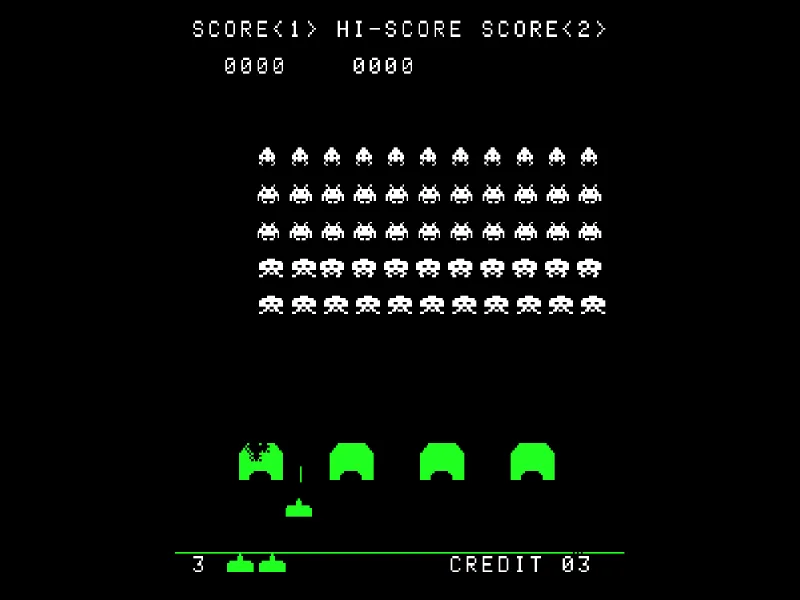
Space Invaders—One of the most important shooters in video game history, released by Taito in 1978.
Why it's here: The origin of everything.
Space Invaders wasn't the first video game, or even the first shooter. But it was the first game to make "shooting" a standalone genre. The alien invaders slowly advancing from left to right, top to bottom—this simple movement pattern created the first sense of "pressure" in gaming history. The closer the enemies got to the bottom, the faster they moved—this was the first dynamic difficulty adjustment system in history, born from hardware limitations rather than design intent (as the CPU processed fewer sprites, rendering speed increased, naturally accelerating the game's pace). In 1978, it was a beautiful accident; today, it is one of the most cited cases in game design history.
We don't recommend it as a starting point for "modern gameplay"—monochrome graphics, fixed screens, no scrolling—but if you want to understand where it all began, Space Invaders is a name you must know.
#11: 1942 (1984, Capcom)
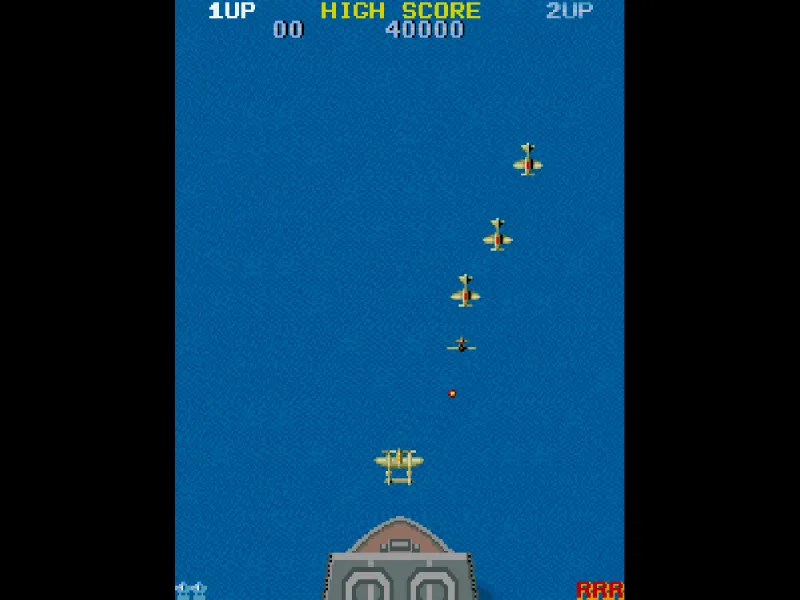
1942—The debut of Capcom's 194X series, a classic vertical shooter based on the Battle of Midway.
Why it's here: The first cornerstone of Capcom's shooting empire.
1942 was Capcom's first true arcade shooter and the start of the long-running 194X series. In 1984, it introduced an important innovation: the Loop (roll). By pressing two buttons simultaneously, your plane performs a barrel roll, briefly avoiding all enemy fire. In an era of "one-hit-kill" gameplay, this design gave players a precious window for error. The P-38 Lightning, the blue skies of the Pacific theater, and boss designs based on historical aircraft carriers—these elements would be refined repeatedly in the subsequent 194X series.
In terms of pure gameplay experience, we don't recommend it as a starting game—the system is relatively primitive and the level design is a bit stiff. But if you want to understand how Capcom built a shooting empire from scratch, 1942 is the first history lesson.
#10: Raiden (1990, Seibu Kaihatsu)
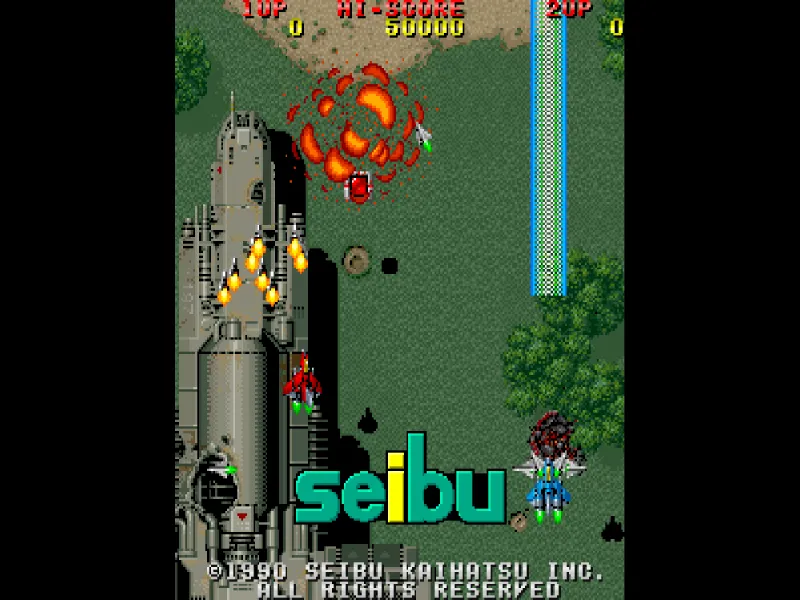
Raiden—The 1990 vertical shooter benchmark by Seibu Kaihatsu that defined the visual language of 90s arcade shooters.
Why it's here: It defined what a "modern vertical shooter" should look like.
Before Raiden, vertical shooters were usually "planes + blue skies." Seibu Kaihatsu changed everything: dark red skies, burning cities, and steel-jungle military bases—Raiden's visual tone was gloomy, heavy, and oppressive. The Vulcan (spread shot) and Laser were the game's two core weapons—the former has wide coverage but low damage, while the latter has high DPS but requires precise aiming. Choosing between Vulcan and Laser isn't a simple "which is stronger" question, but a strategic decision that needs to be adjusted dynamically throughout the game based on enemy formations.
Raiden's difficulty curve is unforgiving—the first level teaches you how to play, and the third level's bullet density tells you to "get your quarters ready." But it is this "zero-tolerance" design philosophy that earned Raiden the nickname of "coin-munching machine" in arcades—and secured its immortal status.
#9: 1941: Counter Attack (1990, Capcom)
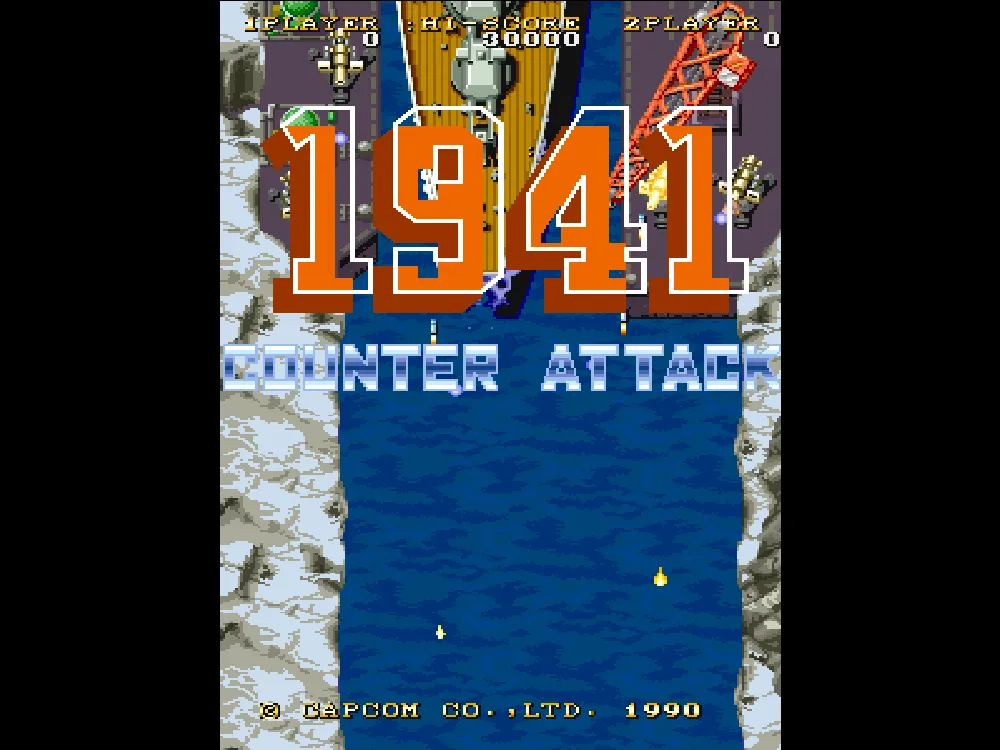
1941: Counter Attack—Capcom's first vertical shooter based on the CPS-1 board, a visual revolution for the 194X series.
Why it's here: A visual leap on the CPS-1 board.
After the first two entries (1942 and 1943) ran on older 8-bit hardware, 1941 was the first in the series to land on the CPS-1 (CP System) board. Multi-layer parallax scrolling, larger sprites, and a richer color palette—the waves on the sea, the layers of clouds, and the particle effects of explosions were all a generation ahead of its predecessors. System-wise, 1941 replaced the traditional one-hit-kill with a "life energy bar"—taking a hit drains energy rather than destroying the plane. It was also the first arcade game to automatically add +1 to the score upon continuing—from this small numerical marker, the "1CC" (One Coin Clear) cultural standard was born.
With the P-38 Lightning and Mosquito bomber, the two selectable planes have completely different trajectories and special weapon effects. The plot is a prequel to the series (1941 North Atlantic theater), adding interesting historical depth to the 194X timeline.
#8: 1943: The Battle of Midway (1987, Capcom)
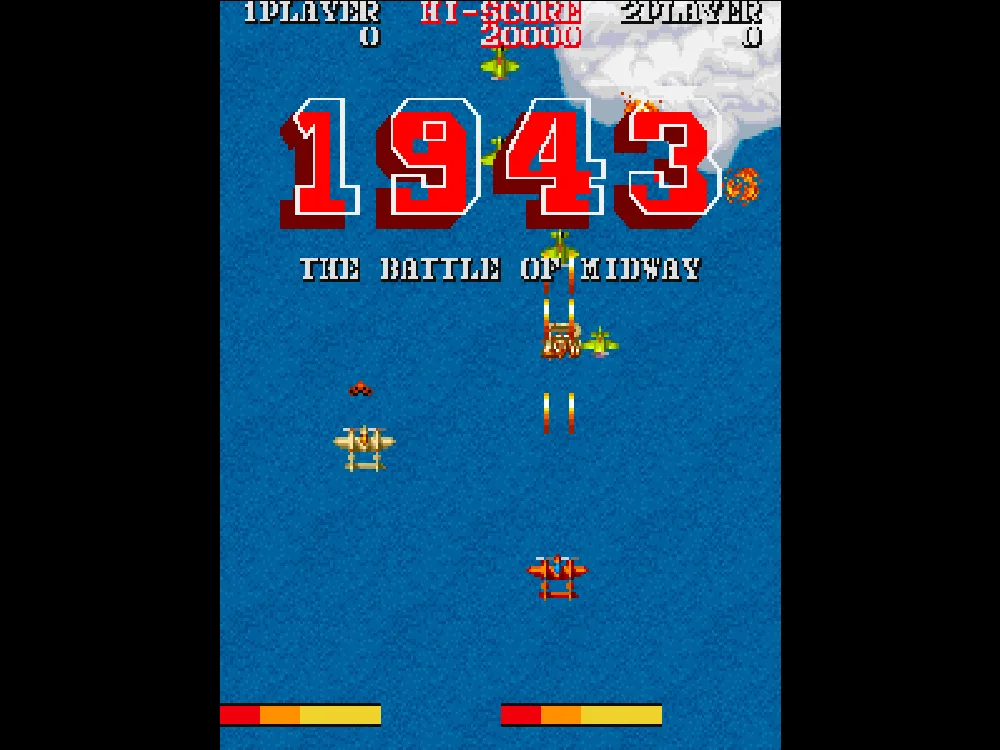
1943: The Battle of Midway—A system innovation for Capcom's vertical shooters, a strategy-based shooter centered on energy management.
Why it's here: The energy system—one of the most important innovations in arcade shooter history.
1942 was one-hit-kill. 1943 overturned this rule: fuel (energy) is constantly consumed, and taking hits or using special attacks accelerates that consumption. Energy zero = Game Over. This isn't just a simple "extra lives" change—it fundamentally altered the game's design philosophy. The Mega Crash (full-screen clear + damage) is a trade-off where you buy safety with energy. The six switchable weapons (spread, three-way, cannon, laser, etc.) each have time limits, and the hidden item system (strawberries, bamboo shoots, dragonflies, cows... even a 100,000-point Mobi-chan easter egg) is a treasure trove of secrets Capcom buried in the game.
16 levels—11 sea-based assaults + 5 aerial battles. The final boss is the largest battleship ever built in human history—the Yamato. History buffs will note that the Yamato never participated in the Battle of Midway, but Capcom's answer was simple: "We needed a final boss that was big enough."
#7: Raiden II (1993, Seibu Kaihatsu)
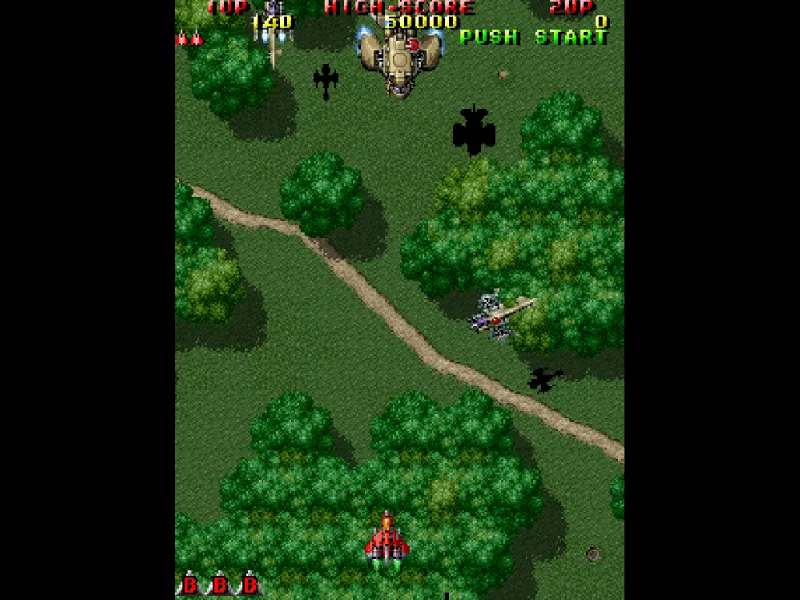
Raiden II—A comprehensive enhancement of the Raiden series by Seibu Kaihatsu, featuring a dual evolution in graphics and systems.
Why it's here: A complete upgrade of the original Raiden in every dimension.
If the first Raiden was "a stunning idea," Raiden II was "a finished masterpiece." The brand-new purple whip laser (Plasma Laser)—a curved, whip-like beam that snakes through enemy groups—is in a completely different dimension from the standard straight lasers of the previous game. Ground target details are richer (tank treads rotating, turrets turning, building collapse animations), level layouts are tighter, and boss designs are more diverse.
Raiden II solved the biggest problem of the original—weapon imbalance (where the Vulcan was far superior to the Laser). In the sequel, the addition of the Plasma Laser made laser-type weapons competitive again. It didn't change the core philosophy of the Raiden series (hardcore, uncompromising, one-hit-kill), but it allowed that philosophy to operate within a more refined and fair framework.
#6: Raiden DX (1994, Seibu Kaihatsu)
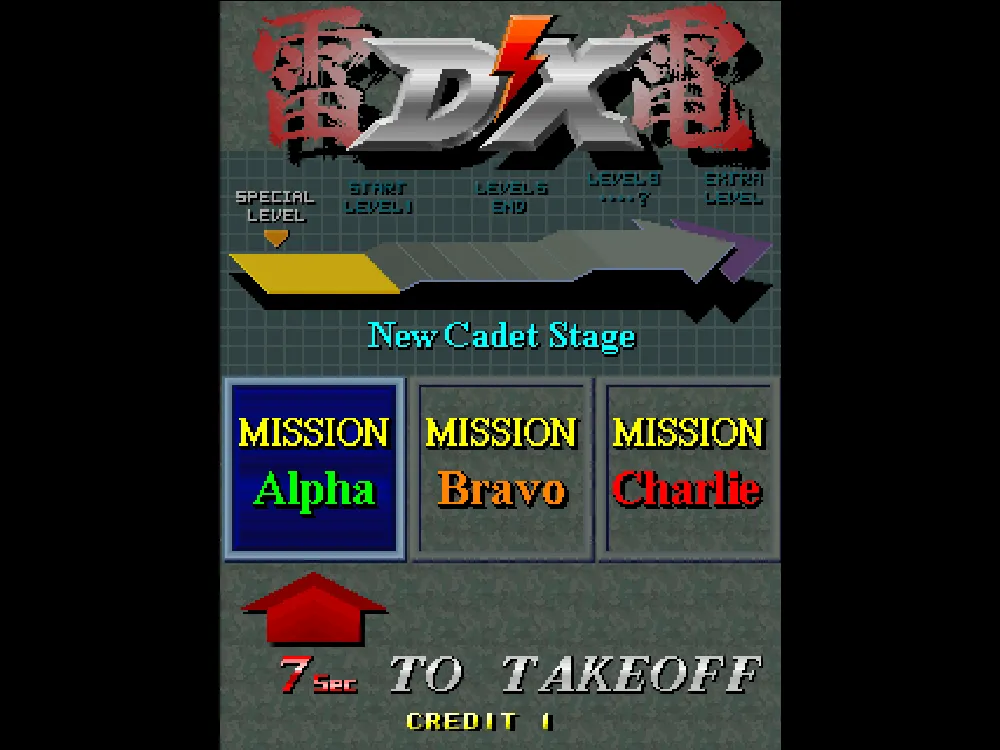
Raiden DX—The refined final chapter of the Raiden series by Seibu Kaihatsu, a multi-mode enhanced version tailored for arcades.
Why it's here: The ultimate form of the Raiden series.
Raiden DX isn't a sequel—it's a "Raiden Best Of" collection, using the Raiden II engine, blending level assets from the first and second games, and re-arranging and refining them. Three modes—Practice (newbie-friendly), Advanced (standard difficulty), and Expert (bullet hell)—allow players of all levels to find a challenge that suits them. The scoring system was redesigned into a chain-scoring system—consecutive rapid kills grant multiplier bonuses—shifting the goal from simply "surviving" to "surviving while racking up high scores."
Raiden DX is the swan song of the arcade era for Raiden. After this, Seibu Kaihatsu's arcade division gradually exited the market, and the series moved to home consoles. If you want to use one game to understand "what Raiden really is," choose Raiden DX.
#5: Strikers 1945 (1995, Psikyo)
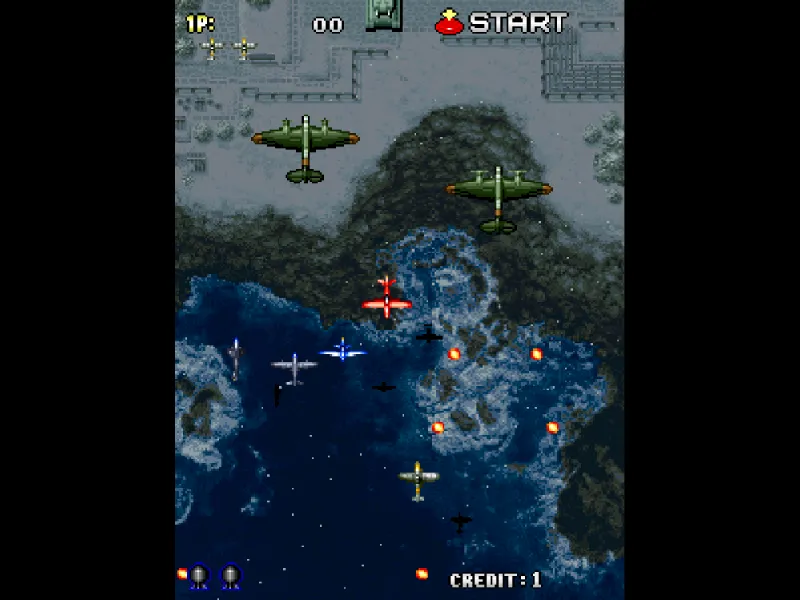
Strikers 1945—A bullet-hell masterpiece by Psikyo, featuring WWII propeller planes vs. sci-fi mechs.
Why it's here: The opening act of the Psikyo bullet-hell dynasty.
In 1995, a company called Psikyo released a shooter that looked like a "WWII air combat" game. Then, in the third level, you encounter a floating mech that fires homing lasers, and you realize this isn't a WWII game—it's a crazy setup of "throwing 1945 propeller planes into a sci-fi robot battlefield." Six selectable fighters—P-38 Lightning, P-51 Mustang, Spitfire, BF-109, Zero, and Shinden—each have completely different main weapons, sub-weapons, and bomb attacks. Psikyo's bullet design philosophy was already taking shape in Strikers 1945: bullet patterns aren't random—they are carefully choreographed, each wave having fixed shapes and visual characteristics. Learn to recognize them instead of fearing them.
Strikers 1945 is one of the most popular shooters in arcades. The premise of propeller planes fighting alien robots is still incredibly cool today.
#4: Strikers 1945 III / Strikers 1999 (1999, Psikyo)
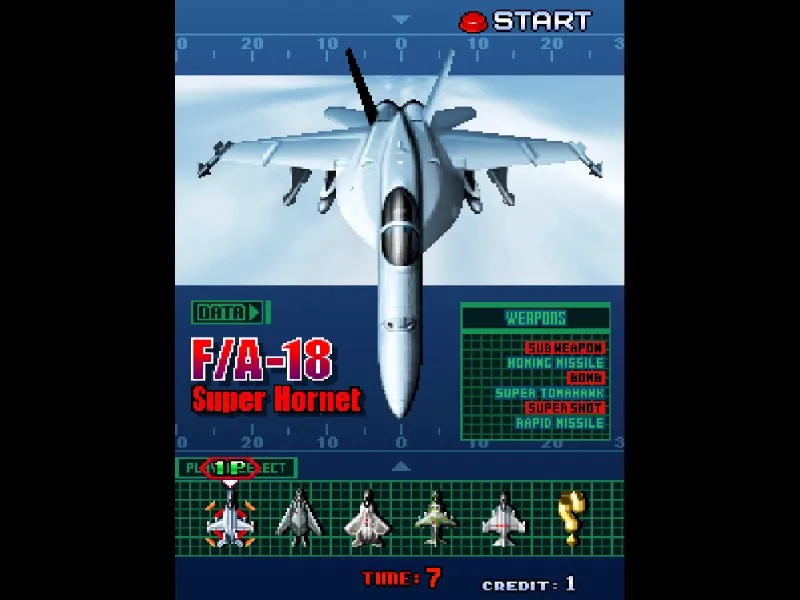
Strikers 1945 III (Strikers 1999)—The technical peak of Psikyo's vertical shooters, known for extreme bullet density and high-speed pacing.
Why it's here: The ultimate expression of Psikyo's speed aesthetics.
If Strikers 1945 II was Psikyo's "system-complete work," Strikers 1945 III was their "technical flex." This entry pushes the setting from WWII to the near-future of 1999—all fighters are now sci-fi jets (F-22 Raptor, F-117 Nighthawk, sci-fi variants of the F-4 Phantom), and the enemy bosses have shifted from robot legions to giant alien warships. Bullet density reaches its peak in Psikyo history—but bullet speed is also significantly increased. Psikyo's bullet philosophy differs from CAVE's: CAVE is slow, dense bullets (fine-tuning in the gaps), while Psikyo is fast, scattered bullets (predicting movement positions before the bullets arrive).
Strikers 1945 III also introduced the Technical Bonus scoring system—breaking specific parts during boss fights within specific frame windows grants huge score rewards. This adds a whole new dimension of skill for players chasing high scores.
#3: Strikers 1945 II (1997, Psikyo)
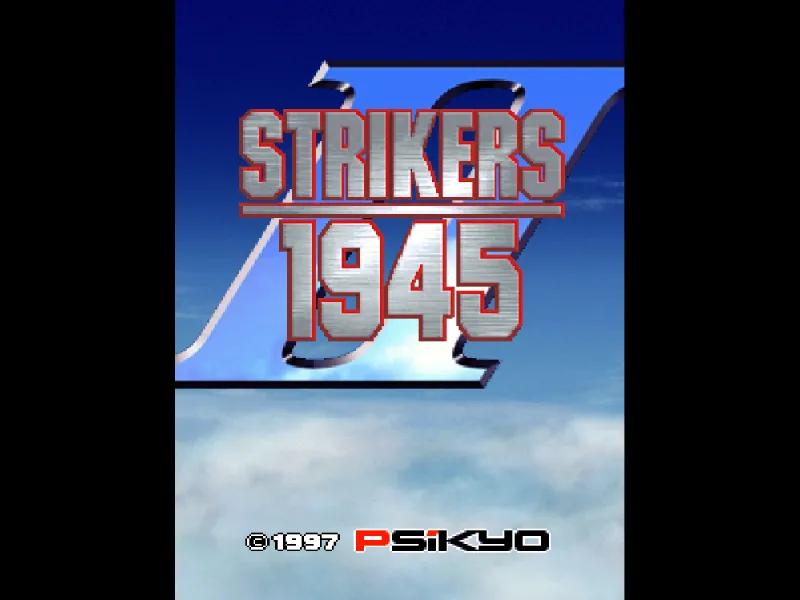
Strikers 1945 II—The peak of Psikyo's bullet-hell design balance, widely considered the most polished entry in the Strikers series.
Why it's here: Psikyo found the perfect balance between "difficulty" and "fairness."
The balance of the original Strikers 1945 was still a bit rough—some planes were far stronger than others. The speed and bullet density of the third game were perhaps too aggressive. Strikers 1945 II stands right at that "just right" golden ratio. The balance between the six selectable fighters (adding the DH.98 Mosquito and Ta-152) is the best in the series—you don't choose a plane because one is "stronger," but because its playstyle suits you better. Level pacing is tight and varied—from the jungles of Pacific islands to the skies over European castles, and finally the lunar surface for the final battle—each level has a distinct visual and rhythmic personality.
In the player community, Strikers 1945 II is the most frequently recommended candidate for "best bullet-hell shooter for beginners." It's hard enough, but it never cheats—every time you die, you can clearly say, "I know exactly where I went wrong."
#2: 1944: The Loop Master (2000, Capcom)
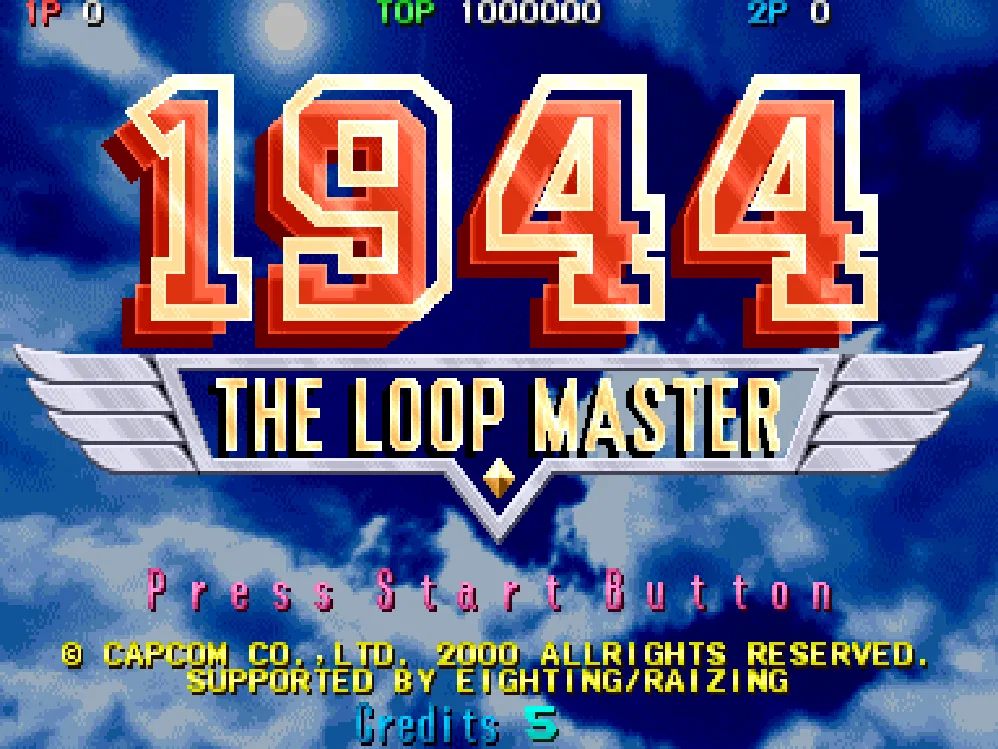
1944: The Loop Master—The culmination of Capcom's 194X series, the ultimate evolution of vertical shooters on the CPS-2 board.
Why it's here: Twenty years of Capcom shooter design, distilled into one game.
When Capcom released 1944 in 2000, the golden age of arcade shooters was nearing its end. Perhaps it was that "last dance" mentality that led Capcom to pour everything they had learned into this title. The graphical boost from the CPS-2 board makes 1944 look far superior to its predecessors—huge, detailed boss sprites, cinematic scene transitions, and the highest bullet density in the entire series. The subtitle "The Loop Master" points to the game's core mechanic—the Loop system. Unlike the simple "replay levels for points" in previous games, the Loop system in 1944 is deeply tied to scoring, resource management, and level progression—experts can create score gaps that beginners can't even imagine through the Loop.
It's worth noting that this is the only game in the 194X series that doesn't use a WWII setting (shifting to a near-future sci-fi battlefield). Abandoning the historical setting in the final chapter of a series about WWII air combat was a bold decision, but it brought the most creative boss designs in the series—without being constrained by historical battleship forms, the design and art teams could let their imaginations run wild.
#1: DoDonPachi (1997, CAVE)
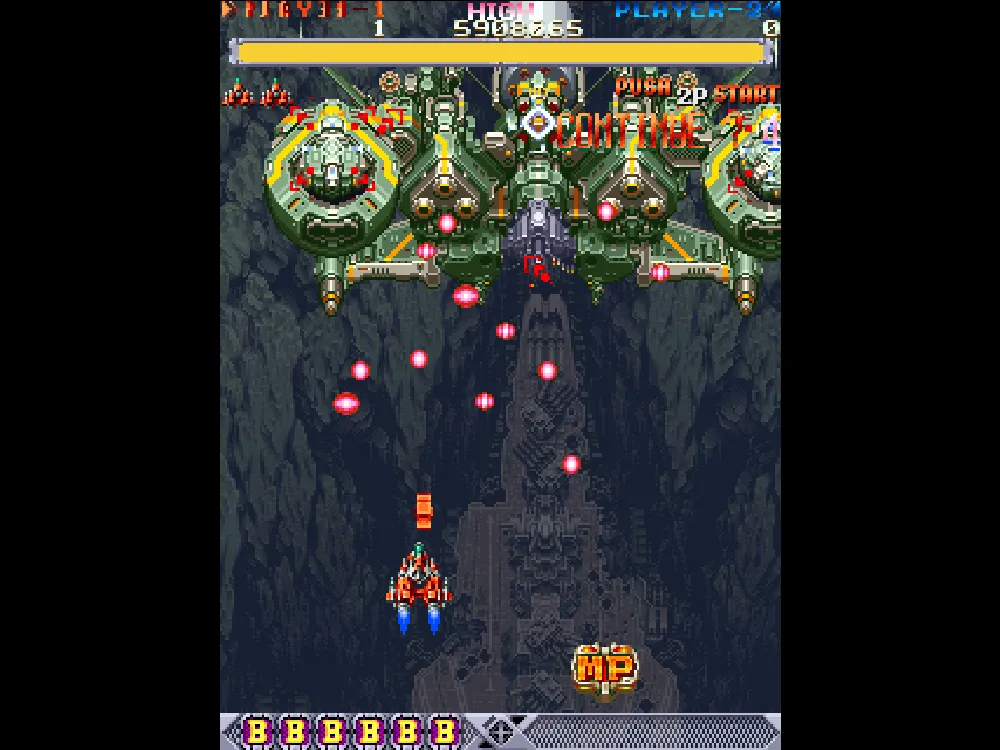
DoDonPachi—A milestone in the bullet-hell genre released by CAVE in 1997, widely recognized as one of the most important vertical shooters in history.
Why it's here: It redefined the meaning of the word "bullet hell" (弾幕).
Before DoDonPachi, "bullet hell" was just a description of difficulty. After it, bullet hell became an art form. The real-time switching between Shot (spread, high speed) and Laser (piercing, low speed)—where you make decisions between "dodging" and "attacking" every single second—is the game's most brilliant design. The GPS combo scoring system upgraded "scoring" from something you do "on the side" to the core loop of the game—you don't just have to survive; you have to keep the laser connected to enemies to maintain your combo multiplier, experiencing a near-gambling ecstasy as your score grows exponentially from 100→200→400→800→...→100,000.
Three selectable fighters (Type A focused, Type B rotating sub-guns, Type C three-way spread) correspond to three completely different philosophies of play. Clearing the first loop is just the appetizer—the real game is in the second loop. By meeting extremely harsh conditions (losing at most two lives, hitting the hit-count requirement, scoring over 50 million, or collecting all 13 bee items in at least 4 out of 6 levels), you unlock the second loop, where bullet density doubles—and you eventually face the hidden true boss, "Hibachi." In the history of global arcades, the number of players who have performed a 1CC of the second loop and defeated Hibachi is less than three digits in any era. DoDonPachi isn't just a game—it's a gauntlet.
Conclusion: The Legacy of Vertical Shooters
Vertical shooters gradually faded from mainstream arcades after 2000—the rise of 3D games, fighting games, and rhythm games pushed this oldest, purest arcade genre into the background. But in the indie scene, its spirit has never died. Crimzon Clover, ZeroRanger, Blue Revolver, Ikaruga—all these indie masterpieces from the 2010s onwards can be traced directly back to one of the games on this list.
The moment you press the Start button—your thumb holds the fire button, the screen scrolls upward, and the first batch of enemies appears from the top—the experience is exactly the same in 1978 as it is today. This is the core charm of the vertical shooter: it needs no explanation, no tutorial, no backstory. It is a pure, distilled arcade experience—like drinking a glass of neat whiskey at a bar.
If you haven't tried these games yet—close this article and start with DoDonPachi or Strikers 1945 II. You won't regret it.