I. Game Background
1.1 Setting the Scene
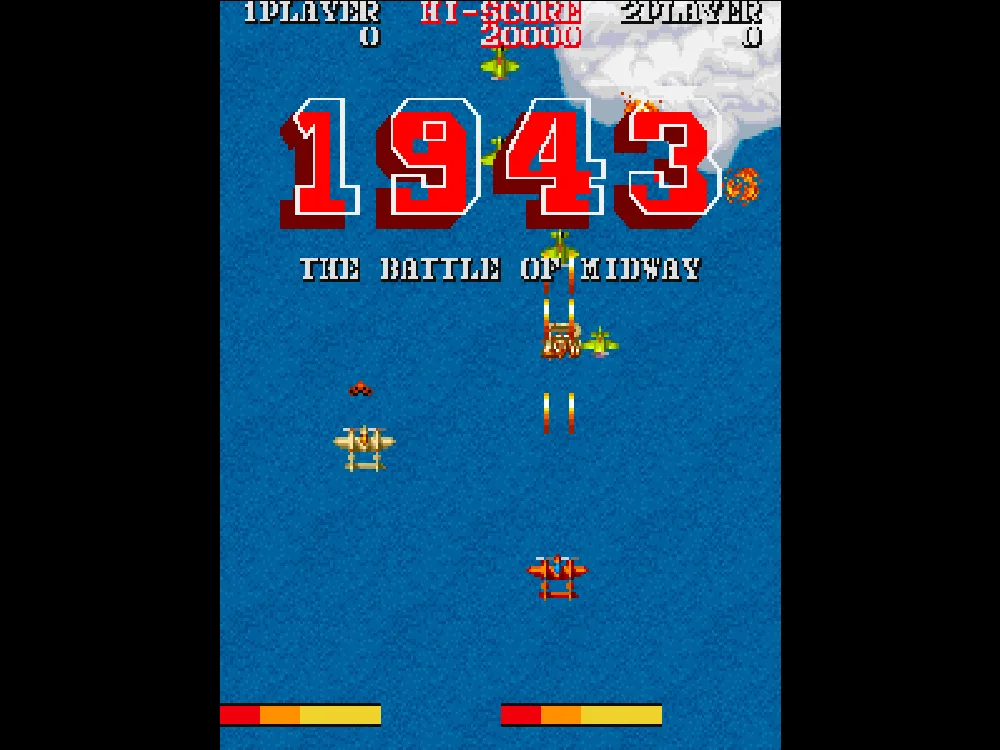
1943: The Battle of Midway transports players to the most critical turning point of the Pacific War: the Battle of Midway. In June 1942, the Imperial Japanese Navy assembled a massive fleet, including four aircraft carriers, in a bid to destroy the U.S. Pacific Fleet. However, thanks to intelligence advantages and the heroic efforts of American pilots, the U.S. forces achieved a stunning victory, sinking all four major Japanese carriers and permanently shifting the momentum of the Pacific theater.
Players take on the role of an unnamed U.S. Navy ace pilot, launching from an aircraft carrier in a P-38 Lightning to soar across the Pacific skies and dismantle the Japanese naval forces. The 16 stages alternate between intense dogfights and naval assaults—sometimes you'll be locked in a mid-air duel with Zero fighters, and other times you'll be skimming the waves, strafing anti-aircraft turrets on massive battleships. Your ultimate objective is the largest steel beast in the Pacific: the battleship Yamato.
1.2 Development History
1943 was first released by Capcom in Japan in June 1987. It serves as the official sequel to 1984's 1942 and is the second entry in the 194X series. The game was produced by Yoshiki Okamoto, with game design by Noritaka Funamizu and a soundtrack composed by Kumi Yamaga.
1943 was among the first Capcom titles explicitly designed with the Western market in mind. Following the Pacific theater theme of 1942, the game casts players as American pilots attacking the Japanese Navy. This setting sparked protests from right-wing groups in Japan, who argued that allowing players to control Americans attacking the Imperial Japanese Navy was an "insult to the spirits of the Yasukuni Shrine." Yoshiki Okamoto later acknowledged the validity of these criticisms on his YouTube channel, admitting he was "too young and didn't consider that perspective" at the time. He explained that the choice of perspective was purely a commercial decision—placing the player on the side of the "victors" to increase immersion.
Despite the controversy, 1943 was a massive commercial success, topping the Game Machine arcade popularity charts in July 1987 and ranking as the second-highest-grossing tabletop arcade game in Japan that year. It was widely ported to platforms including the NES, PC Engine, Amiga, and Atari ST. The NES version notably introduced a permanent upgrade system, which significantly altered the game's balance.
II. Character Introduction
In 1943, you don't control a character, but a legendary warplane: the P-38 Lightning. Unlike the dual-plane selection in 1941, 1943 features only one pilotable aircraft.
P-38 Lightning
| Attribute | Rating |
|---|---|
| Firepower | ★★★★☆ |
| Speed | ★★★☆☆ |
| Energy Capacity | ★★★☆☆ |
| Difficulty | ★★★★☆ |
- Pros: The twin-engine heavy fighter offers stable and powerful output. It can utilize six different weapons and three special attacks (Lightning, Tsunami, Cyclone), providing immense tactical variety. In two-player mode, two P-38s can overlap to transfer energy—a rare cooperative mechanic in arcade shooters.
- Cons: The energy gauge (fuel meter) is your biggest limitation. Every action—taking damage, using special attacks, or even just flying—consumes energy. Once your energy hits zero, it's game over. This forces players to constantly weigh "aggression" against "survival."
- Verdict: The P-38 in 1943 is a masterclass in resource management. You aren't just shooting; you are investing every drop of fuel into tactical decisions.
III. Controls and Mechanics
3.1 Basic Controls
| Button | Action | Description |
|---|---|---|
| 8-Way Joystick | Movement | Standard vertical shooter movement |
| A Button | Fire | Continuous fire with the currently equipped weapon |
| B Button | Special Attack / Roll | Press to unleash a special attack (consumes energy); press both buttons to perform an evasive roll |
3.2 The Energy System (Fuel Meter)
1943's core innovation was replacing the traditional life system with an energy gauge. This remains one of the most significant system evolutions in arcade shooter history:
- Energy (fuel) constantly drains over time.
- Taking damage deducts a large amount of energy.
- Using special attacks (B button) consumes energy.
- Empty energy = Crash.
- Collect POW items to replenish energy.
The philosophy behind this system is: Every hit is a "resource trade-off" rather than a "random one-hit-kill penalty."
3.3 The Six Weapons
Weapons are obtained by destroying red fighter formations and collecting the dropped POW items. They have a time limit (up to 64 seconds):
| Weapon | Features | Best For |
|---|---|---|
| Machine Gun (Default) | Basic twin-shot, stable and balanced | Reliable in any situation |
| Shotgun | Wide fan spread, short-range, clears enemy bullets | Dense enemy swarms, defensive scenarios |
| 3-Way | Forward + diagonal shots | All-purpose clearing, the most versatile choice |
| Auto | 8-shot burst per press | Rapid burst damage, transition weapon |
| Shell | High single-line damage, hold to rapid-fire | Boss fights, highest DPS |
| Laser | Piercing, extremely rare | Ultimate boss killer, requires special conditions |
3.4 Special Attacks (B Button)
| Special Attack | Best Used For | Effect |
|---|---|---|
| Lightning | Air stages | Instantly destroys all small aerial targets on screen |
| Tsunami | Sea/Battleship stages | Destroys small targets + continuous damage to ships + pauses scrolling |
| Cyclone | Any scenario | Clears all enemy bullets on screen (pure survival skill) |
Additionally, using a Mega Crash near a battleship boss triggers a "Low-Altitude Tsunami," dealing higher damage and pausing the screen for longer.
3.5 Hidden Bonus Items
Capcom packed 1943 with hidden elements—a pioneer of "exploratory" design in arcade shooters:
| Item | Score | How to Obtain |
|---|---|---|
| Bamboo Shoot | 500 + 2,200 | Fly in a specific way above the clouds |
| Strawberry | 10,000 | Destroy the highest, smallest ship then shoot a specific spot |
| Barrel | 10,000 | Hidden location near water areas |
| Dragonfly | 10,000 | The hardest to get—when a ship appears from the air background, if your continue count ends in 9 |
| Cow | 20,000 | Hidden in specific locations in the stage |
| Mobi-chan | 100,000 | May escape from the bridge after a ship is 100% destroyed |
IV. Stage Walkthrough and Boss Strategy
1943 features 16 stages: 11 naval battleship assaults and 5 aerial dogfights. Bosses are named after historical Imperial Japanese Navy ships—Kaga, Hiryu, Akagi, Soryu (the four Midway carriers), Tone, Yamato, etc.
4.1 Stages 1-4: Midway Coast — Carrier Hunt
| Item | Content |
|---|---|
| Setting | Clear blue skies with the Midway atoll visible. These stages focus on air combat against Zero fighters and torpedo bombers. |
| Bosses | Kaga, Akagi, Hiryu, Soryu—the four main aircraft carriers of the Japanese fleet at Midway. |
| Strategy | Each carrier is equipped with multi-layered AA guns and catapults. Core strategy: Destroy turrets before targeting the hull. The flight deck is the largest weak point—strafing the center damages both the bridge and hangar. The Shotgun is best here for its wide coverage. 3-Way is most efficient for clearing escort planes. |
4.2 Stages 5-8: Deep Pacific — Battleship Fleet
| Item | Content |
|---|---|
| Setting | Deep into the Pacific. The water turns dark blue, and the weather shifts to overcast. Enemy AA density increases significantly. |
| Bosses | Kongo-class battleships (Kongo, Haruna, Kirishima) and Tone-class cruisers (Tone, Chikuma). |
| Strategy | Weak points are beneath the main turrets—the Shell's piercing power shines here. Tsunami is most valuable in these stages—use it close to the ship to pause the screen and deal massive damage. Use Cyclone to clear dense bullet patterns. Energy management is critical—don't burn all your fuel on Mega Crashes before reaching the boss. |
4.3 Stages 9-12: Aerial Annihilation
| Item | Content |
|---|---|
| Setting | Pure air combat above the clouds. Enemies include heavy strategic bombers and the new "Shiden Kai" fighters. |
| Bosses | Super-heavy bomber formations + massive single-engine bombers (destroy four engines one by one). |
| Strategy | The pace is much faster than sea stages. Lightning is very effective here for clearing entire bomber formations. For large bombers, focus fire on the four engines. Switch to Shell or Auto weapons. |
4.4 Stages 13-16: Final Showdown — The Yamato
| Item | Content |
|---|---|
| Setting | The deepest part of the Pacific. The sky is black with smoke, and oil slicks burn on the water. Enemy density is at its peak. |
| Boss | Yamato—the largest battleship in human history. It occupies over 40% of the screen width, featuring over 20 turrets. |
| Strategy | The longest boss fight in the game. It requires 3-4 cycles of "destroy turrets → expose weak point → attack → new turrets rise." Phase 1: Clear 25mm AA guns. Phase 2: Handle 127mm AA guns. Phase 3: Once 460mm turrets are destroyed, the bridge is exposed—switch to Laser or Shell for max DPS. Destroying the bridge may release a Mobi-chan for 100,000 points. |
V. Tips and Advanced Strategy
5.1 Survival Basics
- Energy is Life: Three drains—time (slow), damage (fast), and special attacks (choice). Treat special attacks as "buying safety." Unnecessary Mega Crashes = slow suicide.
- 3-Way is versatile, Shell is for Bosses: Keep 3-Way for mobs, switch to Shell for bosses.
- E Items > Weapons: POW items cycle. If energy is below 50%, prioritize E (Energy) over weapon switching. Staying alive is the best DPS.
- Co-op Energy Transfer: Overlap P-38s to transfer energy. If 1P is low, 2P can "donate" energy by flying close for 2-3 seconds.
- Hidden Laser: Using a specific number of Mega Crashes in certain stages triggers the hidden Laser—the highest DPS weapon in the game.
5.2 Boss Tactics
- Turrets > Hull: Don't waste ammo on the hull until turrets are gone.
- Tsunami Pause: Using a Mega Crash near a ship triggers a Tsunami, which pauses the screen and stops enemy movement. Use this during the densest bullet patterns.
- Don't Get Greedy: Don't burn your last bit of energy for one extra Mega Crash if it leaves you vulnerable.
5.3 Advanced Trivia
- 1943 Kai: A 1987 Japan-only arcade variant with adjusted difficulty and drop rates. The PC Engine port is based on this version.
- Right-wing Protests: Okamoto admitted the game faced backlash in Japan for casting players as Americans. This led later 194X games to move toward sci-fi settings.
- NES RPG Elements: The NES version added permanent upgrades for attack, defense, and energy, making it feel more like an RPG-shooter hybrid.
VI. Trivia and Arcade Legends
6.1 Why "1943" for Midway?
The Battle of Midway was in 1942. Capcom likely chose 1943 to follow the numerical sequence from 1942, as the 1942 title was already taken.
6.2 Okamoto's Confession
Decades later, Okamoto admitted that the choice to play as Americans was purely commercial, reflecting the 1980s focus on making games appealing to the global (Western) market.
6.3 Hidden Item System
1943 was revolutionary for its hidden items (Bamboo Shoots, Strawberries, etc.), each with unique, complex trigger conditions—a precursor to modern indie "exploratory" design.
6.4 Mobi-chan
First appearing in Hyper Dyne Side Arms, Mobi-chan became Capcom's first recurring "Easter egg," appearing here as a 100,000-point bonus.
6.5 Co-op Revolution
The energy transfer mechanic was a unique cooperative innovation that remains rare in the genre.
6.6 Yamato at Midway?
The Yamato was not at Midway. Capcom included it simply because they needed a massive, iconic final boss.
6.7 Two Soundtracks
The arcade version features a unique "military march + FM synth" style, while the Kai version features a more melodic, multi-composer score.