I. Game Background
1.1 World Setting
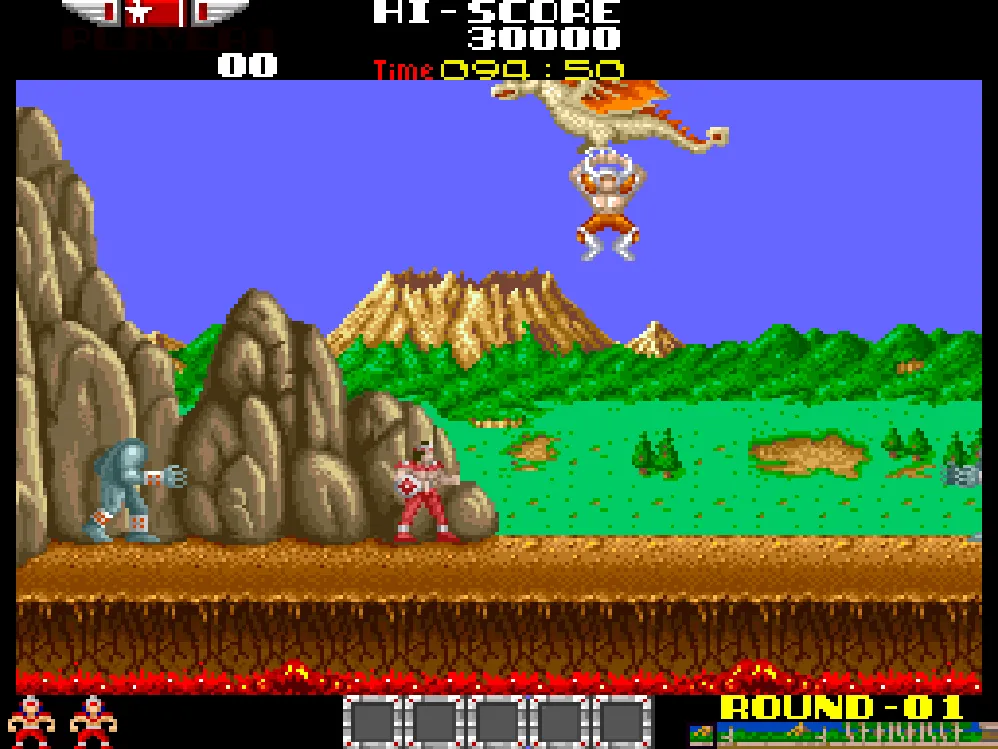
Rygar takes place in an ancient and mysterious savage world. The game's opening text declares: throughout Earth's 4.5 billion-year history, countless rulers have risen and fallen; now, a new dominator has arrived—the evil "Dominator" has led his legions to occupy the land. Players take on the role of a legendary warrior from the Kingdom of Argus, wielding the unique chain-blade weapon known as the "Diskarmor," embarking on a solitary journey to reclaim their homeland.
The game's visual style blends elements of ancient Greco-Roman mythology with sword-and-sorcery fantasy—crumbling temples, lava-filled underground caverns, towering giant trees, and the magnificent throne room of the final boss. Although the arcade version's plot is minimalist, its mysterious and poetic world-building was unique among 1986 arcade games, evoking a sense of "ancient mural" visual storytelling.
1.2 Development History
Rygar was developed and published by the Japanese company Tecmo in 1986. Designed by Hideo Yoshizawa, it ran on Nintendo's licensed PlayChoice-10 arcade hardware—a multi-game arcade system based on the NES architecture.
The game debuted in Japan in May 1986, launched in North America on June 20, and entered the European market on August 1. The Japanese title is Argos no Senshi (Warrior of Argos), while the Western version was titled Rygar. There is a long-standing trivia story regarding the name "Rygar": in the original Japanese version, the final boss is named "Ligar" (a man-lion monster). The protagonist had no specific name in the Japanese version, referred to only as the "Legendary Warrior." During translation, "Ligar" was transliterated as the boss's name, while the hero was given a variant spelling, "Rygar"—a name originally intended for the villain eventually became synonymous with the hero.
The arcade version was a commercial success: it reached third place in Japanese arcade rankings (July 1986) and was the seventh highest-grossing arcade game in Japan for 1986. On European arcade charts, it held the sixth position consistently from August 1987 to January 1988. As of June 2007, cumulative sales across all platforms reached 1.5 million units.
The NES port, released in Japan in April 1987, was developed in-house by Tecmo. It differed significantly from the original, shifting from a side-scrolling action game to a top-down, semi-open-world exploration game with side-scrolling stages. It introduced an RPG-style experience system, three types of magic, and key item collection, and is recognized by modern critics as an important pioneer of the "early Metroidvania" genre. While it wasn't uncommon for 1980s ports to differ drastically from their arcade counterparts, Rygar is a special case where both versions were highly acclaimed.
II. Character Introduction
The Legendary Warrior (Rygar)
| Attribute | Rating |
|---|---|
| Attack Power | ★★★★☆ |
| Attack Range | ★★★★★ |
| Speed | ★★★☆☆ |
| Difficulty | ★★★★★ |
- Pros: The Diskarmor is one of the most creative weapons in arcade history—it features both melee (close-range slashing) and ranged (throwing) modes, with an attack hitbox covering a fan-shaped area in front. The arc of the aerial attack is highly effective against flying enemies.
- Cons: One-hit death—there is no health system; touching an enemy or projectile results in immediate death. Jump height and distance are fixed, and you cannot adjust your trajectory in mid-air. Movement speed is moderate to slow, making the player vulnerable to fast enemies.
- Overall Evaluation: The Legendary Warrior is a classic case of a "fragile god of war"—his attack power is enough to sweep through armies, but he is as fragile as paper. The game's design philosophy seems to be: "You are powerful, but you cannot afford a single mistake." This hardcore "one-hit death" design makes every completion feel like a genuine achievement.
III. Controls
3.1 Basic Controls
| Button | Action | Description |
|---|---|---|
| Joystick ←→ | Move | Standard horizontal movement |
| Joystick ↑↓ | Climb | Climb up/down ropes; release to jump |
| A Button | Diskarmor Attack | Throw the Diskarmor forward; it flies out and returns, attacking in an arc |
| B Button | Jump | Fixed jump height and distance; press A in mid-air for an aerial attack |
3.2 Diskarmor Attack Modes
The Diskarmor is the game's core signature design—a "sharp rotating shield on a chain," similar to a yo-yo. IGN ranked it 93rd on its "Top 100 Video Game Weapons of All Time" list in 2012.
| Attack Mode | Input | Effect |
|---|---|---|
| Standing | Stand + A | Throws the chain-blade horizontally to hit mid-range enemies |
| Crouching | Crouch + A | Throws the blade low to hit crawling or low-profile enemies |
| Aerial | Jump + A | Throws the blade in a downward arc, perfect for flying enemies |
| Overhead | (After Sun Power) A | Throws the blade vertically upward, covering the character's blind spot |
3.3 Five Power-Ups
All power-ups are temporary and are lost upon death. They are obtained by hitting stones that appear in the environment, which randomly drop power-up items.
| Power-Up | Icon | Effect |
|---|---|---|
| Sun Power | Sun | Replaces standard forward attack with a vertical upward attack |
| Crown Power | Crown | Defeats multiple enemies at once |
| Cross Power | Cross | Temporary invincibility |
| Tiger Power | Tiger | Defeats enemies instantly by jumping on their heads |
| Star Power | Star | Significantly extends the Diskarmor's attack range |
Hidden Bonus Mechanism: If a player collects the Cross Power (invincibility) while holding the other four power-ups, they receive 30 seconds of invincibility + 170,000 points.
The "?" (Question Mark) item is a rare power-up that cycles through different types when hit—players can hit it multiple times to select the power-up they want.
3.4 Buy-In Mechanism
Rygar's continue design differs from most arcade games of its time:
- Stages 1-20: You can continue from the furthest progress by inserting coins.
- Stages 21-27: No continues allowed—you must start from the beginning.
This is a deliberate design choice to "prevent players from buying their way to the end," forcing the most difficult final 7 stages to be conquered through pure skill.
3.5 Time Limit and the Fire Demon
Each stage has a time limit. If time runs out, a powerful Fire Demon appears on screen and actively pursues the player. The demon's speed increases the longer you evade it—an anti-stalling mechanism that forces players to keep moving forward.
IV. Stage Walkthrough and Boss Strategy
Rygar features 27 stages. Due to the large number of stages (rare for a 1986 arcade game) and the smooth scrolling transitions, we have grouped the most representative stages for discussion.
4.1 Stages 1-5: The Awakening Land
| Item | Content |
|---|---|
| Setting | Lush fields and ancient temple ruins. Background features rolling mountains and floating clouds. Enemies are primarily basic orc infantry and flying gargoyles. The scene is an open horizontal-scrolling field with ropes between trees and cliffs. |
| Strategy | The first 5 stages serve as a tutorial. Focus on: ① Diskarmor rhythm—it takes about 0.5 seconds to return, and it deals damage during the return; ② Jump + Attack for safe aerial output; ③ Rope climbing height control. Don't waste power-ups here—save them for later. Be aware that gargoyles starting from stage 3 have unpredictable flight paths; jump attacks are recommended. |
4.2 Stages 6-10: Underground Lava
| Item | Content |
|---|---|
| Setting | Underground caverns with flowing lava. Orange-red background with dripping magma effects. Platforms are separated by lava pits—falling in means instant death. Enemies include fire-breathing dragon monsters and swarms of bats. |
| Strategy | The core challenge is platforming combined with aerial enemies. Do not attack mid-jump—the Diskarmor has a slight wind-up, and if you throw it mid-jump, the recoil might cause you to miss your landing. Land safely first, then deal with enemies. Use jump attacks to clear multiple bats at once. Stage 10 features a mid-boss—a large Cyclops whose hammer strikes create ground shockwaves; jump to dodge when the hammer hits the ground. |
4.3 Stages 11-16: The Sky Tree
| Item | Content |
|---|---|
| Setting | A giant tree reaching into the sky. The stage becomes a vertical climb with significantly increased rope density. Enemies are mostly flying types—harpies and flying demons. The background transitions from the ground to a sunset sky above the clouds. |
| Strategy | This is the most rope-intensive set of stages. Getting hit while climbing will knock you off—usually resulting in a fall to the lower level. Clear all enemies on your current level before climbing higher. Sun Power is most valuable here—vertical attacks handle enemies directly above you without needing to climb up. Stage 13 hides the "Argos Secret Scroll," worth 1,000,000 points—crucial for high-score runs. |
4.4 Stages 17-22: The Dominator's Castle
| Item | Content |
|---|---|
| Setting | Inside a gothic dark castle. The color palette shifts to dark gray and blood red, with torches on stone walls providing limited lighting. Enemies become heavy armored knights—high health, high damage, and faster than previous enemies. |
| Strategy | Difficulty spikes starting at stage 17. Armored knights require two Diskarmor hits to kill; they will briefly stagger after the first hit but won't die. Strategy: Hit once → prepare for the second hit (or adjust your position while it returns) → finish them off. Cross Power (invincibility) is invaluable in crowded corridors; use it around stage 20. Note: From stage 21 onwards, you cannot continue—if you lose all your lives, you must start from the beginning. |
4.5 Stages 23-27: The Final Battle
| Item | Content |
|---|---|
| Setting | The Dominator's Throne Room—a magnificent marble hall with towering pillars and red carpets. Before the final boss, players must traverse a final corridor guarded by elite soldiers. The background music tempo increases, building tension. |
| Boss | Ligar—The final Dominator, a giant man-lion monster over three times the size of the protagonist. Attacks include: ① Long-range jump stomp (covers half the screen); ② Double claw swipe; ③ Roar shockwave (linear piercing attack). Ligar's jump attack is the most lethal—the landing spot is predictive (it jumps toward your current location), but the jump speed is extremely fast, leaving a very small reaction window. |
| Strategy | Ligar is the ultimate test—defeating him means you've survived the game's hardest 7 stages without continues. Core strategy: Do not stand in the center of the screen—Ligar's stomp and shockwave cover the center. Try to stay at a 45-degree angle to his side, and use the 1-second stagger window after his jump to throw the Diskarmor. Keep Tiger Power for this fight—jumping on his head deals massive damage and stuns him. After defeating Ligar, the people cheer and the hero is freed. The ending text appears: "A new resurrected threat may challenge you again"—a cryptic hint at a sequel. |
V. Game Tips and Advanced Strategy
5.1 Basic Survival Tips
- Diskarmor is not infinite ammo—master the rhythm: You are "unarmed" while the disk returns. Do not spam the attack button, or you will be left vulnerable. The most common cause of death for beginners is spamming the button and getting hit while the disk is returning.
- Jump attacks are safe clearing tools: The Diskarmor's arc covers both front and below. While attacking in the air, you are essentially using the jump's "invincibility window" (though the game lacks true i-frames, your aerial position is higher than most enemy hitboxes).
- Ropes = Lifelines: Use ropes to bypass ground enemies. But remember—getting hit while climbing causes a fall. Saving Cross Power for emergencies while climbing is the best strategy.
- Power-up Management: Power-ups are random, but stone locations are fixed. Memorizing which stones drop what is a fundamental skill for high-score players.
- Hidden Score Trick: At the end of each stage, as the game auto-walks your character, push the joystick to ↙ (down-left). If the hundreds digit of your score matches the last digit of your time, you get a 10,000-point bonus.
- Dealing with the Fire Demon: If time is running out, don't panic. The Fire Demon is slow initially—you can often reach the stage exit faster than trying to fight it.
5.2 Boss Battle Rules
- Ligar's landing spot is your current position—move in the opposite direction immediately after he jumps to dodge.
- The roar shockwave is telegraphed by him tilting his head back—crouch or jump immediately.
- Do not stand in the 180-degree front range—this is where all of Ligar's attacks are focused. The sides are the safest spots.
5.3 Advanced Trivia
- Arcade vs. NES are different games: The NES version is a semi-open-world exploration game with RPG elements, considered a Metroidvania pioneer. Both versions are highly acclaimed independently.
- X68000 version is the ultimate collector's item: The 1994 port by Dempa Micomsoft is considered the most faithful arcade reproduction, with near 100% accuracy in graphics, sound, and controls.
- "?" Item trick: You can hit the "?" item repeatedly to cycle through power-ups until you get the one you want.
- Stage 13's Million-Point Scroll: The "Argos Secret Scroll" is worth 1,000,000 points and is a must-have for high-score chasers.
VI. Trivia and Arcade Legends
6.1 The Accidental Name Origin
In the original Japanese version, the name "Rygar" didn't exist. The hero was just the "Legendary Warrior," and the boss was "Ligar." During English translation, the name was split—"Rygar" for the hero, "Ligar" for the villain. Tecmo eventually adopted this "mistake" as official.
6.2 IGN's "Top 100 Weapons" #93
In 2012, IGN ranked the Diskarmor 93rd on its list of the greatest video game weapons, noting its yo-yo-like design was ahead of its time.
6.3 NES Version—The Accidental "Metroidvania Pioneer"
With its world map, RPG stats, and key-item-gated exploration, the NES version of Rygar was a full-fledged Metroidvania long before the term was coined.
6.4 The "Mysterious Relationship" with Nintendo
The arcade version ran on Nintendo's PlayChoice-10 hardware. In exchange, the NES version was a Tecmo-developed exclusive for the Famicom, a common hardware-licensing model in the 80s.
6.5 The Sega Master System "Ghost Company" Port
In 1988, a port appeared on the Sega Master System by a company called "Salio"—a dummy corporation created by Tecmo to bypass Nintendo's exclusivity agreements.
6.6 27 Stages—An Arcade Marathon
Most 1986 arcade games were 5-10 stages long. Rygar's 27 stages were a test of endurance, and the "no-continue" rule for the final 7 stages made it a legendary feat to complete.
6.7 PS2 3D Rebirth
In 2002, Tecmo released Rygar: The Legendary Adventure on PS2, a 3D action-adventure reimagining. While reviews were mixed, it proved the IP still had brand appeal 16 years later.
6.8 Comic Book Crossovers
Tecmo released three official comics for the NES version in 1987, a marketing strategy that wouldn't become industry standard for decades.