I. Game Background
1.1 Setting the Scene
Mario Bros. takes place in an unexpected location: the sewers of New York City. The premise is simple yet engaging: Italian-American twin plumbers Mario and Luigi discover a swarm of strange creatures in the city's sewer system. As plumbers, they decide it's their duty to head down—armed only with their tools (and their bare hands)—to investigate and clear out these uninvited guests.
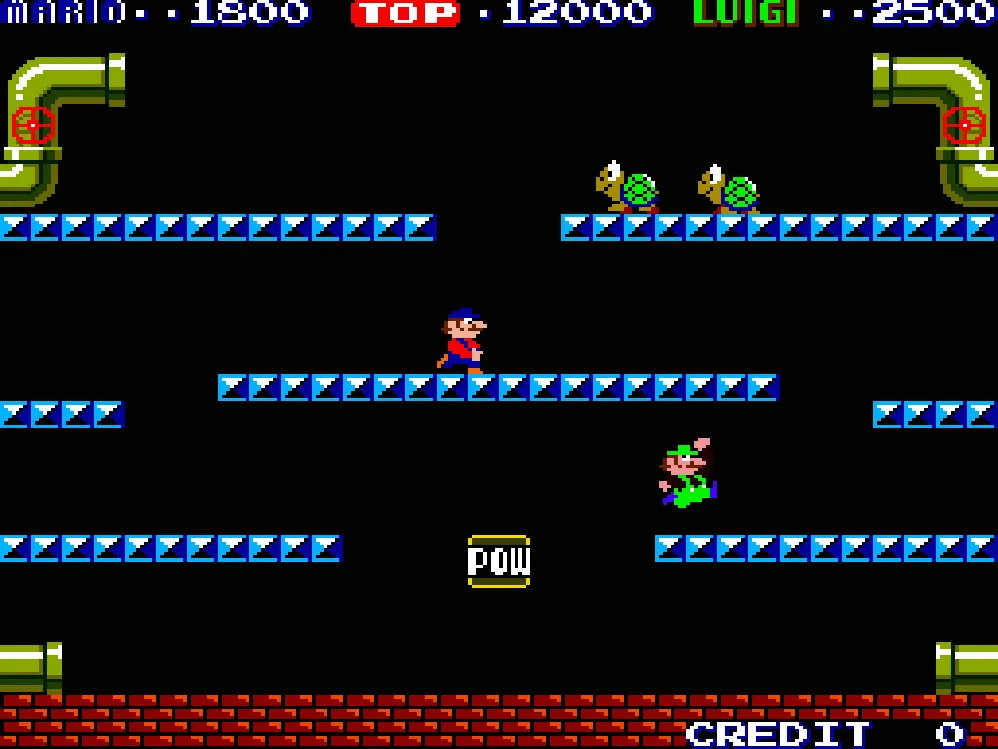
The game's stage is a classic New York underground pipe system, featuring green pipes at the top corners of the screen and a POW block in the center. The multi-level platform structure evokes the crisscrossing layers of city pipes. This simple setup became the foundation for the entire Mario universe—green pipes, coins, and turtle enemies all made their debut here.
Shigeru Miyamoto confirmed that the game is set in New York, "most likely Brooklyn." This setting follows Mario's identity as a carpenter on a New York construction site in Donkey Kong. His transition from "carpenter" to "plumber" was a direct result of the sewer-themed setting of Mario Bros.
1.2 Development History
Released by Nintendo in 1983, Mario Bros. was the third arcade collaboration between Shigeru Miyamoto and Gunpei Yokoi, following Donkey Kong (1981) and Donkey Kong Jr. (1982). The reunion of these two genius designers created a watershed moment in gaming history.
The game's design was inspired by Williams' 1982 arcade hit, Joust. Known for its two-player simultaneous gameplay and unique aerial collision mechanics, Joust served as the starting point for Miyamoto and Yokoi to "start throwing ideas around" for their own two-player arcade game.
Several key decisions shaped the final product. Gunpei Yokoi suggested that Mario should be able to fall from any height without taking damage—Miyamoto initially felt "this wouldn't be challenging enough," but eventually accepted it and designed the jumping and platform-climbing mechanics. Yokoi also proposed that players attack the bottom of platforms to defeat enemies, but this made the game too easy. The team's clever fix was to require players to touch the flipped enemy to kick them away, which also led to the design of the turtle-like enemy (because it "can't get back up once flipped").
Mario's "plumber" profession came directly from the "giant pipe network" setting. The green color of the pipes was also a practical choice—limited by the color palette of the time, Miyamoto found that "two shades of green looked good together." The pipe imagery was inspired by wasteland scenes in manga he had seen. Additionally, Mozart's "Eine kleine Nachtmusik" was used as the opening theme.
As for the origin of the name "Mario": a widely circulated story is that Nintendo of America's Italian-American landlord, Mario Segale, burst into the office to demand rent, and employees renamed the game's "Jumpman" after him. Former NoA warehouse manager Don James confirmed this, noting that he and president Minoru Arakawa used the name as an inside joke about the landlord who had never actually been seen.
Mario Bros. was a "moderate success" in the arcade market—selling about 2,000 units in the U.S. by July 1983, with a total of 3,800 arcade cabinets sold. In Japan, Game Machine magazine listed it as the third most popular table-top arcade unit in July 1983. The game was completely unaffected by the North American video game crash of 1983.
On home consoles, the NES version was the first game developed by Intelligent Systems, selling 2.28 million copies. The Atari 2600 version sold 1.59 million, and the Famicom version sold over 1.63 million in Japan. Combined cartridge sales reached nearly 4 million units.
II. Character Introduction
Mario Bros. marks the debut of Luigi. Notably, both characters perform identically—Luigi is essentially a palette swap of Mario (green overalls vs. red overalls). This "perfectly symmetrical design" was intended to reduce development complexity at the time, but the coexistence of the two characters laid the foundation for the differentiated two-player gameplay in the later Super Mario Bros. series.
Mario — 1P
| Attribute | Rating |
|---|---|
| Speed | ★★★☆☆ |
| Jump | ★★★☆☆ |
| Attack | ★★★☆☆ |
| Difficulty | ★★★★☆ |
- Pros: The classic red overalls are the most recognizable; he is the default 1P character. In two-player mode, he usually acts as the "lead attacker."
- Cons: Identical stats to Luigi; no unique advantages. In the game's high-difficulty stages (after Level 15), the speed and number of enemies make it challenging for any character.
- Verdict: As one of the greatest characters in gaming history, Mario showed his potential to become a superstar in this, his first "titular" game—even if his design was still quite primitive. From Jumpman to Mario, from carpenter to plumber, Mario's image was definitively established in this title.
Luigi — 2P
| Attribute | Rating |
|---|---|
| Speed | ★★★☆☆ |
| Jump | ★★★☆☆ |
| Attack | ★★★☆☆ |
| Difficulty | ★★★★☆ |
- Pros: The green overalls provide a clear visual distinction from Mario in two-player mode. In fact, Luigi's existence itself is a pro—without him, there would be no two-player mode.
- Cons: No performance differences compared to Mario. At the time, he was just a "palette swap" character created for the sake of two-player mode.
- Verdict: Although Luigi's debut was "humble" (merely a palette swap), it didn't stop him from becoming one of Nintendo's most beloved characters. Interestingly, Miyamoto once revealed that he didn't initially design any backstory for Luigi—he was born simply as an object for the 2P controller.
III. Controls and Gameplay
3.1 Basic Controls
Mario Bros. controls are extremely simple—only joystick movement and jumping, with no attack buttons. This "minimalist controls, deep strategy" design philosophy later became a hallmark of Nintendo game design.
| Button | Action | Description |
|---|---|---|
| Joystick ←→ | Move Left/Right | The screen edges "wrap around"—walking off the right edge brings you out on the left |
| Joystick ↑ | Jump | Fixed jump height; you cannot change direction in mid-air |
| Jump under platform ↑ | Hit Platform | Hit the platform from below to flip enemies on top |
3.2 Core Combat Mechanics
The combat system in Mario Bros. is unique—you cannot simply stomp on enemies (a mechanic introduced later in Super Mario Bros.). Instead, you need a "two-stage kill":
- Flipping Stage: Jump directly under the platform where the enemy is standing and hit it with your head. The platform will vibrate, flipping the enemy on top (leaving them on their back).
- Kicking Stage: Once the enemy is flipped, quickly jump onto that platform and touch the struggling enemy to kick them away.
If you wait too long (about 5-7 seconds) after an enemy is flipped, they will flip themselves back over and recover—their color will change to warn you. Enemies that turn red move faster and are harder to flip again.
3.3 POW Block
Located in the center of the screen, the POW block is your most important strategic resource. Activating the POW block (by hitting it from below) flips all enemies currently standing on platforms or the ground.
- The POW block can only be used 3 times before it disappears.
- It reappears in later levels, but each reset also provides only 3 uses.
- Enemies flipped by the POW block still need to be kicked manually.
3.4 Special Mechanics
| Mechanic | Description |
|---|---|
| Screen Wrap | Walking off the left side brings you out on the right, and vice versa. Use this to reposition or escape. |
| Coin Collection | Kicking away enemies causes coins to pop out of the pipes. Collect them for extra points. |
| Icicle Trap | Starting from Level 5, icicles form under platforms and fall. Getting hit by one costs a life. |
| Fireballs | Starting from Level 8, red and green fireballs appear. Red moves diagonally; green moves horizontally/vertically. Contact is fatal. |
| Bonus Stage | Triggers every few levels; a dedicated stage for collecting coins with no enemies. Purely for points. |
IV. Progression and Enemy Guide
Mario Bros. doesn't have traditional "levels"—it uses an infinite loop "Phase" system. Clearing all enemies in the current phase automatically advances you to the next, where enemies get faster, more numerous, and hazards like icicles and fireballs are added. Theoretically, the game has no end, but it will overflow and crash after Phase 99.
4.1 Enemy Bestiary
Shellcreeper
| Attribute | Content |
|---|---|
| First Appearance | Phase 1 |
| Movement | Moves slowly horizontally on platforms, occasionally speeds up |
| Attack | Fatal on contact (unless flipped) |
| Flipping | Hit the platform from directly below |
| Special | Flips back after ~5 seconds. Turns red and moves much faster after recovery |
| Strategy | The most basic enemy. Don't jump directly under it—approach from behind and hit the platform just as it's about to walk over your head. |
Trivia: The Shellcreeper is the ancestor of all "turtle enemies" in the Mario series. It later became the prototype for the Goomba (though the Goomba itself isn't a turtle) and the Koopa Troopa in Super Mario Bros. Miyamoto explained that he chose turtles as enemies precisely because they "can't get back up once flipped."
Sidestepper
| Attribute | Content |
|---|---|
| First Appearance | Phase 4 |
| Movement | Horizontal movement, much faster than the Shellcreeper |
| Attack | Fatal on contact. Unlike the Shellcreeper, they don't attack if you jump onto the same platform—they only attack when on the same level |
| Flipping | Hit the platform from below. Requires timing due to their speed |
| Special | Turns red and speeds up after the first flip; requires a second flip to defeat. The only enemy requiring a double flip |
| Strategy | The most annoying enemy type. Use the POW block for red Sidesteppers—it's the most efficient method. |
Fighter Fly
| Attribute | Content |
|---|---|
| First Appearance | Phase 7 |
| Movement | Moves by jumping in a parabolic arc; does not stick to platform surfaces |
| Attack | Fatal on contact (unless flipped) |
| Flipping | Same as the Shellcreeper, but with a restriction: can only be flipped when touching a platform surface. Cannot be flipped in mid-air |
| Special | Unpredictable flight path |
| Strategy | Patiently wait for it to land before attacking. Chasing it while it jumps is futile. Use the POW block if possible. |
Slipice
| Attribute | Content |
|---|---|
| First Appearance | Phase 10+ |
| Movement | Moves horizontally on platforms |
| Attack | Doesn't attack directly, but makes platforms slippery. Increases movement inertia |
| Flipping | Same as normal enemies |
| Special | Icy platforms persist for a while after the Slipice is defeated |
| Strategy | Prioritize eliminating these—they make the environment dangerous for all other encounters. |
4.2 Environmental Hazards
| Hazard | First Appearance | Description |
|---|---|---|
| Icicle | Phase 5 | Hangs from platforms and falls. Fatal on contact. |
| Red Fireball | Phase 8 | Bounces diagonally across the screen. Fatal on contact. |
| Green Fireball | Phase 8 | Moves horizontally/vertically across the screen. Fatal on contact. |
4.3 Difficulty Timeline
| Phase | Content |
|---|---|
| Phase 1-3 | Shellcreepers only. Learn the two-stage kill. |
| Phase 4-6 | Sidesteppers added. Requires double-flipping. |
| Phase 5+ | Icicles appear. Constant movement required. |
| Phase 7-9 | Fighter Flies added. Combat becomes chaotic. |
| Phase 8+ | Fireballs added. Unkillable moving threats. |
| Phase 10+ | Slipice added. Slippery platforms + all previous threats. |
| Phase 15+ | All threats combined. Maximum enemy speed. |
V. Tips and Advanced Strategy
5.1 Survival Tips
- Build Muscle Memory: "Hit → Kick." Don't hesitate after flipping an enemy.
- Use Screen Wrap: If cornered, walk off the edge to reappear on the other side.
- Don't Linger Under Icicles: Keep moving every 2 seconds.
- Learn Fireball Patterns: They follow fixed trajectories. Observe them to find safe zones.
- Kill Priority: Fighter Fly > Sidestepper > Shellcreeper > Slipice.
- POW Blocks are Lifesavers: Save them for emergencies (e.g., multiple red enemies or chaotic screen states).
5.2 Two-Player Cooperation
- Don't Sabotage Each Other: Divide the screen: 1P takes the left, 2P takes the right.
- Relay Kicking: One player flips, the other kicks. This is the most efficient way to handle enemies.
- POW Coordination: Communicate before using the limited POW blocks.
- Coins are Shared: Don't let greed lead to accidental collisions.
5.3 High Score Tips
- POW Combos: Flipping multiple enemies at once with a POW block grants a massive score multiplier.
- Clear Bonus Stages: These are free points and extra lives.
- Don't Skip Kicks: While risky, kicking is essential for points.
5.4 Advanced Trivia
- Phase 99 Bug: The game crashes after Phase 99 due to an integer overflow.
- World Record: Steve Kleisath set the Twin Galaxies world record of 5,424,920 points on October 16, 2015.
- Green Pipes: A choice made purely due to the limited color palette of the time.
- Atari 8-bit Version: The only home port that faithfully includes the icicle mechanic.
VI. Trivia and Arcade Legends
6.1 The Origin of "Mario"
Named after Mario Segale, the landlord of Nintendo of America, who burst into the office to demand rent. It started as an inside joke.
6.2 Yokoi's "Masterstroke"
Gunpei Yokoi insisted that Mario should not die from falling from heights. This decision paved the way for the entire platformer genre.
6.3 Luigi—The Greatest "Byproduct"
Created simply because the arcade cabinet had two joysticks and needed a 2P character. He was just a green palette swap of Mario.
6.4 Joust Inspiration
Mario Bros. core gameplay was heavily inspired by the 1982 arcade hit Joust.
6.5 Japan-Exclusive Version
Kaettekita Mario Bros. (1988) featured product placement for Nagatanien instant noodles!
6.6 Hudson Soft's "Mario Spin-offs"
Before Nintendo tightened IP control, Hudson Soft was authorized to create Mario Bros. Special and Punch Ball Mario Bros. for Japanese home computers.
6.7 Virtual Boy Mario Bros.
Cancelled after a poor reception at Nintendo Space World 1994; concepts were later reused for Mario Clash.
6.8 Surviving the "Atari Crash"
Mario Bros. was one of the few games that remained successful during the 1983 North American video game crash.