I. Game Background
1.1 Setting the Stage
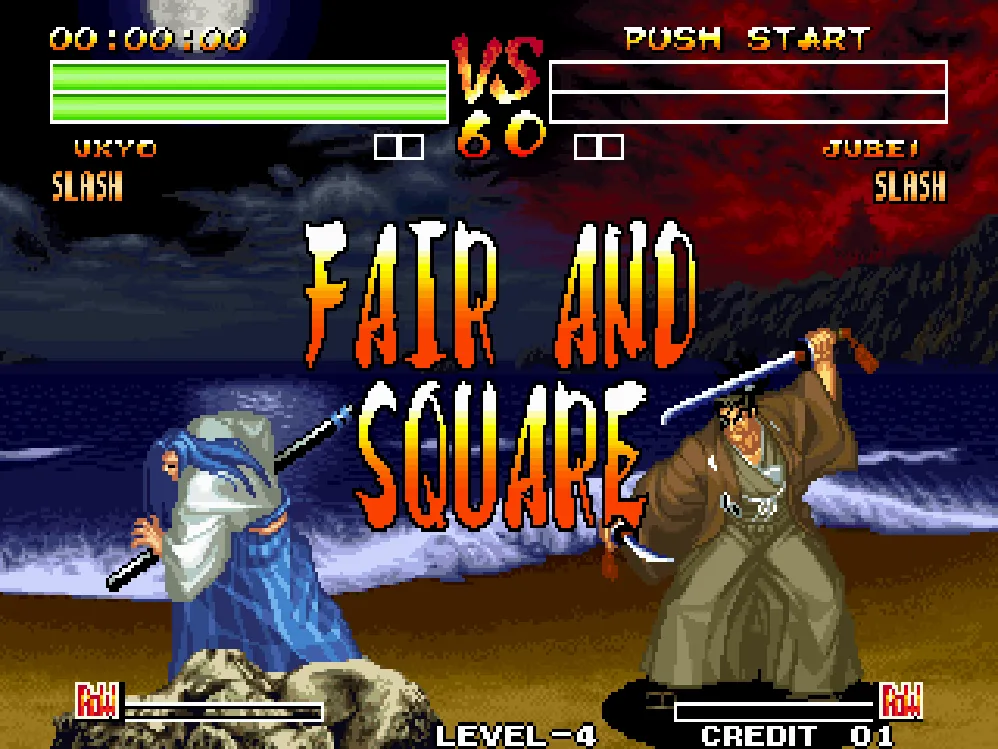
Samurai Shodown IV: Amakusa's Revenge picks up immediately after the events of Samurai Shodown III: Blades of Blood, serving as a bridge between the original Samurai Shodown and Samurai Shodown II. Though the dark swordsman Shiro Tokisada Amakusa was defeated in the previous chapter, his soul lingered in the abyss, gathering even greater dark power. Now, he has returned from hell, fueled by vengeance and shrouding Japan in a terrifying, supernatural darkness.
Caught in the center of this calamity are two brothers from the Kazama clan. Kazuki Kazama, a young ninja who wields fire-based ninjutsu, abandons his clan to rescue his kidnapped sister, Hazuki. His older brother, Sogetsu Kazama, a master of water-based ninjutsu, is ordered by the clan elders to hunt down his traitorous sibling. Their tragic fate—brothers torn apart by fire and water—becomes a cruel pawn in Amakusa's grand design.
Meanwhile, warriors from across the globe—including the French fencer Charlotte, the Indonesian giant Tam Tam, and the one-eyed master Jubei Yagyu—return to the fray, drawn into the ultimate showdown against Amakusa.
1.2 Development History
Developed by SNK, Samurai Shodown IV debuted on the Neo Geo MVS arcade hardware on October 25, 1996. The game was led by designer Kiyoji Tomita, with a haunting soundtrack composed by Hideki Asana, Yasumasa Yamada, and Yoshihiko Kitamura. In the Japanese gaming community, the title is affectionately known as "TenSamu" (a portmanteau of "Amakusa Kōrin" and "Samurai Spirits").
As the fourth main entry, the game refined the "Slash/Bust" dual-character system from Samurai Shodown III and introduced key innovations: the CD Combo system (14-hit combo) brought modern chain-attack elements to the series' "one-hit-kill" philosophy. It also removed air blocking, significantly increasing the risk of jumping attacks, and replaced manual Rage charging with a "suicide" tactic: forfeiting a round to start the next with a full Rage meter.
The game was a massive success in Japanese arcades, with Game Machine magazine naming it the #1 most popular arcade game in Japan in December 1996. The Neo Geo AES home version sold over 9,253 copies in its first week. It was later ported to the Sega Saturn and PlayStation (the PS version added Cham Cham from Samurai Shodown II as an exclusive character) and is now available on modern platforms like Nintendo Switch, PS4, and Xbox One via Hamster Corporation's ACA Neo Geo series.
II. Character Roster
Samurai Shodown IV features 17 characters (including bosses), each with "Slash" and "Bust" versions, offering distinct move sets and combat styles.
2.1 Returning Classics
Haohmaru — The Eternal Protagonist
| Slash | Bust |
|---|---|
| Classic Whirlwind Slash + Crescent Moon combo; balanced and versatile | Enhanced uppercut-style strikes; higher close-range burst damage |
- Verdict: Haohmaru remains the most well-rounded character in the series. Slash is perfect for beginners, while Bust suits players who prefer aggressive close-quarters pressure.
Ukyo Tachibana — The Consumptive Genius
| Slash | Bust |
|---|---|
| Iai-jutsu + Apple Cut; mid-range pressure | Enhanced Swallow Slash; faster but with a slightly smaller hitbox |
- Verdict: Ukyo's Apple Cut (projectile) is the most elegant zoning tool in the series. His "tragic, sickly youth" aesthetic contrasts beautifully with his lethal swordsmanship.
Charlotte Christine de Colde — The Returning French Fencer
| Attribute | Rating |
|---|---|
| Attack | ★★★★ |
| Speed | ★★★★ |
| Reach | ★★★★★ |
- Weapon: Rapier—the longest reach in the game.
- Traits: Returning after missing Samurai Shodown III, Charlotte's rapier offers the longest normal attack range, allowing her to zone opponents safely from outside their reach.
- Verdict: A top pick for beginners. Her reach advantage lets you focus on learning fundamental spacing without being overwhelmed by close-range pressure.
Tam Tam — The Indonesian Giant
| Attribute | Rating |
|---|---|
| Attack | ★★★★★ |
| Speed | ★★ |
| Reach | ★★★★ |
- Weapon: Giant Cleaver—reach is second only to Charlotte, but with significantly higher single-hit damage.
- Verdict: Another returning veteran. Tam Tam is the archetype of the "slow but heavy" character—he moves deliberately, but one strike can turn the tide.
Jubei Yagyu — The One-Eyed Master
| Attribute | Rating |
|---|---|
| Attack | ★★★★ |
| Speed | ★★★ |
| Defense | ★★★★★ |
- Weapon: Katana—a defensive counter-attacker using a dual-wielding stance.
- Verdict: The best "counter-attacker" in the series. If you enjoy waiting for the opponent to commit before punishing them, Jubei is your best choice.
2.2 Newcomers: The Kazama Brothers
Kazuki Kazama — The Renegade Fire Ninja
| Attribute | Rating |
|---|---|
| Attack | ★★★★ |
| Speed | ★★★★ |
| Skill | ★★★★★ |
| Difficulty | ★★★ |
- Weapon: Ninja Blade + Fire Ninjutsu.
- Story: Abandoned his clan to save his sister, Hazuki. His fire ninjutsu—from explosive fireballs to pillars of hellfire—features the most visually spectacular effects in the game.
- Strengths: Massive hitboxes on fire attacks; fluid combos; excellent dual-threat zoning and close-range pressure.
- Weaknesses: Low defense; fire ninjutsu requires precise input.
- Verdict: The most popular newcomer. His fiery visuals and "fighting for family" motivation make him one of the most "passionate" protagonists in the series—both literally and figuratively.
Sogetsu Kazama — The Water-Wielding Assassin
| Attribute | Rating |
|---|---|
| Attack | ★★★ |
| Speed | ★★★★ |
| Skill | ★★★★★ |
| Difficulty | ★★★★ |
- Weapon: Ninja Blade + Water Ninjutsu.
- Story: An elite ninja ordered to hunt his brother. He uses water—water pillars, whirlpools, and water prisons—to contrast his brother's fire. He is not cold-blooded, but torn between duty and kinship.
- Strengths: Best long-range control in the game; Water Prison can trap opponents, creating safe windows for damage.
- Weaknesses: Lower single-hit damage; requires high execution precision.
- Verdict: One of the highest skill-ceiling characters. His water-control chains can leave opponents helpless. The visual symmetry between his "water" and his brother's "fire" is a masterpiece of SNK character design.
2.3 The Final Boss
Amakusa Shirou Tokisada—The vengeful spirit returned from hell. As the final boss, he possesses projectiles, teleportation, massive sweeping slashes, and a full-screen super move. Amakusa is more sinister in this entry, flanked by dark energy spheres ("Amakusa Orbs") that track and attack the player. The only way to break his offense is to strike during the brief recovery window after his teleport—one of the most challenging boss fights in the series.
2.4 Slash vs. Bust — Two Versions, Two Souls
Samurai Shodown IV continues the "Slash/Bust" system. Choosing a different version changes not only the moves but the character's personality and combat philosophy:
| Feature | Slash | Bust |
|---|---|---|
| Concept | Faithful to original lore | Wild, forbidden dark side |
| Style | Classic sword techniques | Demonic, mutated skills |
| Example | Haohmaru Slash = Classic Whirlwind | Haohmaru Bust = Enhanced Uppercut |
III. Controls and Mechanics
3.1 Basic Controls
Samurai Shodown IV uses the standard Neo Geo 4-button layout (A=Light Slash, B=Medium Slash, C=Heavy Slash, D=Kick) + 8-way joystick:
| Action | Input | Description |
|---|---|---|
| Light Slash | A | Fastest strike, lowest damage |
| Medium Slash | B | Balance of speed and damage |
| Heavy Slash | C | Slowest strike, highest damage—the "one-hit-kill" move |
| Kick | D | Unique kicks—some have special properties |
| CD Combo | C+D simultaneously → press any attack button | 14-Hit Combo—the core new system |
| Dash/Backstep | →→ / ←← | High-speed movement |
| Taunt | Specific combo | Reduces opponent's Rage meter |
| Rage Explosion | Automatic when meter is full | Temporary boost to attack power |
| Weapon Disarm | Specific conditions | Knocks the opponent's weapon away—combat power is halved |
3.2 Core System Innovations
CD 14-Hit Combo: The most revolutionary addition. Press C+D to initiate; if it connects, rapidly press any attack buttons (A/B/C) to execute a combo of up to 14 hits. It adds a much-needed combo element to the series, allowing for breathtaking comebacks. However, the startup has significant recovery—if predicted, you will be punished.
No Manual Rage Charging — The "Suicide" Tactic: You can no longer manually charge your Rage meter. Instead, you can choose to forfeit a round to start the next one with a full meter. This creates a strategic layer: do you fight hard now, or sacrifice a round to guarantee a full-meter comeback? In BO3 arcade matches, intentionally losing the first round is a common psychological tactic among high-level players.
No Air Blocking: If you get hit in the air, you take the full damage—no mitigation. This makes jumping attacks a high-risk, high-reward gamble.
Weapon Destruction: Under specific conditions, you can disarm your opponent. A disarmed character suffers significantly reduced attack power and reach—a devastating way to neutralize a threat.
IV. Strategy and Character Guide
4.1 Fundamental Principles
- "One Strike, One Soul" — Don't get greedy: The core philosophy isn't about the longest combo, but the most lethal strike. A well-timed Heavy Slash (C) when the opponent is open can take half their health. CD combos are a backup, not your primary output.
- Rage Management is Key: Since you can't charge manually, you must take damage to build Rage. A full meter is a turning point in the match. Use the psychological pressure of your full meter to dictate the opponent's movement.
- No Air Blocking — Think before you jump: Every jump is a gamble. If your opponent is skilled at anti-air, jumping in is a free ticket to taking a full-damage Heavy Slash.
4.2 Matchup Quick-Check
| Opponent Type | Recommended Character | Strategy |
|---|---|---|
| Speed (Ukyo, Galford) | Haohmaru (Slash) or Charlotte | Use Heavy Slash reach—don't chase their speed, let them come to you |
| Power (Tam Tam, Wan-Fu) | Ukyo or Sogetsu | Keep max distance—use projectiles/water to chip away, don't let them get close |
| Boss (Amakusa) | Charlotte or Kazuki | Charlotte's long reach punishes his teleport recovery; Kazuki's fire pressure limits his movement |
V. Trivia and Arcade Legends
5.1 "TenSamu" — The Arcade Legend
In Japan, Samurai Shodown IV is known as "TenSamu," a contraction of "Amakusa Kōrin" and "Samurai Spirits." From 1996-1997, it was a staple of Japanese arcades. Seeing "Today's TenSamu Tournament" on a shop sign was a common sight. A fan-made abbreviation becoming a subcultural identifier is the ultimate sign of a game's impact.
5.2 The Kazama Brothers — Peak Symmetry
Kazuki (Fire) and Sogetsu (Water)—two brothers, two opposing elements, two opposing fates. This is SNK's character design at its peak, using elemental conflict to symbolize family division. When you choose one, you aren't just picking a character; you're choosing a side.
5.3 The Suicide Tactic — Cold-Blooded Strategy
In the high-stakes world of arcade gaming, "throwing the first round" to secure a full Rage meter for the next two is a ruthless but effective strategy. It's a psychological attack: "I'll give you one round—but I'll take the next two with a single strike." In 1996, this was known as "Sute-ge" (Throw-game), a secret code among elite players.
5.4 December 1996 — The King of Arcades
In a month where Street Fighter Alpha 2, KOF '96, and Tekken 2 were all competing, Samurai Shodown IV topped the Game Machine popularity charts. A slow-paced, weapon-based fighter beating the speed-focused giants is the ultimate proof of the series' design philosophy.