I. Game Background
1.1 Setting the Scene
Raiden DX is the most unique entry in the Raiden series—it is neither a full-fledged sequel nor a simple enhanced port. The story continues from the previous titles: in the 2090s, the interstellar war between humanity and the Cranassian Empire rages on. While the plasma lasers of the Raiden Mk-II fighters achieved brilliant results on the front lines, the Empire has since adapted to human tactics.
United Defense Force High Command decided to integrate all combat data into an "Ultimate Training and Combat Simulation System"—the Raiden DX Project. By analyzing millions of combat records from the first two Raiden operations, the DX system provides pilots with three distinct combat courses—ranging from endurance tests to full-scale combat simulations. Every Raiden pilot must pass the DX system's rigorous assessments to qualify for the next generation of Raiden fighters.
1.2 Development History
Raiden DX was released by Japan's Seibu Kaihatsu in 1994 for arcade hardware. After Raiden II (1993) conquered arcades with the visual impact of its plasma lasers, Seibu Kaihatsu faced a choice: develop Raiden III or create a "bridge" title? They chose the latter—but the ambition of this "bridge" far exceeded anyone's expectations.
Raiden DX is not just an "enhanced version." While retaining the core weapon system and boss lineup of Raiden II, it introduced three fundamental changes: all-new stage layouts (choose between Alpha, Bravo, or Charlie courses), a new scoring system (medal decay + flash-recovery mechanic), and a hidden ninth stage (unlocked by clearing the Expert course without continuing). It also serves as a love letter to hardcore fans—the depth of the medal system, the exploration of hidden towers, and the ultimate challenge of the ninth stage were all tailored for veterans.
A unique gameplay feature in Raiden DX is the "Timed Boss Battles"—a countdown timer appears at the end of each stage; the faster you defeat the boss, the higher your bonus score. This design flips the traditional "slowly chip away at the boss" strategy on its head, encouraging you to aggressively dive into the boss's attack range to unleash maximum firepower in the most dangerous zones.
In 1997, the game was ported to the PlayStation, released exclusively in Japan. The PS version included a wealth of exclusive content: a 3D fighter and boss model gallery ("Encyclopedia" mode), a 10-boss rush challenge, and the Viper Phase 1 soundtrack and AI perfect-play demo unlocked after clearing the game. This PS version is still considered a treasure by Japanese shoot-'em-up collectors.
Because Raiden DX was never officially released in Western markets (neither the arcade nor the PS version), it is less well-known among Western players than Raiden or Raiden II. However, in the Japanese hardcore shmup community, Raiden DX is widely considered the "definitive Raiden II"—the ultimate version that includes everything with no regrets.
II. Game System Breakdown
2.1 Three Combat Courses
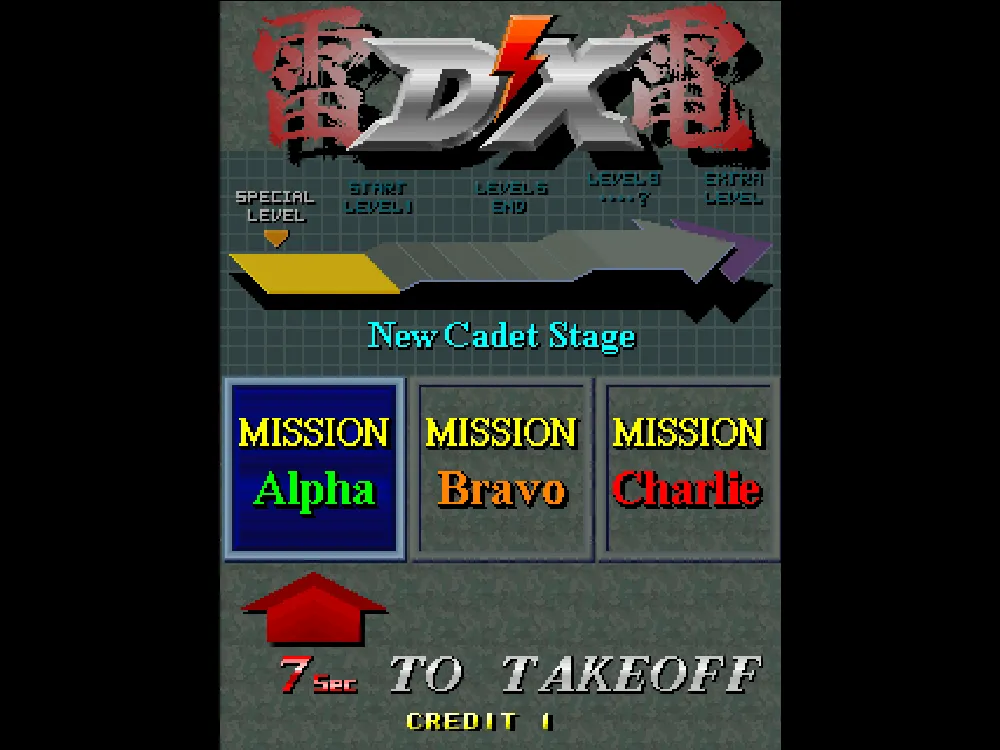
The core innovation of Raiden DX is the three-course selection on the main menu. Each course features different stages and enemy configurations, with distinct design philosophies and target audiences:
| Course | Codename | Stages | Target Audience | Design Philosophy |
|---|---|---|---|---|
| Training Course | Alpha | 1 Stage (approx. 15 mins of continuous combat) | Hardcore Players | A pure endurance test with no continues—one life, one shot. Final evaluation is based on flight distance and kill count. |
| Beginner Course | Bravo | 5 Stages | Beginners | Uses the layout of the first 5 stages of Raiden II—ends at the ground stage, skipping the space segment. |
| Expert Course | Charlie | 8 Stages + Hidden 9th Stage | Experts | Completely redesigned terrain and enemy placement—uses different blueprints than Raiden II. Unlocks the 9th stage if cleared without continues. |
2.2 The Medal System—The Soul of Raiden DX
The medal system is the biggest gameplay difference between Raiden DX and Raiden II. It is a scoring mechanic that fascinates veterans and challenges newcomers:
- Gold Medals: Start at 500 points. As they stay on screen, they fade to gray—each stage of fading reduces the value by 100 points. Gray medals are worth only 10 points.
- Flash Recovery: About one second after a medal turns completely gray, it will flash with a brilliant golden light for a split second. Collect the medal during this ~0.5-second window: Gold Medal = 3,000 points, Blue Medal = 10,000 points.
- Shift in Gameplay: You no longer just "grab medals when you see them"—you "count the seconds, wait for them to turn gray, and dash in at the moment of the flash." Waiting for that 0.5-second window amidst dense bullet patterns is the most heart-pounding design in Raiden DX.
- Max Bomb Bonus: If you already hold 7 bombs of the same type, picking up another grants a massive score bonus instead of wasting it.
- Hidden Towers: Flying over specific hidden spots on the map causes a tower to rise from the ground—destroy it for 50,000 points.
2.3 Weapon System
Inherited from Raiden II, the weapon system sees the Plasma Laser receive a new visual upgrade:
| Main Weapon | Color | Features |
|---|---|---|
| Vulcan Cannon | Red | Fan-shaped spread fire—wide coverage, best for clearing mobs. |
| Laser | Blue | Straight piercing beam—high single-target damage, stable output for boss fights. |
| Plasma Laser | Purple | Curved, writhing beam—wraps around targets for continuous damage. Now features multi-color flash effects—the beam cycles between purple, blue, and gold when locked onto an enemy. |
Sub-weapons (Nuclear Missiles and Homing Missiles) and bomb types remain consistent with the previous game.
III. Controls
| Action | Description |
|---|---|
| 8-Way Joystick | Move your Raiden fighter |
| Button A (Fire) | Hold for continuous fire—main weapon + sub-weapon fire automatically |
| Button B (Bomb) | Screen-clearing blast + short invincibility frames |
Hitbox: The Raiden fighter's hitbox is only about 4×4 pixels at the very center of the craft—much smaller than the visual sprite. In dense bullet patterns, micro-dodging is safer than large movements.
IV. Stage Flow and Boss Strategy
4.1 Training Course (Alpha)
Approx. 15 minutes of continuous combat in one stage—no continues, no stage transitions. The game calculates your final grade based on flight distance and kill count. The boss is the unique Desert Striped Tank—a massive land battleship equipped with star-shaped scatter turrets. The sense of achievement after defeating it in the Alpha course is unlike any other Raiden boss fight, because you know it was a "no-continue run."
4.2 Beginner Course (Bravo)
Uses the first 5 stages of Raiden II—City Ruins → Canyon → Sea Fortress → Snow Base → Forest Front. Ends at the ground stage, skipping the space segment.
4.3 Expert Course (Charlie)
8 stages with completely redesigned terrain and enemy placement. Bosses are the same as Raiden II but with different color schemes. New enemy types include statues in stage 4 that fire bullets from their mouths. Overall difficulty is higher than the original Raiden II.
4.4 Hidden 9th Stage—The Ultimate Challenge
Unlocked by clearing the Expert course without continues. The stage starts in an asteroid belt, then suddenly descends onto a "chrome surface" where enemies morph out of the flat metal ground. After a flash of lightning, the true final boss appears: the Cranassian Empire's red core encased in a giant metal sphere—the sphere transforms into a vicious Platinum Tank during the fight, summoning small red diamonds to assist. This stage does not allow continues—dying sends you back to a checkpoint. This is the ultimate trial Raiden DX has prepared for series veterans.
V. Tips and Advanced Strategy
5.1 Basic Survival Tips
- Flash Recovery is the key to scoring: Don't grab medals immediately. Wait for them to turn gray, then wait for that 0.5-second flash window. Executing this in dense bullet patterns requires extreme focus and precision.
- Timed Boss Bonuses encourage aggression: Every boss has a kill timer—the faster you kill them, the higher the bonus. You cannot slowly chip away at bosses like in Raiden II; you must aggressively dive into their fire to deal maximum damage.
- Memorize Hidden Tower locations: Flying over specific coordinates triggers hidden towers—destroy them for 50,000 points. These are fixed in every course; memorizing them is a prerequisite for high scores.
- Max Bomb Bonus: If you have 7 bombs, picking up another grants a huge score bonus.
5.2 Advanced Scoring Strategies
- Miclus's Sneeze: Hidden Miclus enemies in specific spots will sneeze (the animation pause is the signal); ramming into them grants 50,000 points. This is one of the hardest rewards to trigger in Raiden DX.
- Co-op Weapon Synergy: If two players use different main weapons, their fire converging in the center creates an extra "star-flash" damage hit. This is the most efficient way to deal damage in co-op.
VI. Trivia and Arcade Legends
6.1 "The Definitive Raiden II"—The Japanese Consensus
In the Japanese shmup community, Raiden DX is generally considered superior to Raiden II. It fixes bullet balance issues in certain stages, adds the medal system for strategic depth, and includes the hidden 9th stage. Unfortunately, due to the lack of a Western release, this consensus is less known abroad. For true Raiden fans, "Have you played Raiden DX?" is the question that separates veterans from novices.
6.2 The PS Version's "Encyclopedia"—Ahead of its time in 1997
The PS port included an "Encyclopedia" mode where players could freely rotate 3D models of the Raiden fighter, all bosses, and hidden enemies. In 1997, a 3D model viewer was a very avant-garde design concept, especially for a 2D vertical shooter. The PS version also included an AI perfect-play demo unlocked after clearing the Training course—"Master of Raiden"—likely one of the earliest "developer-included AI clear videos" in gaming history.
6.3 Avoid the "New" Version
There is a budget version known as Raiden DX New—avoid this version. It removes most of the original soundtrack, replacing it with low-quality substitutes, and has Sound CPU programming errors that severely degrade sound effects.