I. Game Background
1.1 Setting
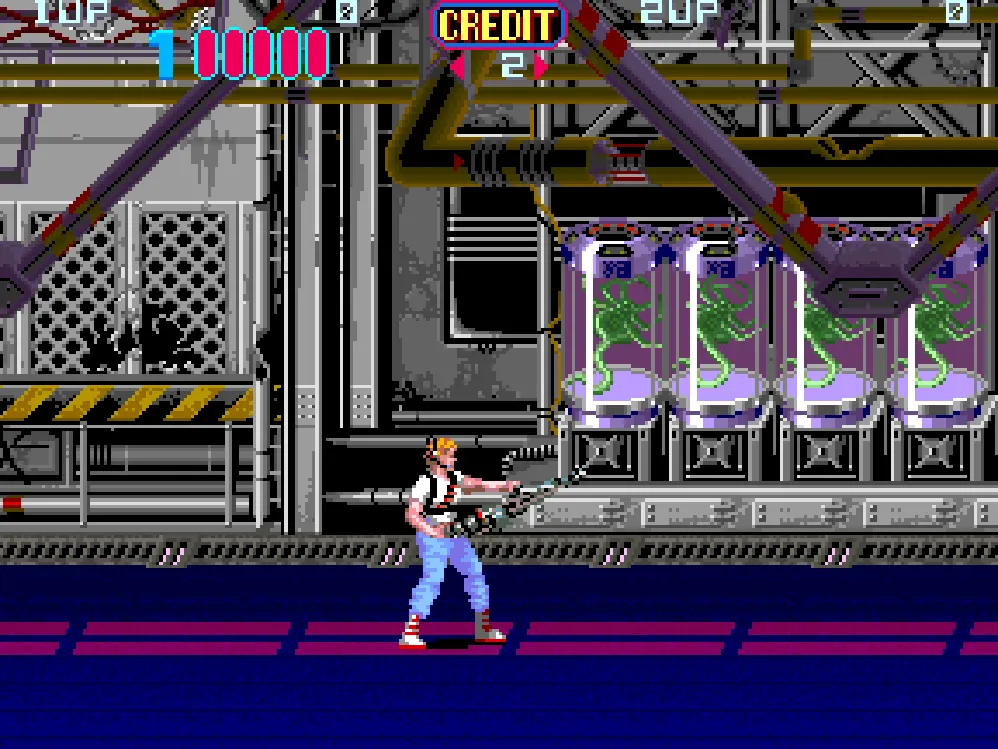
Aliens (Japanese title: エイリアンズ) picks up directly after the events of James Cameron's 1986 sci-fi classic. The game drops players straight into Hadley's Hope on LV-426—a human colony that has been completely overrun by Xenomorphs.
After receiving a distress signal, a Colonial Marine squad lands on the colony, only to find it transformed into a nightmarish breeding ground. Creepy hissing echoes through the ventilation shafts, walls are coated in black resin, and cocooned colonists hang from the ceilings. Players take control of Lieutenant Ellen Ripley or Corporal Dwayne Hicks, armed with M56 Smartguns, as they venture deep into the hive to exterminate the infestation and rescue the sole survivor, a young girl named Newt.
Unlike the film, Konami introduced a variety of original Xenomorph variants, enriching the enemy roster and filling every level with a sense of unknown dread. The game is drenched in an industrial sci-fi atmosphere, paired with Konami's signature electronic soundtrack, creating an intense, claustrophobic experience even amidst the noisy arcade environment.
1.2 Development History
Aliens was officially released by Konami in March 1990, licensed by Twentieth Century Fox. The game was directed by Satoru Okamoto, produced by Koji Hiroshita, with lead programming by Hirotaka Ishikawa and K. Ozaki. Character design was handled by Kengo Nakamura, and the music was composed by Masanori Adachi.
Running on Konami's own GX875 arcade hardware, the game featured a 3MHz custom processor, a Z80 sub-processor for audio with YM2151 and K007232 sound chips, and a 512-color palette at a 288×224 resolution. For 1990, this was high-end hardware, capable of supporting smooth side-scrolling action and dense, chaotic battlefields.
Following its global debut at the ATEI show in London in January 1990 and the AOU show in Japan in February, the game launched in March, coinciding with its appearance at the ACME show in Chicago. At ACME, RePlay magazine and distributors named it the "Best New Conversion Kit." It earned a silver award from the AAMA and became Konami's second-highest-selling arcade game of 1990, trailing only Teenage Mutant Ninja Turtles.
Notably, Aliens was never ported to any home console—no NES, SNES, or Genesis versions exist. This was likely due to its 1990 release date, four years after the film's peak, causing it to miss the prime window for home console ports. This makes it a rare "arcade exclusive," and until the rise of emulators, the only way to experience it was to step into an arcade.
II. Character Profiles
Aliens offers two playable characters. Their handling and base stats are identical, with differences limited to appearance and lore. Both are equipped with the standard M56 Smartgun and can utilize more powerful firepower by picking up special weapons.
2.1 Ellen Ripley — 1P Default Character
| Attribute | Rating |
|---|---|
| Strength | ★★★ |
| Speed | ★★★ |
| Skill | ★★★ |
- Pros: The default 1P character and the film's protagonist, offering maximum immersion. The game gives Ripley a distinct blonde bob (Sigourney Weaver had long brown hair in the film), a visual choice made to ensure she was easily recognizable on low-resolution arcade screens.
- Cons: Performance-wise, she is identical to Hicks with no unique advantages.
- Verdict: As one of the earliest female protagonists in gaming history, Ripley's presence is iconic. In 1990, seeing a female character wielding heavy weaponry against aliens left a lasting impression on countless players. If it's your first time playing, choosing Ripley is the most authentic experience.
2.2 Corporal Dwayne Hicks — 2P Character
| Attribute | Rating |
|---|---|
| Strength | ★★★ |
| Speed | ★★★ |
| Skill | ★★★ |
- Pros: As a Colonial Marine, his design fits the "professional soldier" archetype perfectly. His character model is slightly more rugged than his film counterpart.
- Cons: Performance is identical to Ripley.
- Verdict: In two-player co-op, Hicks is the only choice for 2P. Having one player control Ripley and the other control Hicks perfectly recreates the film's dynamic. While there's no mechanical difference, the "movie duo" feel is the unique charm of arcade co-op.
In Summary: Character selection in Aliens is about identity rather than stats. Unlike Capcom's Cadillacs and Dinosaurs, where every character has unique speed, damage, and range, Konami chose to make the characters "equal," leaving the differentiation to the weapon system.
III. Controls
3.1 Basic Controls
Aliens uses a standard 8-way joystick + 2-button layout, typical of Konami's action-shooter style:
| Button | Function |
|---|---|
| Shoot 1 | Standing fire (Smartgun or current special weapon) |
| Shoot 2 | Crouch fire / Throw grenade (if equipped) |
| Both | Throw grenade (alternative trigger) |
The game supports both side-scrolling movement and fixed-perspective shooting. In side-scrolling levels, you move freely in a 2D plane, similar to Contra. In specific sequences (like the APC escort), the game switches to a fixed-perspective rail shooter where you control only the crosshair.
3.2 Special Weapons & Pickup System
Special weapons drop from the sky in supply crates. Picking one up replaces your current main weapon. All special weapons have limited ammo; once depleted, you automatically revert to the Smartgun.
| Weapon | Features |
|---|---|
| Smartgun | Starting weapon, infinite ammo, medium fire rate; your most reliable companion. |
| Flamethrower | Short-range area attack, highly effective against swarms, but requires careful positioning. |
| 3-Way Gun | Fires in three directions simultaneously; best for clearing crowds. |
| Missile Launcher | Highest single-target damage, great for bosses, but slow fire rate. |
| Grenade Launcher | Explosive splash damage, ideal for dense enemy groups; limited ammo. |
| Bomb | Full-screen explosion, clears all enemies; a lifesaver in emergencies. |
3.3 Power Loader
In certain levels, players can pilot the iconic yellow Power Loader. While movement speed is reduced, attack power is significantly boosted, and the mechanical arms can deal devastating melee damage. The Power Loader is a highlight that captures the film's atmosphere—especially the final showdown against the Alien Queen.
IV. Level Walkthrough & Boss Guide
Aliens features 6 stages (Japanese version configuration; the International version adds APC rail-shooter segments between levels), each with unique atmospheres and boss designs.
Stage 1: Living Quarters
| Item | Details |
|---|---|
| Setting | Hadley's Hope living quarters—dim corridors, flickering lights, and walls covered in alien resin. |
| Boss | Giant Alien Warrior (Two phases) |
| Strategy | In phase one, the boss is large and slow; keep your distance and fire away. After destroying its head, it enters phase two—the headless alien charges wildly and fires plasma balls from its neck. Don't stay on the same horizontal line; move vertically to dodge charges and counter-attack during its recovery frames. |
Stage 2: Factory
| Item | Details |
|---|---|
| Setting | Large industrial processing area—massive pipes, steam vents, and furnaces create a dangerous environment. |
| Boss | Enhanced Alien Guard |
| Strategy | This boss is much faster than standard aliens. Explosive barrels are a double-edged sword—they can damage the boss but also you. Clear the fodder enemies first, then lure the boss into open space. The flamethrower shines here due to the boss's frequent melee charges. |
International Version Exclusive: After this stage, the International version triggers an APC rail-shooter sequence where you man the gunner seat. The Japanese version omits all APC segments.
Stage 3: Factory Deep (Factory 2) — Vents & Elevator
| Item | Details |
|---|---|
| Setting | Starts in narrow ventilation shafts, then moves to a rickety industrial elevator descending deep into LV-426. |
| Boss | Shrinky-Dink Aliens |
| Strategy | Four small aliens emerge and grow to full size. Prioritize attacking those currently growing. During the elevator descent, protect the cables—if they are destroyed, the elevator crashes (instant death). You get the Power Loader here; use its melee attack to one-shot standard aliens. |
Stage 4: Queen Alien's Den
| Item | Details |
|---|---|
| Setting | The heart of the hive—resin-covered caves, cocooned victims, and eggs everywhere. |
| Boss | Alien Queen (First Encounter) |
| Strategy | The most intense level. You must find and rescue Newt. The Queen is massive and summons minions. The 3-Way Gun is a godsend here for crowd control. Don't get greedy; use obstacles as cover and wait for the Queen's recovery frames. Avoid the eggs—getting too close triggers Facehuggers that drain your health. |
Stage 5: Escape Route
| Item | Details |
|---|---|
| Setting | The path out—outdoor platforms, burning corridors, and collapsing tunnels. |
| Boss | Elite Alien Swarm + Tracker Alien |
| Strategy | A "reverse" level design—the path you've taken is collapsing behind you. Flying aliens appear in large numbers; crouch-fire to hit them. Save at least one bomb for the boss fight's final swarm. |
Stage 6: Battle Ship SULACO — Final Showdown
| Item | Details |
|---|---|
| Setting | The Sulaco hangar—massive bay doors, cargo crates, and elevators. |
| Boss | Alien Queen (Final Battle, Power Loader) |
| Strategy | Phase 1: The Queen charges and uses tail stabs. Keep distance, use crates as cover, and unload missiles/grenades. Phase 2: After taking damage, she becomes faster. The Power Loader returns—engage in a final melee brawl. The mechanical arms are powerful but slow; time your strikes between her attacks. Two endings depend on how you finish her. |
Dual Ending System: ① Airlock Ending (Film accurate): Blow the Queen into space; ② Total Annihilation Ending: Fight until she explodes. The latter requires high damage output and is a challenge for experts.
V. Tips & Advanced Strategy
5.1 Survival Tips
- Keep Moving: Standing still is suicide. Constant vertical movement helps dodge charges.
- Crouch-Fire: Essential for hitting low-flying aliens and Facehuggers.
- Weapon Management: Don't rush for crates if surrounded. Changing weapons leaves you vulnerable.
- Smartgun is Reliable: Don't underestimate the infinite-ammo default weapon. It's your best friend in long fights.
- Bombs are Insurance: Always keep one for emergencies.
- Use the Environment: Explosive barrels are free damage. Lure enemies to them.
5.2 Co-op Strategy
- Crossfire: Don't overlap. One covers the front, one the back.
- Boss Roles: One lures/distracts, the other deals heavy damage.
- Share Resources: Communicate who needs the weapon crate.
- Rescue: If a partner is swarmed, support them immediately.
5.3 Boss Tactics
- Observe Patterns: Bosses have fixed AI loops. Watch for 10-15 seconds before committing.
- Prioritize Minions: Fodder enemies are usually more dangerous than the boss.
- Hit and Run: Never stand toe-to-toe. Back away while firing.
- Bomb Timing: Use bombs when the screen is too crowded, not just when the boss is low on health.
5.4 Advanced Knowledge
- Difficulty: The Japanese version is easier (lower enemy HP, more drops). International ROMs are harder.
- 1UP Mechanic (JP): If you pick up a new weapon while still having ammo for the old one, the next crate becomes a 1UP.
- Power Loader Value: Its melee attack is a one-hit kill on standard aliens. Don't avoid it just because it's slow.
- APC High Scores: In the International version, every bullet counts toward your score. Keep firing!
VI. Trivia & Arcade Legends
6.1 A Forgotten Konami Masterpiece
Aliens was Konami's second-best-selling arcade game of 1990, yet it was overshadowed by TMNT. Computer and Video Games magazine gave it a 91% score, calling it "the bloodiest arcade game since Splatterhouse." It remains a buried gem of arcade history.
6.2 The Simpsons Arcade Cameo
In Konami's 1991 The Simpsons arcade game, an Aliens cabinet appears in the background. An alien bursts out of the screen, scaring a "space mutant"—who turns out to be Marge Simpson in a mask! A classic bit of Konami self-referential humor.
6.3 "Winners Don't Use Drugs"
Players of the US version will remember the FBI badge screen at startup. This was part of a 1989–2000 anti-drug campaign. The Japanese version lacks this, allowing for faster boot times.
6.4 Why are the Aliens Pink?
Konami's art team rendered the adult aliens in a distinct purple/pink hue. This wasn't a technical limitation, but a "high-visibility design" choice to ensure enemies stood out against dark backgrounds on low-res screens.
6.5 The Tragedy of No Ports
Why no home ports? Licensing issues with 20th Century Fox and Konami's focus on the TMNT home console series in 1990 are the primary culprits. By 1992, Sega acquired the interactive rights, effectively killing any chance for a Konami port.
6.6 "Suicide Mission"
In the arcade scene, the game was nicknamed "Suicide Mission" due to the brutal difficulty spike in stages 5 and 6, which could drain a player's credits in seconds.
6.7 Forgotten "Zombie" Enemies
Few remember the "Zombies" that crawl out of vents. They added a Resident Evil-esque horror vibe, showing Konami's creative freedom to deviate from the source material to make the game "cooler."
FAQ
Q1: How many versions are there?
- Japanese: Easier, more drops, unique 1UP mechanic, no APC segments.
- International: Harder, includes APC segments, includes FBI anti-drug screen.