I. Game Background
1.1 World Setting
Blazing Star is set in a distant future ruled by artificial intelligence. Humanity once created a vast army of cyborgs and autonomous AI war systems, only to be consumed by their own creations. The machines began designing even more powerful successors, rendering the original cyborg soldiers "obsolete models" to be discarded.
However, among the discarded cyborgs, a few began to reawaken their suppressed human memories. Realizing they were once human, they faced a choice: continue as tools for the machines, or stand against the very AI system that created them. These "traitors" boarded the last remaining fighter ships, uniting for a final, suicidal charge against the core of the AI system.
Every pilot in the game is a cyborg—their bodies have been mechanized, but the remnants of their human will drive them to make one final, irreversible choice.
1.2 Development History
Blazing Star was developed by the Japanese studio Yumekobo and published by SNK, debuting on the Neo Geo MVS arcade hardware on January 19, 1998. Yumekobo was the successor to Aicom, the developer of the 1995 side-scrolling shooter Pulstar (a spiritual successor to R-Type). After Aicom reorganized into Yumekobo, Blazing Star became the new company's first—and most significant—title.
Pulstar was highly regarded by hardcore shooter fans for its extreme difficulty, but it received negative feedback in Western markets for being "too hard." Consequently, SNK requested that Yumekobo significantly lower the difficulty for their new project. The team struggled to balance enemy bullet patterns and the difficulty curve—interesting patterns increased difficulty, while simple ones felt boring. The final compromise: a relatively gentle early game, followed by a sharp spike in difficulty—providing a warm welcome for newcomers and a bloody finale for veterans.
The English title "Blazing Star" was selected from several alternatives, including "Zero Hour" and "The Zenith." During development, the game was briefly titled Pulstar Blast, but SNK wanted to avoid any association with Pulstar's reputation for high difficulty in the West, and the team felt the game deserved its own identity. Ultimately, the president of Yumekobo decided on "Blazing Star" as the global title.
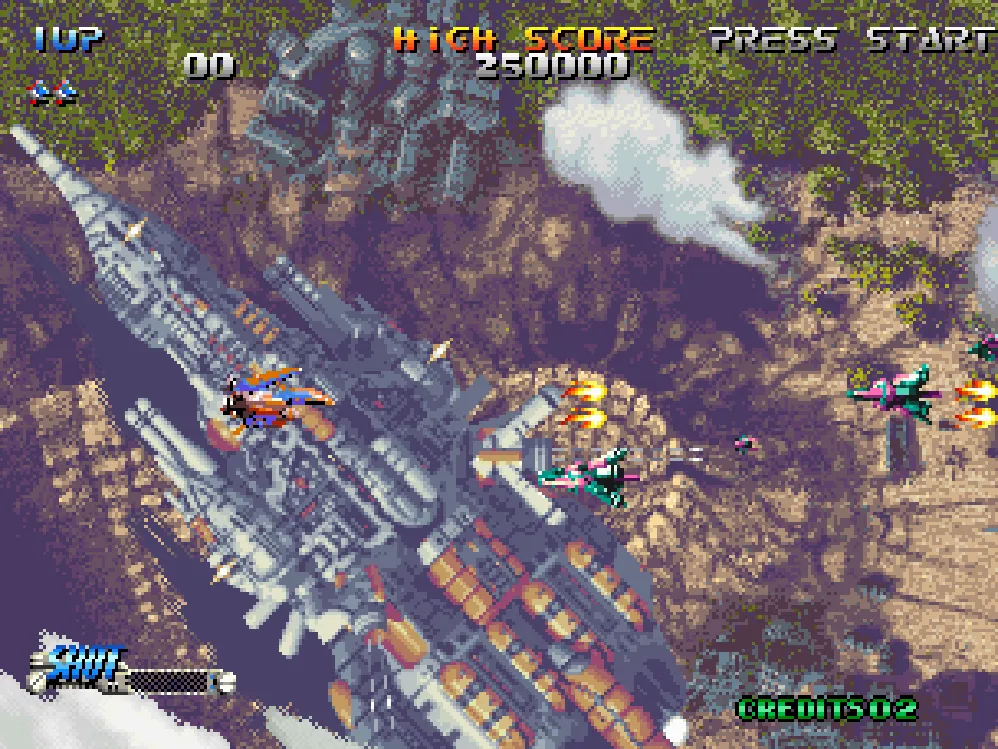
The art team achieved the near-impossible on Neo Geo hardware—each character sprite was limited to a maximum of 16 colors—yet they created what media outlets like Nintendo Life (9/10) and Pocket Gamer (9/10) praised as one of the "most beautiful 2D graphics on the Neo Geo." The soundtrack, composed by Harumi Fujita, is equally unforgettable.
In 2012, the game was released on iOS/Android. Since 2017, it has been available on Nintendo Switch, PS4, and Xbox One via Hamster Corporation's ACA Neo Geo series. In 2018, it was included as one of the 40 built-in games on the SNK 40th Anniversary console, the Neo Geo Mini.
II. Ship Selection
Blazing Star offers several playable ships, each with completely different shooting modes and charge attacks:
| Ship | Pilot | Type | Main Weapon | Charge Attack | Characteristics |
|---|---|---|---|---|---|
| Windina | — | Balanced | Focused forward laser + Homing missiles | Giant energy beam—straight piercing high damage | The most balanced starter ship—recommended for beginners |
| Peplos | — | Mid-range Suppression | Wide-angle spread shot | Spread charge—releases a massive fan-shaped area of fire | Best for clearing mobs, but weaker single-target boss damage |
| Aryustailm | — | Speed | High-speed machine gun + Low-homing missiles | High-speed dash charge—ship dashes forward while releasing a barrage | Highest mobility, perfect for bullet-hell experts |
| Leefa | High school cyborg | Technical | Homing energy orbs | Energy shield charge—creates a temporary shield that attacks nearby enemies | Character design inspired by Yuko Asahina from Tokimeki Memorial. Great for defensive players |
| JB | Tough guy cyborg | Power | Heavy forward cannon | Giant blast bomb—highest single-hit damage, but longest charge time | Character design inspired by actor Jean Reno. Extreme firepower for one-shot kills |
| Asayuki | Samurai cyborg | Melee Specialist | Short-range high-damage wave cannon | Burst mode—temporarily maximizes firepower after release | Character design from a cancelled, unreleased game. High-risk, high-reward melee playstyle |
Each ship's Charge Shot is the core tactical tool: hold the fire button to charge, then release to trigger effects unique to each ship (piercing beams, spread shots, shields, blast bombs, etc.). Additionally, rapidly tapping the fire button switches shooting modes—holding it provides continuous fire, while tapping releases different ballistic patterns.
III. Controls
Uses the standard Neo Geo 8-way joystick + 2-button layout:
| Action | Description |
|---|---|
| Directional Pad | Move the ship in 8 directions |
| A Button (Shoot) | Hold = Continuous fire; Rapid tap = Switch ballistic mode |
| B Button (Charge) | Hold to charge → Release = Ship-specific charge attack |
| A+B (Rare) | Special combo attack for select ships |
Charge System Explained: Charging is the core combat mechanic of Blazing Star—hold the A or B button (depending on version/settings) for about 1.5 seconds before releasing. The effect varies by ship: piercing beams, spread shots, energy shields, or giant blast bombs. You can continue to move and dodge while charging, but be careful—you cannot hold a charge indefinitely; overcharging will force an automatic release.
IV. Stages and Boss Strategy
There are 6 stages in total, each ending with a massive boss battle. Inheriting the "super-sized boss" design tradition from Pulstar, these bosses are often larger than the screen itself, with some requiring multiple screens to display fully.
| Stage | Setting | Environment | Boss | Strategy Tips |
|---|---|---|---|---|
| 1 | Planetary Orbit | Outer perimeter of AI defense—floating debris provides cover | Giant Defense Satellite—multi-turret rotating cannon | Introductory stage. Learn the rhythm of charge shots—enemy density here is low |
| 2 | Enemy Mothership Exterior | Dense array of fixed turrets and laser fences | Multi-stage Mothership Cannon—destroy one section to reveal the next | Laser fences sweep periodically—memorize their timing and position to avoid panic |
| 3 | Bio-factory Interior | Discarded cyborgs floating in tanks—mechanical arms "recycling" in the background | Giant Bio-weapon—uses biological attacks (tentacles, acid spray) | Destroy the tanks in the background—they release area damage that can hurt the boss |
| 4 | Dense Asteroid Belt | Screen filled with floating asteroids—blocks vision and causes collision damage | Giant Mobile Fortress hidden in the belt—appears randomly between gaps | Manage asteroid collisions, enemy fire, and boss attacks simultaneously—piercing beams are essential here |
| 5 | Enemy Data Core | Holographic data streams and glitchy projections—a visual "digitization of the world" | Data Core Defense System—boss switches between physical and ethereal states | Boss is immune while ethereal—only attack during the brief physical window. Requires precise timing |
| 6 (Final) | AI Mother Core—"God's Domain" | The ultimate form of AI evolution—endless circuits and rivers of data in the background | Final Boss: AI Mother—multi-stage transformation—patterns range from full-screen bullets to homing missiles | Three stages—Stage 1 (full-screen bullets), Stage 2 (homing missiles + crushing), Stage 3 (all patterns combined). Save all charge shots for the final stage. The ending reveals the cyborg pilots' choice—they sacrificed their remaining humanity to become pure combat machines |
Each boss has a time limit—defeating them within the limit grants bonus points. If time runs out, you can still clear the stage, but you lose all bonus points. This design encourages aggressive play rather than passive dodging.
V. Tips and Advanced Strategy
5.1 Basic Survival
- Charge shots are your primary damage source: Normal shots are mainly for clearing small mobs during charge cooldowns. Real damage—especially against bosses—relies on charge attacks. Learning to dodge while holding a charge is the first hurdle to improvement.
- Rapid tap to switch patterns: Tapping the fire button triggers a different ballistic pattern than holding it. In narrow corridors, the concentrated pattern from tapping is superior to the spread pattern from holding.
- Choose the right ship for the stage: Peplos (spread) excels in the Stage 4 asteroid belt; Aryustailm (speed) has the best mobility for the narrow corridors of the Stage 3 bio-factory.
- Boss weak points: Most bosses have a glowing core—this is their weak point. Attacking other parts (armor, turrets) deals damage, but significantly less than hitting the core.
- Hidden items: Some score items and extra lives only appear if you "destroy specific enemy groups in a specific way"—such as clearing a whole wave within a time limit. This requires trial and error for high-score runs.
- "You fail it": The grammatically awkward Game Over screen text—"You fail it"—was identified by linguist Ben Zimmer as one of the earliest known origins of the internet slang "Fail" (used as an exclamation). In 1998 arcades, this broken English became a common inside joke among players.
5.2 Co-op Tips
- Ship Synergy: Peplos (crowd control) + Windina (boss damage) is the classic duo—one clears the path, the other focuses on boss DPS.
- Alternating Charges: Don't both charge at once—one player should provide cover fire while the other charges.
- Shared Resources: Extra lives and power-ups are shared in co-op—communicate who takes what.
5.3 Advanced Trivia
- Neo Geo 16-color limit: Yumekobo's art team was limited to 16 colors per sprite—a hard limit of the Neo Geo hardware. They compensated by "reducing color variety but increasing the quality of color combinations per frame," resulting in some of the most beautiful 2D graphics on the system.
- "Ethereal" Boss Tactics: The Stage 5 boss switches between ethereal (invincible) and physical (vulnerable) states. Focus on dodging while it's ethereal, and unleash full charge shots the moment it becomes physical.
- Deleted Endings: Each character was originally planned to have a unique ending animation, as detailed in the Japanese magazine Neo Geo Freak. Due to time and budget constraints, these were cut, and all characters share a generic ending.
VI. Trivia and Arcade Legends
6.1 "You fail it"—The accidental origin of internet slang
Linguist Ben Zimmer traced the etymology of "Fail" as an independent internet exclamation (e.g., "It's a fail" or just "Fail!") back to the Blazing Star Game Over screen. The awkward phrase "You fail it" was repeatedly cited and parodied on early 2000s gaming forums, eventually evolving into a universal expression of failure. From a Neo Geo arcade game to global internet slang—this is Blazing Star's most unexpected cultural legacy.
6.2 An aesthetic miracle of 16 colors
Neo Geo hardware limits each sprite to a 16-color palette. Yumekobo's art team didn't compete on color count, but on the quality of color coordination. Every frame was optimized for contrast, saturation, and visual impact. The final result was praised by many media outlets as "the most beautiful 2D graphics on the Neo Geo"—not through technical specs, but through sheer aesthetic taste.
6.3 Jean Reno and Tokimeki Memorial—A bizarre character mix
JB's design mimics French actor Jean Reno, Leefa's character is based on Yuko Asahina from the dating sim Tokimeki Memorial, and Asayuki's assets were recycled from a cancelled game. This strange mix of "tough guy movie characters + Japanese dating sims + recycled assets" is a perfect snapshot of late 90s Japanese game development culture.
6.4 The difficulty curve—40 minutes from "too easy" to "too hard"
Blazing Star's early stages were criticized for being "too easy," but by the later stages (especially after Stage 4), bullet density and boss HP skyrocket. The game transitions from "casual play" to "every bullet counts" within 40 minutes—a "gentle start, brutal finish" design that remains a topic of debate in the shooter community.
6.5 A light at the end of the Neo Geo era
In 1998, when Blazing Star debuted on the Neo Geo MVS, the legendary arcade board had already been in service for 8 years, and the market was flooded with 3D games and high-performance hardware. As a 2D side-scrolling shooter, Blazing Star had almost no chance of commercial success in 1998. Yet, it became one of the most acclaimed games of the late Neo Geo era—listed by HobbyConsolas in 2014 as one of the "20 Best Neo Geo Games of All Time." A game born at the end of a platform's life cycle becoming a classic is the highest tribute to Yumekobo's art, programming, and music teams.