I. Game Background
1.1 Story and Setting
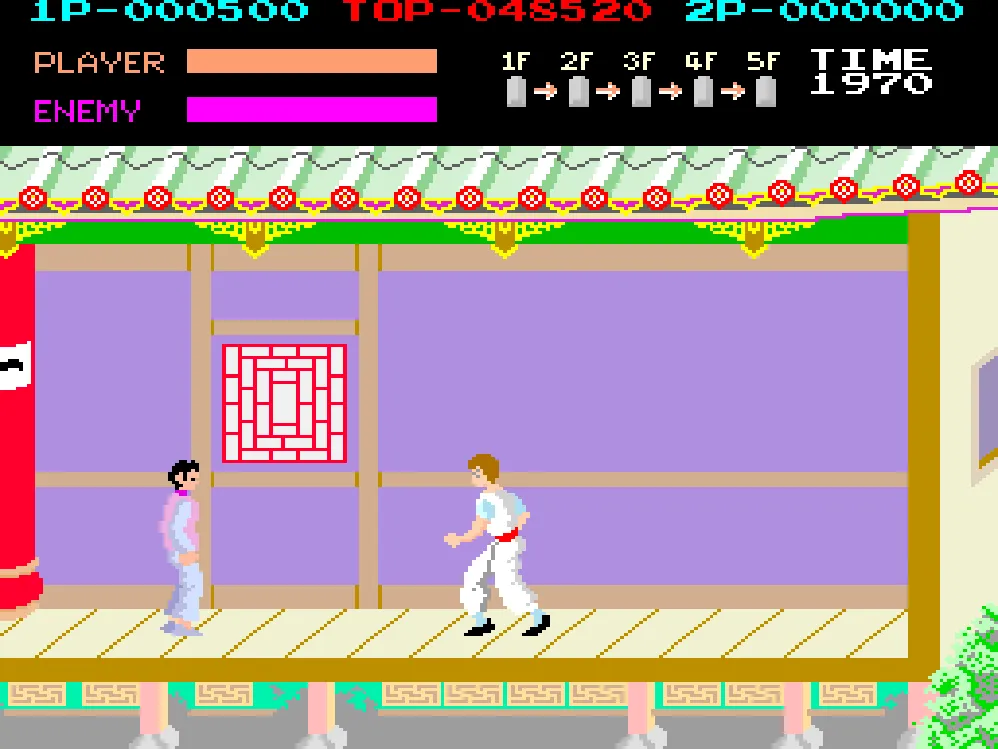
The story of Kung-Fu Master is simple yet iconic: martial arts expert Thomas receives a letter informing him that his girlfriend, Sylvia, has been kidnapped by the crime boss Mr. X and is being held at the top of the "Devil's Tower." Thomas must storm the five-story tower alone, with each floor guarded by one of Mr. X's henchmen. From stick-wielding masters to shuriken-throwing ronin, and from giant brutes to mysterious wizards, this is the earliest example of the "tower-climbing" narrative in arcade history.
This framework was directly inspired by Bruce Lee's 1972 final film, Game of Death, in which Lee climbs a pagoda, facing a different martial arts master on each floor. After securing the license for Jackie Chan's 1984 film Wheels on Meals, the game named its protagonist "Thomas" (after Chan's character) and the heroine "Silvia." The Japanese title, Spartan X, is the Japanese release title of Wheels on Meals, a name well-known to arcade players in Japan.
1.2 Development History
Kung-Fu Master was released by the Japanese company Irem in December 1984. The lead designer was Takashi Nishiyama. Having previously created Irem's classic side-scrolling shooter Moon Patrol (1982), Nishiyama sought to blend the rhythmic pacing of shooters with combat elements, effectively inventing the "beat 'em up" genre.
The soundtrack was composed by Masato Ishizaki. Interestingly, Nishiyama initially wanted the game to have no music, but Ishizaki insisted on composing a melody. After comparing versions with and without music, Nishiyama agreed to keep it—the resulting tune became one of the most recognizable BGM tracks in arcade history. Ishizaki later went on to compose for classics like R-Type.
Toward the end of development, Nishiyama accepted an offer from Capcom and left Irem. At Capcom, he used the health-bar-based boss fight design from Kung-Fu Master to pitch Street Fighter (1987). He later moved to SNK, where he led the creation of legendary fighting game series such as Fatal Fury, Art of Fighting, Samurai Shodown, and The King of Fighters. It is no exaggeration to say that the entire history of modern fighting games can be traced back to this 1984 beat 'em up.
The NES (Famicom) port was developed by Nintendo's R&D4 division, with Shigeru Miyamoto serving as producer and Koji Kondo handling the sound. Released in Japan on June 21, 1985, the NES version sold 3.5 million copies worldwide. Miyamoto has stated that the technical experience gained from developing Kung-Fu Master and Excitebike was a key foundation for creating Super Mario Bros.
Commercially, Kung-Fu Master was a massive success: it topped the Game Machine arcade earnings chart in Japan for two consecutive months and sold 5,000 arcade cabinets in the U.S. by April 1985, becoming the second-highest-earning arcade game in the U.S. that year (behind Karate Champ).
II. Character Profile
Thomas — Kung-Fu Master
| Attribute | Rating |
|---|---|
| Punch Power | ★★★☆☆ |
| Kick Power | ★★★★☆ |
| Speed | ★★★☆☆ |
| Difficulty | ★★★★☆ |
- Pros: Fast punch combos with precise hit detection; jump kicks have a wide range and are excellent for anti-air and opening attacks; crouching attacks handle low-profile enemies and counter certain boss patterns.
- Cons: No defense button (cannot block); no dash or dodge ability, forcing you to fight through crowds; while health allows for multiple hits, the high damage and dense enemy waves in later levels will drain your life quickly.
- Verdict: Thomas is a "martial arts master surrounded by enemies." He has no flashy moves, no item system, and no character variants—just punches, kicks, jump kicks, and directional control. Yet, this "minimalist" design gives every strike weight, and every victory is a testament to pure player skill.
III. Controls
3.1 Basic Controls
Kung-Fu Master uses an 8-way joystick and 2 action buttons. The design is simple, but the depth lies in choosing the attack height (high/mid/low):
| Button | Action | Description |
|---|---|---|
| Joystick ←→ | Move | Standard horizontal movement |
| Joystick ↑ | Jump | Fixed jump height; press punch or kick in mid-air for jump attacks |
| Joystick ↓ | Crouch | Avoid high attacks; press punch or kick while crouching for low attacks |
| Punch | Punch | Higher damage, shorter range. Can be used standing, crouching, or jumping |
| Kick | Kick | Lower damage, longer range. Can be used standing, crouching, or jumping |
3.2 Attack Height System
The core combat depth of Kung-Fu Master lies in switching between three attack heights:
| Stance | Attack Type | Best For |
|---|---|---|
| Standing | Mid-range | Standard enemies; your most common attack |
| Crouching | Low-range | Crawling enemies (snakes, dwarves), low-profile bosses (e.g., the Witch) |
| Jumping | High/Air | Flying enemies (moths, dragons), avoiding ground attacks while dealing damage |
3.3 Special Mechanics
- Grippers: Enemies that grab Thomas and drain health; shake the joystick left and right rapidly to break free.
- Time Limit: Each floor has a countdown; running out of time costs a life and restarts the floor.
- Health Bar System: This was one of the first arcade games to feature visible health bars for both the player and the boss. This 1-on-1 duel design directly inspired later games like Street Fighter.
IV. Level Walkthrough & Boss Strategy
Kung-Fu Master consists of 5 floors, each featuring waves of corridor enemies followed by a boss fight. On even-numbered floors (2 and 4), flying projectiles like snake eggs, dragon balls, and explosive balls fall from the ceiling.
4.1 Floor 1: The Stick Fighter
| Item | Content |
|---|---|
| Scene | First floor of the Devil's Tower. Corridors filled with female warriors and knife-throwing men. |
| BOSS | Stick Fighter — A master of the long staff. He uses high sweeps (standing) and low sweeps (crouching). |
| Strategy | The first boss is a tutorial. His attacks have clear wind-ups. Strategy: Crouch when he raises the staff to avoid the high sweep, then stand up and land two punches during his recovery. Don't get greedy—back off after two hits. Jump kicks are safe openers, but retreat immediately after landing. |
4.2 Floor 2: The Boomerang Hunter
| Item | Content |
|---|---|
| Scene | Second floor. Snake eggs, dragon balls, and explosive balls begin to fall. Dwarf enemies appear, rolling to attack crouching players. |
| BOSS | Boomerang Thrower — A hunchbacked thrower who tosses up to two boomerangs at once. |
| Strategy | Your first encounter with a projectile boss. The boomerang returns, so don't let your guard down after the first pass. Strategy: Keep mid-distance. Crouch the moment he throws (the boomerang flies high). After he throws, dash in for a combo. Key: Do not get close while he is holding the boomerang—he will counter-attack. |
4.3 Floor 3: The Giant
| Item | Content |
|---|---|
| Scene | Third floor. Enemy density increases, and the corridor is narrower. Knife-throwers and dwarves appear together. |
| BOSS | The Giant — A massive brute. His punches and kicks are devastating. |
| Strategy | The first boss you cannot "out-punch." His reach is huge. Strategy: Use jump kicks to open → land and immediately crouch → land 2-3 crouching punches → roll or back away before he counters. Keep your distance and "kite" him. Warning: Even a glancing blow from his heavy punch can take 1/3 of your health. |
4.4 Floor 4: The Witch's Magic Realm
| Item | Content |
|---|---|
| Scene | The most eerie area. Dark background with magic effects. Frequent falling hazards and deadly snakes/dragons. |
| BOSS | Black Magician — The most challenging boss. She uses fireballs, snake eggs, and dragons. |
| Strategy | The ultimate test of the "three-height" system. Attacking her head makes her teleport (ineffective), so you must crouch and punch her body. Strategy: Stay in the center → wait for her magic cycle to end → dash in, crouch, and land 2-3 punches on her body → retreat immediately. Patience is key. |
4.5 Floor 5: The Final Showdown
| Item | Content |
|---|---|
| Scene | The top of the tower—Mr. X's throne room. The final corridor is the most crowded in the game. |
| BOSS | Mr. X — The final boss, a Western-style fighter. He mirrors your moves: punches, kicks, jump kicks, and crouching attacks. |
| Strategy | A classic "mirror match." You cannot rely on patterns; you must rely on fundamentals. The only effective strategy is the crouching kick combo: spam low kicks. Mr. X will try to counter with standing punches, but because you are crouching, you are in his blind spot. Keep the pressure on until he falls. Sylvia is saved, and the game loops with increased difficulty. |
V. Tips and Advanced Strategy
5.1 Survival Tips
- Kicks are better than punches: While punches deal more damage, kicks have longer range. Use kicks to keep enemies at bay. Only switch to punches during boss recovery.
- Jump kicks are the best opener: They are the safest way to start an attack and can interrupt most ground moves.
- Keep moving: Don't stand still for more than 2 seconds. Practice "micro-adjusting" your position constantly.
- Prioritize projectile enemies: Knife-throwers are the deadliest. Kill them first.
- Breaking free: Shake the joystick left and right rapidly to escape Grippers.
- Time management: If you die more than twice on a floor, you might run out of time. It's often better to sacrifice a life to restart the floor with a full timer.
5.2 Boss Fight Rules
- Find the safe distance: Every boss has a "sweet spot" where you are safe from their primary attack.
- Attack → Retreat → Attack: Never try to overwhelm them. Hit 2-3 times, then back off.
- Crouching is a universal dodge: When in doubt, crouch.
- 50,000 points = 1 extra life: Don't skip enemies; farm points to earn extra lives.
5.3 Advanced Trivia
- NES vs. Arcade: The NES version (titled Kung Fu) was produced by Miyamoto. It has slight graphical adjustments but retains the core gameplay. It sold 3.5 million copies.
- Second Loop: After beating the game, it restarts with higher enemy speed and smarter AI.
- World Record: A "one-life" clear is possible for experts. It's all about memorization and reaction.
VI. Trivia and Arcade Legends
6.1 The First Pillar of Fighting Games
Takashi Nishiyama's design of Kung-Fu Master—the first beat 'em up—laid the groundwork for his later work on Street Fighter and his time at SNK. The "boss health bar" mechanic is the DNA of the modern fighting game genre.
6.2 The Jackie Chan Connection
Licensed from the 1984 film Wheels on Meals (Spartan X in Japan), the protagonist Thomas is named after Chan's character. However, the plot (tower rescue) is closer to Bruce Lee's Game of Death.
6.3 Miyamoto's "Etude"
Shigeru Miyamoto produced the NES port. He credited the experience of working on Kung-Fu Master and Excitebike as essential for the development of Super Mario Bros., particularly regarding side-scrolling logic.
6.4 Influence on Zelda II
Zelda II: The Adventure of Link (1987) adopted the high/low stance switching and jump-attack mechanics directly from Kung-Fu Master.
6.5 Akira Toriyama and the Red Ribbon Army
Dragon Ball creator Akira Toriyama cited the Famicom version of Kung-Fu Master as the inspiration for the "Muscle Tower" arc in Dragon Ball, where Goku climbs a tower fighting guards on each floor.
6.6 The "Impossible" Port
Dan Kitchen's 1987 Atari 2600 port is considered a technical miracle, squeezing a complex 1984 arcade game into 1977 hardware.