I. Game Background
1.1 World Setting
The story of Raiden II picks up right after the original. In the first Earth counter-offensive—codenamed "Operation Raiden"—humanity managed to repel the initial invasion by the Cranassian Empire at a heavy cost. The United Defense Force recovered key alien energy weapon technology from the wreckage of the enemy mothership, reverse-engineering it to develop the next-generation "Raiden Mark II" fighter.
However, just three years later—in 2093 AD—the Cranassian Empire's second expeditionary fleet arrived in Earth's orbit. This time, the enemy force was more than three times larger than the first invasion; they had analyzed human tactical weaknesses and brought specialized weaponry designed to counter the Raiden fighter. Humanity was forced to pin all its hopes on the Raiden Mark II, equipped with a revolutionary new ultimate weapon: the "Plasma Laser."
1.2 Development History
Raiden II was released by Japan's Seibu Kaihatsu in 1993 for arcade hardware. As a sequel released just three years after the massive success of the original Raiden (1990), Raiden II faced immense pressure to surpass a classic. Seibu Kaihatsu's strategy was brilliant: keep the core gameplay intact while pushing visual fidelity and weapon variety to the limit.
This title achieved a quantum leap in graphical quality—backgrounds expanded from single-layer scrolling to multi-layer parallax, explosion effects utilized more translucent pixel layers, and mechanical boss animations featured significantly higher frame counts. But the most memorable innovation was the introduction of the purple Plasma Laser—a writhing, curving beam of light that offered unparalleled visual impact on 1993 CRT monitors. Due to its shape and color, players worldwide affectionately nicknamed it the "Toothpaste Laser."
In the arcade market, Raiden II continued the critical and commercial success of its predecessor. Many players consider it "one of the most beautiful vertical shooters ever made." In 1994, Seibu Kaihatsu released Raiden DX—essentially an enhanced version of Raiden II that added a practice mode and difficulty adjustments.
II. Weapon System Breakdown
2.1 Three Main Weapons
Raiden II's greatest innovation was adding the purple Plasma Laser to the red and blue weapons from the original:
| Weapon | Color | Trajectory Characteristics | Best Use Case |
|---|---|---|---|
| Vulcan | Red | Fan-shaped spread, wide coverage | Clearing mobs, high fault tolerance |
| Laser | Blue | Straight piercing beam, high single-target damage | Consistent damage for boss fights |
| Plasma | Purple (New) | Curving, writhing energy beam, locks onto targets | Versatile, great for both groups and bosses |
The core advantage of the Plasma Laser is its homing/wrapping damage: the beam automatically curves and wraps around targets, dealing continuous damage without requiring the player to maintain precise aim. When facing fast-moving small enemies, the Plasma Laser's clearing efficiency even exceeds that of the red Vulcan.
2.2 Two Sub-weapons (Missiles)
| Missile Type | Warhead Color | Features |
|---|---|---|
| Nuclear (N) | White | Fully automatic tracking, great for dense bullet patterns |
| Semi-Homing (H) | Green | Wide-angle arc, higher single-hit damage |
2.3 Bombs and Death Penalties
- Bomb: Clears the screen + provides ~2 seconds of invincibility. Quantities are limited; treat them as survival tools, not offensive weapons.
- Death Penalty: Upon being hit, all weapons are downgraded to the lowest level—a brutal mechanic carried over from the original. In mid-to-late stages, one death often leads to a chain reaction of losses, as the base weapon is nearly impossible to survive with against high-density bullet patterns.
III. Controls
| Action | Description |
|---|---|
| 8-Way Joystick | Move the Raiden Mark II |
| Button A (Fire) | Hold for continuous fire—Main + Sub weapons fire automatically |
| Button B (Bomb) | Clear screen + short invincibility frames |
Hitbox: The Raiden fighter's hitbox is a tiny 4×4 pixel area at the very center of the ship—much smaller than the visual sprite. This "smaller than it looks" hitbox is the core secret for experts surviving dense bullet hell patterns. Bullets grazing the wings do not count as hits.
IV. Stage Flow and Boss Strategy
Raiden II features 8 stages, with boss mechanical detail far exceeding the original.
Stage 1: City Ruins
| Item | Details |
|---|---|
| Setting | Bomb-ravaged city streets and highways |
| Boss | Bipedal Mech—Rotating rapid-fire guns + main cannon |
| Strategy | The introductory stage. The visual impact of the purple Plasma Laser weaving through city buildings is the first impression Raiden II leaves on new players. |
Stage 2: Canyon Defense
| Item | Details |
|---|---|
| Setting | Steep canyons lined with enemy turrets |
| Boss | Canyon Fortress—Fixed turret array firing from multiple angles |
| Strategy | Blue sky background + high-saturation rock walls; the graphical upgrade of Raiden II is fully showcased here. |
Stage 3: Sea Fortress
| Item | Details |
|---|---|
| Setting | Floating fortress fleet on the open sea |
| Boss | Giant Naval Battleship—Multi-layered armor, independent weapon systems on each layer |
| Strategy | The sea reflection effect is one of the most impressive background features in Raiden II. The boss must be dismantled layer by layer. |
Stage 4: Snow Base
| Item | Details |
|---|---|
| Setting | Enemy experimental base in a frozen wasteland |
| Boss | Super-sized Snow Battleship—Tracked land ship, side tracks can be destroyed independently |
| Strategy | Enemy density begins to spike; the Plasma Laser's crowd-control advantage becomes indispensable from this stage on. |
Stage 5: Forest Front
| Item | Details |
|---|---|
| Setting | Burning forest and mechanized ground troops |
| Boss | Giant Six-Legged Forest Mech—High mobility + multi-layered weapons |
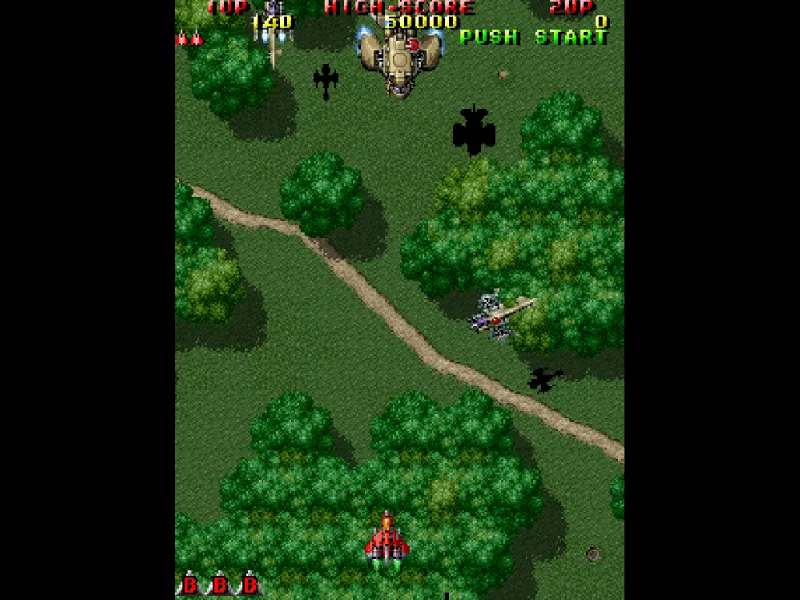
| Strategy | Fire effects + forest background make this the most visually striking stage. The soundtrack is also one of the most intense in the game. |
Stage 6: Sky Fortress
| Item | Details |
|---|---|
| Setting | Enemy flying fortress above the clouds, floating platforms, and railguns |
| Boss | Giant Aerial Mothership—Continuously launches small fighters from the flight deck |
| Strategy | Bullet density enters "insane" mode. The death penalty is lethal here—a Raiden Mark II with base-level weapons can barely survive the patterns after this stage. |
Stage 7: Orbital Elevator
| Item | Details |
|---|---|
| Setting | Massive orbital elevator facility connecting Earth to space |
| Boss | Orbital Defense Array—Multi-layered laser fences + homing missile matrix |
| Strategy | One of the hardest mid-sections in the series. The sense of depth and the visual spectacle of the space elevator are the peak moments of Raiden II. |
Stage 8: Mothership Core
| Item | Details |
|---|---|
| Setting | Energy core inside the enemy mothership |
| Boss | Mothership Core—Multi-stage transformation boss; each destruction leads to a faster form |
| Strategy | The bullet patterns in the second and third stages cover nearly the entire screen. Save your bombs—the invincibility frames are more valuable than damage at this point. Witness the final victory of humanity after clearing. |
V. Tips and Advanced Strategy
5.1 Basic Survival Tips
- Weapon Choice Matters: Mobs → Purple Plasma (crowd control); Bosses → Blue Laser (stable single-target); Beginners → Red Vulcan (wide coverage, high fault tolerance).
- Bombs are for Survival, Not Damage: Always keep at least one bomb in reserve. When cornered or surrounded by bullet patterns, a bomb is your only escape.
- Master the Plasma Laser's Wrapping: You don't need to aim constantly—once the beam hits and wraps, focus on dodging. The beam will continue to deal damage automatically.
- Backgrounds are Intel: In the multi-layered parallax backgrounds, shadows of enemy formations appearing in the distance will enter the combat zone in a few seconds. Use these shadows to predict enemy arrival.
- The Hitbox is Tiny—Use It: Only the 4×4 pixel area at the center of your ship counts. Bullets grazing the wings are safe. Avoid large, jerky movements—micro-adjustments are safer than wide sweeps.
- Avoid Dying in Late Stages: The weapon reset penalty is lethal after Stage 6. In high-difficulty stages, one death often leads to a "Game Over" chain reaction.
5.2 Co-op Tips
- Weapon Division: One player uses Red Vulcan for crowd control (wide coverage), the other uses Blue Laser for boss damage. The purple laser can be visually distracting in co-op, making red/blue a more efficient combo.
- Staggered Bombing: Don't use bombs at the same time. Wait for one player's invincibility to end before using the next—this allows for nearly 4 seconds of continuous invincibility.
- Positioning: One player stays in the bottom half of the screen (safer), while the other stays in the top half (closer to enemy spawn points for aggressive damage).
5.3 Advanced Trivia
- Raiden DX: The 1994 enhanced version, adding a practice mode (start from any stage), adjusted difficulty curves, and hidden items. It is widely considered the "definitive version of Raiden II."
- The Vanishing Plasma Laser: The purple Plasma Laser was a hit in Raiden II but was not carried over to Raiden III or IV. This makes Raiden II the only entry in the series to feature it—a "one-off innovation" that adds to its unique charm.
- Series Sales: The Raiden series has sold over 1 million copies (including home ports), a rare example of long-term commercial success in the vertical shooter genre.
VI. Trivia and Arcade Legends
6.1 The "Toothpaste Laser" Visual Revolution
The "writhing" visual effect of the Plasma Laser was a revolutionary innovation on 1993 arcade CRT monitors. The distorted beam, created by layering translucent pixels, is still cited by players as one of the "most beautiful weapon effects in arcade history." In Japanese shooter communities, the Plasma Laser is always on the list when discussing the "coolest vertical shooter weapons."
6.2 Stage 5 BGM—One of the Most Intense Tracks in Arcade History
The Raiden II soundtrack, composed by Seibu Kaihatsu's in-house team, blends the intensity of military marches with the cold precision of electronic music. The BGM for Stage 5 (Burning Forest) is frequently voted by players as "the most hype track in a vertical shooter"—the burning visuals, intense melody, and dense bullet patterns create a perfect immersive experience.
6.3 The "Abandoned" Plasma Laser
Despite its popularity, the purple Plasma Laser was absent from Raiden III (2005) and Raiden IV (2007). Seibu Kaihatsu never publicly explained why. The most common theory is that the visual effect was difficult to adapt from CRT to digital LCD displays. Regardless, it cements Raiden II as the "only Raiden with the Plasma Laser."
6.4 The Veteran's Obsession—Raiden DX
In the Japanese vertical shooter scene, Raiden DX (1994) is generally considered superior to Raiden II—it fixed bullet balance issues, added a practice mode, and included hidden items. However, because the overseas release of the DX version was much smaller than the original, Western players have historically been less aware of it. For true Raiden fans, asking "Have you played Raiden DX?" is a classic way to distinguish a veteran from a novice.