1. Game Background
1.1 World Setting
The story of Salamander takes place in a universe threatened by organic lifeforms. Players pilot the legendary Vic Viper from the Gradius series (known as the "USS Light Speed" in the English arcade version), alongside the red wingman Lord British controlled by Player 2, as they venture deep into the planet Latis, which has been corrupted by a malevolent entity known as "Zelos." Your mission is to traverse this living planet—flying into the gaping maw of a colossal creature, through its flesh, organs, and pulsating blood vessels—and ultimately destroy the Zelos Force at the planet's core to save this parasitized and corrupted world.
Salamander's most memorable visual identity is its "bio-horror" aesthetic—unlike the cold mechanical fortresses of Gradius, the battlefields in Salamander are living, breathing organisms. Fangs, eyes, tentacles, and pulsating flesh form the core visual elements of the stages. The American version, Life Force, pushed this concept to an even more extreme dimension—the stages become the interior of a giant biomechanical warrior called "Sentinel XR1," and your goal is to destroy the tumor in its brain. This "shrunken inside the human body" premise is almost a direct lineage from the film Fantastic Voyage in gaming history.
1.2 Development History
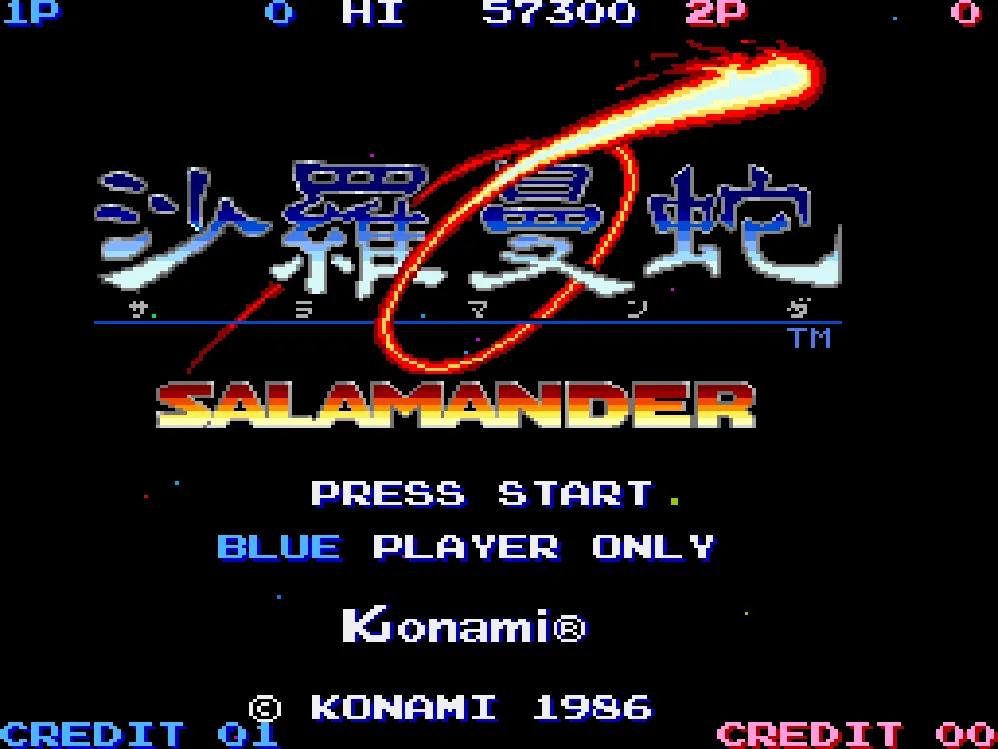
Salamander was released by Konami in 1986, a sister title released one year after Gradius (1985), and a transitional work between the original and Gradius II (1988). The protagonist remains Vic Viper, but Salamander introduced the "Ripple Laser," which would go on to become a signature weapon of the Gradius series.
Unlike the traditional "weapon selection bar" upgrade system of the Gradius series, Salamander adopted a simpler design—weapon upgrade items are dropped randomly by enemies. Players can collect multiple shields and distribute them along the sides of their ship. Upon death, you respawn instantly in place (with no checkpoint restart penalty), a fluidity that was extremely rare in shooters in 1986.
The music for Salamander was composed by Miki Higashino—who also composed for Gradius. Higashino would later become renowned for the grand soundtracks of the Suikoden series, and while the FM synth sound of Salamander is "thin" (as critics noted), the compositional quality already showcased her talent.
The American arcade version was released as Life Force, repackaging the game with the "battle inside a biological body" premise. The Japanese re-release of Life Force further emphasized the biological theme—turning Stage 2 into a "kidney" (asteroids renamed "kidney stones"), Stage 3 into a "stomach" (flames recolored as blue stomach acid), Stage 4 into a "liver," and adding more voice samples ("Fire! Fire!").
The NES/Famicom port merged the best of both arcade versions—using Salamander's graphics with Life Force's upgrade system—and added original stages. The Famicom version's ending reveals a stunning twist: the pilot is a woman—a reveal clearly inspired by Samus Aran from Metroid.
2. Character Introduction
Vic Viper (1P) — Blue Fighter
| Attribute | Rating |
|---|---|
| Firepower | ★★★★☆ |
| Speed | ★★★★☆ |
| Defense | ★★★☆☆ |
| Difficulty | ★★★☆☆ |
- Weapons: Standard cannon → upgrades to Ripple Laser, multi-directional missiles, etc.
- Overall Assessment: The legendary fighter of the Gradius series. Vic Viper handles more nimbly in Salamander than in Gradius—without the weapon selection bar, you can stack power-ups faster to build up your arsenal. The Ripple Laser's circular waves cover a wide area, making it the top choice for clearing swaths of enemies.
Lord British (2P) — Red Wingman
| Attribute | Rating |
|---|---|
| Firepower | ★★★★☆ |
| Speed | ★★★★☆ |
| Defense | ★★★☆☆ |
| Difficulty | ★★★☆☆ |
- Overall Assessment: A perfectly symmetrical red wingman to Vic Viper. Salamander's two-player mode is one of the smoothest co-op experiences in 1986 shooters—no checkpoint penalties, mutual cover fire, and instant respawn after death. Lord British's presence makes two-player the core appeal of this game.
3. Controls and Gameplay
3.1 Basic Controls
| Button | Action | Description |
|---|---|---|
| 8-way Joystick | Move | Works in both horizontal and vertical stages |
| A Button | Shoot | Continuously fire with current weapon |
| B Button | Missile | Launch missiles (upgradeable) |
3.2 Unique Alternating Horizontal/Vertical Scrolling
Salamander is one of the very few shooters in the Gradius series that features both horizontal and vertical scrolling. The six stages alternate between horizontal (odd-numbered) and vertical (even-numbered)—forcing players to rapidly switch between two completely different spatial awareness modes. In horizontal stages, you're used to dodging left and right; in vertical stages, you must adapt to dodging up and down—this "alternating scroll" design makes Salamander richer in gameplay dimensions than any contemporary shooter.
3.3 Item Drop System
Unlike Gradius's weapon selection bar, Salamander's power-ups are dropped randomly by enemies:
| Item | Effect |
|---|---|
| Speed Up | Increases fighter movement speed |
| Ripple Laser | Signature circular wave weapon |
| Multi-Directional Missiles | More missiles with enhanced tracking |
| Shield | Collect multiple to distribute along ship's sides |
3.4 Death and Continue
You respawn instantly in place after death—no checkpoint rollback. In the arcade version, single-player cannot continue (coins only increase the life cap), but in two-player mode, you can continue infinitely until the final stage. This is a very unique design—it elevates Salamander's co-op from "playing together" to "keeping each other alive"—as long as one player is on screen, the other always has a chance to come back.
4. Stage Walkthrough and Boss Strategies
Six stages, alternating between horizontal and vertical.
4.1 Stage 1: Inside a Living Colossus
| Item | Details |
|---|---|
| Setting | Horizontal stage. You fly into the gaping maw of a colossal creature—through chomping teeth, sticky mucous membranes, and pulsating flesh tunnels. This is Salamander's most impactful opening. |
| Boss | Golem—a floating giant brain with a central eye and swaying tentacles extending outward. |
| Strategy | Golem's tentacles periodically sweep to restrict your movement space. The core weak point is the central eye—but it repeatedly closes under tentacle cover. Strategy: Use the Ripple Laser's circular coverage to suppress multiple tentacles simultaneously, then focus fire on the eye during gaps in the tentacle swings. |
4.2 Stage 2: Asteroid Belt
| Item | Details |
|---|---|
| Setting | Vertical stage. Dense streams of asteroids and meteor fragments. This is where the series' classic enemy first appears—Tetran, a mechanical foe similar to Gradius's Big Core but with four rotating multi-jointed arms. |
| Boss | Tetran—four rotating arms periodically extend and sweep fire. |
| Strategy | Tetran's rotating arms are both its strongest weapon and its most obvious weakness—when arms extend, the exposed arm bases become weak points. Stay directly above or below Tetran (vertical stage's up/down direction)—this is the blind spot of its arm rotation coverage. |
4.3 Stage 3: Flame Tunnel
| Item | Details |
|---|---|
| Setting | Horizontal stage. A burning tunnel with massive arcing flames erupting from the walls. Flame patterns are fixed but numerous. |
| Boss | Flame Dragon—a dragon made of fire that spews fireballs and moves in serpentine patterns. |
| Strategy | The Flame Dragon's body is invincible most of the time (fire has no physical hitbox); only the head (mouth) can be damaged. Its serpentine movement causes the head to dip periodically—that's your attack window. This is the most patience-testing and prediction-heavy boss in the game. |
4.4 Stage 4: Cruiser Battlefield
| Item | Details |
|---|---|
| Setting | Vertical stage. The setting closely resembles Gradius's first stage—a mechanized space fortress. This is Konami's homage to its own predecessor. |
| Boss | Mechanical Core—a central core protected by multiple armor layers. |
| Strategy | You must destroy outer armor layers one by one to damage the core. Armor layers fly toward your position after being destroyed—immediately move to the opposite side of the screen after destroying each layer. |
4.5 Stage 5: Asteroid Belt Redux
| Item | Details |
|---|---|
| Setting | Horizontal stage. A second pass through the asteroid belt—but this time, the asteroids are bigger, more numerous, and denser. |
| Boss | Enhanced Tetran—with additional attack patterns beyond the Stage 2 version. |
| Strategy | Strategy is similar to Stage 2, but the enhanced version's arms rotate faster. Key difference: it adds homing missiles when its health drops below half—maintain constant up-and-down movement to shake off the tracking. |
4.6 Stage 6: Enemy Base → Final Battle
| Item | Details |
|---|---|
| Setting | Vertical stage. The enemy's final base—first a group of Gradius-series ship bosses, then pulsating Moai statues—the most famous enemies of the Gradius series. |
| Boss | Zelos Force—a giant red orb of light. It has no attack capability (completely defenseless)—but it slowly drifts off-screen. If you can't destroy it before it exits the screen—you're forcibly sent back to replay previous stages. After destroying Zelos Force, the scroll speed dramatically increases—you must escape the exploding base at high speed through narrow corridors. |
| Strategy | Zelos Force is the most unique final boss in the game—it doesn't attack you; it just "runs away." You need maximum firepower to deplete its health before it escapes the screen. This tests not your dodging skills—but your firepower output efficiency. Save all power-ups for this fight—Ripple Laser + maxed missiles is the standard loadout to defeat Zelos. |
5. Tips and Advanced Strategies
5.1 Basic Survival Tips
- Ripple Laser is the all-around best choice: Its circular coverage clears mobs efficiently and damages multiple boss parts simultaneously. Once you get the Ripple Laser, try not to swap it out.
- Shields stack: Collecting multiple shields distributes them along your ship's sides—side shields can block bullets coming from the flanks. Actively using side shields to "catch" side barrages is an advanced technique.
- Advantage of "instant respawn" after death: Death doesn't send you back to a checkpoint—you respawn instantly in place. This means in extremely dense bullet sections, deliberately dying (if you have lives left) to use the brief respawn invincibility frames to pass through barrages is a viable (though costly) tactic.
- "Survival first" in two-player mode: As long as either 1P or 2P is alive, the other can continue infinitely. So the top priority in co-op isn't "clearing the screen" but "keeping at least one player alive"—the sacrificed player can return in seconds.
5.2 Advanced Knowledge
- Lost Options can be recovered: Options (sub-ships) left behind from your previous life remain floating on screen after you respawn—fly over to re-collect them. This is Salamander's unique "death compensation" mechanic.
- NES 30-lives cheat: The NES version includes the Konami Code (Up Up Down Down Left Right Left Right B A)—unlocking 30 lives.
- MSX hidden ending: The MSX version made significant changes—including selectable stage order, a hidden "prophecy" system, and a true ending requiring the Gradius 2 cartridge in the second slot.
6. Trivia and Arcade Legends
6.1 The Ateji Wordplay of "Salamander"
The Japanese kanji logo for "Salamander" is "沙羅曼蛇"—an Ateji-style creation, literally meaning something like "gorgeous soft sand snake." Konami used the same wordplay technique on the Japanese Contra title. This practice of phonetically transliterating English titles with kanji was an interesting trademark design tradition in Konami's 1980s works.
6.2 Life Force — A "Reskin" That Saved the Day
The American Life Force repackaged Salamander's space battlefield as "battling inside a biomechanical warrior." Behind this change was Konami of America's commercial judgment—they believed the "inside a biological body" premise had more market appeal than "space shooter" (influenced by Fantastic Voyage and Alien). The results proved them right—Life Force was more successful than Salamander in North America, to the point that many North American players today remember this game as "that game where you fight tumors inside a body" rather than a "space shooter."
6.3 The Hidden Female Pilot Twist
The NES/Famicom version's ending reveals—the pilot of Vic Viper is a woman. This twist was extremely rare in 1986 shooters—and coincidentally, Miki Higashino was also a female composer. This gender-reveal ending clearly drew from Samus Aran in Metroid—both use the same narrative device of revealing the protagonist's gender only at the very last moment.
6.4 Alternating Horizontal/Vertical — An Underrated Design Revolution
Salamander's design of alternating horizontal and vertical scrolling within a single game—was groundbreaking in 1986. It forces players to constantly switch thinking between two completely different spatial coordinate systems—this "cognitive switching" experience has been proven in modern game design as an effective way to extend player attention span, but in 1986, Konami was the first to do it.
6.5 Pioneer of Bio-Horror Aesthetics
Before Salamander and Life Force, shooter battlefields were almost exclusively space and mechanical fortresses. Konami brought H.R. Giger-style organic bio-horror aesthetics (pulsating flesh, fangs, tentacles, eyes) into shooters—a full year before Alien's penetration into mainstream gaming culture. The opening of Stage 1, flying into the maw of a colossal beast, remains one of the most impactful stage openings in shooter history.