1. Game Background
1.1 World Setting
The story of Double Dragon 3: The Rosetta Stone takes brothers Billy and Jimmy Lee out of their familiar American streets—into a globe-trotting adventure spanning five continents. A fortune teller named Hiruko tells the Lee brothers that to challenge "the strongest enemy in the world," they must find three Rosetta Stones scattered across the globe.
The adventure begins on American soil—clearing out the remnants of the Black Warriors gang; then moves through China—the territory of the Chin Brothers (Tai Chi masters); then to Japan—a land guarded by ninjas; then to Italy—an ancient city defended by archers; and finally deep into Egypt—where they face supernatural mummies and resurrected pharaohs in Cleopatra's tomb.
Compared to the "street gang brawl" theme of the first two Double Dragon games, the "global treasure hunt" narrative of the third installment is a bold thematic upgrade. It transforms the series from a "mass brawl" game into a "martial arts epic across the world"—though whether the game's quality truly matches its ambitious narrative remains a topic of debate among players to this day.
1.2 Development History
Double Dragon 3 was released in 1990 by Technōs Japan—but there's a key behind-the-scenes fact: this game was not developed in-house by Technōs; it was outsourced to another company, East Technology (whose previous work was the 1989 arcade shooter Gigandes). Technōs was busy developing WWF Superstars and The Combatribes at the time and couldn't handle a Double Dragon sequel—so they outsourced the project. The result was a Double Dragon that "looked and played completely differently from its predecessors."
The American version was completed and released first on May 31, 1990 (before the Japanese version)—a reversal that hinted at a shift in market focus. The Japanese version was released in November 1990 but was significantly altered due to controversial feedback about the North American "shop system."
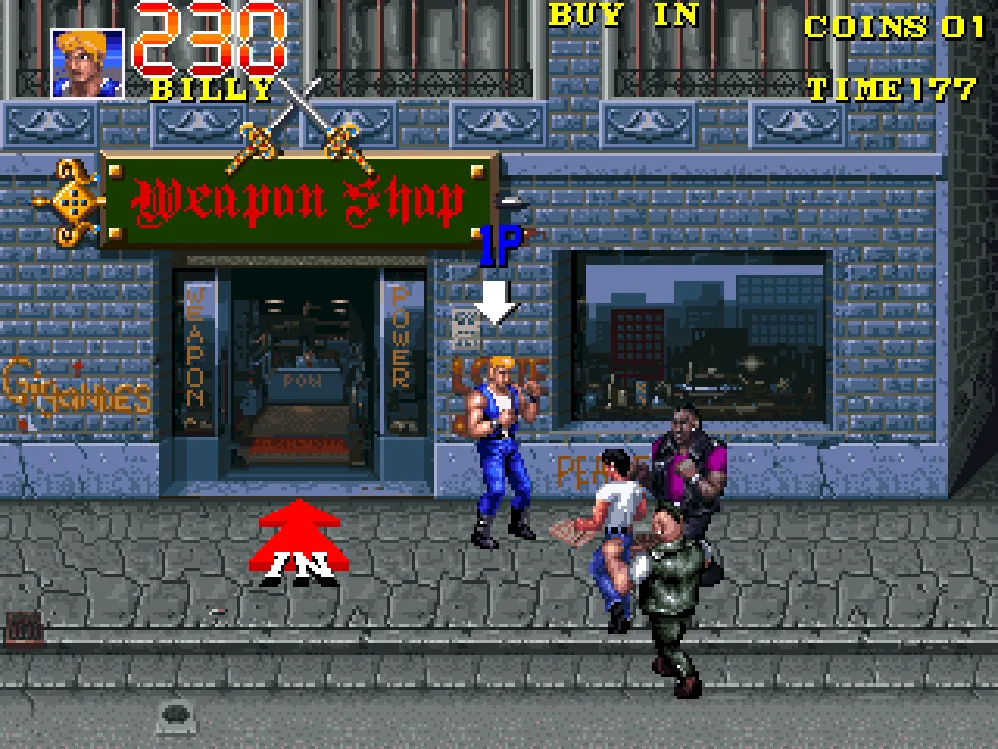
Double Dragon 3's most historically significant (and infamous) design is its shop system—where players could insert coins to purchase items, skills, weapons, and even new characters at the start of certain levels. Later critics have identified this as "one of the earliest forms of microtransactions in video game history." This design sparked controversy in the North American version, and the Japanese version ultimately removed it in response to negative player feedback.
The music was composed by Akira Inoue and Takaro Nozaki, replacing the original series composer Kazunaka Yamane (who was busy with The Combatribes at the time; he later returned for Super Double Dragon). On June 21, 1991, Pony Canyon released a joint soundtrack CD for Double Dragon 3 and The Combatribes.
2. Character Introduction
Double Dragon 3's character system is the most unique in the series—besides the default Lee brothers, you can "purchase" three new playable character sets in the shop.
The Lee Brothers (Default)
Billy Lee — 1P
| Attribute | Rating |
|---|---|
| Attack Power | ★★★☆☆ |
| Speed | ★★★★☆ |
| Attack Range | ★★★☆☆ |
| Difficulty | ★★☆☆☆ |
- Overall: A balanced mid-range brawler. Billy uses jumping kicks and spinning kicks to control distance—he doesn't aim for close-quarters combat but wears down opponents with kicks from mid-range. As the default character, he's the best choice for beginners.
Jimmy Lee — 2P
- Overall: A perfectly symmetrical 2P version of Billy.
Sonny — 3P
- Overall: A 3P character—a palette swap of the Lee brothers in yellow. Three-player mode is a major feature of the Double Dragon 3 arcade version (similar to The Combatribes).
Shop-Purchasable Characters
Urquidez Brothers — Mixed Martial Arts Champions
| Attribute | Rating |
|---|---|
| Attack Power | ★★★★☆ |
| Speed | ★★★★☆ |
| Attack Range | ★★★☆☆ |
| Difficulty | ★★★☆☆ |
- Overall: Available for purchase in the shops of Stages 1 and 5. Mixed martial arts champions—all-rounders with both offense and defense. Their punch-kick combos are fluid, fast, and deal high damage—a comprehensive upgrade over the Lee brothers.
Chin Brothers — Tai Chi Masters
| Attribute | Rating |
|---|---|
| Attack Power | ★★★★★ |
| Speed | ★★☆☆☆ |
| Attack Range | ★★☆☆☆ |
| Difficulty | ★★★★☆ |
- Overall: Available for purchase in the Stage 2 shop. Tai Chi masters—immense power but short attack range. Their iron palm strikes cause massive hitstun—perfect for taking down tanky enemies. However, their slow speed and short range demand precise distance control.
Ōyama Brothers — Karate Masters
| Attribute | Rating |
|---|---|
| Attack Power | ★★★★☆ |
| Speed | ★★★★☆ |
| Attack Range | ★★★☆☆ |
| Difficulty | ★★★☆☆ |
- Overall: Available for purchase in the Stage 3 shop. Karate masters—the most well-rounded purchasable characters. Their moves combine speed and power, making them the "optimal solution" for clearing the game.
Ninjas and Archers (Enemies/Characters)
In the Japanese version, players can directly select the Lee, Urquidez, Chin, or Ōyama brothers from the start screen (similar to character selection in Golden Axe or Final Fight)—the shop system is completely removed. Additionally, strategy guides mention a ninja character "Yagyū Ranzō"—fastest movement + shuriken ranged attacks—ideal for a "hit-and-run" playstyle against agile enemies.
3. Controls and Operation
3.1 Basic Controls
| Button | Action | Description |
|---|---|---|
| A Button | Punch | Quick close-range attack |
| B Button | Jump | Jump attack, wall jump |
| C Button | Kick | Mid-range poke, spinning kick |
3.2 New Action System
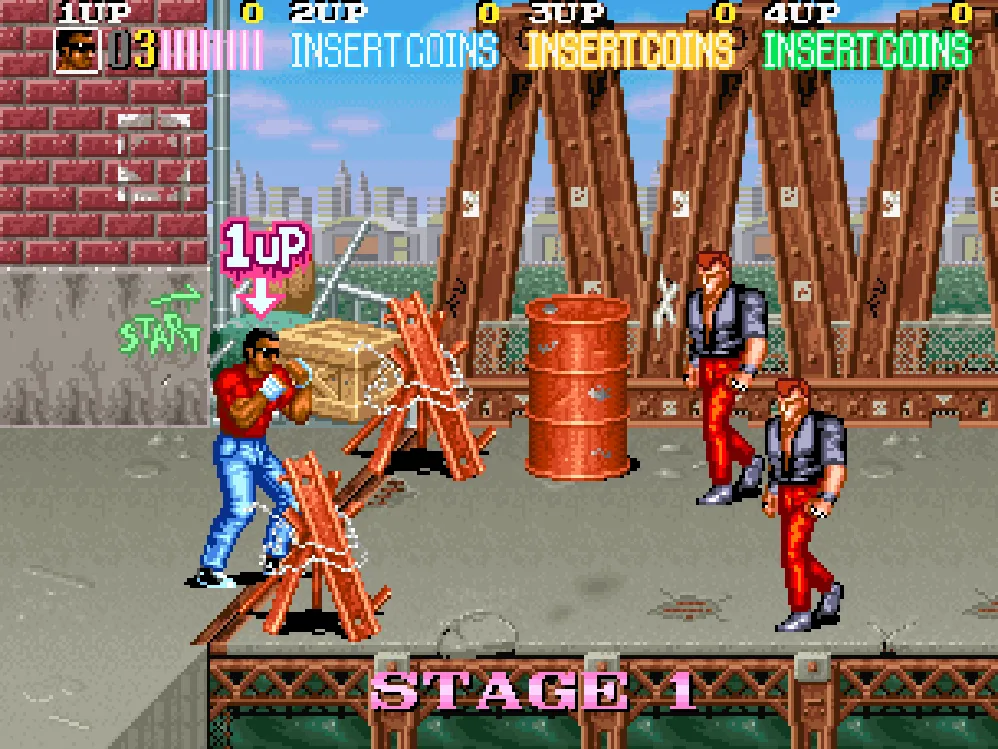
Double Dragon 3 overhauls the action system compared to its predecessor—abandoning the directional attack buttons of Double Dragon II and returning to the original punch/kick format, while adding a host of new moves:
- Run: Quickly tap the directional button twice—can chain into a running headbutt
- Back-to-Back Spinning Kick: A combined move triggered when two players stand back-to-back
- Wall Jump Kick: A kick after bouncing off a wall
- Running Headbutt: Charge into enemies while running
- Back Throw (Shoulder Throw): Throw an enemy over your back to the ground
- Jumping Knee Strike: A knee strike delivered mid-air
3.3 Shop System (North American Version)
This is Double Dragon 3's most controversial design—at the start of certain levels, players enter a shop where they can insert coins to purchase items:
| Item | Effect |
|---|---|
| Energy | Restores health to 150% |
| Power Up | Increases attack speed |
| Tricks | Unlocks two new moves: spinning kick and jumping throw |
| Weapons | Stage 2: nunchaku; Stages 3 & 5: sword |
| Extra Guys | Purchase Urquidez, Chin, and Ōyama brothers |
Each item costs one coin. This "pay real money for in-game advantages" design was unprecedented in 1990—and later critics have identified it as one of the pioneers of video game microtransactions.
4. Stage Walkthrough and Boss Strategies
Five countries, five adventures.
4.1 Stage 1: USA
| Item | Details |
|---|---|
| Setting | American streets—where the remnants of the Black Warriors gang hold sway. A continuation of the classic settings from the first two Double Dragon games. |
| Boss | The vanguard of the Black Warriors—a street fighter. |
| Strategy | Tutorial stage. Get familiar with the rhythm of jump kicks and spinning kicks. The timing for spinning kicks is more precise than in previous games—don't press too early or too late. |
4.2 Stage 2: China
| Item | Details |
|---|---|
| Setting | The territory of the Chin Brothers (Tai Chi masters)—Chinese architecture, courtyards, and martial arts schools. |
| Boss | Tai Chi master—uses slow but devastating iron palm strikes. |
| Strategy | The Tai Chi master's iron palm has a long wind-up but deals massive damage—retreat immediately when you see him raise his hand. Don't engage him in close combat—use jump kicks to wear him down from mid-range. |
4.3 Stage 3: Japan
| Item | Details |
|---|---|
| Setting | A Japanese castle guarded by ninjas. Ninjas use shuriken for ranged harassment, combined with high-speed hit-and-run attacks. |
| Boss | Ninja leader—the fastest boss, with shuriken barrages and high-speed thrusts. |
| Strategy | Ninjas move extremely fast—your jump kicks are hard to land. Strategy: use the stage boundaries to limit their movement space—corner them and overwhelm with consecutive punches. |
4.4 Stage 4: Italy
| Item | Details |
|---|---|
| Setting | An ancient Italian city—defended by archers. Archers' ranged attacks cover the entire screen—you need to keep moving to dodge arrows. |
| Boss | Archer leader—ranged arrows + close-range dagger. |
| Strategy | Arrows fly in straight lines across the screen—keep moving to avoid them. Don't approach the boss in a straight line—use zigzag movement. Once you're close, his dagger attacks are weaker than his arrows—so closing in and pressuring is the best choice. |
4.5 Stage 5: Egypt (Final Stage)
| Item | Details |
|---|---|
| Setting | Cleopatra's tomb—an Egyptian temple filled with traps. Supernatural mummies awaken from sarcophagi. |
| Boss | Cleopatra—the final boss. She possesses supernatural attack power and wide-reaching moves. |
| Strategy | The core rule for the final boss fight: never stand on the same horizontal line as her. Her straight-line attacks have an extremely wide hitbox—always stay above or below her attack line. Use jump kicks or the ninja's fast combos to punish her recovery frames. Don't get greedy—retreat immediately after each attack and wait for the next opportunity. |
5. Game Tips and Advanced Strategies
5.1 Basic Survival Tips
- Timing is key for the spinning kick: The spinning kick is central to area control—but its timing is stricter than in previous games. Releasing it at the moment an enemy starts an attack can interrupt theirs and grant invincibility frames. Too early or too late, and you'll be interrupted.
- Jump kicks are the best distance control: Billy's jump kick is extremely effective at mid-range—use it to manage the distance between you and enemies, rather than trading blows up close.
- Combined moves are the most efficient for crowd clearing: When two players stand back-to-back, releasing a combined spinning kick or back throw can clear out many enemies at once. In stages with dense enemy groups, combined moves far outweigh any single-player technique.
- Shop purchase priority (North American version): Extra Guys (new characters) > Tricks (new moves) > Energy (healing). Weapons are the least cost-effective—they're easily knocked out of your hands.
- Don't get greedy: The combat pace in this game is slower and more realistic than its predecessors—combos aren't everything; precise distance judgment is. Always leave room to retreat after each attack.
5.2 Advanced Trivia
- Major differences between Japanese and American versions: The Japanese version removes the shop system (replaced with character selection at the start), reduces enemy damage by 1/3, requires more precise timing for the spinning kick, and changes weapons to ground pickups. If you find the North American version too hard or the shop annoying—the Japanese version offers a better experience.
- Side effects of outsourcing: Because it was developed by East Technology rather than in-house at Technōs, Double Dragon 3's feel and visual style differ noticeably from its predecessors—this is the root cause of its polarized reception among players.
6. Trivia and Arcade Legends
6.1 The Pioneer of Video Game Microtransactions
Double Dragon 3's shop system—inserting coins to buy characters, items, and skills—has been recognized by later game historians as "one of the earliest forms of microtransactions in video game history." In 1990, this design was unprecedented: the traditional business model for arcade games was "insert coin to continue," but Double Dragon 3 pioneered "insert coin to gain an advantage." This design sparked controversy in North American arcades—players could clearly feel that "money was deciding the outcome." The Japanese version completely removed the shop system after player feedback.
6.2 The "Disconnect" of Outsourced Development
Technōs's decision to outsource Double Dragon 3 to East Technology is a famous "outsourcing failure" case in game history. East Technology's style differed significantly from Technōs's in-house Double Dragon series—more realistic art, slower pacing, and a greater emphasis on distance judgment—leading to a strong sense of "this isn't Double Dragon" among veteran players. Technōs returned to in-house development for Super Double Dragon (1992) and brought back original composer Kazunaka Yamane.
6.3 The Same-Named but Completely Different NES Version
The NES version, Double Dragon III: The Sacred Stones (February 1991), is not a port of the arcade version—it's a parallel project developed simultaneously with the arcade version. The stories are similar (searching for the Rosetta Stone), but the graphics, systems, and characters are completely different. The NES version replaces the shop system with a mechanic where you automatically gain partners after clearing stages. This practice of "same name, different game" was not uncommon in the early 1990s arcade/console crossover, but Double Dragon 3 is one of the most typical examples.
6.4 The Cultural Symbol of the "Rosetta Stone"
The "Rosetta Stone" in the game's title refers to the famous artifact discovered in Egypt in 1799—the stone that helped humanity decipher ancient Egyptian hieroglyphs. Using this historical artifact as the narrative core of the "search" is an interesting setup—it gives Double Dragon 3's global adventure a more meaningful goal than just "beat up the bad guys." The game is also listed on Wikipedia's "Rosetta Stone in popular culture" page.
6.5 The "Market Reversal" of the American Version Preceding the Japanese Version
Double Dragon 3 was completed and released first in America (May 1990)—the Japanese version came half a year later (November 1990). This reflects the massive success of the Double Dragon series in North America—Technōs's game was even more popular in the West than in its home country. This "American-first" development order was extremely rare for Japanese game companies in 1990.