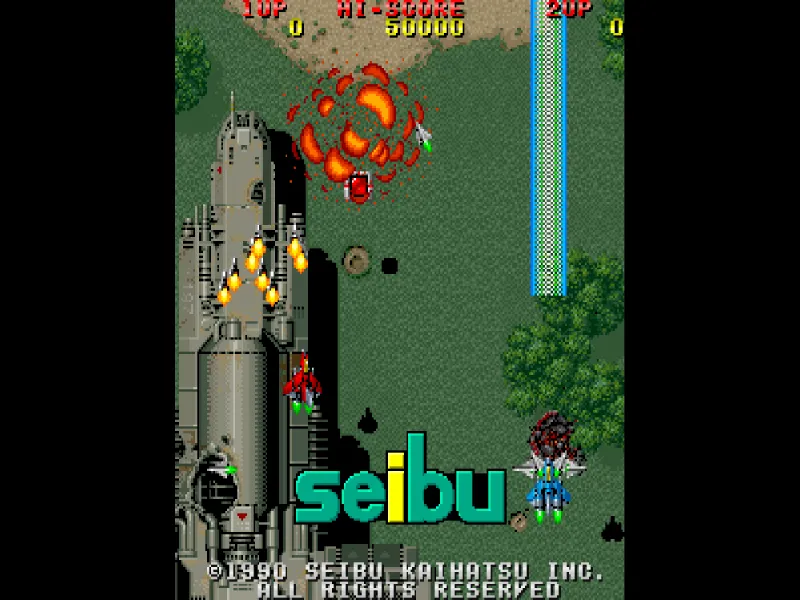
I. Game Background
1.1 World Setting
In the year 2090, Earth was caught off guard by a sudden invasion from the "Cranassian" Empire, an extraterrestrial force from deep space. Within 72 hours, the enemy's orbital weaponry decimated humanity's primary urban defense systems, followed by a wave of tens of thousands of combat mechs and orbital warships sweeping across the surface. The United Nations Defense Force lost over 80% of its aerial power in the initial contact, leaving civilization on the brink of collapse.
In this desperate hour, humanity's last hope rested on a supersonic fighter jet codenamed "Raiden." This aircraft integrated reverse-engineered alien technology—including a variable energy weapon system and adaptive armor—secretly manufactured at the last remaining joint fighter development base. The Raiden fighter was equipped with a revolutionary "Vulcan" spread-energy weapon and a "Laser" piercing beam cannon, capable of launching from an aircraft carrier to penetrate enemy lines solo.
The identity of the Raiden pilot was never officially disclosed—military records left only a single line: "All qualified pilots were killed on the first day of the mission. Replacement pilots were volunteers who had not completed their training." This setting persisted from the original Raiden to its sequels—"Raiden" is not just the codename of the fighter, but also the codename for those nameless pilots who might never return.
1.2 Development History
Raiden was released in 1990 on arcade hardware by the Japanese game company Seibu Kaihatsu. While the company's core team had previously developed several shooters, Raiden was their first true international success. The game's director and lead designer remain a mystery to this day—Seibu Kaihatsu refused media interviews, and the development team never disclosed the specific production process in any public forum.
However, Raiden's influence is indisputable. The game's core design philosophy was simple yet efficient—two main weapons (the red Vulcan's fan-shaped spread and the blue Laser's straight-line penetration), two sub-weapons (homing missiles and nuclear missiles), and a life-saving bomb. This "three-system" weapon framework became the industry standard for vertical shooters for the next three decades, imitated and paid homage to by countless successors.
Raiden's success in the arcade market was rapid and enduring. In Japan, it became the "highest coin-op vertical shooter" in arcades; in North America, it served as a "hardcore player certification test"—"surviving 10 minutes on a Raiden cabinet" became an unspoken benchmark among arcade fighting game players. The series has since spawned over eight main titles and spin-offs, cementing the legendary status of Seibu Kaihatsu and later MOSS in the vertical shooter genre.
II. Weapon System Breakdown
Raiden's weapon system is the heart of the game. You aren't just piloting a plane; you are managing a mobile weapons platform—your weapon loadout dictates your tactical style.
2.1 Main Weapons
| Weapon | Color | Features | Best For |
|---|---|---|---|
| Vulcan | Red | Fan-shaped spread fire with wide coverage; at max level, it covers over one-third of the screen. Lower damage per shot than the laser, but the coverage compensates for lack of precision | Clearing mobs—wide coverage ensures no enemies slip through |
| Laser | Blue | High-damage, straight-line piercing beam. At max level, the beam thickens and damage doubles, penetrating multiple enemies. No spread, but single-target output is 2-3x that of the Vulcan | Boss fights—rapidly destroying core components |
2.2 Sub-Weapons
| Missile Type | Warhead Color | Features |
|---|---|---|
| Nuclear (N) | White | Auto-homing—automatically locks onto the nearest enemy. Extremely practical when dealing with flanking enemies |
| Half-Homing (H) | Green | Wide-angle arc scan; lower hit rate than nuclear missiles but higher damage per hit |
2.3 Bombs
Full-screen clearing weapons. Upon release, all enemy bullets disappear, ground enemies take massive damage, and the player gains about 2 seconds of invincibility. Quantities are limited—use them wisely.
2.4 Death Penalty
Upon death, all weapons are downgraded to the lowest level. This is the most brutal mechanic in the Raiden series—losing max-level firepower instantly is essentially a death sentence in later stages.
III. Controls
| Action | Description |
|---|---|
| 8-Way Joystick | Move the Raiden fighter across the screen |
| Button A | Hold for continuous fire—Main weapon + Sub-weapon fire automatically |
| Button B | Bomb—Clear the screen + brief invincibility |
Raiden's hitbox is approximately 4x4 pixels, located at the very center of the fuselage. This means the wings can safely pass through bullets without being counted as a "hit."
IV. Stage Walkthrough & Boss Strategy
Raiden consists of 8 stages, moving from ruined cities deep into the enemy's mothership core.
Stage 1: Coastal Defense
| Item | Details |
|---|---|
| Setting | Beachhead, enemy landing craft and ground turrets |
| Boss | Twin Landing Ship—side turrets fire fan-shaped patterns, central missile launcher fires homing missiles periodically |
| Strategy | The easiest stage. Vulcan is efficient for clearing mobs. Destroy side turrets first, then focus fire on the core |
Stage 2: Urban Ruins
| Item | Details |
|---|---|
| Setting | Bomb-ravaged city ruins, filled with enemy tanks and half-tracks |
| Boss | Giant Land Battleship—heavily armored front, destructible side turrets |
| Strategy | Ground vehicles are the main threat. Boss fight difficulty increases—central cannon bullet density rises |
Stage 3: Offshore Oil Field
| Item | Details |
|---|---|
| Setting | Enemy-occupied oil rigs, fixed turrets and helicopter squads |
| Boss | Floating Turret Array—core engine + multi-layered surrounding turrets |
| Strategy | Pacing accelerates. Lasers are highly effective against ground turrets. Dismantle the boss layer by layer from the outside in |
Stage 4: Desert Base
| Item | Details |
|---|---|
| Setting | Large desert base, dense ground and air force presence |
| Boss | Giant Desert Battleship—multi-barrel Gatling guns + vertical missile launch system + bomber deck |
| Strategy | Air + Ground + Boss triple-layer bullet patterns. Bomb timing is crucial. Switch to blue laser to maximize single-target output |
Stage 5: Naval Fleet
| Item | Details |
|---|---|
| Setting | Enemy carrier strike group in open waters |
| Boss | Heavy Aircraft Battleship—main bow cannon fires screen-covering energy blasts |
| Strategy | Entire stage takes place over the ocean. Predict the boss's screen-covering attack by watching the charge-up animation and move to the opposite side of the screen early |
Stage 6: Snowy Fortress
| Item | Details |
|---|---|
| Setting | Icy fortress, heavy armored turrets and vertical missile arrays |
| Boss | Fortress Core Turret Group—a bullet wall covering nearly the top half of the screen |
| Strategy | Enemy density peaks here. The firepower reset penalty after death becomes lethal from this point on |
Stage 7: Orbital Weapon Platform
| Item | Details |
|---|---|
| Setting | Enemy near-Earth orbital platform—a mix of mechanical and energy environments |
| Boss | Orbital Defense Core—laser grid + homing missile network |
| Strategy | One of the hardest stages in the series. Nuclear (N) missiles are most useful here—focus entirely on movement |
Stage 8: Mothership Core
| Item | Details |
|---|---|
| Setting | Energy conduits inside the enemy mothership |
| Boss | Mothership Hub—core wrapped in multi-layered rotating armor. After the first layer is destroyed, a faster second-phase bullet pattern is revealed |
| Strategy | Two-phase boss fight. Save at least 3 bombs for the second phase—their survival value far outweighs their damage output here |
V. Tips & Advanced Strategy
5.1 Basic Survival
- Know your hitbox: It's a 4x4 pixel area at the center of the ship. Wings can safely pass through bullets—moving from "dodging bullets" to "threading the needle" is the key to leveling up your skills.
- Weapon loadout is your first decision: Red Vulcan + N Nuclear Missile = Safest for stages (wide coverage, auto-homing). Blue Laser + H Half-Homing = Best for boss fights (max single-target damage).
- Bombs are for survival, not killing: The 2 seconds of invincibility are more valuable than the damage. When cornered, a bomb is your only escape.
- Death penalty is the soul of Raiden: Losing max firepower is lethal in later stages. You must aim for zero deaths—you don't need a 1-credit clear, but you must learn to "survive 5 seconds longer in the bullet hell."
- Predict bullet trajectories: All boss attacks have clear charge-up/turning animations. Watch the animation, not the bullets themselves.
- Use the "safe zones" at the screen edges: The left and right edges are often the safest spots—enemies are less likely to appear from the sides than from the top.
5.2 Advanced Tactics
- Firepower movement: Continuous firing while micro-adjusting position—these two actions must be completely independent.
- Laser piercing advantage: Blue lasers pierce multiple enemies. Against a line of enemies, one laser is worth ten Vulcan shots.
- Nuclear missile homing algorithm: N missiles lock onto the nearest enemy. Use this to "guide" missiles to specific targets by getting close before firing.
- Bomb chain timing: If you only have one bomb left and face an unavoidable pattern—throw the bomb, then use the 2 seconds of invincibility to fly to the safest spot on the screen.
VI. Trivia & Arcade Legends
6.1 The "100 Yen per Coin" Arcade Economy
In 1990s Japanese arcades, Raiden was one of the "highest coin-op vertical shooters." The pricing strategy was simple: 100 yen per life. In Raiden, one life usually lasted 3-5 minutes—a perfect revenue model for arcades. One arcade owner recalled: "A Raiden cabinet could eat over 200 100-yen coins a day—more profitable than fighting game cabinets."
6.2 The "Test Cabinet" Legend
In 1990s US and Japanese arcade communities, Raiden cabinets were used as a "hardcore player certification test." If a new player claimed to be a pro, veterans would take them to the Raiden cabinet: "Survive 10 minutes here, then we'll talk." Anyone who could clear the first three stages on one credit was considered a "worthy opponent." This tradition persisted in the fighting game scene for over a decade.
6.3 Seibu Kaihatsu's Mysterious Silence
Seibu Kaihatsu was one of the most low-profile companies in the Japanese game industry. They rarely accepted media interviews, attended game shows, or released developer diaries. The Raiden development team never discussed the game's production process in detail in public. This silence fueled various community legends—some claimed the designer was a former Irem programmer, others said a former Toaplan member. These legends remain unconfirmed to this day.
6.4 Raiden's "Sound Effect Uncanny Valley"
The explosion sound effects in Raiden were deliberately amplified and distorted. The design intent was to provide "tactile feedback" for every kill. In arcades equipped with high-end sound systems, Raiden's sound effects could drown out the background noise of all surrounding cabinets—players felt as if the world had shrunk to nothing but the sound of explosions and their own rapidly moving fingers.
6.5 Blue or Red—The Eternal Debate
The most heated, unresolved debate in the Raiden community: Red Vulcan vs. Blue Laser—which is stronger? Pro-red players argue that coverage is "synonymous with safety"; pro-blue players argue that "maximum output is the best defense." Thirty years later, there is still no consensus—which is exactly the brilliance of Raiden's weapon balance.