I. Game Background
1.1 World Setting
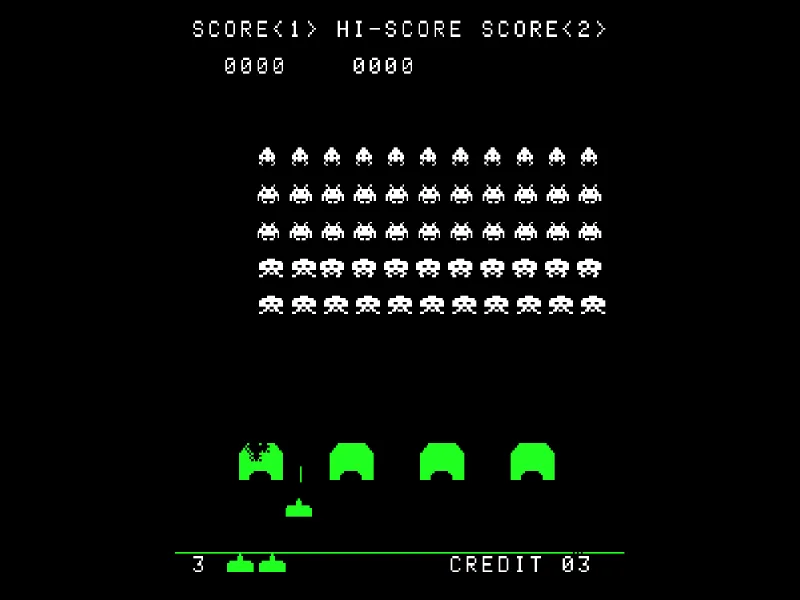
The story is as simple as it gets: Earth is being invaded. Not by organic life forms, but by rows upon rows of pixelated aliens. They march in a precise 5x11 formation, moving mechanically from the left side of the screen to the right, dropping down one step each time they reach the edge. Their weapons are vertically falling energy bolts. Your weapon is a laser cannon that can only move left and right and fire upwards. Four fragile bunkers stand between you and the aliens—but each hit makes them crumble a little more.
There are no plot twists. No character growth. No boss fights. No final ending—once you destroy the last alien, a new formation automatically appears, faster and more frantic. The game continues until you run out of lives. This is the 1978 Space Invaders—the purest "Humanity vs. Unstoppable Destructive Force" narrative in video game history.
1.2 Development History
In 1978, programmer Tomohiro Nishikado of the Japanese game company Taito single-handedly completed the entire development of Space Invaders—from hardware design to software programming, graphics, and sound effects, all within one year. The staggering part of this achievement is that in 1978, there were no mature game development tools, no prior experience to reference, and the profession of "video game designer" didn't even exist.
Nishikado originally wanted to make a "shooting moving targets" game, inspired by a combination of Spacewar! and Breakout. In the initial design, the enemies were silhouettes of human soldiers, but Nishikado felt that "shooting humans didn't feel right," so he changed them to alien creatures. The design of the aliens was reportedly inspired by the octopus-like Martians described in H.G. Wells' The War of the Worlds. However, due to the extremely low pixel resolution of the time, the final aliens looked more like simplified pixel blocks.
The impact of Space Invaders on the Japanese arcade market was unprecedented—it propelled video games from "novelties in the corner of a bar" to an "independent entertainment industry." It was also the first arcade game to use the Intel 8080 microprocessor (rather than traditional TTL logic circuits), a technical decision that laid the foundation for all subsequent "software-driven" arcade games.
After completing the development, Tomohiro Nishikado received a bonus of approximately $3,000. Over the following years, the game generated over $500 million in revenue for Taito—an astronomical figure in 1978.
II. Game Mechanics
2.1 Basic Rules
| Element | Description |
|---|---|
| Alien Formation | 55 aliens (5 rows × 11 columns), in three types: top row 30 points, middle three rows 20 points, bottom row 10 points |
| Laser Cannon | The player-controlled green cannon, can only move left/right and fire upwards. Only one shot can be fired at a time |
| Bunkers | Four green bunkers that can withstand shots—but will be gradually destroyed by fire |
| UFO | A mysterious ship that flies across the top of the screen periodically—destroy it for a random high score of 50/100/150/300 points |
| Lives | Start with 3 lives; earn extra lives by reaching certain scores |
2.2 The Alien Acceleration Effect—The Fewer, The Faster
This is the most brilliant design in Space Invaders. As the player eliminates aliens, the remaining ones automatically move faster. The more you kill, the faster they get. When only the last alien remains, it moves at nearly 10 times the initial speed—dashing frantically back and forth across the top of the screen.
This design creates a perfect "pressure curve": easy start → tense mid-game → frantic finale. No traditional "level switching" is needed—the tension arises naturally from within. This "reverse difficulty curve" has been borrowed by countless games, but few have integrated it with core gameplay as naturally as Space Invaders.
2.3 Stepping Sound Effects—The First "Pressure Audio Design" in History
The four-beat "thump-thump-thump-thump" sound made by the aliens as they move accelerates as the aliens speed up. This sound effect is the first "environmental tension audio design" in video game history—it doesn't just signal that the aliens are moving; it stimulates your adrenaline with an increasingly rapid rhythm, much like the heartbeat sound in a horror movie.
Many veteran players recall: "Hearing that accelerating footstep sound was more nerve-wracking than seeing the aliens themselves. When the rhythm reached a certain point, my hands would start to shake."
III. Controls
| Action | Description |
|---|---|
| Move Left/Right | Left/Right buttons or joystick |
| Shoot | A single button—only one bullet can be fired at a time. You must wait for the bullet to leave the screen or hit a target before firing again |
| Use Bunkers | Hide behind bunkers to block shots—but they will be gradually destroyed by both your and enemy fire |
Given the technical limitations of 1978, these controls are minimalist. However, the "single-shot" limitation is the core challenge of Space Invaders—if continuous fire were allowed, the game would lose all its pressure. You must precisely predict the aliens' movement trajectory within the rhythm of "shoot → wait for bullet to clear → shoot again."
IV. High Score Strategies and Advanced Tips
4.1 Basic Strategy
- UFOs are the Key to High Scores: The number of UFO appearances per wave is limited. The UFO's point value (50-300) is far higher than destroying a single alien (10-40 points). To rack up a high score, you must memorize the UFO's appearance patterns and ensure you hit it every time.
- Alien Counting: Before each shot, calculate quickly in your head—how long does it take for the bullet to travel? How far will the aliens move in that time? Space Invaders players used their brains as ballistic computers—this is the primitive form of muscle memory.
- Edge Priority: Prioritizing the destruction of the leftmost and rightmost aliens reduces the movement range of the entire formation, thereby delaying their downward descent. This is a core technique.
- Bunker Management: Bunkers are destroyed over time. Treat them as "temporary shelters" rather than "permanent safe zones." When a bunker is less than half-intact, switch to "mobile shooting" mode—take the initiative outside the bunker.
- Exploit Alien Firing Intervals: Alien bullets cannot pass through each other—when the front alien fires, the ones behind it cannot fire from the same position. Use this "bullet overlap" gap to fire safely.
4.2 Advanced High Scoring
- Perfect Wave Theory: The number of UFO appearances per wave is limited and calculable. Top players synchronize their alien-killing rhythm with the UFO's appearance—clearing aliens until only the slowest one remains, then repeatedly killing the last one while waiting for the UFO to appear.
- The Last Alien Window: When only one alien is left dashing at a frantic speed, don't rush. Wait for it to dash from one side to the other, and lock onto your firing window the moment it turns around.
- UFO Point Pattern: The UFO's point value (50-300) is not entirely random—it is based on a modulo operation of the current shot count. Experienced players can "predict" the high-score window for the next UFO.
V. Trivia and Arcade Legends
5.1 The 100-Yen Coin Shortage—Changing the Real Economy
Between late 1978 and 1979, Japan experienced a nationwide shortage of 100-yen coins. The reason: Space Invaders arcade cabinets required 100 yen per play, and the game's popularity meant massive amounts of coins were locked inside machines across the country, unable to circulate. The Japan Mint was forced to triple the production of 100-yen coins. Banks had to provide "emergency coin delivery services" for arcade operators. This was the first currency circulation crisis in human history caused by a video game—and one of the earliest signs of the video game industry's influence.
5.2 One Person Making History
Tomohiro Nishikado designed and programmed all of Space Invaders by himself. At the time, Taito had no dedicated game development department—Nishikado was assigned to a corner of a warehouse, working with recycled microprocessors and hardware prototypes he designed himself. After completion, he received a bonus of about $3,000. The game later brought Taito over $500 million in coin revenue—likely the highest "return-to-R&D-cost" ratio in video game history (approx. 160,000 times).
Nishikado is a very low-profile person who rarely accepts media interviews. In 2018 (the 40th anniversary of Space Invaders), he gave a rare interview to NHK. When talking about the days of developing it alone, he said something moving: "I was lonely back then."
5.3 "Space Invaders Thumb"—The First Recorded Video Game Injury
Between 1978 and 1979, the Japanese medical community recorded a new repetitive strain injury—known as "Space Invaders Thumb" (スペースインベーダー親指). Patients complained of pain and limited movement in their right thumb joints, all of whom were Space Invaders players at arcades. These players' right thumbs would move at a frequency of 3-4 times per second on the single-shot button for hours. This was the first "video game injury" officially recorded in medical literature.
5.4 Atari 2600—The First "System Seller"
Space Invaders was ported to the Atari 2600 home console in 1980—the first "third-party licensed port" in home console history. Sales of the Atari 2600 version of Space Invaders pushed the console's install base from about 4 million to over 10 million—Space Invaders was the first "System Seller." From this moment on, home consoles were no longer "simple toys" but true entertainment platforms for which consumers would buy hardware.
5.5 The Fate of Taito
Space Invaders transformed Taito from a mid-sized entertainment equipment manufacturer into a globally renowned video game giant. In 2005, Taito was acquired by Square Enix. However, the Taito brand and the Space Invaders IP remain active today—Space Invaders has been remade, adapted, and paid homage to countless times, from Space Invaders Extreme (NDS/PSP) to Space Invaders Forever (Switch), and from T-shirts to movie tributes. A simple pixel game created by one person in 1978 still holds a place in global culture nearly 50 years later.