1942 -- Arcade Game Overview
1. Game Background
1.1 Setting
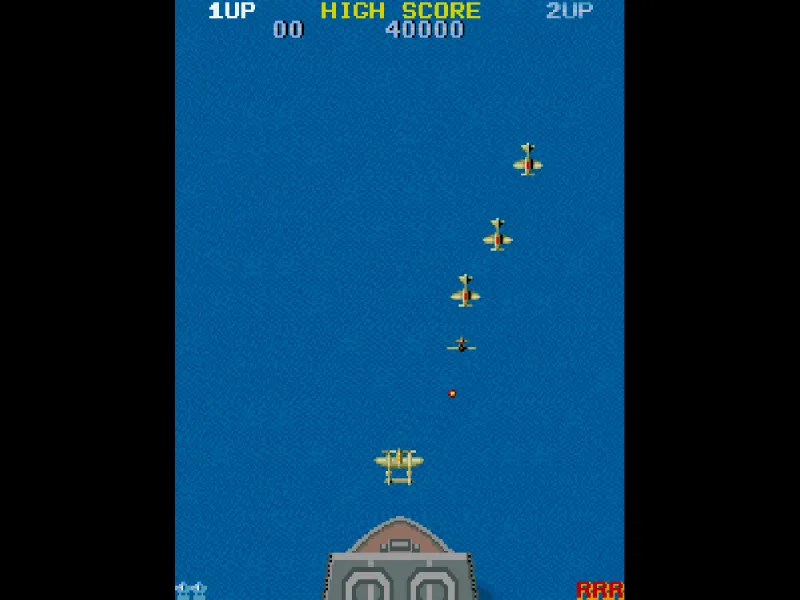
The game is set in the Pacific Theater of World War II. Players take on the role of an Allied pilot flying the legendary Lockheed P-38 Lightning. Starting from an aircraft carrier in the Pacific, you must fly west across the vast ocean, aiming to reach the Japanese mainland, destroy the enemy naval fleet, and deliver a final, decisive blow in Tokyo. The game achieves this grand strategic vision through 32 distinct stages—an incredibly vast level design for an arcade game in 1984.
Enemy formations are designed with historical accuracy in mind. Players face iconic Japanese naval and air force models, including the A6M Zero, the Nakajima B5N, and the Mitsubishi G4M. Ground and sea targets are equally diverse, with aircraft carriers, battleships, destroyers, and anti-aircraft batteries creating a multi-layered web of fire. While the visuals may seem simple by modern standards, the use of color and the variety of scenes—from lush green islands and deep blue oceans to grey carrier decks—bring a sense of visual freshness to every new stage.
1.2 Development History
1942 was released by Capcom in 1984 and stands as one of the company's early iconic titles. The game's planning and core design were led by Yoshiki Okamoto, the legendary producer who would later create Street Fighter II. In 1942, he first demonstrated his precise control over game pacing and player psychology. At the time, Capcom was a young company only five years old; the commercial success of 1942 provided the capital and industry reputation that laid the foundation for the later Street Fighter series.
Running on Capcom's proprietary Z80-based hardware, 1942 presents intense aerial combat via vertical scrolling. One of the game's biggest technical innovations was the introduction of the "loop-the-loop" evasion system—players could press two buttons simultaneously to perform a barrel roll, making the plane completely invincible for a short duration. This was a groundbreaking design for shooters at the time, giving players an active defense mechanism against dense bullet patterns. The game became an instant global hit, was ported to almost every major platform including the NES, Commodore 64, ZX Spectrum, and Game Boy Color, and spawned numerous successful sequels like 1943: The Battle of Midway, forming a classic series that has spanned decades.
2. Character Introduction
The player's aircraft is the Lockheed P-38 Lightning. This twin-engine fighter was a mainstay for the U.S. military in the Pacific theater, known for its unique twin-boom design and high-altitude, high-speed performance. In the game, the P-38 is viewed from a top-down perspective, capable of 8-way movement and continuous fire.
Enemy forces are categorized by type. Aerial threats include the Zero (highly maneuverable, often appearing in formations), the Nakajima B5N (heavy payload, firing fan-shaped bullet patterns), and the Kawasaki Ki-61 Hien (fast-moving interceptors). Large targets include Kaga-class aircraft carriers and Nagato-class battleships; these massive units feature multiple gun turrets that players must destroy piece by piece. Ground facilities include coastal anti-aircraft batteries, military camps, and fuel depots.
3. Controls
3.1 Basic Controls
| Action | Input | Description |
|---|---|---|
| Movement | 8-way Joystick | Move the fighter freely within the screen area |
| Normal Shot | Shot Button | Standard machine gun fire, supports rapid fire |
| Loop-the-Loop | Shot + Loop Buttons | Perform a 360-degree roll; invincible during the animation |
| Bomb Drop | Loop Button (Ground only) | Drop bombs on ground/sea targets (select versions) |
3.2 The Loop-the-Loop System
The loop-the-loop is the most iconic mechanic in 1942. Upon execution, the P-38 performs a full vertical loop in place, during which the plane's hitbox disappears, rendering it immune to all enemy bullets and collisions. The maneuver lasts about one second, followed by a short cooldown. This system fundamentally changed the early shooter genre, where players previously relied solely on movement to dodge, providing a "get out of jail free" card in desperate situations. Mastering the timing of the loop—especially against dense boss bullet patterns—is the key skill that separates casual players from experts.
4. Stage Progression and Boss Strategy
| Stage Range | Theme | Boss/Target | Strategy Tips |
|---|---|---|---|
| Stages 1-4 | Midway | Medium Carrier Fleet | Destroy anti-aircraft guns on the sides before targeting the bridge |
| Stages 5-8 | Mariana Islands | Zero Fighter Squadron | Use loops to evade high-speed dives; clear with fan-spread fire |
| Stages 9-12 | Philippine Sea | Heavy Cruiser | Fire is dense; avoid staying in one spot for too long |
| Stages 13-16 | Iwo Jima | Ground Bunkers | Prioritize clearing AA batteries; watch for terrain when flying low |
| Stages 17-20 | Okinawa Coast | Large Carrier Fleet | Bullet density increases; save loops for critical clusters |
| Stages 21-24 | Kyushu Coast | Mixed Fleet | Major enemy warships appear; destroy small escorts first to reduce fire |
| Stages 25-28 | Honshu Coast | Saturation Attack | Waves of enemies appear; focus on survival over kills |
| Stages 29-32 | Tokyo Skies | Final Enemy Fleet | Peak bullet density; weapon power-ups are vital for victory |
5. Tips and Advanced Strategy
5.1 Basic Survival Tips
-
Move to the bottom of the screen during loop cooldowns. The vulnerability period after a loop is a common cause of death. Move to the bottom (the safest area) immediately after the animation ends to avoid newly spawned enemies.
-
Prioritize wingman power-ups. Small P-38 wingmen fly alongside you and assist with fire, effectively doubling your horizontal coverage—invaluable in dense enemy scenarios.
-
Destroy red formations for higher scores and better drops. Fully destroying a complete red enemy formation guarantees a power-up drop; don't miss these opportunities.
-
Ensure you have at least one loop ready before a boss fight. Boss bullet patterns are vastly different from standard stages; clearing them without a loop is nearly impossible.
-
Don't waste loops. Beginners often rely too heavily on them, leading to cooldown-related deaths. Superior movement is the ultimate foundation for clearing the game.
6. Trivia and Arcade Legends
The "30 Seconds Over Tokyo" Legend
Among all 32 stages, the difficulty spike in the final four (the Tokyo stage) is extreme. It is said that even during internal testing at Capcom, not even the developers could consistently clear it; the final stage was designed more as an "idealized ultimate challenge." A popular legend in Japanese arcades was that if someone could clear 1942 with a single credit, the entire arcade would gather to watch, as witnessing it was a rare event.
Why the P-38?
In later interviews, Yoshiki Okamoto revealed that choosing the P-38 Lightning was not a random decision. Its unique twin-boom design allowed for better survivability after taking damage compared to single-engine fighters, which perfectly matched the game's logic of "continuing to fight after being hit." Additionally, the P-38 shot down more Japanese aircraft in the Pacific theater than any other plane, making it a historically fitting choice.
The Longest Scrolling Shooter
With a 32-stage run, 1942 pushed the limits of the arcade shooter genre in 1984. Most contemporary titles had only 5 to 8 stages, making 1942 equivalent to four standard shooters combined. This led to an interesting phenomenon: very few players ever saw all 32 stages, with most experiences ending within the first 16.