1. Game Background
1.1 Setting the Scene
It is 1945, and World War II is entering its final stages. The Allies and Axis powers are locked in a final showdown across the Pacific, Europe, and North Africa. However, as the war nears its end, an unprecedented threat emerges from the darkness—an extraterrestrial force with technology far beyond human comprehension. Their massive mechs, beam weapons, and energy shields render all conventional human weaponry obsolete.
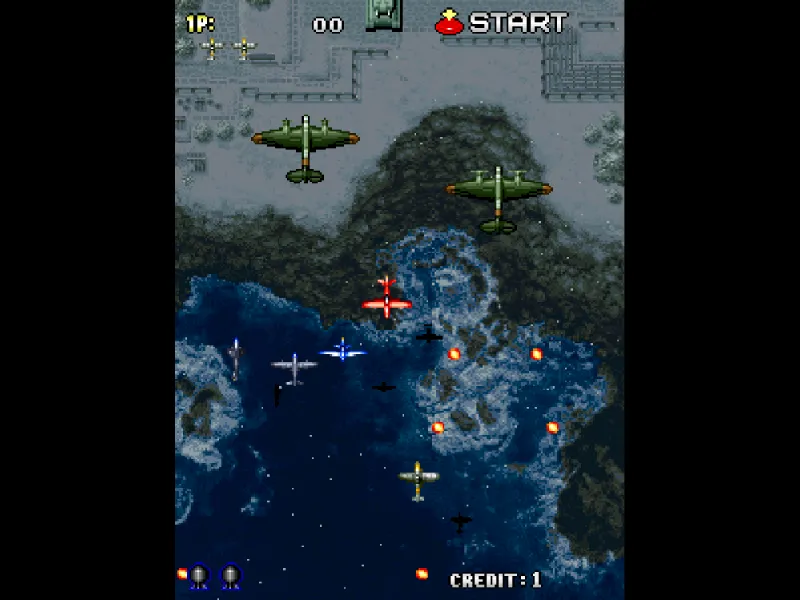
Facing this common, otherworldly threat, air forces across the globe make the same desperate choice: deploying their most advanced propeller fighters to the front lines. From the American P-38 Lightning and P-51 Mustang to the British Spitfire, the German Bf 109, and the Japanese Shinden and Zero—these legendary WWII aircraft engage in an impossible battle against alien high-tech weaponry in the skies of 1945.
This "WWII propeller planes vs. alien super-weapons" premise is the unique aesthetic core of Strikers 1945.
1.2 Development History
Strikers 1945 was released in 1995 by the Japanese developer Psikyo. It was the title that propelled the company from an "up-and-coming shooter developer" to the "Kings of Vertical Shooters." Psikyo was founded in 1993 by core members of Video System, the studio behind the Sonic Wings (Aero Fighters) series. The founding team brought years of experience in vertical shooter development, aiming to create a game that was "even more exhilarating than Sonic Wings."
Strikers 1945 achieved that goal. Upon its release in Japanese arcades in 1995, it became an instant hit. The visual impact of WWII legends meeting alien tech, Psikyo's signature "Technical Bonus" scoring system, and the iconic "destructible parts" boss system formed the perfect Psikyo recipe.
Over the next five years, Psikyo released four sequels (Strikers 1945 II, Strikers 1945 Plus, Strikers 1945 III / 1999) and several spin-offs (such as Gunbird and Sengoku). The series cemented Psikyo's place in gaming history; to shooter fans, the name "Psikyo" is synonymous with "exhilarating, hardcore, and mechanical beauty."
2. Fighter Selection
Strikers 1945 features 6 legendary WWII fighters, each with its own unique weapon configuration and playstyle.
2.1 Fighter Overview
| Fighter | Nationality | Main Gun Type | Characteristics |
|---|---|---|---|
| P-38 Lightning | USA | Charge | Highest damage and hit range in the game—the undisputed "newbie-friendly" choice and "boss-killer." |
| P-51 Mustang | USA | Rapid-fire | The most balanced fighter; solid performance in all areas. |
| Spitfire | UK | High-mobility | Highest mobility in the game, perfect for experts chasing high Technical Bonuses. |
| Bf 109 | Germany | Burst | High firepower, low defense—high risk, high reward. |
| Shinden | Japan | Special | Experimental interceptor with a unique weapon trajectory. |
| Zero | Japan | Speed | Classic Imperial Navy fighter with well-rounded performance. |
Each fighter's weapon system consists of three tiers: Main Gun (Shot, rapid or charge), Sub-Weapon (homing/burst/spread), and Bomb (the ultimate screen-clearing weapon).
2.2 Hidden Fighter
By meeting specific conditions (usually reaching certain stages without continuing), you can unlock the hidden fighter X-36—an experimental jet fighter ahead of its time. The X-36 boasts top-tier speed and firepower, but its defense is the lowest in the game—a single bullet can end your run. It is Psikyo's "ultimate reward" for experts.
3. Stages and Boss Strategy
Strikers 1945 consists of 8 stages. Every boss features Psikyo's signature "massive destructible mechanical" design—each has multiple independent parts that can be destroyed to alter the boss's attack patterns.
Stage 1: Pacific Airspace
| Item | Details |
|---|---|
| Setting | Island chains over the blue ocean, facing the first enemy patrol fleet. |
| Boss | Massive twin-hull seaplane bomber with independent turrets and wing-mounted missile launchers. |
| Strategy | A gentle introduction. Use the P-38's charge attack to take out half a turret in one hit. This boss introduces Psikyo's "destructible parts" philosophy. |
Stage 2: Continental Europe
| Item | Details |
|---|---|
| Setting | French countryside and German industrial zones with tank divisions and anti-aircraft batteries. |
| Boss | Massive land battleship featuring a rotating shield that covers almost the entire screen width. |
| Strategy | The rotating shield is a classic Psikyo design. The gap in the rotation is your only window to hit the core. Destroy the side mortars first, then wait for the shield to open. |
Stage 3: Arctic Circle
| Item | Details |
|---|---|
| Setting | Ice-covered polar seas with massive icebergs and hidden enemy submarine fleets. |
| Boss | Giant submersible carrier equipped with torpedo tubes and vertical missile systems. |
| Strategy | Predict torpedo trajectories on the water surface. The boss has limited windows above water—go all-out when it surfaces and focus on dodging when it dives. |
Stage 4: Middle Eastern Desert
| Item | Details |
|---|---|
| Setting | Enemy desert base with massive pyramid-like structures. |
| Boss | Desert Fortress—a core composed of multiple rotating armor rings covered in turrets. |
| Strategy | Bullet density increases significantly here. The P-38's charge attack can pierce through multiple armor rings to hit the core directly—the most effective tactic. |
Stage 5: Deep Pacific
| Item | Details |
|---|---|
| Setting | The ocean floor, featuring sunken ships and deep-sea creatures. |
| Boss | Giant mechanical squid with multiple independent tentacles and a central core. |
| Strategy | Tentacles can be destroyed individually, but they regenerate faster. Destroy them only to create windows to attack the core, not to clear them entirely. |
Stage 6: Space Orbit
| Item | Details |
|---|---|
| Setting | An alien fleet assembly point in low Earth orbit—a sight never before seen in human history. |
| Boss | Orbital Defense Satellite—an array of dozens of small satellites moving in complex geometric patterns. |
| Strategy | The game enters the "alien tech" phase here. Enemy craft are no longer WWII-style planes, but energy entities and UFOs. |
Stage 7: Lunar Surface
| Item | Details |
|---|---|
| Setting | The moon's surface, featuring alien outposts, craters, and metal domes. |
| Boss | Lunar Base Core—a multi-stage transforming boss. First form is a giant dome; second form is a dense bullet-hell pattern. |
| Strategy | One of the hardest mid-stage sections in the game. Enemies swarm from behind craters. Saving bombs for this stage is essential. |
Stage 8: Alien Mothership
| Item | Details |
|---|---|
| Setting | The energy conduits and outer hull of the alien mothership. |
| Boss | Mothership Core—the most complex multi-stage boss. Strip away armor layers, then survive the screen-filling bullet hell once the core is exposed. |
| Strategy | A masterclass in Psikyo's mechanical aesthetic. Save at least 3 bombs for the second phase—the invincibility frames are more valuable than the damage. The P-38's charge attack can hit the core through the bullet screen—the reason it's considered the strongest fighter. |
4. Tips and Advanced Strategy
4.1 Basic Survival
- Technical Bonus is the soul of Psikyo: When you shoot enemies at close range, the Technical Bonus in the top-left corner increases. Maintaining the maximum bonus (usually by staying right in front of the enemy) is the key to high scores and advanced play. However, it puts you closer to enemy fire.
- P-38 is the safest choice for beginners: Large charge attack hitboxes, high damage, and the ability to hit bosses through bullet screens—it's Psikyo's "hidden easy mode."
- Spitfire is a scoring machine: High mobility allows you to maintain Technical Bonuses in dangerous close-quarters without getting hit. This requires precise movement—it's a fighter for experts.
- Bombs aren't just for killing: They are insurance to maintain close-range output while staying alive. Experts use bombs not just to survive, but as "invincible damage windows" during critical boss phases.
- Know your fighter's weapons: The Bf 109's sub-weapon is a burst-homing shot—perfect for clearing groups of fast-approaching enemies. The Zero's sub-weapon is a wide spread—great for area coverage.
- Death resets firepower: Like the Raiden series, dying downgrades your weapons to the minimum. Dying in stages 7 or 8 is almost a restart—you must maintain a very low death rate.
4.2 Universal Boss Rules
- Read the bullet patterns: Observe the bullet trajectory during the first attack cycle of every boss—then counter-attack during the second.
- Prioritize destructible parts: Almost every boss has destructible turrets or armor. Destroying these weakens the boss's bullet density—often more efficient than attacking the core directly.
- Use the piercing nature of charge attacks: The P-38 and some other fighters can pierce boss armor to hit the core—a huge advantage against "rotating shield" bosses.
5. Trivia and Arcade Legends
5.1 The Birth of Psikyo
The name "Psikyo" comes from "Sai" (Colorful) and "Kyo" (Capital)—they wanted to be the "Capital of Colorful Games." After splitting from Video System in 1993, the founding team spent their first year in a rented studio apartment, using second-hand arcade boards for development. Two years later, they launched their first hit with Strikers 1945.
5.2 Inspiration for "WWII Planes vs. Alien Tech"
The core premise—WWII propeller planes fighting high-tech alien weapons—is said to have come from a trip the Psikyo president took to the US. While visiting the Smithsonian National Air and Space Museum in Washington, he stood in front of a P-38 Lightning and wondered: "What if this plane flew into outer space?" That thought became Strikers 1945 two years later.
5.3 Japan's "Strikers Shonen"
During the golden age of Japanese arcade culture, a group of high schoolers dubbed "Strikers Shonen" by the media would visit the same arcade after school, lining up to challenge each other's high scores on the same Strikers 1945 cabinet. The arcade owner eventually organized an "Unofficial Japan Strikers Tournament," which attracted over 100 participants. It remains a classic snapshot of arcade shooter community culture.
5.4 Defining "Psikyo Difficulty"
In the shooter community, "Psikyo Difficulty" is a professional term. It refers to a unique design philosophy: "The bullet screen looks impossible to pass, but if you stand perfectly still, you'll find the bullets just barely graze you." Psikyo's bullet patterns use deliberate "visual deception"—the dense screen always leaves a gap, provided you are in the right spot.