1. Game Background
1.1 Setting
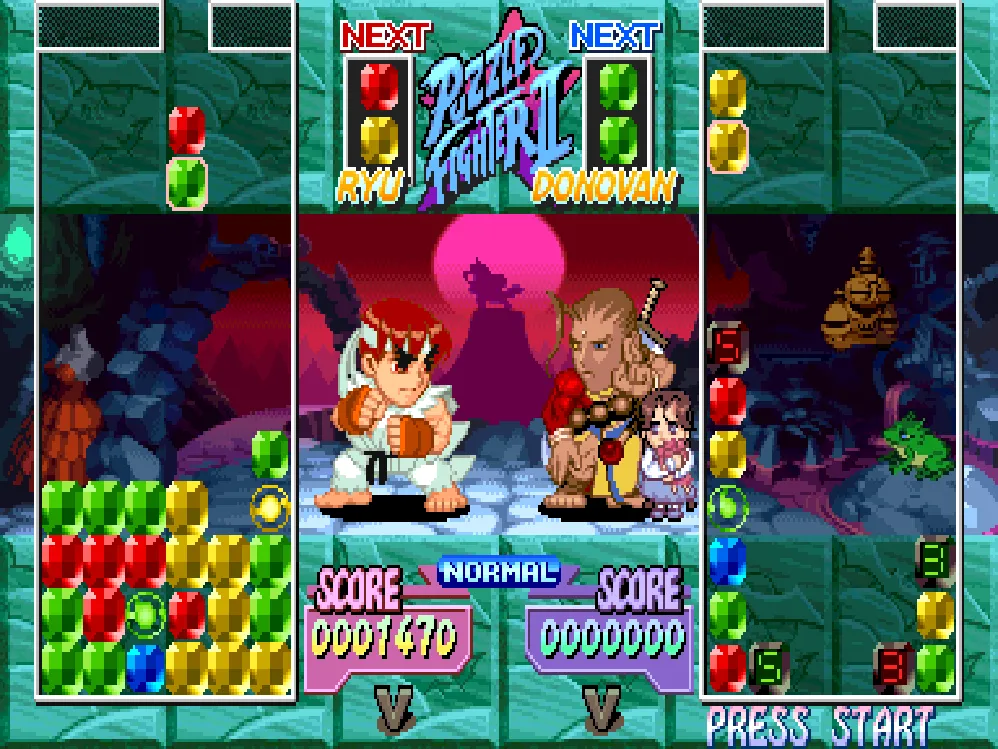
Super Puzzle Fighter II Turbo doesn't have a traditional narrative—its "world" is essentially the entire Capcom fighting game universe crammed into a chaotic, chibi-style party. Ryu and Ken aren't sparring seriously; they're throwing blocks at each other. Chun-Li's Lightning Legs aren't for kicking opponents—they're for shattering entire rows of gems. Morrigan and Felicia have descended from the dark world of Darkstalkers, but their combat style involves rotating colored gems and launching devastating chain reactions.
It sounds absurd. That’s exactly what Capcom intended. The title itself is a self-deprecating joke—Super Puzzle Fighter II Turbo (known as Super Puzzle Fighter II X in Japan)—parodying Super Street Fighter II Turbo. It’s as if the developers were saying, "Sure, we never made a 'Puzzle Fighter I,' but that won't stop us from jumping straight to II Turbo." This humor defines the game's entire tone.
1.2 Development History
Developed and published by Capcom in 1996 for the CPS-2 arcade hardware, the game was born from a clear commercial motive: Capcom needed a product to compete directly with Compile and Sega’s Puyo Puyo 2 in the arcade puzzle market. While Puyo Puyo 2 was dominating Japanese arcades, Capcom’s strategy wasn't to make a "Puyo Puyo clone," but to create a crossover that blended Capcom’s all-star roster with the "attack-counter" logic of fighting games.
The result was a near-perfect puzzle game design. Unlike most contemporary puzzle games (like Tetris or Puyo Puyo), the chain-combo and Counter Gem system in Puzzle Fighter gives the game a fighting-game-like rhythm of "offense and defense." You aren't just clearing blocks; you are engaged in a real-time battle using gems as ammunition.
The arcade version debuted in 1996, followed by rapid ports to PlayStation and Sega Saturn in December of that year. It arrived on Windows in 1998. The 2001 Dreamcast version added three extra modes (X/Y/Z modes). The 2003 Game Boy Advance version was cancelled for the Japanese market. The 2007 HD Remix version launched on Xbox 360 and PS3—this is the most complete home version, featuring online play, 4-player mode, a gem editor, and several balance adjustments to the gem-clearing mechanics.
The arcade version was a commercial success, with Game Machine magazine ranking it as the sixth most popular arcade game in Japan in August 1996. Electronic Gaming Monthly (EGM) named it the runner-up for Puzzle Game of the Year in 1997. In 2004, GameSpot inducted it into its "Greatest Games of All Time" list.
2. Character Roster
The arcade version of Super Puzzle Fighter II Turbo features 8 playable characters (from the Street Fighter and Darkstalkers series), plus 3 hidden characters. Each character differs not just in appearance, but in their "Gem Drop Pattern," which is the most critical tactical variable in character selection.
Street Fighter Characters
Ryu
| Attribute | Rating |
|---|---|
| Gem Pattern | ★★★☆☆ |
| Difficulty | ★★☆☆☆ |
- Gem Pattern: Balanced—Red, Blue, Yellow, and Green are distributed evenly. This is the easiest pattern for opponents to predict and counter.
- Overall Rating: The standard "beginner character." Ryu's balanced pattern means you’ll never get stuck with a column blocked by a single color, but it also means fewer opportunities for massive chains. He is for learning the basics, not for winning high-level matches.
Ken
| Attribute | Rating |
|---|---|
| Gem Pattern | ★★★☆☆ |
| Difficulty | ★★☆☆☆ |
- Gem Pattern: Similar to Ryu but with a higher ratio of Red and Blue—making it easier to trigger Red and Blue chains, though Yellow and Green are relatively scarce.
- Overall Rating: A variant of Ryu. Ken’s advantage in Red and Blue makes small-scale two-color chains easier, but the scarcity of Green and Yellow can be fatal in late-game scenarios requiring full-color coverage.
Chun-Li
| Attribute | Rating |
|---|---|
| Gem Pattern | ★★★★☆ |
| Difficulty | ★★★☆☆ |
- Gem Pattern: The distribution is weighted toward the bottom half—colors are concentrated in the first few columns and then the last few—suitable for advanced "zoning" strategies.
- Overall Rating: Chun-Li’s pattern is perfect for a "one color per zone" building strategy—stacking gems of the same color in specific columns rather than spreading them out. This strategy is most effective in mid-level play.
Sakura
| Attribute | Rating |
|---|---|
| Gem Pattern | ★★★★☆ |
| Difficulty | ★★★☆☆ |
- Gem Pattern: Dominated by Blue and Green—allows for quickly building powerful Blue/Green gems early on.
- Overall Rating: Fast and rhythmic. Sakura’s bias toward Blue and Green means she can build 2x2+ Power Gems faster than other characters—but the scarcity of Red and Yellow means you are weaker if an opponent attacks with Red/Yellow Crash Gems.
Darkstalkers Characters
Morrigan Aensland
| Attribute | Rating |
|---|---|
| Gem Pattern | ★★★★☆ |
| Difficulty | ★★★☆☆ |
-
Gem Pattern: Balanced distribution, but with a hidden advantage—Red and Blue appear slightly more frequently, making Red/Blue chains more stable. She is second only to Donovan in popularity.
-
Overall Rating: An advanced character with a balanced-to-Red/Blue bias. Morrigan’s visual design (her chibi succubus look) is also the most striking—in her attack animations, her little bats and soul fireballs are replaced by piles of colorful gems.
Donovan
| Attribute | Rating |
|---|---|
| Gem Pattern | ★★★★★ |
| Difficulty | ★★★★☆ |
- Gem Pattern: Widely considered by the community to be the strongest in the game. The four-color distribution is highly optimized—every column is designed to maximize chain-trigger probability.
- Overall Rating: The top choice for competitive play. Donovan’s strength isn't in one specific column—it's that his gem arrangement ensures that at any height, you have one or two columns that can be triggered immediately by the gems in your hand. The fear of "getting comboed by Donovan" is a shared experience for every Puzzle Fighter player.
Felicia
| Attribute | Rating |
|---|---|
| Gem Pattern | ★★★☆☆ |
| Difficulty | ★★★★☆ |
- Gem Pattern: Red and Yellow dominant—suitable for building small, high-frequency Red/Yellow chains.
- Overall Rating: A speed-based strategy—don't aim for one massive explosion, aim for constant harassment. Felicia’s strategy is to "never give the opponent time to build large gems"—using high-frequency small chains to dump garbage (Counter Gems) onto the opponent's field.
Hsien-Ko (Lei-Lei)
| Attribute | Rating |
|---|---|
| Gem Pattern | ★★★☆☆ |
| Difficulty | ★★★☆☆ |
- Gem Pattern: A balanced distribution with a bias toward Blue and Green.
- Overall Rating: Similar to Chun-Li, she is a zoning-strategy character. Hsien-Ko’s chibi design is arguably the cutest in the game—a mini zombie girl using her claws to shatter gems.
Hidden Characters
Dan Hibiki — The Weakest Character
- Gem Pattern: All Red—every column drops only Red gems. Sounds strong? Not at all. All Red means you can never trigger a Crash Gem (clearing requires matching colors—all Red is a single color, so there are no "other colors" to clear). Dan is essentially a joke character who "cannot play the game properly" in Puzzle Fighter—just as he cannot fight properly in the Street Fighter series.
Akuma (Gouki) — The Strongest Character (Theoretically)
- Gem Pattern: The most optimized balanced distribution—perfectly balanced across all four colors.
- The Cost: The number of Counter Gems Akuma sends to his opponent is only 70% of a normal character's output.
- Overall Rating: His gem arrangement is the best in the game—but he is saddled with a permanent "70% damage" penalty. This design simultaneously proves that "Akuma is indeed the strongest" and that "Akuma must learn how to win with 70% power."
Devilotte — Hidden Boss
- From: Capcom’s Cyberbots: Fullmetal Madness (1995).
- Gem Pattern: A mirror of Akuma’s pattern—same optimization level, same 70% penalty.
- Victory Quote: Her victory quote is one of the funniest self-deprecating jokes in Capcom history: "What? You don't know me!? Cyberbots is Capcom's #1 masterpiece!"—a poignant and hilarious declaration for a niche, poorly-selling mech fighting game.
Console-Exclusive Characters
- Mei-Ling: Hsien-Ko’s twin sister—manifested as the talisman on Hsien-Ko’s hat. Console exclusive.
- Anita: The young psychic girl adopted by Donovan. Console exclusive.
3. Controls and Mechanics
3.1 Basic Controls
Controls are extremely simple—3 active buttons:
| Button | Action | Description |
|---|---|---|
| D-Pad ←→ | Move | Move falling gems left or right |
| D-Pad ↓ | Fast Drop | Instantly drop gems to the bottom |
| Left Rotate | Counter-Clockwise | Rotate the two gems |
| Right Rotate | Clockwise | Rotate the two gems |
3.2 The Gem System—The Soul of the Game
Normal Gems: Fall in pairs, 4 colors (Red, Blue, Yellow, Green). They do nothing on their own—they are only cleared when triggered by a Crash Gem of the same color.
Crash Gems: Special gems with a flashing spark. When placed on the field, they immediately clear all adjacent Normal Gems of the same color. If the cleared gems include another Crash Gem of the same color, a chain reaction triggers—the second Crash Gem continues to clear adjacent gems, and so on. The perfect chain can clear half the field at once—dumping dozens of Counter Gems onto your opponent.
Power Gems: When 2x2 (or larger) Normal Gems form a square/rectangle, they automatically merge into a giant Power Gem. When cleared (must be triggered by a Crash Gem), Power Gems send significantly more garbage to the opponent than the same area of Normal Gems. "Building large Power Gems and blowing them up all at once" is the core strategy for all Puzzle Fighter experts.
Counter Gems: After an opponent triggers a chain, Counter Gems fall onto your field—they display a countdown number starting from 5. Every time you place a pair of gems, the Counter Gem's number decreases by 1. When it hits zero, the Counter Gem turns into a Normal Gem and is no longer a threat. Key mechanic: If you hit the area where a Counter Gem is located with a Crash Gem before the countdown hits zero, the Counter Gem is cleared early, preventing it from becoming a Normal Gem and cluttering your field. This "choice to counter while the timer is ticking" is the design that turns Puzzle Fighter from a "game of luck" into a "game of strategy."
Diamond: Appears after every 25 pairs of gems dropped. When a Diamond lands, it clears all gems of the same color on the field—regardless of whether they are adjacent. Diamonds are the game's "comeback mechanic"—when your field is about to overflow, a well-timed Diamond can instantly clear half the board.
3.3 Garbage Countering (Sousai)
This mechanic is borrowed directly from Puyo Puyo 2: When an opponent sends Counter Gems to you, if you are also performing a chain combo at the same moment, the Counter Gems generated by your combo can "cancel out" the opponent's attack—with the excess flowing back to the opponent's field. This creates a high-risk/high-reward rhythm: when your field is being pressured by garbage—don't rush to clear—instead, build up for a massive counter-attack—and the moment the opponent thinks they've won, send all that garbage back doubled.
4. Core Strategy
Puzzle Fighter has no "levels" in the traditional sense. The core of the game is 1v1 or 2v2 real-time gem combat.
4.1 Basic Building: Power Gem Stacking
The optimal strategy is to stack a large Power Gem on one side of the field (usually the two leftmost columns)—the bigger, the better—3x3, 4x4, or even a giant Power Gem occupying half the field. Keep the other side clean to receive and clear Counter Gems. Once the Power Gem is complete, wait for a Crash Gem of the same color to appear, place it next to the Power Gem, and trigger a devastating chain.
4.2 Tactical Use of Diamonds
Diamonds appear every 25 pairs of gems (about every 30-45 seconds). As a Diamond is about to appear, proactively stack a large number of a specific color in one column (e.g., stack 4-5 rows of Red Normal Gems at the bottom)—once the Diamond lands, choose Red—and instantly clear the opponent's carefully arranged Red gem zone.
4.3 Counter Gem "Countdown Window" Tactics
When an opponent sends a large number of Counter Gems, don't rush to clear them. It takes 5 gem placements for a Counter Gem to count down from 5 to 0—roughly 3-5 seconds. During this time, you can continue building above the Counter Gems—when the countdown hits 1, use a Crash Gem to clear the Counter Gem area and the extra gems you just built above it simultaneously—doubling the explosion damage sent back to the opponent.
4.4 Character Compatibility and Pattern Selection
- For Beginners: Choose Ryu or Ken to learn basic Power Gem stacking.
- For Intermediate Players: Choose Morrigan or Chun-Li to learn zoning and two-color chains.
- For Experts: Choose Donovan to learn how to "never let the opponent build a large Power Gem."
- For Trolling Friends: Choose Dan—and watch your friend laugh while asking, "What on earth are you doing?" on your all-red field.
5. Tips and Advanced Strategy
5.1 Basic Survival Tips
- Always build large Power Gems in the two leftmost columns—use the two rightmost columns for miscellaneous gems and emergency clearing. This zoning strategy is the consensus among all Puzzle Fighter experts.
- Don't be greedy for 4x4 giant Power Gems—3x3 is enough. A 4x4 takes longer to build (waiting for the perfect gem arrangement)—during which you are easily overwhelmed by the opponent's chain attacks.
- The Counter Gem countdown is your window for a counter-attack—use it. Beginners panic when they see a Counter Gem counting down from 5. Experts smile—because they know that timer is also counting down the moment for their own counter-attack.
- Don't use Diamonds randomly—decide which color you want to clear before the Diamond appears (and stack that color at the bottom in advance). A well-planned Diamond is ten times more destructive than two random ones.
- "Sousai" (Countering) is for attacking, not defending. If your field is half-filled with Counter Gems—it's not time to clear—it's time to launch your biggest chain—and send everything back at the peak of the Counter Gem pile-up.
5.2 Advanced Trivia
- Diamond BUG (Original): There is a bug in the original arcade version—under certain conditions, a Diamond can send back more than 50% of the Counter Gem volume (the normal value should be 50%). The 2007 HD Remix version fixed this bug—and set the Diamond strength to "80% of a normal chain."
- HD Remix Balance Adjustments: All characters' gem drop patterns were redesigned—some patterns considered "too strong" (like the original Donovan) were nerfed to a balanced level. The "X'" mode is a new mode balanced specifically for competitive play.
- Dreamcast X/Y/Z Modes: X = Original, Y = Match-3 Connection mode (similar to Columns—same-colored gems connect in "threes"), Z = 2x2 Rotation Block mode (similar to Tetris Attack—a 2x2 block can be rotated and placed).
6. Trivia and Arcade Legends
6.1 Capcom’s "Self-Deprecating Title"
The name Super Puzzle Fighter II Turbo is a multi-layered joke. "Super"—Capcom used it to identify upgrades to Street Fighter II. "II"—implies this is a sequel to an "I"—but Puzzle Fighter I never existed. "Turbo"—this suffix had already been used by Capcom in the Street Fighter series at least three times. The whole title says: "We named this game after a non-existent predecessor—because Capcom's naming conventions are just that absurd." As a perfect continuation of this self-mockery, in 1997 Capcom actually released a game called Super Gem Fighter Mini Mix (also known as Pocket Fighter)—using the chibi character sprites from Puzzle Fighter.
6.2 Dan’s "Anti-Meta" Perfection
Dan Hibiki is Capcom’s malicious parody of SNK’s "Fire Dragon" (a mockery of Ryo Sakazaki and Robert Garcia). In the Street Fighter series, Dan is a joke character that "no serious fighting game player would ever pick." In Puzzle Fighter—Capcom perfectly ported this setting to the puzzle game framework: all of Dan’s gem columns drop only Red gems—making him unable to trigger any Crash Gem chain combos—meaning picking Dan is equivalent to "voluntarily giving up the game." This design can be understood as Capcom’s ultimate dedication to character lore—even in a puzzle game, Dan must maintain his status as "forever the weakest."
6.3 Puyo Puyo vs. Puzzle Fighter—A Clash of Giants
The mid-90s Japanese arcade puzzle market was dominated by two products: Compile/Sega’s Puyo Puyo 2 and Capcom’s Puzzle Fighter. The two differ fundamentally in core mechanics: Puyo Puyo’s clearing logic is based on "adjacent connection" (4 of the same color clear), closer to Columns; Puzzle Fighter’s clearing logic is based on "triggering" (Crash Gems act like bombs detonating all surrounding same-colored gems), closer to the logic of Bomberman. Both designs are similar in direction—but feel completely different tactically—Puyo Puyo is like "Go" (continuous accumulation, gradual expansion), while Puzzle Fighter is like a "one-on-one Western quick-draw duel" (stillness—waiting—an instant—deciding the winner).
6.4 Devilotte—The Lone Warrior of Capcom’s Most Obscure IP
Devilotte de Deathsatan IX comes from Capcom’s 1995 mech fighting game Cyberbots: Fullmetal Madness. This game sold poorly, had almost no sequels, and remains one of Capcom’s most obscure arcade titles. Making her the hidden boss of Puzzle Fighter is a masochistic inside joke—as if the production team were saying: "Our company has so many famous IPs, but we’re going to use this character that nobody in the world knows as the hidden boss." Her victory quote—"What? You don't know me!? Cyberbots is Capcom's #1 masterpiece!"—might be the most sincere declaration of love for their most humble work in Capcom history.
6.5 Puzzle Fighter HD Remix—A Perfect Rebirth 13 Years Later
The 2007 HD Remix version was a total reimagining of the original—redrawing all chibi characters and gem patterns based on a new 1080p HD engine. Capcom’s development team (in collaboration with Backbone Entertainment) didn't stop at "graphical upgrades"—they redesigned the battle mode, added online multiplayer and spectator functions, fixed the original Diamond bug, and balanced all characters' gem patterns. HD Remix is the standard case study for "how to properly upgrade a game without changing its soul."
6.6 Why Puzzle Fighter Never Had a True Sequel
In 2017, Capcom released a mobile game called Puzzle Fighter—using 3D character models and new clearing mechanics. This game was shut down in 2018 (operating for less than a year). The answer is perhaps simple—the 1996 Puzzle Fighter was a "perfect storm" of Capcom’s arcade puzzle design capability, 2D art prowess, and all-star IP roster at the best possible intersection. It cannot be replicated, because that combination of "running chibi Ryu throwing colored gems at SD Morrigan on CPS-2 hardware" was an absurdity and passion that only existed once in 1996. It continues to be released in the Capcom Fighting Collection (2022) and Capcom Arcade 2nd Stadium, and is constantly being revisited and studied by the arcade puzzle community, emulator community, and new generations of players. It is not Capcom’s most successful game—but it might be Capcom’s most perfectly designed game.