I. Game Background
1.1 World Setting
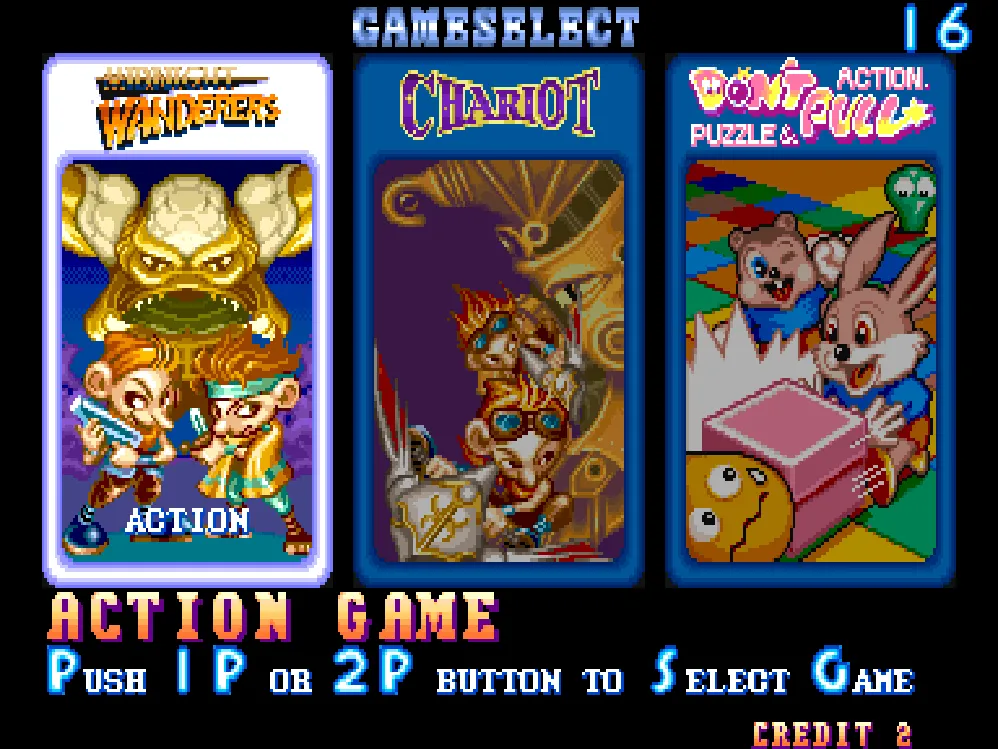
Three Wonders isn't just one game—it's three. In 1991, Capcom did something incredibly rare for the era: they packed a side-scrolling action game, a horizontal shoot 'em up, and a puzzle game onto a single CPS-1 arcade board. These games share a common fantasy world (with the exception of the standalone Don't Pull), collectively telling a complete adventure story.
Midnight Wanderers: The protagonist is a hobbit-elf archer named Lou, who sets out with his partner Siva to find the mythical "Chariot." An evil mastermind is turning their people into wooden statues—the only power capable of breaking the curse is hidden within the legendary Chariot. From lush forest kingdoms to deep-sea water realms, and from enchanted toy kingdoms to haunted castles, it is a quintessential Capcom-style side-scrolling fantasy adventure.
Chariot: The story continues directly from Midnight Wanderers. After finding the Chariot, Lou and Siva pilot the flying machine out of the atmosphere and straight to the moon. The gameplay shifts from platforming to horizontal shoot 'em up, with the Chariot equipped with a charge-shot main cannon and upgradable tail turrets for the final showdown against the mechanical legion.
Don't Pull: Unlike the first two titles, this is a pure puzzle game with no narrative background. 1P controls a rabbit named Don, and 2P controls a squirrel named Pull, pushing blocks on a grid to crush monsters and clear the stage. While it doesn't share the world of Midnight Wanderers, as the "third wonder" on the CPS-1 board, it made this collection one of the most cost-effective arcade experiences in history.
1.2 Development History
Three Wonders was released by Capcom in Japan in July 1991, running on the CPS-1 hardware. The game was directed by legendary Capcom producer Yoshiki Okamoto, with design by Toshihiko Uda, lead programming by Koma Chan, and a soundtrack composed by Masaki Izutani.
Commercially, Three Wonders was a stroke of genius. By 1991, Capcom's CPS-1 board already dominated the fighting and beat-'em-up markets with Street Fighter II and Final Fight. However, the hardware cost was high—running only one game on an expensive board was inefficient for arcade operators. Three Wonders packed three different genres into one board—action fans played Midnight Wanderers, shooters played Chariot, and puzzle fans played Don't Pull—meaning a single cabinet could attract three completely different types of players.
Three Wonders performed steadily, ranking 5th in the table-top arcade category by Game Machine on August 1, 1991. In 1998, Japan's Xing Entertainment licensed the game for ports to the Sega Saturn and PlayStation (Japan exclusive). Lou, the protagonist of Midnight Wanderers, later appeared as a support character in Marvel vs. Capcom: Clash of Super Heroes (1998), while Siva's character design was adapted into the playable character Shiba Shintaro for the Capcom arcade shooter Cannon Spike (2000).
II. Character Introduction
2.1 Lou — 1P Hobbit-Elf Archer
| Attribute | Rating |
|---|---|
| Attack | ★★★☆☆ |
| Speed | ★★★★☆ |
| Fire Rate | ★★★★☆ |
| Difficulty | ★★☆☆☆ |
- Weapon: Bow and arrow (default) / Various upgradable weapons.
- Pros: Small hitbox, agile movement, fast fire rate. The default bow has moderate power but stable trajectory.
- Overall Evaluation: The co-protagonist of both Midnight Wanderers and Chariot. Lou's hobbit-elf design makes him one of the most unique fantasy leads in Capcom's library—he isn't a warrior or a mage, but an adventurer navigating gothic castles and toy kingdoms with a bow.
2.2 Siva — 2P
- Weapon: Same as Lou.
- Overall Evaluation: Lou's partner. Their controls and stats are identical (standard Capcom symmetrical design for two-player co-op); Siva's role is primarily to enable two-player gameplay.
III. Controls
3.1 Basic Controls (Midnight Wanderers)
| Button | Action | Description |
|---|---|---|
| A | Shoot | Fire at enemies directly in front |
| B | Jump | Adjust landing position mid-air |
| ↓ + Jump | Slide | Slide to pass through low gaps and avoid high attacks |
3.2 Weapon System (Midnight Wanderers)
Weapons in Midnight Wanderers are obtained by breaking treasure chests or defeating specific enemies. Weapons are replaced rather than stacked:
| Weapon | Features |
|---|---|
| Bow (Default) | Single straight shot, moderate speed, most stable |
| Big Dagger | High fire rate, wide coverage, best for clearing mobs |
| Homing Missiles | Automatically tracks enemies, best against agile flying foes |
| Fireball | Slow fire rate but high area damage, leaves burning damage on enemies |
3.3 Armor Mechanic (Midnight Wanderers)
When hit, the character doesn't die immediately—they lose their clothes and armor, entering a "half-naked" state. If hit again in this state, the character dies. This design carries the unique humor of early Capcom arcade games—think of it as a "two-stage health" system, just presented in a more comical way.
3.4 Charge Attack (Chariot)
In shoot 'em up mode, hold the attack button to charge—releasing it fires a high-damage shot. This is the most important tool for defeating bosses. Tail turrets can be upgraded by picking up items—extra turrets not only increase firepower but can also block enemy bullets—this is the game's most vital defensive mechanic.
3.5 Chain Pushing (Don't Pull)
Pushing blocks to crush monsters is the core mechanic. The key is chain reactions—pushing a whole row of blocks can crush multiple enemies at once. Enemies crushed by chains drop high-score items. Enemies bounce off screen edges—use this to predict their movement and push blocks into their path in advance.
IV. Stage Walkthrough & Boss Strategy
Act I: Midnight Wanderers — Five Kingdoms
Stage 1: Forest Country
| Item | Content |
|---|---|
| Setting | A lush fantasy forest. Sunlight filtering through the canopy and dense bushes create multi-layered platforms. Enemies are mostly goblins and treants. |
| Mid-Boss | Golem Wood — A giant stone golem made of ancient trees and vines. Its punches create ground shockwaves. |
| Boss | Balgoss — A giant wyvern. Uses fire breath, tail sweeps, and aerial dives. |
| Strategy | The core of the Golem fight is sliding—its shockwaves travel along the ground, and sliding allows you to pass under them perfectly. For Balgoss, jump to the side the moment you see it flap its wings to dive. Recommended weapon: Big Dagger—Balgoss is highly mobile, making low-tracking weapons easy to miss. |
Stage 2: Water Country
| Item | Content |
|---|---|
| Setting | Deep-sea coral reefs and underwater palaces. Includes water currents where jump height is reduced. |
| Mid-Boss | Shell Shock — A giant hermit crab that rolls into its shell to charge. |
| Boss | Terror Twins: Laru — Sword Laru and Fire Laru, two demons working in tandem. One strikes in melee, the other fires projectiles. They form a perfect crossfire. |
| Strategy | Shell Shock is invincible from the front while rolling—jump over it to attack its back. The Laru twins are one of the hardest boss fights—prioritize killing Fire Laru (the ranged one) first, as her bullet patterns restrict your movement. |
Stage 3: Toy Country
| Item | Content |
|---|---|
| Setting | A toy factory cursed into a monster playground. Giant blocks, toy soldiers, and clockwork robots are the main enemies. |
| Mid-Boss | Dumpty — Twin egg-shaped toy bosses that bounce and attack in coordination. |
| Boss | Dougar — A giant mechanical toy dragon that breathes fire and uses a spinning tail attack. |
| Strategy | The Dumpty twins have fixed bounce trajectories—stand in the middle to hit both at once. Dougar's tail spin covers the whole screen—jump at the exact moment it winds up to dodge. |
Stage 4: Ghost Castle
| Item | Content |
|---|---|
| Setting | A dark fantasy gothic castle. Ghosts, gargoyles on walls, and skeletons rising from floor cracks. |
| Boss | Moeban — A giant flying demon that teleports, releases homing ghost bullets, and adds dark beam sweeps at half health. |
| Strategy | Moeban's teleportation is frustrating—it appears behind or above you and attacks immediately. Counter: Slide the moment it teleports—the invincibility frames of the slide allow you to pass through its initial attack. Recommended weapon: Homing Missiles—they will track it wherever it teleports. |
Final Stage: Gaia's Throne
| Item | Content |
|---|---|
| Setting | The dark palace of the final boss. The long corridor before the throne room—highest enemy density in the game. |
| Final Boss | Gaia — The Demon King. Three-stage boss fight: 1st = Giant humanoid, 2nd = True demon form, 3rd = Berserk form. |
| Strategy | Gaia is a classic example of Capcom CPS-1 boss design—each stage adds new patterns. The 1st stage is slow but has large hitboxes—sliding is the safest way to deal damage. The 2nd stage is faster with screen-wide beams. The 3rd stage is a "time attack"—the longer it takes, the denser the bullet patterns, so finish it quickly. |
Act II: Chariot — Sky Journey
| Item | Content |
|---|---|
| Setting | Pilot the Chariot out of the atmosphere, through asteroid belts, and fight the mechanical legion on the moon. Each stage is a side-scrolling shooter. |
| Boss | Bosses in Chariot are original giant mechanical creatures—mecha-dragons, lunar fortresses, etc. Each has multiple phases. |
| Strategy | The charge shot is the core of boss fights—hold the button to charge and release when the boss reveals its weak point. Upgrading tail turrets is essential for both firepower and defense—keep them angled to block enemy fire. In 2P mode, one player charging while the other fires continuously is the best combo. |
Act III: Don't Pull — Puzzle Challenge
| Item | Content |
|---|---|
| Rules | Push blocks on a grid—push a whole row into an enemy's path to crush them. Clear all enemies to finish the stage. |
| Strategy | Core mindset: Don't chase enemies—predict their movement and push blocks into their path ahead of time. Enemies bounce off screen edges—this is predictable—wait for them to reach the bounce point and push immediately. Chain crushes (3+ enemies at once) drop the highest score multipliers. |
V. Tips & Advanced Strategy
5.1 Midnight Wanderers Survival Tips
- Armor is your first life: Being hit leaves you naked—not for laughs, but to warn you that "the next hit will kill you." Play extremely conservatively when naked and prioritize finding armor items.
- Sliding is the most underrated skill: It has invincibility frames—use it to pass through boss patterns, narrow gaps, and damage low-lying enemies. Don't just use it for movement—it's an "evasive attack."
- Weapon Priority: Big Dagger > Homing Missiles > Fireball > Bow. The Big Dagger's fire rate and coverage make it the best choice for mobs and sustained boss damage. Homing Missiles are invaluable against high-mobility bosses (Moeban, Laru Twins).
5.2 Chariot Flying Tips
- Charge shots are for bosses—don't waste them: The damage is dozens of times higher than normal bullets. Release them only when the boss is vulnerable.
- Tail Turrets = Mobile Shields: Upgraded turrets can block bullets—keep them positioned toward the densest part of the boss's bullet patterns.
5.3 Trivia
- Capcom's 3-in-1 Experiment: Packing three different games onto one board was a commercial experiment in 1991. The success of Three Wonders laid the foundation for later Capcom compilations (like Capcom Classics Collection).
- Lou's Multiple Identities: A platformer protagonist becoming a support character in Marvel vs. Capcom isn't common for non-fighting game characters, showing how much the designers loved Lou.
VI. Trivia & Arcade Legends
6.1 One Coin, Three Experiences — The "3-in-1" Revolution
Before Three Wonders, arcade games were usually "one coin = one game." Capcom broke this rule—you could choose from three completely different games on one cabinet. For operators, this attracted three different player bases, meaning higher revenue efficiency. For players on a budget, one coin for three types of games was almost unique in arcade history.
6.2 The Bloodline from Midnight Wanderers to Metal Slug
If the visual style of Midnight Wanderers feels familiar—colorful fantasy, detailed pixel art, humorous character design—it's because the art team overlapped with the core staff who later created the Metal Slug series. The "pistol + slide + fantasy world" framework is, in a way, a "fantasy predecessor" to Metal Slug.
6.3 Don't Pull — The Overlooked Arcade Puzzle Classic
In an era where "high score = high difficulty," putting a puzzle game on a CPS-1 board took courage. Don't Pull has no boss fights, no health bars, and no continues—it's pure logic. But its chain-pushing mechanics and 2P competitive mode are top-tier for the genre.
6.4 Siva → Shiba Shintaro — A Character's Second Life
Siva's (Midnight Wanderers 2P) sprite was recycled by Capcom in 2000 as the visual base for Shiba Shintaro, a playable character in the arcade shooter Cannon Spike. This is a classic example of Capcom's "sprite recycling" tradition.
6.5 Japan-Exclusive Home Ports
In 1998, seven years after the arcade release, Xing Entertainment licensed the game for the Sega Saturn and PlayStation. Both ports were Japan-exclusive—North American and European players never received an official home port until the 2006 release of Capcom Classics Collection Vol. 2 (PS2/Xbox).