I. Game Background
1.1 World Setting
The Last Blade 2 (known in Japan as Bakumatsu Roman: Dai Ni Maku Gekka no Kenshi) is set during the twilight of the Japanese Bakumatsu era—a turbulent time where swords and firearms coexisted, and the code of the samurai clashed with modernization. In 1864, the skies over Kyoto turned blood-red as the "Shrine Maiden of the Seal" was possessed by the power of the Hell's Gate, threatening to open the path to the underworld. Warriors chosen by the Four Symbols—Azure Dragon, Vermilion Bird, White Tiger, and Black Tortoise—are drawn into a "Seal War" that will decide the fate of the world.
The original The Last Blade (1997) centered on the first opening of the Hell's Gate. In the first game's ending, the protagonist Kaede defeated his foster father, Kagami, who had been possessed by the gate's dark power. In The Last Blade 2, a new threat emerges: "The Eternal," Kouryu, a being with the power to manipulate time, who seeks to drag Japan into eternal darkness. Meanwhile, Kaede's senior, Moriya Minakata, returns after years of disappearance—no longer just a rival, but a man burdened by an unspeakable destiny.
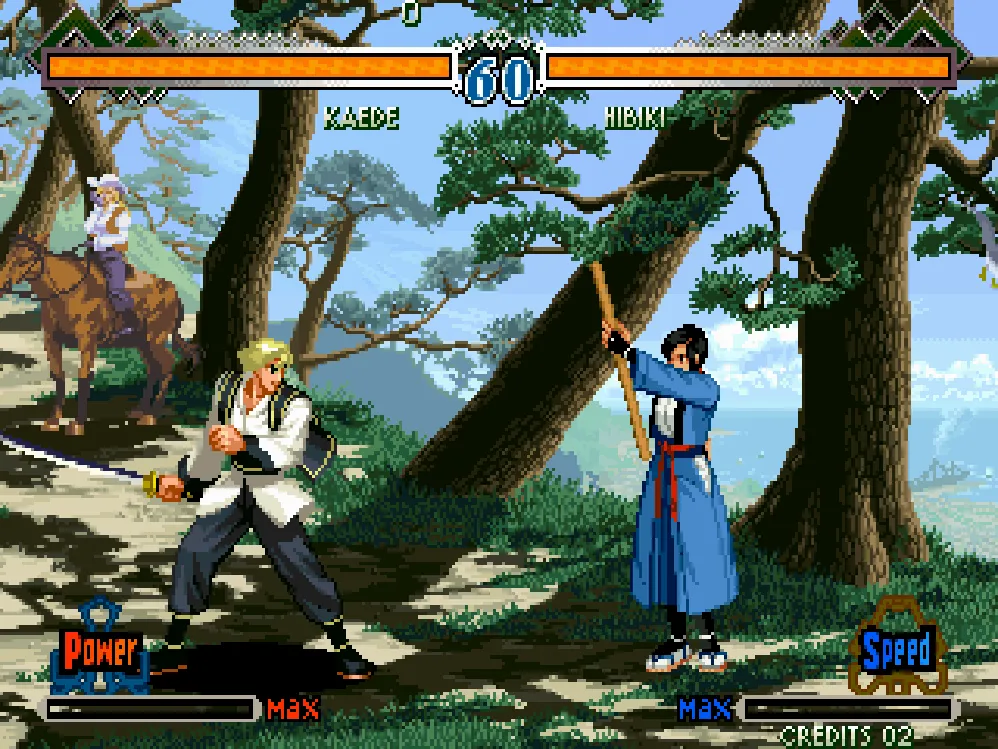
The Last Blade 2 is the most profound and exquisite interpretation of "Bakumatsu" aesthetics in fighting game history. While Capcom’s Samurai Shodown series uses ukiyo-e brushstrokes to depict samurai duels, SNK’s The Last Blade takes a different path: moonlight, falling cherry blossom petals, withered leaves caught in the wind, and raindrops under oil-paper umbrellas. Its visual language is lyrical rather than visceral. If Samurai Shodown is Akira Kurosawa, then The Last Blade is Masaki Kobayashi.
1.2 Development History
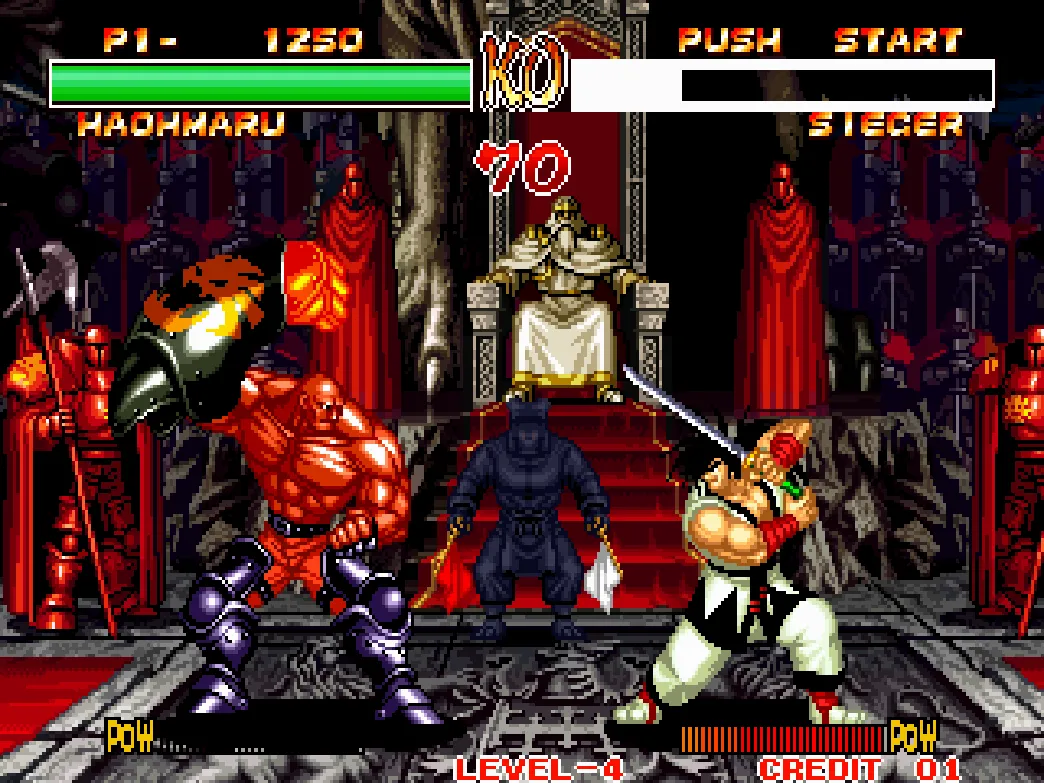
Released by SNK in November 1998 for the Neo Geo MVS arcade board, The Last Blade 2 is one of the most critically acclaimed weapon-based fighting games in SNK's library, often cited alongside Capcom’s Samurai Shodown II as one of the "twin peaks" of sword-fighting games.
Compared to the original, the sequel completely rebuilt and refined the core "Sword Quality" system. While the first game offered two styles—"Power" and "Speed"—the sequel added a third: "Extreme." This seemingly simple addition elevated the game's tactical depth to a new dimension. The roster expanded from 12 characters to 16 regulars plus 2 hidden bosses, introducing iconic fighters like Setsuna, Hibiki Takane, and Kojiroh Sanada.
Widely praised for its graphics, animation quality, and system depth, it is considered the pinnacle of Neo Geo fighting games. It was ported to the Neo Geo AES/CD, Neo Geo Pocket Color, and Dreamcast (as The Last Blade 2: Heart of the Samurai), and has remained accessible on modern consoles for over two decades via the ACA Neo Geo series.
II. Character Profiles
The Last Blade 2 features 16 regular characters and 2 hidden bosses. Each character’s playstyle shifts significantly depending on whether you choose Power, Speed, or Extreme mode.
Main Characters
Kaede — Azure Dragon
| Attribute | Rating |
|---|---|
| Attack | ★★★★☆ |
| Speed | ★★★★☆ |
| Combo Ability | ★★★★★ |
| Difficulty | ★★★☆☆ |
- Weapon: Hayate.
- Signature Moves: Morning Mist/Gale Slash (Anti-air), Single Blade/Sky Fang (High-speed thrust), Awakening Super: Morning Mist/Blade Flurry.
- Overview: The cover protagonist of both games. Having defeated Kagami and sealed the Hell's Gate in the first game, Kaede’s moveset builds on the classic "projectile + anti-air" framework with a "speed-based iaijutsu" flair—fast, high-density combos, and strong pressure. In competitive play, his "Speed" mode (allowing chain combos) is the most common choice.
Moriya Minakata — Destiny
| Attribute | Rating |
|---|---|
| Attack | ★★★★★ |
| Speed | ★★★☆☆ |
| Combo Ability | ★★★☆☆ |
| Difficulty | ★★★★☆ |
- Weapon: Yasha.
- Signature Moves: Iai/Moonlight (High-speed draw), Iai/Minazuki (Tracking slash), Iai/Izayoi (Rapid slashes).
- Overview: Kaede’s senior and a lone swordsman from the same school as Kagami. His iaijutsu is among the highest single-hit damage in the game. He doesn't chase combo density like Kaede; he seeks the precision of a "one-hit kill." His storyline is the most complex in the series, as he struggles between his duty and the dark power he both rejects and craves.
Yuki — Ice Maiden
| Attribute | Rating |
|---|---|
| Attack | ★★★☆☆ |
| Speed | ★★★☆☆ |
| Combo Ability | ★★★★☆ |
| Difficulty | ★★★★☆ |
- Weapon: Ice Katana. Uses ice magic to augment her swordplay.
- Signature Moves: Ice Formation/Snow Makeup (Ground ice pillars), Frost/Icicle (Aerial ice shards), Frozen Fang/Blizzard.
- Overview: The only character who perfectly blends ice magic with swordplay. Yuki’s ice pillars restrict enemy movement, freezing opponents in place for follow-up strikes. Her defensive control is exceptional in Power and Extreme modes.
Setsuna — Dark Swordsman
| Attribute | Rating |
|---|---|
| Attack | ★★★★★ |
| Speed | ★★★★☆ |
| Combo Ability | ★★★★☆ |
| Difficulty | ★★★★☆ |
- Weapon: Nameless Dark.
- Signature Moves: Ignorance/Dark Harvest (Shadow dash), Impermanence/Darkness (Sky-splitting slash), Infinite/Eternal Darkness (Full-screen slash).
- Overview: The most prominent dark swordsman introduced in the sequel. Setsuna is a vessel for the power of the Hell's Gate. His moveset relies on a "vanish-then-reappear" logic, keeping opponents guessing where he will strike next. He is one of the strongest high-risk, high-reward characters in the game.
Hibiki Takane — Iai Girl
| Attribute | Rating |
|---|---|
| Attack | ★★★☆☆ |
| Speed | ★★★★★ |
| Combo Ability | ★★★★★ |
| Difficulty | ★★★★☆ |
- Weapon: Iai Sword.
- Signature Moves: Kanzaki Style/Flash (Classic Iai: Sheathe-Draw-Sheathe), Kanzaki Style/Minazuki (Spiral draw slash).
- Overview: A highly popular newcomer. Her iaijutsu is visually elegant—she sheathes her blade, and just as you think she’s given up, she strikes. Her moves have very short frame data and fast recovery, but low single-hit damage. She requires a precise "hit-and-run" strategy. Her goal isn't to overwhelm, but to make the opponent "too afraid to move while she is sheathing her sword."
Kojiroh Sanada — Shadow Warrior
| Attribute | Rating |
|---|---|
| Attack | ★★★★☆ |
| Speed | ★★★★☆ |
| Combo Ability | ★★★☆☆ |
| Difficulty | ★★★★☆ |
- Weapon: Ninja Sword + Shuriken + Smoke Bombs.
- Overview: A ninja-style character. While Kojiroh Sanada is a historical figure, the game reimagines him as a shadow warrior protecting the Shrine Maiden. His projectile attacks (shuriken, smoke bombs, chains) make him the most "trap-and-harass" oriented character in the game.
Kouryu — Final Boss / Hidden Character
- Weapon: Sword of Space-Time. Can pause, reverse, and accelerate time.
- Overview: One of the most gorgeously designed bosses in SNK history. Kouryu can pause time (leaving you frozen while he moves), reverse time (your own attacks hit you), and accelerate time (super-speed combos). Defeating him requires finding a split-second window of safety amidst the fragments of time.
Other Key Characters
- Kagami: The first game's final boss and Kaede’s foster father. He returns as a playable character, using fire-based sword techniques that contrast with Kaede’s wind-based style.
- Akari Ichijo: A lively young onmyoji who uses talismans and shikigami. The game’s most unique mid-range magic user.
- Amano Hyo: A wandering swordsman seeking the "strongest blade." His style is pure "one-sword" combat—heavy slashes combined with perfect timing.
- Juzoh Kanzaki: A sumo wrestler using a massive wooden sword. A grappler whose command throws can take away half an opponent's health bar.
- Okina: The elderly guardian of the Black Tortoise, using a giant iron turtle shell as a shield and weapon. A defensive powerhouse.
- Washizuka Keiichiro: Captain of the Shinsengumi. His style is orthodox samurai swordplay—thrusts, overhead slashes, and diagonal cuts. Simple, but devastatingly heavy.
- Shikyoh: A dark mage who controls opponents with puppet strings. His playstyle is like a real-time strategy game.
- Zantetsu: A blind assassin using dual blades. His heightened senses allow him to predict moves beyond what the eyes can see.
- Shigen Naoe: A former ninja using a kusarigama (chain-sickle). His mid-range reach gives him the initiative against close-quarters fighters.
- Lee Rekka: A fire-wielding martial artist from China. He combines Chinese martial arts with fire elements, fighting steel with his bare hands.
III. Controls
3.1 Basic Controls
4-button layout—the classic Neo Geo design:
| Button | Action | Description |
|---|---|---|
| A (Light Slash) | Fast light attack | Low damage, used for combo starters and interrupting |
| B (Heavy Slash) | Heavy attack | Slow but high damage, large hit range |
| C (Kick) | Kick | Mid-range harassment, low attacks |
| D (Defend/Deflect) | Guard / Parry | Block or deflect opponent attacks |
3.2 The Sword Quality System
The Last Blade 2's core innovation is the "Sword Quality" selection. This choice fundamentally changes your playstyle.
Power
- No Chain Combos—attacks must be input precisely within specific frames.
- Super Special moves can be released when the Rage gauge is full—extremely high single-hit damage.
- Highest damage for all normal and special moves.
- Core Philosophy: One chance, one strike. Quality over quantity.
Speed
- Chain Combos available—Light → Heavy → Special moves can be canceled into each other.
- Damage scaling makes long combos comparable to Power mode's short bursts.
- Features "Deflect/Parry"—press D just before an attack hits to open the opponent up.
- Core Philosophy: Fluid, elegant, and unpredictable. Constant pressure.
Extreme
- Combines Power’s damage boost and Speed’s chain combos.
- Cost: Defense is significantly reduced (takes 1.5x+ damage).
- Slowest Rage gauge accumulation.
- Core Philosophy: "Glass Cannon." You are the strongest attacker but the most fragile defender. One mistake is fatal.
3.3 The Deflect System
Deflecting is the series' most unique defensive mechanic. Press D just before an attack hits. A successful deflect leaves the opponent in a brief stun, allowing for a counter-attack. The window is tight (6 frames for Speed, 8 for Power)—wider than Street Fighter III's parry, but still requiring intense focus.
3.4 Rage System
Taking damage or blocking fills the Rage gauge. Once full, you enter "Rage" mode—increased attack power and access to Super Specials. In Power mode, a single Super Special can deplete over 50% of an opponent's health. High-level play is a game of probing and feinting until someone hits that Rage threshold—then the pace changes instantly.
IV. Tactics and Boss Strategy
Core Character Tactics
- Kaede (Speed): Focus on Light (A) → Chain Heavy (B) → Gale Slash → Super Special. His combo chain is the smoothest in the game. If the opponent blocks the first hit, use Kick (C) to reset.
- Moriya (Power): His "Iai/Moonlight" is a zero-frame start-up move. Use it the moment an opponent approaches. Don't chase; wait for the perfect counter.
- Setsuna: Use "Impermanence/Darkness" to vanish and reappear from unexpected angles. Keep the opponent guessing.
- Yuki: Use ice pillars to control space. Force the opponent into your sword range.
- Kouryu: When he pauses time, use Deflect to predict his first strike. During time reversal, play defensively and wait for the effect to end.
V. Advanced Tips
5.1 Choosing Your Style
- Beginner → Power: Focus on landing hits rather than long combos.
- Fighting Game Veteran → Speed: Adapt to the tight cancel windows of chain combos.
- Pro → Extreme: If you can avoid being hit, this is the ultimate stage for dominance.
5.2 General Techniques
- Deflect is the ultimate win condition: A successful deflect leads to the highest-reward counter-attack window in the game.
- Don't save Super Specials for the end: Use them when the opponent is at 60-70% health to exert psychological pressure.
- Throws break defense: When an opponent turtles, dash-throw is the most efficient way to break their guard.
VI. Trivia and Legends
6.1 The "Moon" Aesthetic
"Gekka" (Moonlight) appears in every stage. SNK’s art team turned the concept of "dueling under the moon" into the most poetic visual theme in fighting game history.
6.2 The Forgotten Revolution
The Last Blade introduced "active parrying" years before Street Fighter III (1997) popularized the term "Parry" globally. SNK was always ahead of the curve.
6.3 Akari Ichijo’s Self-Parody
Akari is a walking SNK easter egg, featuring moves that parody Fatal Fury and other SNK titles—a testament to SNK’s unique sense of humor.
6.4 The Dreamcast Legacy
For many in the West, the 2000 Dreamcast port, The Last Blade 2: Heart of the Samurai, was their first introduction to this masterpiece, ending years of reliance on expensive imports.
6.5 The Final 2D Requiem
Released in 1998, The Last Blade 2 was SNK’s final original 2D weapon-based fighting game. It didn't chase the 3D trend; it perfected the 2D canvas.
6.6 Rebirth in ACA Neo Geo
Available on modern consoles, the ACA Neo Geo version preserves every frame of the original 1998 pixel art, allowing a new generation to experience the "last sword under the moonlight."