I. Game Background
1.1 World Setting
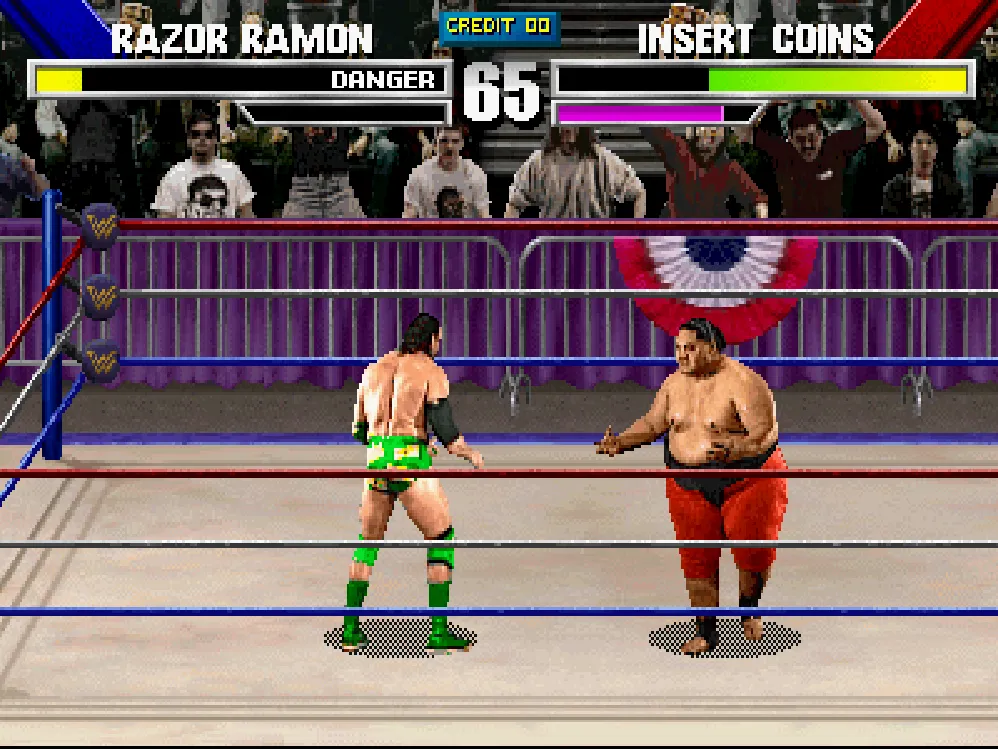
WWF WrestleMania (Arcade) brings the "New Generation Era"—the golden age of the World Wrestling Federation (WWF, now WWE) in the mid-1990s—straight to the arcade screen. The premise is simple: you are a superstar of the WWF, stepping into the ring to beat your opponents until they bleed (or spill bizarre items), win the Intercontinental title, and eventually claim the WWF Championship throne. But Midway delivered far more than a realistic wrestling simulation—it’s a comic-book-style, exaggerated, and violent arcade fighting spectacle.
Every strike in the ring is accompanied by thunderous sound effects, and every finisher looks like a panel ripped straight from a superhero comic. The Undertaker can unleash spirits and demons from his hands, Razor Ramon’s arms transform into sharp blades, and Bam Bam Bigelow’s head erupts in flames. This isn't an ESPN sports broadcast—it’s the wild result of Midway’s "Mortal Kombat" engine colliding with the star power of the WWF.
1.2 Development History
Released by Midway in 1995, WWF WrestleMania was an experiment in applying their "digitized real-life footage + exaggerated action" formula to professional wrestling, following the massive success of Mortal Kombat and NBA Jam.
The game runs on the Midway Wolf Unit arcade hardware, equipped with an ADSP2150 audio processor and Midway’s DCS (Digital Compression System). Like Mortal Kombat, the characters aren't hand-drawn; they are digitized sprites created from motion-captured footage of real WWF wrestlers. Bret Hart later admitted in an interview that the multi-day motion capture sessions "took a lot out of me." Superstars like The Undertaker, Yokozuna, and Shawn Michaels all participated in the motion capture themselves—performing their signature moves and hit reactions repeatedly in a studio, which was grueling, high-intensity work at the time.
Lead programmer Mark Turmell completed the game with a near-manic work ethic—six months of "sixteen hours a day, seven days a week." Constant playtesting in the office and the relentless drive of artists like Sal DiVita helped polish this arcade classic.
the voice cast is equally legendary: WWF commentators Vince McMahon and Jerry "The King" Lawler provided ringside commentary, while Howard Finkel recorded the opening introductions.
Commercially, the arcade version was a hit, with RePlay magazine ranking it as the third most popular arcade game in the U.S. at the time. The following year, home console ports developed by Sculptured Software and published by Acclaim arrived on almost every major platform (Genesis/32X/SNES/PS/Saturn/MS-DOS). The PlayStation version earned an EGM Platinum Editor's Choice award (9/10), with critics noting it "made anyone wanting to make a wrestling game on the PS give up."
II. Character Profiles
The arcade version features 8 playable WWF superstars, each presented with digitized real-life footage and exaggerated, comic-style special moves.
Bret "The Hitman" Hart
| Attribute | Rating |
|---|---|
| Striking | ★★★★☆ |
| Grappling | ★★★★★ |
| Speed | ★★★☆☆ |
| Difficulty | ★★★☆☆ |
- Signature Move: Sharpshooter – The iconic submission hold of the Hart family; connects with various strike combos.
- Bleed Item: Valentine Hearts – Instead of blood, he spills pink hearts when hit, a nod to his "Heartbreak Kid"-adjacent persona.
- Verdict: A technical wrestler's arcade dream. Bret’s striking and grappling are perfectly balanced. His combo chains are ideal for beginners learning the "strike-to-grapple" transition. Midway’s motion capture precision for him is the highest in the game—you can clearly recognize his signature ring walk and stance.
The Undertaker
| Attribute | Rating |
|---|---|
| Striking | ★★★★★ |
| Grappling | ★★★★☆ |
| Speed | ★★☆☆☆ |
| Difficulty | ★★★☆☆ |
- Signature Move: Tombstone Piledriver – Drives the opponent's head into the mat; Spirit Blast – Fires a projectile from his hands.
- Verdict: The character with the most supernatural elements. The Undertaker can unleash spirit energy—something that certainly didn't happen in real WWF matches, but fits perfectly into Midway’s Mortal Kombat-style aesthetic. He is a classic "heavy hitter"—large frame, high damage, but slow speed. During motion capture, The Undertaker even performed a high-difficulty Moonsault, a feat still talked about by wrestling game fans today.
Shawn Michaels — "The Heartbreak Kid"
| Attribute | Rating |
|---|---|
| Striking | ★★★☆☆ |
| Grappling | ★★★★☆ |
| Speed | ★★★★★ |
| Difficulty | ★★★★☆ |
- Signature Move: Sweet Chin Music – A lethal superkick with lightning-fast speed and high damage. The game uses his 1994 "Sexy Boy" entrance theme (the version featuring Sherri Martel).
- Verdict: The fastest character in the game. Shawn’s lightweight frame translates into incredibly fast animation frames. His playstyle is "hit and run," using his speed to land Sweet Chin Music during the opponent's recovery frames. High skill ceiling; beginners may struggle due to his low health.
Razor Ramon
| Attribute | Rating |
|---|---|
| Striking | ★★★★☆ |
| Grappling | ★★★★☆ |
| Speed | ★★★☆☆ |
| Difficulty | ★★★☆☆ |
- Signature Move: Razor's Edge – A powerful throw where he lifts the opponent overhead before slamming them down. His special attacks feature blades sprouting from his arms—a direct homage to his "street thug" persona.
- Verdict: A standard balanced character with above-average striking and grappling. Razor's Edge is one of the most visually impactful throws in the game. Razor Ramon was a "bumping machine" during motion capture, repeatedly performing high-difficulty landings with impressive dedication.
Yokozuna
| Attribute | Rating |
|---|---|
| Striking | ★★★★★ |
| Grappling | ★★★★★ |
| Speed | ★☆☆☆☆ |
| Difficulty | ★★★★☆ |
- Signature Move: Banzai Drop – A devastating finisher where he uses his massive weight to sit on the opponent's chest.
- Verdict: The largest character in the game. Yokozuna’s speed is painfully slow, but once he gets close, his grappling damage and pressure are terrifying to speed-based characters. He is a literal "human wall" capable of absorbing massive punishment. The SNES port even had to delete Yokozuna and Bam Bam Bigelow due to memory constraints—a testament to how much data his sprites required. Requires precise distance control to be effective.
Bam Bam Bigelow — "The Beast from the East"
| Attribute | Rating |
|---|---|
| Striking | ★★★★★ |
| Grappling | ★★★★☆ |
| Speed | ★★★★☆ |
| Difficulty | ★★★☆☆ |
- Signature Move: Flaming Headbutt – His head ignites in flames during the attack. He is one of the few characters weighing nearly 300 lbs who possesses high mobility—a contradiction that made his motion capture sessions quite grueling.
- Verdict: An unreasonable combination of heavy weight and high speed—an intentional exaggeration by Midway for gameplay purposes. Bam Bam’s Flaming Headbutt is one of the coolest special moves in the game. His iconic flame-tattooed look from the WWF is perfectly digitized.
Doink the Clown
| Attribute | Rating |
|---|---|
| Striking | ★★☆☆☆ |
| Grappling | ★★★☆☆ |
| Speed | ★★★☆☆ |
| Difficulty | ★★★★☆ |
- Signature Move: Conjures a giant rubber mallet out of thin air—the most surreal move in the game. He also has various "clown trick" interference moves.
- Verdict: The "comic relief" of WWF WrestleMania. Doink’s raw power ranks at the bottom of the 8, but his bizarre moves, unpredictable patterns, and psychological tactics make him the most annoying opponent in the hands of a pro. He is a character designed to "troll" rather than "defeat" opponents.
Lex Luger — "The All-American"
| Attribute | Rating |
|---|---|
| Striking | ★★★★☆ |
| Grappling | ★★★★☆ |
| Speed | ★★☆☆☆ |
| Difficulty | ★★☆☆☆ |
- Signature Move: Torture Rack – A submission hold where he carries the opponent on his shoulders and bends them backward. The Forearm Smash is his core starter move.
- Bleed Item: Dumbbells – He spills dumbbells instead of blood when hit, playing into his "muscle-bound hero" persona.
- Verdict: One of the most beginner-friendly choices. Luger’s power-based style is straightforward—start with a Forearm Smash, finish with a grapple combo. His "All-American" persona is fully "cartoonized" in the game.
Hidden Character: Adam Bomb — Unfinished
According to Midway executive Roger Sharpe and developer Sal DiVita, Adam Bomb was originally planned as a hidden character but was never completed. His data remains in the arcade ROM, but he is unplayable in any version. The debate over whether he is "actually selectable" has lasted over twenty years and remains one of the most persistent rumors in the wrestling gaming community.
III. Controls
3.1 Basic Controls
The game uses an 8-way joystick + 5 action buttons—two more than Midway’s previous Mortal Kombat, reflecting the game's focus on wrestling move variety:
| Button | Action | Description |
|---|---|---|
| A | Light Punch | Fast strike, combo starter |
| B | Heavy Punch | High damage, slower startup |
| C | Block | Defend against attacks |
| D | Light Kick | Low attack, kick combo starter |
| E | Heavy Kick | High damage kick |
| Joystick + Button | Grapple | Different directions + buttons trigger different throws |
3.2 Core Systems
Strike + Grapple Hybrid System: Unlike pure fighting games, WWF WrestleMania is a fusion of striking and grappling. Most of the match takes place standing—similar to the rhythm of Mortal Kombat—but every character has 2-3 directional throws (front, back, corner), and throws generally deal more damage than strikes.
Comic-Style Finishers: Every character has surreal special attacks—The Undertaker’s spirit projectile, Razor’s arm blades, Doink’s rubber mallet. These are the strongest moves in the game, but require specific distance and joystick inputs.
Unique "Bleed" System: When hit by heavy attacks, characters "bleed"—but instead of blood, they spill funny items matching their personality: dumbbells for Luger, hearts for Bret, toys for Doink. This was a clever design by Midway to bypass censorship while maintaining the game's violent DNA.
Vince + Jerry Ringside Commentary: The duo appears as digitized avatars in the corner of the screen, chiming in during matches: "He's going for the pin!", "What a maneuver!"—these sparse but accurate voice clips add a unique arcade immersion to every match.
IV. Game Modes & Strategy
WWF WrestleMania offers four modes:
4.1 Intercontinental Championship
| Item | Content |
|---|---|
| Schedule | 4 matches (1v1) → 2 matches (1v2) → 1 match (1v3), 7 matches total |
| Strategy | The Intercontinental route is the "beginner" path. The first 4 matches are easy, allowing you to adapt to your character. The 5th-6th matches (1v2) are the real challenge—facing two opponents means you can't focus on just one; use "block + movement" to make them collide. The final 1v3 tests your ability to find openings while being swarmed—use the invincibility frames of your throws to break the cycle of being beaten down. |
4.2 WWF Championship
| Item | Content |
|---|---|
| Schedule | 4 matches (1v2) → 2 matches (1v3) → WrestleMania Challenge (Gauntlet), 7+ matches total |
| Strategy | The final stage of the Championship mode—the "WrestleMania Challenge"—is a gauntlet: you start 1v3, and every time you defeat an opponent, a new one rushes in from the back. You must defeat all 8 wrestlers in a row to win. Core strategy: Every round is a 3-on-1 swarm, so quickly finishing off low-health opponents is more important than flashy combos—removing one person doubles your survival space. |
4.3 Tag Team Mode
Two modes: Co-op (two players vs. AI team) and Versus (two players vs. each other). In Co-op, you and your partner need to coordinate—one focuses on crowd control and drawing fire, the other focuses on landing finishers.
V. Tips & Advanced Strategy
5.1 Basic Survival Tips
- Blocking is your only defense: No dodging, no rolling. Hold C to block when the opponent throws a heavy attack—a successful block creates a ~0.5-second "opponent recovery window," which is your best chance to counter.
- Grapples > Strikes—especially in Boss fights: You are briefly invincible during a grapple, and the damage is much higher than normal strikes. In the final gauntlet of Championship mode, the invincibility frames of your throws are your lifeline.
- Use the corners: Cornering an opponent limits their movement and significantly increases your throw accuracy.
- Watch the "bleed" animation: Each character’s hit-stun animation is slightly different—learn which attacks cause the longest stun, then link your finisher during that window.
- Don't throw specials out of nowhere: The Undertaker’s spirit blast or Razor’s blades have very low hit rates if used randomly. Use them when the opponent is getting up (recovery animation) or when you have them cornered for double the accuracy.
5.2 Advanced Trivia
- The Genesis version is the best cartridge port: The SNES version removed Yokozuna and Bam Bam Bigelow and suffered from slowdown when 3 characters were on screen. The Genesis version kept the full 8-man roster and supported 4-player screen action (with minor slowdown), making it the best 16-bit home version.
- The PS version removed background music: Due to storage constraints, the PS version removed the in-match BGM (it only plays a winner's theme after a 1v1 victory). The graphics are the best of all versions, but a silent wrestling ring feels a bit strange.
- Arcade exclusivity without a true sequel: While Acclaim released WWF In Your House in 1996 as a spiritual successor, the arcade experience of WWF WrestleMania was never 100% replicated on home consoles—the arcade version had higher frame rates, larger sprite sizes, and full live commentary.
VI. Trivia & Arcade Legends
6.1 "Virtual Bleeding"—Midway’s Censorship Genius
In 1995, the U.S. gaming industry was under intense pressure regarding violence—the ESRB rating system was less than a year old. Midway’s Mortal Kombat series was at the center of the storm. When developing WWF WrestleMania, they faced a dilemma: blood was essential to wrestling—it was part of the WWF storyline. Midway’s solution was genius: let characters "bleed" when heavily damaged, but instead of blood, they spill funny items matching their personality—dumbbells, hearts, toys. This design kept the violent atmosphere while bypassing censorship, becoming the game's most memorable feature.
6.2 Bret Hart: Motion Capture Nearly Killed Me
In the 2020s, Bret Hart recalled his motion capture experience, stating, "That shoot wore me out." Motion capture technology back then was much cruder—actors had to wear skin-tight suits covered in sensors and perform their signature moves and "hit reactions" over and over in a green-screen studio with no audience. Hart specifically mentioned that repeatedly performing the Sharpshooter put immense pressure on his back—the technique required maintaining a leg-locking position (against thin air) for several seconds. The Undertaker even performed a Moonsault—a backflip by a 300lb giant, which is extremely dangerous even on safety mats. In 2024, nearly 30 minutes of behind-the-scenes footage of The Undertaker’s motion capture resurfaced, drawing massive attention from wrestling game fans.
6.3 Mark Turmell’s "Six Months of Hell"
Lead programmer Mark Turmell worked for six months straight, seven days a week, sixteen hours a day. He stated in interviews that "internal matches" in the office were the main driver of development—the Midway team would play the unfinished version during breaks, and artist Sal DiVita would rush into the programmers' office daily saying, "This move needs three more frames of animation" or "This hit impact isn't hard enough." This "internal die-hard fan-driven" development model was the secret sauce behind Midway’s string of hits in the 1990s.
6.4 Adam Bomb: The 9th Man Who Never Was
The debate over whether Adam Bomb was a hidden character has lasted over twenty years. Some players claimed to have selected him via complex button combinations in the arcade; others believed he was just leftover data in the ROM—a character cut by Midway at the last minute. Sal DiVita finally confirmed: Adam Bomb was indeed planned as a hidden character but was cut before completion. Some of his animation and move data remained in the arcade ROM, but he is not fully playable in any version.
6.5 Lasting Influence on Classics like WWF No Mercy
Although publisher Acclaim later pursued their own direction for home console wrestling games (WWF War Zone, WWF Attitude), the N64 masterpieces developed by THQ and AKI, WWF WrestleMania 2000 and WWF No Mercy, spiritually inherited the core philosophy of the WWF WrestleMania arcade version—replacing the clunky simulation controls of early wrestling games with a fast-paced strike-and-grapple system. In this sense, the arcade version of WWF WrestleMania laid the operational framework for wrestling games for the next decade.