All arcade games support online multiplayer. No registration or installation required—play directly in your browser.
Oriental Legend Special: Dance of the Demons
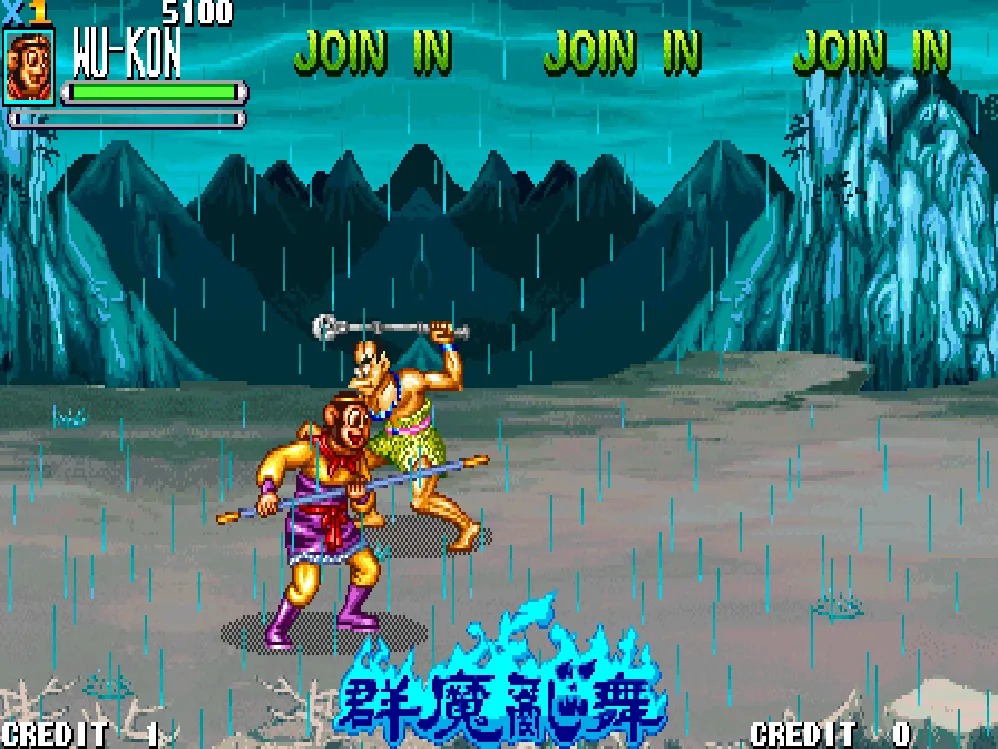
Play the arcade classic "Oriental Legend Special: Dance of the Demons" for free in your browser—no login required. Experience the legendary Journey to the West with 4-player co-op, magical artifacts, and intense beat-'em-up action.
About Arcade Games: Oriental Legend Special: Dance of the Demons
"Oriental Legend Special" (known in Chinese as *Xi You Shi E Zhuan: Qun Mo Luan Wu*) is a PGM beat-'em-up released by IGS in 2004, featuring support for up to 4-player cooperative play.
I. Game Background
1.1 World Setting
The story of Oriental Legend Special is rooted in the Chinese classic Journey to the West, following the four pilgrims (Sun Wukong, Zhu Bajie, Sha Wujing, and Tang Sanzang) on their quest to the West. However, in this version, the perspective is fundamentally flipped: the demons are no longer just background fodder—they are active participants in the story.
"Dance of the Demons" (Qun Mo Luan Wu)—the title itself signals the core change: the demon faction characters are no longer just bosses; they are playable warriors. Red Boy, the Spider Demoness, Tiger Strength, the White Bone Demoness, the Golden Winged Peng, the White Elephant King, and the Azure Lion King—all of whom were defeated or destroyed in the original work—now possess complete move sets and independent story arcs. They will fight alongside (or against, in certain branches) the pilgrim team to face the ultimate evil lurking at the end of the journey: the Phantom Demon.
1.2 Development History
Developed by Taiwan's International Games System (IGS), Oriental Legend was a strategic follow-up to the massive success of Knights of Valour, applying their mature beat-'em-up engine to another classic Chinese IP. The original Oriental Legend (1997, PGM board) took arcades by storm with its 4-player cooperative gameplay. The 2004 "Super" version overhauled the system, adding the "Illusion Realm" transformation mechanic and expanding the artifact and combo systems.
Dance of the Demons is the definitive version of the Super series. The title was IGS's direct response to the player community—in previous versions, players constantly asked: "Why can't I play as Red Boy? Why is Tiger Strength only a boss?" IGS answered by giving them everything they wanted. Every demon was given a full move set, exclusive artifacts, and a unique ending. It stands as one of the final triumphs of the arcade beat-'em-up era. Released in 2004, when arcades in mainland China were already in decline, this title gained a second life in the emulator era thanks to its extreme character variety and cooperative depth.
II. Character Introduction
The greatest feature of Dance of the Demons is that both "Good and Evil" sides are playable. Characters are divided into two factions: the Pilgrim Team (Good) and the Demon Faction (Evil).
Overview: The most agile character in the game. The Jingu Bang offers massive range, fast combos, and the most versatile aerial attacks. His "72 Transformations" allow for various forms—shrinking, flying, and cloning—making him the ultimate all-rounder for clearing mobs and suppressing bosses.
Zhu Bajie — Marshal Tianpeng
Attribute
Rating
Attack
★★★★★
Speed
★★☆☆☆
Combo Ability
★★★☆☆
Difficulty
★★☆☆☆
Weapon: Nine-Tooth Rake.
Artifacts: Milky Way Water (Area damage), 36 Transformations (Defense boost).
Overview: A powerhouse. The rake's sweep has incredible range, and his single-hit damage is second only to Sha Wujing. Bajie has the highest HP in the game—he is a tank who can survive in the thick of battle.
Sha Wujing — General Curtain-Lifting
Attribute
Rating
Attack
★★★★★
Speed
★☆☆☆☆
Combo Ability
★★☆☆☆
Difficulty
★★★★☆
Weapon: Demon-Subduing Staff.
Artifacts: Quicksand Domain (Slow trap), Arhat Golden Body (Temporary invincibility).
Overview: The highest single-hit damage in the game. His heavy staff attacks can shave off 1/4 of a boss's health bar—but his recovery time is massive. Not for beginners; you need to know boss patterns perfectly to land hits and retreat safely.
Tang Sanzang — Reincarnation of Golden Cicada
Attribute
Rating
Attack
★★☆☆☆
Speed
★★☆☆☆
Combo Ability
★★★☆☆
Difficulty
★★★★★
Weapon: Nine-Ring Staff + Buddhist Spells.
Artifacts: Tight-Fillet Spell (Silences enemies), Tathagata Sutra (Full-screen Buddhist attack).
Overview: The most unique character—a mage, not a warrior. His physical damage is low, but his Buddhist spells (artifact system) are the most powerful in the game. Certain artifacts are twice as effective in his hands. The ultimate choice for item-focused players.
Xiao Longnu — Dragon Princess
Attribute
Rating
Attack
★★★☆☆
Speed
★★★★★
Combo Ability
★★★★★
Difficulty
★★★★☆
Weapon: Ice Crystal Sword.
Artifacts: Frozen World (Freeze), Dragon Roar Wave (Water shockwave).
Overview: The speedster of the pilgrim team. Her light attack density is extremely high, and her ice spells provide excellent crowd control. Her fragility is the trade-off—she has the lowest HP in the game.
The Demon Faction
Red Boy — The Holy Infant
Attribute
Rating
Attack
★★★★☆
Speed
★★★★★
Combo Ability
★★★★☆
Difficulty
★★★☆☆
Weapon: Fire-Tip Spear.
Artifacts: Samadhi Fire (Continuous burn), Fire Wheels (Orbiting fireballs).
Overview: The most popular character in the demon faction. His spear attacks combine speed with fire-based area damage. His crowd-clearing efficiency rivals Sun Wukong's, and his Samadhi Fire is the strongest damage-over-time artifact.
Spider Demoness — Mistress of the Silk Cave
Attribute
Rating
Attack
★★★☆☆
Speed
★★★★☆
Combo Ability
★★★★☆
Difficulty
★★★★☆
Weapon: Spider Silk + Poison Claws.
Artifacts: Heaven and Earth Net (Mass bind), Spider Venom (Poison damage).
Overview: A crowd-control specialist. Her webs can bind multiple enemies at once, making her the most valuable support character in 4-player co-op. When playing solo, her poison is her core damage source—slowly draining bosses rather than brute-forcing them.
Tiger Strength — Taoist of Chechi
Attribute
Rating
Attack
★★★★★
Speed
★★☆☆☆
Combo Ability
★★☆☆☆
Difficulty
★★★☆☆
Weapon: Tiger-Head Broadsword.
Artifacts: Five Thunder Method (Lightning strike), Weather Control (Weather barrier).
Overview: The "heavy tank" of the demon faction. His broadsword hits as hard as Sha Wujing's staff, but he is much more durable. The downside is that he is so slow you could drink a cup of tea between swings. Recommended for patient, power-focused players.
Overview: The technical master of the demon faction. Her twin swords are fast and fluid. Her "Decoy" ability creates a clone to draw fire, allowing the real body to flank and attack—a mechanic that is invaluable in boss fights.
Other Demon Characters
Golden Winged Peng: A bird demon known for speed and aerial dashes, possessing the best air-combat ability.
White Elephant King: A powerhouse giant who uses his trunk and immense strength for devastating close-range attacks.
Azure Lion King: A balanced demon warrior whose "Lion's Roar" provides area-of-effect stun, making him a core crowd-control unit.
III. Controls
3.1 Basic Controls
Key
Action
Description
A
Attack
Press repeatedly for basic combos
B
Jump
Allows for aerial attacks
C
Select Artifact
Cycle through equipped artifacts/items
D
Use Artifact
Activate the selected artifact
↓↘→ + A
Special Move
Powerful move consuming Ki
A+B
Combo Move
Joint special move for 2-player co-op
3.2 Artifact System
Artifacts are the core system that distinguishes the Oriental Legend series. Each character has exclusive artifacts, and general artifacts can be collected throughout levels.
Type
Examples
Effect
Attack
Samadhi Fire, Five Thunder, Heaven Blade
Large area damage
Control
Tight-Fillet, Web, Frozen World
Bind/Freeze/Silence enemies
Support
Somersault Cloud, Arhat Body, Quicksand
Speed/Invincibility/Slow traps
Recovery
Peach, Ginseng Fruit, Elixir
Restore HP/Ki
Artifacts are cycled with C and used with D. They enter a cooldown after use—resource management (when to use them and on which boss) is key to clearing high-difficulty stages.
3.3 Illusion Realm
Inherited from the Super version—after meeting specific conditions (e.g., using a specific artifact in a specific scene), characters enter the "Illusion Realm." In this state, attack power and speed are greatly increased, and artifact cooldowns are halved. It is limited in duration, but while it lasts, you are unstoppable.
IV. Stages and Boss Strategy
4.1 Five Elements Mountain → Gao Village
Item
Content
Scene
Starting from the foot of Five Elements Mountain. Forest paths and the Flowing Sand River—classic Journey to the West scenes rendered in IGS's signature pixel art style.
Boss
Black Wind Demon—A bear demon with thick skin, focusing on charges and paw swipes.
Strategy
The tutorial boss. The charge attack has a clear wind-up (pawing the ground for 1.5s)—the perfect window to flank. Use this fight to test different artifacts for future resource management.
4.2 Yellow Wind Ridge → White Tiger Ridge
Item
Content
Scene
A ridge ravaged by gales. Sandstorms affect visibility—the White Bone Demoness's "Decoy" is highly valuable here (the clone attracts enemies hidden by the sand).
Boss
Yellow Wind Demon (Yellow Wind Ridge) + White Bone Demoness (White Tiger Ridge, demon route). The Yellow Wind Demon's gale is the most frustrating crowd-control move in the game—getting hit knocks you to the other side of the screen and stuns you.
Strategy
The core strategy is "don't get blown away." He takes a deep breath (1s) before releasing the wind; move to the top or bottom of the screen to dodge. Getting stunned and then comboed by mobs is the most common cause of death here.
4.3 Chechi Kingdom → Tongtian River
Item
Content
Scene
The arena of Chechi Kingdom. Interact with incense burners to find supplies. Tongtian River is an ice stage—movement has inertia.
Boss
Three Taoist Demons (Chechi) / Spirit King (Tongtian River). The Three Taoists fight is the only "3-boss-at-once" battle in the game.
Strategy
Their coordinated attacks are brutal. Strategy: Prioritize killing the Yang Taoist (the ranged threat), then the Deer Taoist, and finally the Tiger Taoist. AOE artifacts like Samadhi Fire are invaluable here.
4.4 Flaming Mountain → Silk Cave
Item
Content
Scene
Flaming Mountain—lava and scorched rock. The environment deals constant minor fire damage. Silk Cave—a dark, web-filled cavern.
Boss
Bull Demon King (Flaming Mountain) / Spider Demoness (Silk Cave). The Bull Demon King is one of the largest bosses, with attacks covering half the screen.
Strategy
The environmental damage means you must finish quickly. The Bull Demon King's axe slam creates a full-screen shockwave—jump at the moment of impact. This is the best time to trigger the Illusion Realm to maximize damage output.
4.5 Little Thunder Monastery → Final Battle
Item
Content
Scene
A golden temple of a false Buddha. Opulent yet sinister—the statues have twisted expressions and the scriptures are inverted.
Boss
Yellow Eyebrow Buddha (Mid-boss) + Phantom Demon (Final Boss). The Phantom Demon is an original boss for Dance of the Demons—a manifestation of the resentment of all demons defeated along the journey.
Strategy
The Yellow Eyebrow Buddha uses fake artifacts to seal you in a pocket dimension where you cannot use your own items—rely on basic combat skills. The Phantom Demon has three phases: 1. Summoning ghosts of previous bosses; 2. A giant demon amalgamation; 3. A human form—extremely fast with illusions—the hardest 1v1 in the game.
V. Tips and Advanced Strategy
5.1 Survival Tips
Artifacts aren't luxury items—use them: Don't hoard them. Cooldowns aren't as long as you think—you can use them at least twice per boss fight.
Don't waste combo moves on mobs: A+B consumes a lot of Ki. Save them for the boss's berserk phase when the output window is shortest.
Ki Management: Ki is your "ammo." It increases when you take damage. It's a dangerous balance—don't intentionally take damage just to build Ki.
Illusion Realm Timing: Use it in the first half of a boss fight to maximize damage before they enter their berserk phase.
2-Player Positioning: 1P distracts from the front, 2P attacks from the back. Backstabs deal more damage—a universal rule in beat-'em-ups.
5.2 Advanced Knowledge
Demon Faction Story Branches: Choosing demon characters changes dialogue and some boss interactions—some bosses will recognize you as kin, though the fight still triggers.
Elemental Weaknesses: Fire-based artifacts deal extra damage to ice enemies; lightning conducts in water. These are hidden mechanics discovered by the community over 20 years.
Combo Move Pairings: Different character combinations (e.g., Wukong + Bajie vs. Wukong + Longnu) result in different damage values. Experiment to find the "strongest duo."
VI. Trivia and Arcade Legends
6.1 IGS's "Dual IP Strategy"
IGS pursued a clear "Dual IP Strategy" in the late 90s: Knights of Valour (Three Kingdoms) and Oriental Legend (Journey to the West). Both shared the PGM engine but differed in art and narrative. In mainland China, these two titles defined the beat-'em-up genre, proving that Chinese developers could compete head-to-head with Japanese giants.
6.2 "Dance of the Demons"—Responding to Players
The title Dance of the Demons was a direct response to the community. Players wanted to play as the bosses. IGS didn't just add one or two characters; they made the entire demon faction playable, each with unique move sets and story branches. Few companies would invest such resources into a "dying industry" product in 2004, but IGS did.
6.3 The Phantom Demon—An Original Ending
The original Journey to the West ends with the pilgrims achieving enlightenment. The Phantom Demon, however, is an original creation—a manifestation of the resentment of all the demons the players defeated. It adds a philosophical weight: where did all that hatred go? It accumulated into your final, most powerful enemy.
6.4 The Emulator Era
When Dance of the Demons was released, arcades were in decline. The emulator community (FBNeo, MAME) kept the game alive for two decades, making it a pillar of the Chinese retro gaming scene.
FAQ
Q1: What is the difference between "Dance of the Demons" and "Oriental Legend Super"?
A: The biggest difference: The demon faction characters are now playable (Red Boy, Spider Demoness, Tiger Strength, White Bone Demoness, Golden Winged Peng, White Elephant King, Azure Lion King). It also adds unique dialogue, branching paths, and the original final boss, the "Phantom Demon."
Q2: Which character is best for beginners?
A: Sun Wukong (Pilgrim) or Red Boy (Demon). Both are speed/combo types with fluid attacks, practical artifacts, and a low learning curve.
Q3: How many players can play at once?
A: Up to 4 players in cooperative mode.
Q4: How do I use artifacts? Can I use them infinitely?
A: Use C to cycle and D to release. Artifacts have a cooldown—shorter for attack types (10-15s) and longer for ultimate types (30-45s).
Q5: How do I trigger the Illusion Realm?
A: It triggers automatically under specific conditions—usually by using a specific artifact in a specific scene or when your HP drops below a certain threshold. It doubles attack power and halves cooldowns.
Q6: Is the story consistent with the original "Journey to the West"?
A: The first half follows the original framework, but the final boss, the "Phantom Demon," is an original creation—a manifestation of the resentment of all defeated demons, transcending the original world view.
In the 1990s, when Street Fighter and The King of Fighters ruled the arcades, Samurai Shodown chose the loneliest path: slow-paced, one-hit-kill, weapon-based combat. For 30 years, it has never been mainstream, nor has it ever needed to be.
From Final Fight to The Punisher, spanning 1986 to 2020: an in-depth analysis, ranking, and recommended play-through guide for the 15 best beat 'em up games.
A curated list of 25 essential classic arcade games, covering beat 'em ups, fighting, shoot 'em ups, platformers, sports, and puzzle games, complete with a quick-reference index.
Arcade Game Box uses cookies to keep the site running properly and provide a better browsing experience.