I. Game Background
1.1 World Setting
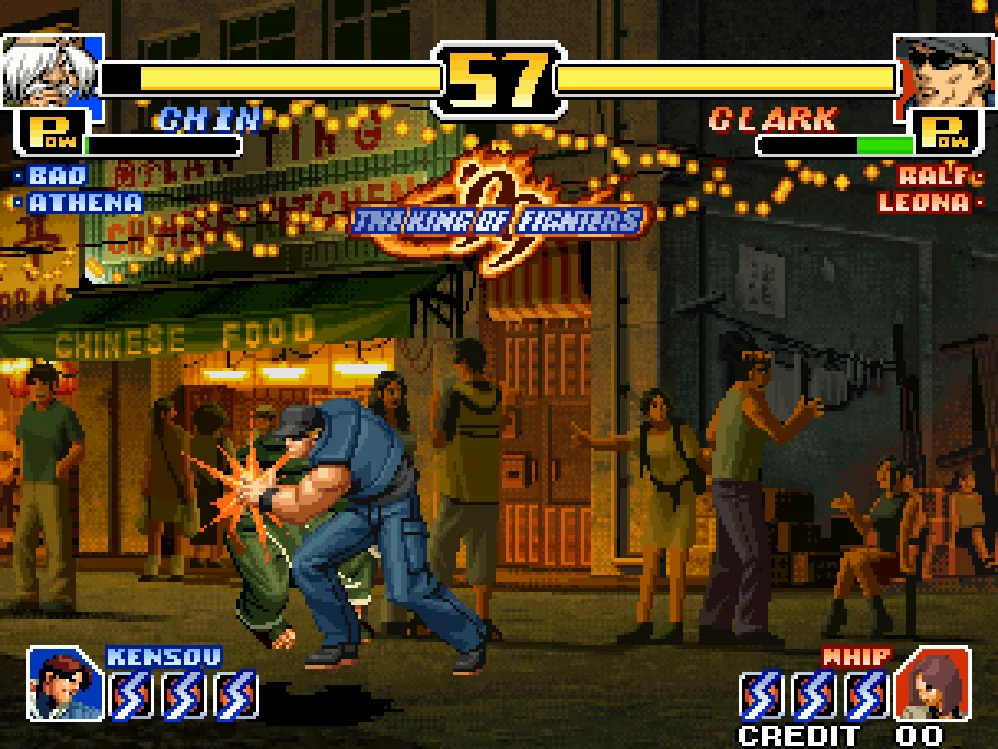
The King of Fighters '99 (KOF '99) marked a complete reboot for the series. After Kyo Kusanagi, Iori Yagami, and Chizuru Kagura sealed away Orochi in KOF '97, the Orochi Saga reached an epic conclusion. KOF '98 served as a "Dream Match" title without a narrative focus. When KOF '99 hit arcades on July 22, 1999, SNK faced a massive challenge: how to start a new chapter after such a legendary finale?
The answer was the NESTS Saga.
A mysterious organization known as NESTS emerged from the shadows. Unlike the Orochi clan, who sought supernatural power, NESTS was a highly technological secret society. They mastered cloning, bio-engineering, and mechanical augmentation, with the ultimate goal of creating "perfect humans" to rule the world.
The story begins with the disappearance of Kyo Kusanagi. Following the Orochi battle, NESTS captured an exhausted Kyo to extract his DNA for cloning experiments. His flame powers were replicated in several test subjects, the most successful being the new protagonist—K'. When NESTS hosted a new KOF tournament, K' and his partner Maxima infiltrated the event to destroy the organization from within.
Meanwhile, Iori Yagami and Kyo Kusanagi appeared as hidden characters. Iori was enraged that clones were tainting his unique rivalry with Kyo. Kyo, scarred by his imprisonment and experimentation, shed his iconic school uniform for a black leather jacket—a redesign that was widely praised by players and marked a new stage in his character development.
The NESTS Saga introduced heavy themes like cloning, identity, human experimentation, and memory tampering. As a "weapon" created by NESTS, K' knew nothing of his past. When he discovered he was merely a tool built to replace Kyo Kusanagi, revenge became his sole driving force.
1.2 Development History
KOF '99 was directed by Tomoyuki Hosokawa and produced by Takashi Nishiyama—his final KOF project before leaving the company in 2000. The art was handled by Shinkiro, and Krizalid’s trench coat animation was hailed as "one of the most detailed character sprites of the Neo Geo era."
The development team’s biggest challenge was creating a new lead after Kyo and Iori. Designer Inoue was tasked with creating K'—a silent, hostile anti-hero with a fighting style dubbed "Pure Violence," contrasting sharply with Kyo’s fiery personality. SNK faced massive backlash during early location tests when players realized Kyo and Iori were missing. SNK was forced to relent, making them hidden, unlockable characters. Kyo’s new leather jacket look was also a major hit, with both players and developers considering it "one of SNK’s best designs."
Developers still loved Kyo’s school uniform, so they created a clever solution: Kyo-1 and Kyo-2, two clones using movesets from different eras. These characters served both as a plot point for the NESTS experiments and a tribute to Kyo’s classic look.
The game’s biggest innovation was the Striker system. Teams expanded from 3 to 4 members (3 active + 1 Striker), allowing players to summon a teammate for a one-time assist. SNK hoped this would encourage players to use a wider roster while adding tactical depth.
II. Character Roster
KOF '99 features 8 teams, plus hidden characters and bosses, totaling nearly 30 fighters.
Hero Team (K' Team): K' is a NESTS cyborg soldier injected with Kyo’s DNA. Maxima is a cyborg and K's only trusted ally. Benimaru Nikaido joins due to Kyo’s disappearance, while Shingo Yabuki (Striker) serves as Kyo’s #1 fan.
Fatal Fury Team: Terry, Andy, and Joe return, with Mai Shiranui joining as the team's official Striker.
Art of Fighting Team: Ryo, Robert, Yuri, and Takuma (Striker) represent the Kyokugen style. Yuri’s moves are more agile than her father and brother's, while Takuma is slowly being phased out of the main roster.
Ikari Warriors Team: Leona, Ralf, Clark, and new member Whip. Whip uses a modified whip and has deep ties to NESTS—she is actually an experimental subject and a relative of someone on K's team.
Psycho Soldier Team: Athena, Kensou, Chin, and newcomer Bao. Bao was added to lower the team’s average age, which was a staggering 42 before his arrival.
Women Fighters Team: King, Blue Mary, Kasumi, and newcomer Li Xiangfei. Xiangfei is a Chinese-American girl specializing in flexible Chinese martial arts.
Korea Team: Kim, Chang, Choi, and newcomer Jhun Hoon. Jhun is a rival to Kim, bringing a fresh, distinct Taekwondo style to the team.
Hidden Characters: Kyo Kusanagi returns in his black leather jacket; Kyo-1 and Kyo-2 inherit moves from KOF '94/'95 and '96/'97 respectively; Iori Yagami’s "Ya Otome" command was changed from counter-clockwise to clockwise—a change that altered muscle memory for a generation of players.
Boss Krizalid: A high-ranking NESTS officer and a clone of K' (though he believes the opposite). He wears a data-analyzing trench coat. The fight features two phases: trench coat and powered-up form. Designers later admitted they "over-engineered" Krizalid, leading to sprite complexity that required some animations to be cut for the Neo Geo version, later restored in the Dreamcast’s KOF '99 Evolution.
III. Controls
3.1 Basic Controls
| Button | Function |
|---|---|
| A | Light Punch (LP) |
| B | Light Kick (LK) |
| C | Heavy Punch (HP) |
| D | Heavy Kick (HK) |
| Forward/Back x2 | Dash / Backstep |
| B+C | Summon Striker |
| A+B+C | Activate Counter or Armor Mode |
3.2 Striker System
The Striker system is the game’s core innovation. Teams consist of 3 active fighters and 1 Striker. Press B+C to summon your Striker for a specific attack. You are limited to 3 summons per match, tracked by the "Strike Bombs" icon.
Strikers vary by type: Offensive (e.g., Mai’s fan dive), Control (throws/knockbacks), or Defensive. Summons can be used during combos, to interrupt pressure, or upon waking up from a knockdown.
This system sparked huge debate. Supporters praised the tactical depth; critics felt it ruined the 1v1 spirit. IGN noted: "KOF purists hate the Striker system," while acknowledging it added a fresh layer of entertainment.
3.3 Counter Mode and Armor Mode
This game merges the two modes from KOF '98 into an Advanced-based design with two special states:
Counter Mode: Greatly increases attack power and allows infinite use of Super Special Moves. Enables "Super Cancel." There is a time limit and a slight defense penalty. Ideal for explosive damage—K' can cancel Ein Trigger into Chain Drive for massive damage.
Armor Mode: Greatly increases defense and reduces hit stun. The character glows gold. However, Super Special Moves are disabled. Perfect for survival when low on health, especially for lightweight characters.
Only one mode can be activated per round. Counter Mode is for "offense as the best defense," while Armor Mode is a purely defensive tool.
IV. Boss Guide: Krizalid
Boss Background
Krizalid is a high-ranking NESTS officer and the final boss. He wears a data-analyzing trench coat. After his defeat, the coat is destroyed, revealing his second, powered-up form.
NESTS sent Krizalid to collect combat data for the "Perfect Human Project." Upon his defeat, NESTS abandoned him, triggering a self-destruct sequence that ended his life—a testament to the organization's cruelty.
Phase 1: Trench Coat Krizalid
Appearance: Dark tech-trench coat, standing in a cold, high-tech control room.
Key Moves:
- Typhoon Rage: Signature move; releases a massive rotating air column for multi-hit damage.
- Cutting Kick: Fast low-hitting dash kick with wind effects.
- Cyclone Barrier: A whirlwind shield that deflects projectiles.
- Data Analysis Dash: A high-speed dash that is nearly impossible to react to.
Strategy:
- Keep mid-to-long range. Krizalid dominates mid-range.
- Avoid projectiles—his Cyclone Barrier will deflect them.
- "Typhoon Rage" has a half-second recovery window—this is your best opening.
- Grapplers can use command throws during his recovery frames.
- He has 1.5x health; be patient.
Phase 2: Unmasked Krizalid
After shedding his coat, his power and speed increase significantly.
Changes: Attack power up ~30%, movement speed increased, new aerial combos, and more frequent "Typhoon Rage."
Strategy:
- Core strategy remains, but the margin for error is razor-thin.
- Save Counter Mode for Phase 2: Activating it here is the most effective way to deal massive damage.
- Do not use moves with long recovery near him; his counter-attack speed is lethal.
- Strikers can interrupt "Typhoon Rage."
- If pressured, keep blocking—he won't break your guard easily. Wait for a gap.
- Designers admitted this boss was "over-tuned"; don't be discouraged by repeated losses.
V. Tips and Advanced Strategy
5.1 Survival Tips
- Master the 3 Striker timings: Extend combos, interrupt pressure, or counter wake-up pressure.
- Don't rush Counter Mode: Use it when you have a guaranteed combo starter for maximum impact.
- Armor Mode is your last resort: Use it when health is critical to survive.
- Know your Striker: Choose one that fits your playstyle (e.g., Terry for zoning, Mai for pressure).
- Learn "Striker baiting": Leave an opening to bait the opponent's Striker, then punish the recovery frames.
- Red Health Supers: You can still use Super Special Moves when your health is flashing red, even if the power gauge isn't full.
5.2 K' Core Combos
K' is one of the top-tier characters. Here are the essentials:
Beginner: Jump Heavy Kick → Close Heavy Punch → Ein Trigger (2nd hit) → Second Shoot Intermediate: Jump Heavy Kick → Close Heavy Punch → Ein Trigger → Summon Striker → Aerial follow-up → Chain Drive Advanced (Counter Mode): Jump Heavy Kick → Close Heavy Punch → Ein Trigger → Super Cancel → Chain Drive → Summon Striker → Aerial follow-up
"Ein Trigger" is K's core zoning and combo starter. "Crow Bites" is his anti-air. "Chain Drive" is his strongest Super—the glove-shattering finish was inspired by a Hong Kong fan comic, a rare case of fan work influencing the game.
5.3 Advanced Trivia
- Krizalid is the clone: The plot twist reveals K' is the "original" and Krizalid is the copy.
- Dreamcast Evolution: One of the most luxurious ports, featuring 3D backgrounds and extra Strikers. Vanessa was planned as a playable character but was relegated to a Striker due to time constraints.
- Iori’s command change: Changing "Ya Otome" from counter-clockwise to clockwise caused massive confusion for veteran players.
- NESTS Trilogy: The story spans KOF '99 to KOF 2001—a grand narrative arc despite SNK's financial struggles.