I. Game Background
1.1 Setting the Scene
Knights of the Round is set during the legendary golden age of King Arthur. In the 6th century, the British Isles were shrouded in war and chaos. Guided by the wizard Merlin, young Arthur pulled the legendary sword Excalibur from the stone, becoming the rightful King of Britain. However, Arthur's throne is far from secure—rebellious lords, invading Saxons, and hidden magical forces all seek to dismantle the order of the Round Table.
King Arthur and his two most loyal knights—Lancelot, the Knight of the Lake, and Perceval, the Knight of the Holy Grail—embark on a journey across Britain: from rebel castles deep in the forests to dragon lairs in the Scottish Highlands, and through cursed castles tainted by dark magic, ultimately facing usurpers and dark sorcerers. Each knight evolves throughout the journey—their armor upgrades from bronze to silver, and finally to gold—symbolizing the elevation of their chivalry.
1.2 Development History
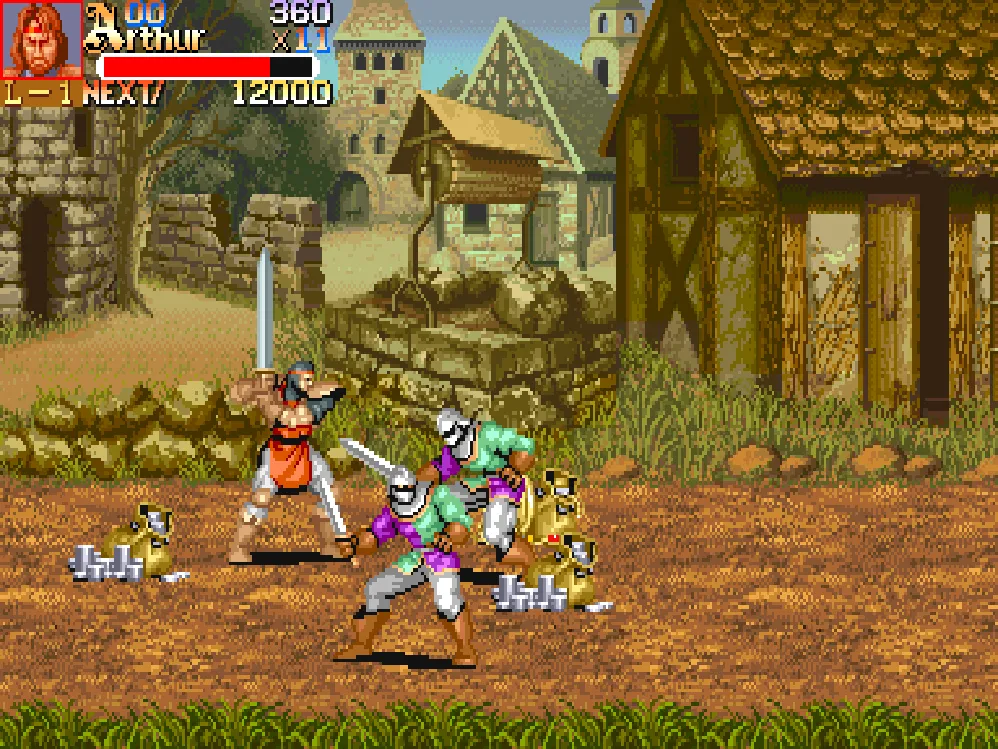
Released by Capcom in 1991 on the CPS1 arcade system, Knights of the Round is one of the four cornerstones of Capcom's golden age of beat-'em-ups (alongside Final Fight, The King of Dragons, and Captain Commando). The game's uniqueness lies in its then-revolutionary leveling system. In most beat-'em-ups, character stats remain static; in Knights of the Round, characters gain experience points by defeating enemies, causing their armor to evolve from bronze to silver to gold, with each upgrade boosting attack power, defense, and speed.
The soundtrack was composed by Capcom's in-house composer Isao Abe, who had previously contributed to Street Fighter II and Final Fight. The score blends medieval folk melodies with orchestral elements. Its main theme bears a subtle resemblance to the Japanese anime Saint Seiya—this is no coincidence, as the composer intentionally wove together the themes of "chivalry" and "passionate combat."
II. Character Profiles
| Character | Weapon | Type | Characteristics |
|---|---|---|---|
| Arthur | Longsword | Balanced | King of Britain. Balanced attack, speed, and range—an all-rounder suitable for any scenario. The best choice for beginners. |
| Lancelot | Broadsword | Speed | Knight of the Lake. Fastest attack and movement speed—can strike enemies before they react. Lower damage but highest combo efficiency. |
| Perceval | Greatsword | Power | Knight of the Holy Grail. Highest attack power—the strongest single-hit damage. Slowest speed—requires precise timing. Recommended for experts. |
Leveling System: Each character has three tiers of armor: Bronze (initial) → Silver (approx. 50,000 points) → Gold (approx. 100,000 points). Gold armor is not just visually stunning—it increases attack power by about 40% and unlocks new attack animations (faster strikes and new combo sequences).
Mount System: In specific stages, you can ride warhorses. Mounted attacks have a significantly larger range—dash attacks can knock away entire rows of enemies.
III. Controls
8-way joystick + 2 buttons:
| Action | Description |
|---|---|
| A (Attack) | Press repeatedly for combos. Each character has a unique rhythm—Lancelot is the fastest, while Perceval is the slowest but hits hardest. |
| B (Jump) | Jump attacks can knock down smaller enemies. You cannot change your jump trajectory in mid-air. |
| A+B | Special Move—consumes about 1/6 of your health to perform a screen-clearing knockback. |
| Block | Hold A and press back—use your sword to parry frontal attacks. Successful blocks reduce damage and allow for a counter-attack. |
| Grab | Automatically grab enemies when close—press Direction + A to throw. |
Core Mechanic—The Block System: Knights of the Round was one of the first Capcom beat-'em-ups to introduce an active blocking mechanic. By holding A + Back, your character enters a defensive stance. Successful blocks allow for immediate counter-attacks, turning boss fights from a war of attrition into a rhythmic cycle of "block, counter, combo, repeat."
IV. Stages and Boss Guide
There are 7 stages in total, with each boss representing a villain or challenger from Arthurian legend.
| Stage | Setting | Boss | Strategy |
|---|---|---|---|
| 1 | Rebel Castle | Scorn—Dual-axe rebel leader | Introductory stage. The axe swings are slow—counter-attack during his recovery frames. Can be cleared in bronze armor. |
| 2 | Deep Forest | Braford—Silver-armored lancer | Long reach with the spear—approach from the side. Blocking his thrusts and countering is the most efficient strategy. |
| 3 | Canyon Fortress | Arlon—Giant with a flail | Large area of effect—keep your distance while he spins the flail. Strike during his 8-frame recovery window. |
| 4 | Dragon's Lair | Phantom—Fire-breathing dragon | Massive size, fire breath covers half the screen. Move to the side when he inhales (the tell for his breath attack). |
| 5 | Dark Castle | Balbars—Dark wizard knight | Teleportation + magic projectiles. Block projectiles, then charge in for a combo. Predict his reappearance after teleporting. |
| 6 | Tournament Grounds | Muramasa—Japanese Samurai (hidden cross-cultural boss) | Extremely fast—the Iaijutsu slash has long range. Blocking is key—he has a 10-frame recovery window after his slash is blocked. |
| 7 | Final Castle | Garibaldi—The usurper boss | Two phases: Phase 1 is sword-and-shield combat (block/counter). Phase 2 is a giant Black Knight—unblockable dark shockwaves. Keep distance and dodge. |
V. Gameplay Tips
- Master the Block: Blocking and countering is the golden rule for boss fights. A successful block grants a free counter-attack window without taking damage—the key to "saving credits" in the arcade. |
- Lancelot's Speed: Interrupt enemies before they strike. Lancelot's fast sword can break through the attack animations of most small and medium enemies. Speed is everything. |
- Perceval's Rhythm: Don't get greedy. Swing once, wait for recovery, observe the enemy, then decide to block or strike again. His high single-hit damage means you don't need to spam buttons. |
- Maximize Mounted Combat: Dash attacks on horseback can clear entire groups of mobs. Always prioritize grabbing a horse whenever available. |
- Leveling Thresholds: Bronze to Silver at ~50,000 points; Silver to Gold at ~100,000 points. Check your score at the end of each stage—if you are close to leveling up, farm extra points from mobs at the end of the stage to ensure you start the next stage with an upgrade. |
VI. Trivia
The Visual Impact of Gold Armor
In 1991, the moment your character upgraded from silver to gold armor on the arcade screen—with golden pixels shimmering on the CRT monitor—it was a near-ritualistic experience for players. "Leveling up" was a brand-new concept in beat-'em-ups; you weren't just "beating the game," you were "growing."
The Subtle Link to Saint Seiya
The game's theme music bears a subtle resemblance to the main theme of the Japanese anime Saint Seiya. Both share the "Medieval Europe + Passionate Combat" theme. Composer Isao Abe was widely recognized at Capcom as the master of melody—the soundtrack remains a top-tier favorite in many retro game music rankings.