I. Game Background
1.1 World Setting
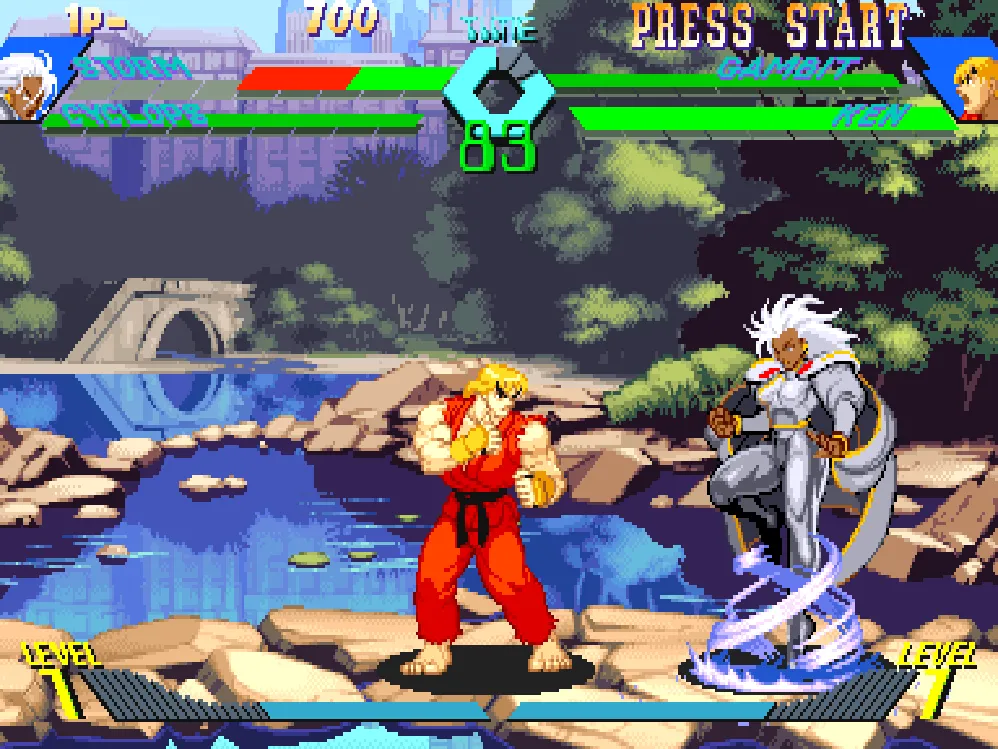
In 1996, CAPCOM did something that sent arcades worldwide into a frenzy: they crammed the world's most popular mutant team from Marvel, the X-Men, and the iconic Japanese fighting IP, Street Fighter, into the same cabinet to duke it out. The game skips complex plot setups, opting for a "parallel universe collision" premise that brings Wolverine and Ryu, Storm and Chun-Li, and Magneto and M. Bison onto the same battlefield. Players select two characters from either side to form a tag-team, defeating various combinations until they face the judgment of the ancient mutant, Apocalypse.
This logic-defying crossover madness is exactly what made 90s arcade culture so charming. The game fuses the precision of Japanese fighting games with the exaggerated aesthetics of American comics—you can control Magneto to lock down opponents with a Magnetic Tempest, then tag in Chun-Li to finish the job with her Lightning Legs. Designed to "cater to the Western market," it deliberately borrowed the tag-team format of American pro-wrestling, setting the wild, uninhibited tone for the entire VS. series that followed.
1.2 Development History
This title is the third Marvel-licensed fighting game released by CAPCOM on the CPS-2 arcade board, following X-Men: Children of the Atom (1994) and Marvel Super Heroes (1995). It was produced by Tetsuya Iizuka, with game design by Atsushi Tomita and music by Yuki Iwai and Yuko Takehara. The arcade version debuted in Japan on September 9, 1996, and hit North America the following month, quickly becoming one of the highest-earning fighting games.
The most critical turning point in development occurred mid-way—the team decided to shift the core gameplay from single-player combat to real-time tag-team switching. According to Tomita, lead programmer Mr. Ikawa was forced to deal with this "unreasonable total rework." While they originally planned unique tag-in attack animations for every character, they eventually standardized them to a kick because it "felt the most comfortable"—a move that later became a hallmark of the VS. series. Another classic element came from a bug: developer Sagata's flash particles for hit effects were considered "not impactful enough." Just as they were about to delete them, a coding error caused them to appear during super jumps. The team thought it "looked pretty cool" and kept it—becoming the super jump effect still used in the VS. series today.
II. Character Introduction
There are 17 playable characters. Most X-Men sprites are inherited from Children of the Atom (Rogue, Gambit, and Sabretooth were newly drawn), while the Street Fighter side is derived from Street Fighter Alpha 2 with significantly exaggerated proportions.
X-Men Characters (8):
| Character (English) | Character (Chinese) | Fighting Style |
|---|---|---|
| Cyclops | 镭射眼 | Mid-to-long range pressure, massive screen coverage with Optic Blast super |
| Wolverine | 金刚狼 | High-speed melee, high-damage claw combos, fast lunging attacks |
| Storm | 暴风女 | Top-tier aerial mobility, lightning attacks cover the whole screen |
| Rogue | 小淘气 | Absorbs opponent moves, highest tactical variability |
| Gambit | 牌皇 | Mid-range zoning with charged cards, fluid staff combos |
| Sabretooth | 剑齿虎 | Heavyweight grappler, surprising lunge speed |
| Magneto | 万磁王 | Projectile pressure, flexible air dashing |
| Juggernaut | 红坦克 | Super armor charge, difficult to interrupt with normal attacks |
Street Fighter Characters (8+1 Hidden):
| Character (English) | Character (Chinese) | Fighting Style |
|---|---|---|
| Ryu | 隆 | All-rounder, extremely exaggerated Vacuum Hadoken effects |
| Ken | 肯 | Enhanced Shoryuken with high damage, excellent air combos |
| Chun-Li | 春丽 | Strong pressure on wake-up with Lightning Legs, fast Kikoken |
| Charlie | 纳什 | Sonic Boom and Somersault Justice cover both range and rushdown |
| Dhalsim | 达尔西姆 | Long-range zoning with limbs, unpredictable Yoga Teleport |
| Zangief | 桑吉尔夫 | Massive command grab range, visually stunning Spinning Piledriver |
| Cammy | 嘉米 | Fast lunge kicks, fluid Spiral Arrow combos |
| M. Bison | 维加 | Massive Psycho Power projectile coverage, dominant hitboxes |
Hidden Character: Akuma—Highlight Magneto, Juggernaut, Dhalsim, or M. Bison on the select screen and press "Up" to select. Features the iconic Raging Demon (LP, LP, Forward, LK, HP).
Final Boss: Apocalypse—A giant character occupying one-third of the screen, possessing super armor. His giant fist slam creates a full-screen shockwave, his drill arm has a long wind-up, and his eye lasers sweep the ground.
III. Controls and Gameplay
3.1 Basic Controls
The game uses the standard CPS-2 six-button layout (Light, Medium, Heavy Punch + Kick). Forward-Forward dashes, Back-Back backsteps; tapping Down then quickly Up performs a Super Jump, allowing for 8-way air dashing. Pressing three punches while blocking pushes the opponent away; while blocking, Down-Back + Heavy Punch + Heavy Kick (consumes one super meter) performs a Variable Counter, tagging in the partner to counter-attack. Press a punch button when grabbed to tech the throw, or Down-Back + Punch when knocked into the air to recover.
The Tag System is the core: Press Heavy Punch + Heavy Kick to perform a Variable Attack—the off-screen character enters with an invincible flying kick. Consuming two super meters and inputting Down-Forward + Heavy Punch + Heavy Kick triggers a Variable Combination, where both characters unleash their supers simultaneously for a full-screen bombardment.
3.2 Supers and Chain Combos
Each character has 1 to 3 super moves. Taking Ryu as an example: Vacuum Hadoken (Down-Forward + 2 Punches, air-ok) fires a massive beam across the screen; Shinku Shoryuken (Forward-Down-Forward + 2 Punches) provides an invincible reversal. The chain combo system allows for sequences in Light -> Medium -> Heavy order, followed by a special move and then a super. Aerial Raves (inherited from Children of the Atom) allow for full air combos after launching the opponent.
Variable Combinations are the game's most revolutionary design—for example, layering Ryu's Vacuum Hadoken with Magneto's Magnetic Shockwave creates a visual spectacle that was a "dimension-breaking" experience in 1996 arcades.
IV. Stage Progression and Boss Guide
Arcade mode uses a single-elimination format (no traditional best-of-three), totaling 7 to 8 matches.
| Stage | Scene | Opponent | Strategy Tips |
|---|---|---|---|
| 1-2 | Death Valley / The Cataract | Random | Warm-up, practice chains and air combos |
| 3-4 | Temple of Fists / On The Hilltop | High-intensity (e.g., Magneto+Dhalsim) | Use Super Jumps to bypass projectiles |
| 5 | Showdown In The Park | Powerful | Keep tagging to let off-screen characters recover health |
| 6 (Conditional) | Intruder Battle | Akuma + Random | Finish at least two matches with a Variable Combination in the first 5 stages; Akuma's AI is aggressive, keep your distance |
| Final | Apocalypse Now! | Apocalypse | See below |
Apocalypse Boss Guide: Apocalypse has super armor; most attacks won't cause hit stun. His fist slam creates an unblockable full-screen shockwave—the only way to avoid it is to jump behind his arm. His drill arm has a ~3-second wind-up; just jump to avoid it. His eye lasers sweep the ground; use a Super Jump to clear them. The strategy is simple: wait for him to miss, land a combo, then back off. Do not get greedy. Variable Combinations have a lock-on damage advantage against giant bosses. Because of his size, he is actually easier to hit, leading players to jokingly call him one of the "weakest final bosses in history."
V. Tips and Advanced Strategy
5.1 Basic Survival Tips
-
Tag frequently. Off-screen characters slowly recover health up to the red line. Rotate both characters to avoid being focused down.
-
Launch -> Super Jump -> Air Combo -> Super is the universal high-damage formula. Master at least one stable air combo route for your main characters.
-
Use Variable Combinations as soon as you have two bars—don't hesitate, as the opponent is building meter too.
-
Variable Counter (costs one bar) is the most direct way to escape pressure: while blocking, input Down-Back + Heavy Punch + Heavy Kick to tag in and kick the opponent away.
-
Super Jumps combined with 8-way air dashing are the most underestimated movement tools for beginners, allowing you to cross the screen and perform cross-up attacks.
-
Never get greedy against Apocalypse. Wait for him to miss, attack, and immediately retreat.
VI. Trivia and Arcade Legends
The 4MB RAM Cartridge War: The 1997 Saturn version was the first game in history to require a 4MB expansion RAM cartridge. This 5,800-yen card cost more than a new game, but it achieved a perfect arcade port—full 2v2 tagging, zero load times, and all animation frames. However, SEGA refused to produce the card in North America and Europe, meaning this Western-focused title was ironically unplayable in those regions. The PS1 version, limited to 2MB, was forced to cut the tag system down to 1v1 with assist attacks, earning a brutal 3.6/10 from GameSpot—yet the PS1 version's 420,000 sales far exceeded the Saturn's 260,000.
The Flash Effect Bug: The flash effect created for hits was considered "lacking impact" by the team. Just as they were about to delete it, a bug caused it to appear during super jumps. Everyone was stunned—"It actually looks pretty cool." This discarded effect became a signature visual element of the VS. series.
Akuma's Word-of-Mouth: This was Akuma's first appearance as a hidden character in a non-Street Fighter game. There were no in-game hints—you had to hold "Up" on specific characters to unlock him, relying entirely on arcade word-of-mouth. One player would discover it, and the whole arcade would crowd around to watch.
CPS-2's Limit Strategy: By 1996, the CPS-2 was aging, but it had one advantage rivals couldn't touch: sprite count. The team designed the Variable Combination to be a full-screen explosion of effects without dropping a single frame or sprite. "Since the hardware is like this, we'll push its only strength to the limit." This pragmatic philosophy helped the game survive the 3D wave and laid the foundation for CAPCOM's crossover fighting empire.