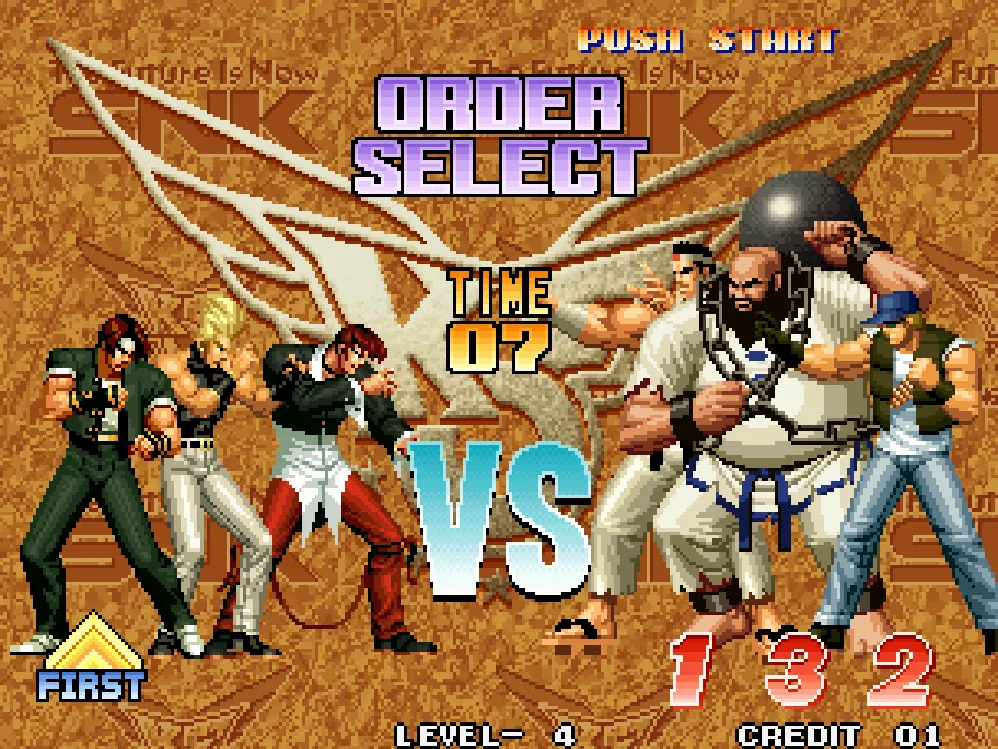
The King of Fighters '96 (KOF '96)
I. Game Background
1.1 World Setting
KOF '96 serves as the middle chapter of the "Orochi Saga" trilogy—a pivotal moment where the KOF series transitioned from a simple "fighting tournament" to an "epic myth."
The story picks up immediately after the ending of KOF '95. Rugal Bernstein, having been defeated by Kyo Kusanagi and his team while empowered by the Orochi force as "Omega Rugal," tears himself apart from within before his self-destruction. This gruesome scene reveals a terrifying truth to the fighters: the Orochi power within Rugal was not natural, but artificially injected. A force far more powerful and ancient than Rugal has been watching from the shadows.
1,800 years ago, the legendary Orochi was sealed away by the Three Sacred Treasures (the Kusanagi Sword, the Yasakani Jewel, and the Yata Mirror). Now, the seal is weakening. His followers—warriors known as the "Hakkeshu"—have begun to move in the shadows. The strongest of them, Goenitz, the master of wind, is determined to resurrect his master, Orochi.
Against this backdrop, a mysterious woman steps forward: Chizuru Kagura, the current heir to the Yata Mirror and one of the guardians of the Three Sacred Treasures. She realizes the seal is breaking and knows she cannot stop the coming disaster alone. She needs the power of Kyo Kusanagi (heir to the Kusanagi Sword) and Iori Yagami (heir to the Yasakani Jewel)—the three guardians must unite to seal Orochi once more.
But there is a problem: Iori Yagami refuses to cooperate. The Yagami clan betrayed the others 660 years ago, sparking a blood feud with the Kusanagi clan. Chizuru uses the KOF '96 tournament as a front to gather the heirs of the three treasures, appearing as the tournament organizer while secretly testing the strength and character of every participant.
Even more terrifying, three members of the Orochi Hakkeshu—Yashiro Nanakase, Shermie, and Chris—enter the tournament as the "New Faces Team." Disguised as ordinary young fighters, they are actually gathering data and evaluating opponents to pave the way for Orochi's resurrection. No one knows their true identities—until the truth is revealed years later in KOF '97.
1.2 Development History
KOF '96 was first released by SNK on July 30, 1996, for the Neo Geo MVS/AES platform, utilizing a 362-megabit cartridge—one of the largest games on the Neo Geo at the time. The game was crafted by SNK's top development team, with Masanori Kuwasaki returning as director and Shinkiro continuing as the lead illustrator.
In terms of game systems, KOF '96 is a landmark entry in the series' evolution. It introduced three systems that would have a profound impact on all future titles:
Emergency Dodge—Triggered by pressing A+B, this forward roll includes brief invincibility frames. This system completely changed KOF's defensive play, giving players an alternative to just "block and counter" when facing projectile pressure.
Dash—Triggered by →→, this high-speed run replaced the relatively slow movement of previous KOF characters. The addition of the dash expanded attack range significantly, shifting the game's pace from "steady neutral" to "high-speed aggression."
Small/Medium/Large Jump System—Depending on the joystick input (tap up, standard up, or direction + jump), characters perform jumps of three different heights and speeds. This system provides rich layers of aerial attack options and is one of the core features that distinguishes KOF from Street Fighter.
These three systems marked KOF's transition from "classic fighting" to "modern fighting." KOF '96 became the operational benchmark for all subsequent KOF titles.
The game's soundtrack, composed by the SNK New World Music Performers, features several tracks—especially Goenitz's boss theme "Trash Head" and Iori Yagami's new theme—that are widely considered the pinnacle of the KOF series' musical history.
II. Character Introduction
Hero Team
| Character | Fighting Style | Power | Speed | Skill | Overall Rating |
|---|---|---|---|---|---|
| Kyo Kusanagi | Kusanagi Ancient Arts + Personal Style | ★★★★☆ | ★★★★☆ | ★★★★★ | Protagonist, fire + new moves, upgraded firepower |
| Benimaru Nikaido | Shooting | ★★★☆☆ | ★★★★★ | ★★★★☆ | Lightning zoning, high mobility |
| Goro Daimon | Judo | ★★★★★ | ★☆☆☆☆ | ★★★☆ | King of throws, massive anti-air throw hitboxes |
Compared to KOF '95, Kyo Kusanagi received a brand-new special move in this game—the "124 Shiki: Aragami" series was officially introduced. This is a chain-move system that branches from "Aragami" into various follow-up attacks, upgrading Kyo's combos from a "fixed route" to a "branching decision tree."
Fatal Fury Team
| Character | Fighting Style | Power | Speed | Skill | Overall Rating |
|---|---|---|---|---|---|
| Terry Bogard | Martial Arts + Personal Style | ★★★★☆ | ★★★★☆ | ★★★★☆ | Power Geyser debut |
| Andy Bogard | Koppo + Shiranui Ninjutsu | ★★★☆☆ | ★★★★☆ | ★★★☆☆ | Speed-based ninja |
| Joe Higashi | Muay Thai | ★★★★☆ | ★★★☆☆ | ★★★☆☆ | Hurricane Upper combo enhancement |
Terry received his signature super move in this game—the "Power Geyser." This massive pillar of energy erupting from the ground is one of the most visually impactful super moves in the KOF series.
Art of Fighting Team
| Character | Fighting Style | Power | Speed | Skill | Overall Rating |
|---|---|---|---|---|---|
| Ryo Sakazaki | Kyokugen Karate | ★★★★☆ | ★★★☆☆ | ★★★★☆ | Tenchi Haoh Ken debut |
| Robert Garcia | Kyokugen + Kicks | ★★★★☆ | ★★★★☆ | ★★★★☆ | Master of kicks |
| Yuri Sakazaki | Kyokugen Karate | ★★★☆☆ | ★★★★☆ | ★★★☆☆ | Transferred from Women Fighters Team |
The biggest change for the Art of Fighting team is Takuma Sakazaki leaving the roster (becoming a hidden character/background NPC), and Yuri Sakazaki transferring from the Women Fighters team to fight alongside her brother, Ryo. This change gives the team a heartwarming "family dojo" feel.
Ikari Team
| Character | Fighting Style | Power | Speed | Skill | Overall Rating |
|---|---|---|---|---|---|
| Leona Heidern | Martial Arts + Orochi Power | ★★★★☆ | ★★★★☆ | ★★★★★ | New Character! Heidern's foster daughter, Orochi bloodline |
| Ralf Jones | Martial Arts | ★★★★★ | ★★☆☆☆ | ★★★☆☆ | One-Punch Man |
| Clark Still | Martial Arts + Throws | ★★★★☆ | ★★☆☆☆ | ★★★★☆ | Throw chains remain intact |
Leona Heidern is one of the most important new characters in this game. She is the sole survivor found by Heidern in the ruins of a Brazilian village—the blood of the Orochi clan sleeps within her. Heidern adopted her and taught her military combat, but Leona often sees herself in nightmares as someone else—a bloodthirsty killing machine with red eyes. Her moveset, which combines cold-weapon-style cutting attacks with the bloodthirsty nature of the Orochi power, immediately made her one of the most popular female characters in the KOF series.
Psycho Soldiers Team
| Character | Fighting Style | Power | Speed | Skill | Overall Rating |
|---|---|---|---|---|---|
| Athena Asamiya | Psycho Power + Chinese Martial Arts | ★★★☆☆ | ★★★★☆ | ★★★★★ | Full-screen projectiles, new outfit |
| Sie Kensou | Psycho Power + Chinese Martial Arts | ★★★☆☆ | ★★★★☆ | ★★★☆☆ | Flexible mobility |
| Chin Gentsai | Drunken Fist | ★★☆☆☆ | ★☆☆☆☆ | ★★★★★ | Unpredictable and tricky |
Women Fighters Team
| Character | Fighting Style | Power | Speed | Skill | Overall Rating |
|---|---|---|---|---|---|
| King | Muay Thai | ★★★★☆ | ★★★★☆ | ★★★☆☆ | Veteran female powerhouse |
| Mai Shiranui | Shiranui Ninjutsu | ★★★☆☆ | ★★★★★ | ★★★☆☆ | Aerial dominance remains |
| Kasumi Todoh | Todoh-ryu Aikido | ★★★☆☆ | ★★★☆☆ | ★★★★☆ | New Character! Aikido counter-style |
Kasumi Todoh is a young girl who entered KOF to find her missing father, Ryuhaku Todoh (the initial boss of Art of Fighting 1). She uses Aikido and excels at using her opponent's strength against them. Her "counter" moves can block attacks and automatically retaliate, a unique defensive design in the fast-paced KOF '96. Kasumi's addition also expanded the SNK universe, bringing a marginalized character from Art of Fighting back to the center stage.
Korea Team
| Character | Fighting Style | Power | Speed | Skill | Overall Rating |
|---|---|---|---|---|---|
| Kim Kaphwan | Taekwondo | ★★★★☆ | ★★★★★ | ★★★★☆ | The terror of the Phoenix Kick |
| Choi Bounge | Taekwondo + Claws | ★★☆☆☆ | ★★★★★ | ★★★☆☆ | Small-frame harassment |
| Chang Koehan | Taekwondo + Iron Ball | ★★★★★ | ★☆☆☆☆ | ★★★☆☆ | Massive iron ball pressure range |
New Faces Team — The most important story team in this game
| Character | Fighting Style | Power | Speed | Skill | Overall Rating |
|---|---|---|---|---|---|
| Yashiro Nanakase | Personal Style (Striker) | ★★★★★ | ★★★☆☆ | ★★★★☆ | Orochi Four Heavenly Kings: Earth |
| Shermie | Personal Style (Grappler) | ★★★★☆ | ★★★☆☆ | ★★★★☆ | Orochi Four Heavenly Kings: Lightning |
| Chris | Personal Style (Speedster) | ★★★☆☆ | ★★★★★ | ★★★★☆ | Orochi Four Heavenly Kings: Flame |
The three members of the New Faces Team appear to be a band of young musicians (Yashiro is the guitarist, Shermie the keyboardist, and Chris the lead singer), but in reality, they are members of the Orochi Hakkeshu—each controlling the power of earth, lightning, and fire. Their goal is to observe the strength of the Three Sacred Treasures' guardians and pave the way for Orochi's resurrection. In KOF '96, their true identities are not revealed—it isn't until KOF '97 that their true faces are shown. This narrative design of "disguising as ordinary fighters and lurking under the player's nose for an entire game" is one of the most brilliant storytelling techniques in the KOF series.
Boss Team
| Character | Fighting Style | Power | Speed | Skill | Overall Rating |
|---|---|---|---|---|---|
| Geese Howard | Ancient Martial Arts + Counters | ★★★★★ | ★★☆☆☆ | ★★★★★ | Fatal Fury's ultimate villain returns |
| Wolfgang Krauser | Comprehensive Martial Arts | ★★★★★ | ★★★☆☆ | ★★★★★ | European noble warrior, Kaiser Wave user |
| Mr. Big | Staff Fighting + Street Fighting | ★★★★☆ | ★★★☆☆ | ★★★☆☆ | South Town crime boss |
The three members of the Boss Team are the final bosses of the Fatal Fury series—Geese (Fatal Fury 1), Krauser (Fatal Fury 2), and Mr. Big (the mastermind in several titles). Putting them together as a team was a top-tier treat for Fatal Fury fans and the first true "All-Boss Team" in KOF history. In KOF '96, Geese can use his signature counters and classic moves like the "Reppuken" and "Raging Storm."
Mid-Boss: Chizuru Kagura
| Attribute | Description |
|---|---|
| Fighting Style | Kagura-ryu Ancient Arts + Yata Mirror Power |
| Height/Weight | 169cm / 52kg |
| Identity | Heir to the Yata Mirror, KOF '96 Tournament Organizer |
| Stage | Temple Stage |
Chizuru Kagura possesses one of the most unique combat mechanics in the KOF series—Clone/Illusion Attacks. She can summon her own mirror images (illusions) to perform attacks, forcing opponents to face threats from two directions simultaneously. Correctly identifying which is the real body and which is the illusion is the key to defeating Chizuru.
As a mid-boss, Chizuru's true goal is not to defeat the participants, but to test if they have enough strength to face the threat of Orochi. Her battle is more like an "entrance exam"—she fights with all her might to draw out her opponent's potential.
Final Boss: Goenitz
| Attribute | Description |
|---|---|
| Fighting Style | Orochi Power: Wind |
| Height/Weight | 193cm / 88kg |
| Identity | Leader of the Orochi Hakkeshu Four Heavenly Kings |
| Stage | Temple Ruins at the Eye of the Storm |
| Signature Quote | "Divine punishment!" |
Goenitz is the most threatening villain in the early Orochi Saga. He masters the power of wind—able to manipulate hurricanes and air pressure to attack. His moveset, consisting of full-screen multi-hit wind blades and aerial assaults, makes him one of the fastest bosses in the KOF series.
- Yonokaze: A full-screen horizontal tornado—Goenitz's signature opening attack.
- Hyoga: Summons ice pillars from the ground—despite being the Heavenly King of Wind, this is an ice-attribute attack.
- Wan Koori: Grabs the opponent at close range and impales them with an ice pillar.
- Darkness·Wail: Goenitz's super move—erupts with devastating wind pressure centered on himself, covering nearly the entire screen.
Goenitz's AI is extremely sharp—he dynamically switches attack modes based on the player's position and inputs. Even worse, his normal attacks have massive hitboxes and very fast recovery, leaving almost no window for players to counter. He is ranked alongside Igniz (KOF 2001) and Omega Rugal (KOF 2002 UM) as one of the "Three Hardest Bosses in KOF History."
III. Controls
3.1 Basic Controls
| Button | Function |
|---|---|
| A | Light Punch |
| B | Light Kick |
| C | Heavy Punch |
| D | Heavy Kick |
| ←/→ | Move |
| ↖/↗ | Jump |
| ↓ | Crouch |
3.2 KOF '96 New Systems
| Action | Move | Debut | Description |
|---|---|---|---|
| A+B | Emergency Dodge (Forward Roll) | KOF '96 | Roll with invincibility frames, revolutionizing defense |
| →→ | Dash | KOF '96 | High-speed run, covering much greater distance |
| Tap ↑ | Small Jump | KOF '96 | Lowest and fastest, great for aerial ambushes |
| ↓+↑ | Medium Jump | KOF '96 | Medium height, suitable for combo links |
| Direction+↑ | Large Jump | KOF '96 | Highest and furthest, for aerial approaches |
3.3 Power System (KOF '96 Version)
The charging system in KOF '96 underwent major changes compared to previous titles:
- Natural Charging: Attacking opponents and being attacked both build power—no need to manually charge with A+B+C.
- MAX State: When a character's health drops below 1/4 (health bar flashes red), they enter MAX state.
- Super Moves: Can be used in normal state (consumes one power bar) or MAX state (no power consumption, increased damage).
- Tactical Management: Because power builds from attacking and being attacked, the power gauge fills much faster than in previous games—meaning super moves are used much more frequently.
3.4 Riot State (Hidden Element)
This game hides two "Riot" characters—Riot Iori and Riot Leona. When in Riot state, their speed increases significantly and attacks are enhanced, but their health slowly drains. These two hidden characters are unlocked via specific commands under certain conditions. Riot Iori's "Ya Otome: Chaiwa" is one of the most impressive MAX super moves in KOF history.
IV. Boss Strategy
4.1 Mid-Boss: Chizuru Kagura
Clone Pattern Recognition: Chizuru's clone attacks follow three rhythms—slow, medium, and fast. Observe which rhythm she uses. The same rhythm will appear twice before switching to another.
Attack Window: Chizuru has about 15 frames of recovery after completing a full clone attack sequence—this is your best time to strike.
No-Jump Principle: Chizuru's anti-air clone (the upward-attacking illusion) covers almost the entire vertical axis. Do not jump—stay on the ground and use a dash to close in when she is in recovery.
4.2 Final Boss: Goenitz
Core Strategy: Goenitz is the boss fight in the KOF series that relies most on "patience" rather than "skill." His AI reads inputs with extreme precision, so head-on attacks are meaningless. Here is the core strategy:
- Learn to dodge Yonokaze: The high-intensity full-screen tornado is a frequent attack. Learn to roll (A+B) 1 frame before the tornado hits—this requires precise timing, but it is possible.
- Exploit recovery frames: After Goenitz finishes a set of wind blade attacks, he has a brief backward movement—dash in and combo immediately.
- Grappler Advantage: Goro Daimon and Clark's throws are particularly effective against Goenitz—his AI has weaker defensive programming against throws.
- Never Jump: Goenitz's "Wan Koori" is his most lethal anti-air—jumping equals death.
- Power Management: Keep at least one bar of power for defense. Goenitz's normal attacks deal massive damage, and the invincibility frames of a MAX super move might be your only escape when pressured.
Goenitz's boss theme "Trash Head"—a frantic piece blending pipe organs, heavy metal guitars, and industrial noise—perfectly matches the destructive nature of the Wind King and is hailed by KOF fans as "the supreme work of the SNK New World Music Performers."
V. Game Tips and Advanced Strategy
5.1 Basic Survival Tips
- Rolling is your new best friend: A+B Emergency Dodge is the most important new system in KOF '96. Learn to roll through projectiles, roll before heavy attacks, and roll to escape corner pressure.
- Dash to control mid-range: Dashing allows you to cross half the screen in less than half a second. Use dash + heavy attack to pressure opponents as they get up.
- Small jump to probe: Small jump attacks are faster and lower than large jumps, making them harder to react to. Use small jump light attacks to test your opponent's defensive habits—this is the foundation of KOF '96 tactics.
- Opponents are your power source: No manual charging needed. Attack aggressively—every hit brings you closer to a super move.
- MAX state is not invincibility: In red-health MAX state, your super moves are stronger, but you are closer to death. Don't intentionally enter red-health—it's a last resort, not a tactical goal.
- The trap of counters: Geese and Kasumi Todoh's "counters" can block your attacks and retaliate automatically. Change your attack rhythm against these characters—don't be predictable.
5.2 Boss Battle Rules
- Goenitz: Learn to give up—You will lose the first round 99% of the time. Don't be discouraged. Watch all his moves before formulating a strategy.
- Chizuru: Observe the rhythm—Her clone attacks have a fixed rhythm cycle. Count in your head and predict the timing of the next attack.
- Geese (if you choose the Boss Team): The threat of his counters is far greater than his Reppuken. Use throws and command grabs to bypass his counters.
5.3 Advanced Trivia
- Unlocking Riot Iori/Leona: Both have independent unlock conditions. Riot Iori is considered the strongest "technical" character in the game—his Ya Otome follow-up "Chaiwa" exceeds the standard Iori in speed and range.
- Geese's "Rashomon": Geese's hidden MAX super move in KOF '96, "Rashomon," can reflect everything—including other super moves. It is the most powerful counter in the entire KOF series.
- Kyo's "Aragami" branches: After Aragami, you can link to Nine Scars → Eight Rust (high damage route), Nine Scars → Seven Lances (safe pressure route), or cancel directly into a super move. Two branches + super cancel = four choices—every use is a tactical decision.
VI. Trivia and Arcade Legends
6.1 The Mythological Roots of the Three Sacred Treasures
The Orochi Saga story in KOF '96 is deeply rooted in Japanese mythology. The Kusanagi Sword (Kusanagi-no-Tsurugi) is the treasure sword found by Susanoo in the tail of the eight-headed serpent Yamata no Orochi; the Yasakani Jewel (Yasakani-no-Magatama) is one of the three imperial regalia; and the Yata Mirror (Yata-no-Kagami) is the mirror used to lure the sun goddess Amaterasu out of the Heavenly Rock Cave. SNK transformed these three ancient artifacts into symbols of three fighting styles—Kusanagi (Sword), Yagami (Jewel), and Kagura (Mirror)—a creative fusion of traditional myth and modern fighting.
6.2 The New Faces Team's God-Tier Disguise
Yashiro, Shermie, and Chris wandered in front of players as a "new band" for an entire game, and almost no one suspected their true identities—until the shocking reveal in KOF '97. SNK's narrative planners designed a complete "band setting" for this team: Yashiro plays guitar, Shermie plays keyboard, and Chris is the lead singer. Their costumes, animations, and victory poses were all designed around their "musician" identity—a stark contrast to their majestic image as the Orochi Four Heavenly Kings. This stunning characterization caused a massive shock to the KOF fan base when it was fully revealed two years after the game's release.
6.3 Leona—The Tragedy of Orochi Blood
Leona's backstory is one of the darkest in the KOF series. According to official lore, when Heidern found Leona in the Brazilian jungle, her entire village had been massacred—the perpetrator was Leona herself in a Riot state. The blood of Orochi awakened within her, and she uncontrollably killed her own parents and all the villagers. When Heidern found her, the young Leona was kneeling among the corpses, blankly repeating one name: "Orochi... Orochi..." This explains why Leona is always reticent and cold—she carries an indelible blood debt.
6.4 The Boss Team Dream Come True
Geese, Krauser, and Mr. Big all playable—this was jaw-dropping in 1996 arcades. Geese was the "unbeatable" final boss in the original Fatal Fury (unless you cheated), Krauser was the powerful final boss of Fatal Fury 2, and Mr. Big was a major force in the South Town underworld. Having all three appear—and be playable!—caused a sensation in the fighting game world at the time.
6.5 Chizuru Kagura—The Forced Substitute Protagonist
According to SNK development interviews, Chizuru Kagura was originally designed as the core protagonist of KOF '96—her screen time and narrative importance were far greater than Kyo Kusanagi's in the original script. But late in development, management decided that "fighting game players wouldn't accept a female protagonist," so Chizuru was demoted to "mid-boss/story catalyst." She was allowed to appear as an unplayable boss in KOF '96—not becoming playable until KOF '97. This decision is still viewed by many KOF fans as a missed opportunity by SNK.
6.6 The Origin of Riot Iori's Code
Riot Iori was created due to a programming error. During the development of KOF '96, a programmer accidentally increased Iori's attack speed parameters by 50% while testing his AI. Testers found that this "bugged Iori," while constantly losing health, was incredibly aggressive—this was the source of the Riot Iori design concept. SNK decided to keep this "bug" as hidden content.
6.7 362MEGS—The Limit of Neo Geo
The 362-megabit cartridge capacity of KOF '96 was one of the largest on the Neo Geo platform in 1996. To fit all the animation frames for every character (especially the large number of animations for new characters and bosses) into the limited ROM space, SNK's development team had to perform extreme optimization. According to interviews with former SNK programmers, the compression rate of KOF '96's graphics data reached a desperate level—some characters' animation frames were compressed to their theoretical limit.
6.8 Shinkiro's Golden Age
The character illustrations drawn by Shinkiro for KOF '96 are widely considered the pinnacle of his career. His unique "realism + manga sensibility" style—emphasizing facial details, clothing texture, and a sense of power in posture—perfectly defined the visual identity of the KOF series throughout the 90s. KOF '96 character art is still collected as posters by fans and is an important artifact in the history of Japanese fighting game art.