I. Game Background
1.1 Setting
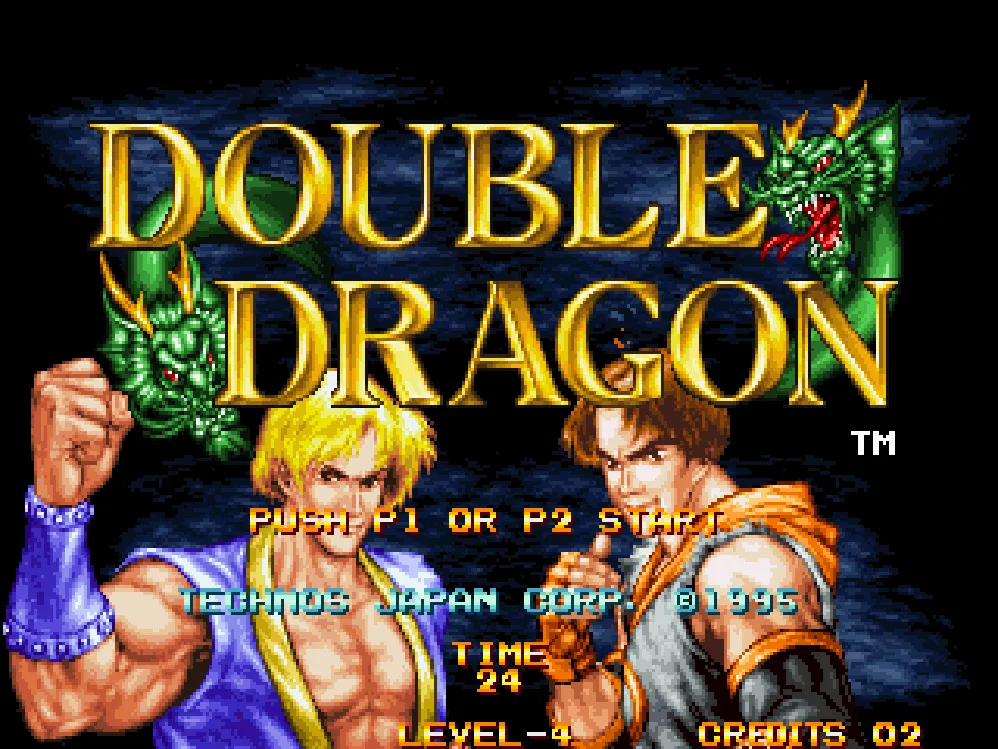
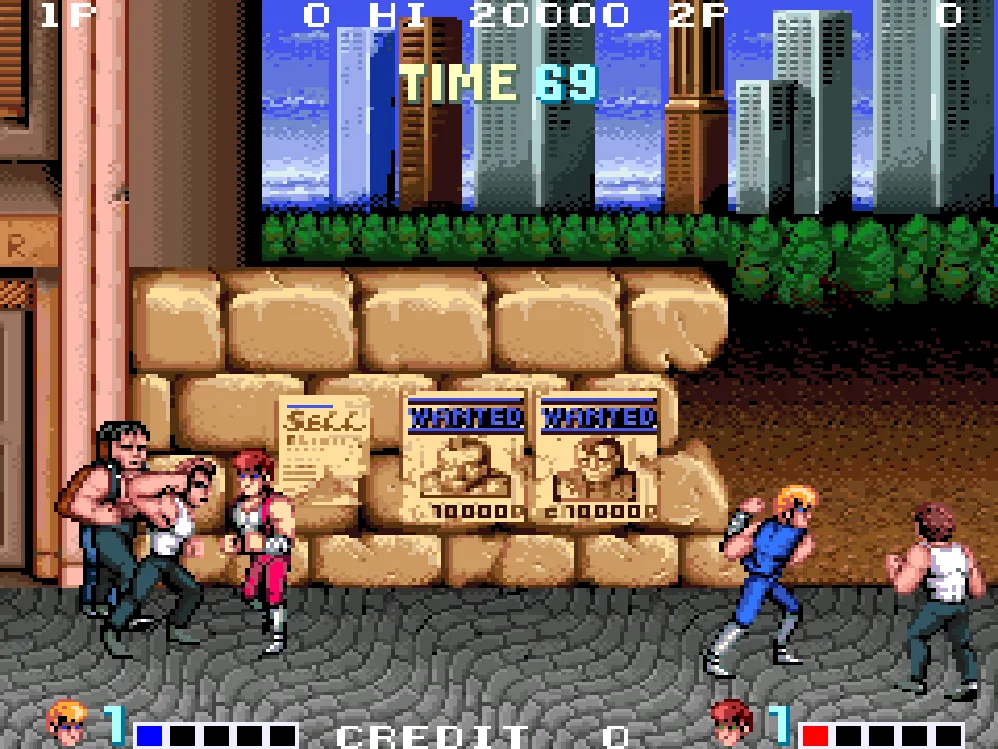
Double Dragon takes place in a near-future city devastated by nuclear war and ruled by street gangs. Billy Lee and Jimmy Lee are twin brothers who run a small martial arts dojo. One day, a street gang known as the "Black Warriors" terrorizes their neighborhood and kidnaps Billy's girlfriend, Marian. As they drive away, they leave a final message: "If you want your woman back, come to our turf."
Billy and Jimmy traverse city slums, industrial ruins, forests, and the Black Warriors' headquarters. Fighting with their bare hands and weapons snatched from enemies (baseball bats, knives, oil drums, whips), they battle through waves of Black Warriors. Finally, in the office of the gang leader, Willy, the brothers will use their twin dragon fists to destroy the Black Warriors once and for all.
1.2 Development History
Double Dragon was released by the Japanese company Technos Japan in 1987 for arcade hardware. Technos had previously pioneered the "side-scrolling" genre with Renegade (1986), but it was Double Dragon that truly defined the "beat 'em up" genre. It introduced almost all the core elements of the golden age of beat 'em ups: multi-layered scrolling stages, weapon scavenging, the grab-throw-attack loop, and cooperative two-player mode.
The success of Double Dragon spawned a massive series: Double Dragon II (1988 arcade), Double Dragon III (1990), Double Dragon Advance (2003), Double Dragon IV (2017), and several home console ports for NES/SFC. The most famous is the 1988 NES/Famicom version, which featured completely different level designs, enemy configurations, and a different final boss compared to the arcade version, selling over a million copies in both Japan and North America. Technos declared bankruptcy in 1996; its IP was acquired by Million (owned by Atlus) and later transferred to Arc System Works.
II. Character Profiles
| Character | Traits |
|---|---|
| Billy Lee (1P) | Blue outfit. Marian's boyfriend. Balanced type—all stats are average. |
| Jimmy Lee (2P) | Red outfit. Billy's twin brother. Performance is identical to Billy—color is only to distinguish 1P/2P. |
Snatching weapons from enemies is a core system—baseball bats (3 uses), knives (infinite until dropped), oil drums (explode after 1 use), and whips (long-range attacks). Weapon damage is significantly higher than punches or kicks—prioritize grabbing them.
Elbow Strike is the most iconic move in Double Dragon—triggered by pressing Jump + Attack simultaneously. The Elbow Strike has a massive hit detection area—covering almost the entire front of the character—and features fast startup and recovery. In the arcade era, "elbow spamming" was the ultimate secret to clearing the game.
III. Controls
8-way joystick + 2 buttons (plus an auxiliary button on some cabinets):
| Action | Description |
|---|---|
| A Button (Punch) | Bare-handed punch. Press repeatedly for a 3-hit combo. |
| B Button (Jump) | Jump. Jump attacks can knock enemies down. |
| Elbow Strike | Press A + B simultaneously—fast, high damage, large hitbox—the best way to clear mobs. |
| Kick | Specific direction + attack combinations—triggers kicks—larger range than punches. |
Grab System: Automatically grab enemies when close—you can perform a headbutt (Attack), knee strike (Kick), or shoulder throw (Direction + Attack). Headbutts and knee strikes provide the highest damage output. If grabbed by an enemy, rotate the joystick quickly to break free.
IV. Levels and Bosses
There are 4 main levels, each spanning different areas of the city.
| Level | Setting | Boss | Strategy |
|---|---|---|---|
| 1 | City Slums | Abobo—Giant bald thug | First mini-boss—large punch range and throw radius. Keep distance and use the Elbow Strike loop—Elbow→Back off→Elbow. |
| 2 | Industrial Zone | Jeff—Nunchaku fighter | Speed type. Strike with elbows during his recovery frames. Prioritize clearing surrounding mobs first. |
| 3 | Forest | Abobo (Round 2) and Willy's Elite Guard | Abobo returns—this time with more elite mobs. Clear the mobs first, then handle Abobo. |
| 4 | Black Warriors HQ | Willy—Leader, armed with a machine gun | Final boss. Uses long-range machine gun fire—hide behind cover, approach, and use rapid Elbow Strikes. Defeat Willy to rescue Marian. |
V. Pro Tips
- The Elbow Strike is the only truth: Press A+B simultaneously—simple, brutal, and efficient. There is no reason not to use the Elbow Strike in Double Dragon—its damage, hitbox, and speed are superior to normal attacks. The optimal strategy is continuous elbow strikes.
- Weapon Priority: Baseball Bat > Knife > Whip > Oil Drum. Three hits with a baseball bat are enough to clear a whole group of enemies. Knives deal the most damage but have limited uses. Throwing an oil drum during a boss fight can deplete a boss's entire health bar.
- The Secret to Grab Combos: After grabbing an enemy—Headbutt→Headbutt→Knee Strike→Headbutt—this is the optimal damage loop. Avoid shoulder throws—they deal less damage than the headbutt/knee combo.
VI. Trivia
The Origin of the Name "Double Dragon"
"Double Dragon" has two meanings: first, it refers to Billy and Jimmy, the "Double Dragon" twin brothers who each represent the power of the "Dragon"; second, it refers to the "Twin Dragon Fist" (Sou-Setsu-Ken) they can perform in the game—when two players attack the same enemy simultaneously, it triggers extra combo damage. This cooperative mechanic was incredibly advanced for 1987.
The Elbow Strike—The "Bug" That Became a Legend
There is a popular legend about the origin of the Elbow Strike: it was accidentally discovered by programmers late in development. Testers noticed that when pressing Attack and Jump simultaneously, Billy performed a "pose that looked like a mistake," but this pose happened to have an incredibly powerful hitbox. The team decided to keep this "bug"—a decision that made Double Dragon a game where "one move is stronger than all others." The Elbow Strike was retained and formalized in all subsequent Double Dragon titles.