1. Game Background
1.1 Setting the Scene
In 1992, Marvel's most popular mutant team, the X-Men, made their grand debut in the arcades. The game is set within the classic Marvel Universe, where mutants—the next stage of human evolution—possess extraordinary powers while facing fear and prejudice from society. Under the leadership of Professor Charles Xavier, the X-Men strive to foster peaceful coexistence between humans and mutants.
However, peace is fleeting. Magneto, the powerful mutant leader capable of manipulating magnetic fields, believes mutants should rule over humanity. He orchestrates a bold plan: kidnapping Professor Xavier and Kitty Pryde, imprisoning them on his space base, Asteroid M. The X-Men must fight their way through city streets and the Savage Land, eventually storming Asteroid M in space to stop Magneto's conspiracy and rescue their mentor and teammate.
1.2 Development History
Developed and published by Konami in 1992, the arcade version of X-Men stands as a hallmark of the golden age of beat-'em-up games. Already a giant in the arcade industry thanks to hits like Teenage Mutant Ninja Turtles and The Simpsons, Konami decided to bring Marvel's most popular team to the screen using an unprecedented hardware setup.
The game's most striking feature was its unique six-player, dual-screen cabinet design. Konami placed two CRT monitors side-by-side to create a wide-screen experience—a daring hardware innovation for 1992. This massive six-player station became an iconic fixture in arcades, allowing players to control all six X-Men simultaneously. While it utilized classic beat-'em-up mechanics, the sheer scale of six-player co-op, the flashy mutant abilities, and the unforgettable voice acting cemented its legendary status in arcade history.
2. Character Roster
There are six playable characters, each with a unique mutant ability (special attack) that consumes a small amount of health when used:
| Character | Ability Name | Special Attack Effect |
|---|---|---|
| Cyclops | Optic Blast | Fires a powerful red energy beam from his eyes, covering a wide area in front |
| Wolverine | Claw Slash | Performs a high-speed spinning slash with his Adamantium claws |
| Storm | Lightning Storm | Summons lightning to strike all enemies on screen |
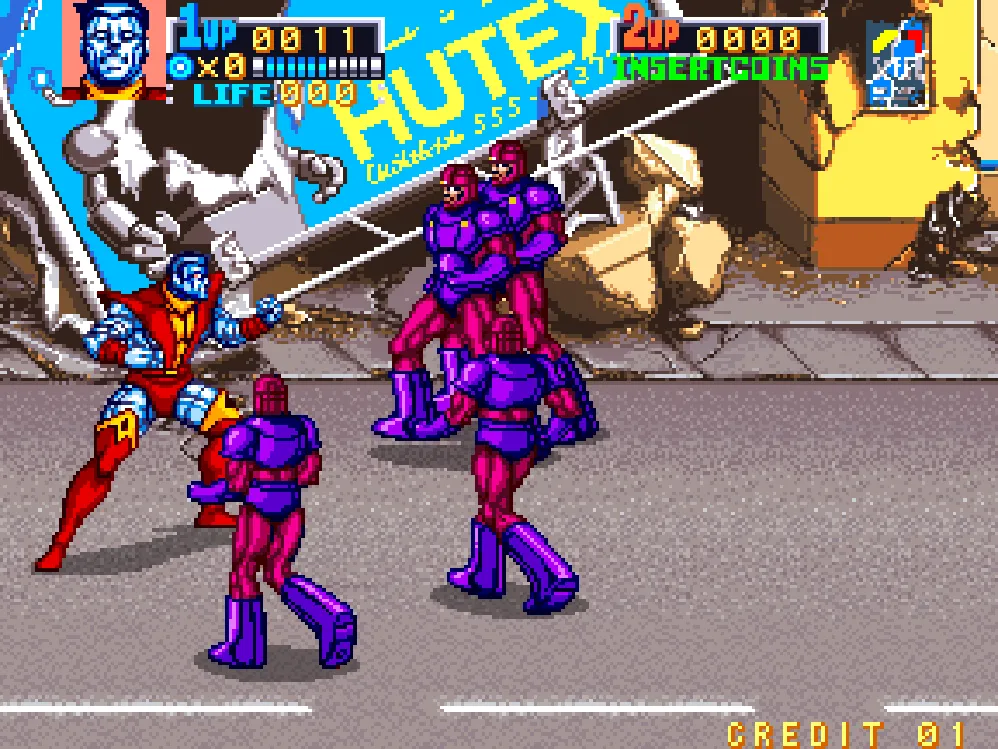
| Colossus | Power Wave | Turns his body into steel and releases a shockwave |
| Nightcrawler | Teleport Attack | Teleports instantly to enemies for a surprise strike |
| Dazzler | Sound Blast | Releases powerful sonic energy to attack enemies |
Each character has slight differences in attack range, speed, and damage. Wolverine is fast but has a short range, making him perfect for close-quarters combat; Cyclops and Storm have larger ranges, ideal for mid-range battles; Colossus is powerful but slightly slower. Players can choose a character that fits their combat style or enjoy the spectacle of the full team in six-player mode.
3. Controls
3.1 Basic Controls
The game uses a classic eight-way joystick and two-button configuration, making it simple and intuitive:
| Button | Function |
|---|---|
| Joystick (8-way) | Move character |
| Attack Button | Normal attack; press repeatedly for combos |
| Jump Button | Jump; can attack in mid-air |
| Attack + Jump | Trigger mutant special ability (consumes health) |
3.2 Dual-Screen Wide-Field Mechanism
The six-player cabinet uses two CRT screens spliced together, doubling the effective screen width. This allows players to see a much larger battlefield, with enemies potentially appearing from anywhere. In multiplayer mode, players can spread out to cover the entire wide-screen battlefield. However, this also means that in single-player mode, you must be more vigilant about enemies attacking from the sides.
4. Stages and Boss Guide
| Stage | Setting | Boss | Strategy Tip |
|---|---|---|---|
| 1 | City Streets | Pyro | Avoid the flame-thrower range and close in for combos during his cooldown |
| 2 | Savage Land | Sentinels | Prioritize small Sentinels; watch for the wind-up animation of the large ones |
| 3 | Underground Base | Blob | Don't fight head-on; use your speed to flank and attack his back |
| 4 | Snowy Mountains | Wendigo | Wendigo is fast; keep your distance and use ranged characters |
| 5 | Magneto's Base | Mystique | She will shapeshift to confuse you; focus fire once you identify the real one |
| 6 | Asteroid M | Juggernaut | Never block his charge head-on; dodge vertically (up or down) |
| Final | Asteroid M Core | Magneto | Use cover to avoid magnetic attacks and coordinate with teammates to distract him |
5. Tips and Advanced Strategy
5.1 Survival Basics
- Timing Special Attacks: Mutant abilities cost health, so don't spam them. Use them when enemies are densely packed to clear the screen efficiently.
- Team Positioning: In multiplayer, don't stand in the same spot. Spreading out covers more ground and prevents the whole team from being hit by a single boss attack.
- Master Jump Attacks: Jumping helps avoid ground-based attacks, and mid-air strikes are particularly effective against certain bosses.
- Food Management: Health-restoring items are limited. Save them for teammates with the lowest health if you aren't in immediate danger.
- Combo the Minions: Use standard combos to clear out grunts quickly, saving your special abilities for boss fights.
- Magneto Strategy: The final boss fight is a marathon. Keeping at least two characters alive is key to victory; never let the whole team get caught in a danger zone simultaneously.
6. Trivia and Arcade Legends
6.1 "Welcome to die!" — The Most Iconic Misquote
The most legendary aspect of the X-Men arcade game is Magneto's line: "I am Magneto, master of magnet! Welcome to die!" The line was likely intended to be a dramatic "Welcome... to DIE!", but the result was the grammatically incorrect "Welcome to die." It has since become one of the most famous misquotes in gaming history, frequently referenced by fans. Interestingly, the 2021 Disney+ animated series X-Men '97 officially paid homage to this line, proving its influence has spanned nearly three decades.
6.2 The Spectacle of the Six-Player Cabinet
The six-player dual-screen cabinet was one of the most ambitious hardware designs in arcade history. The wide-screen effect created by two side-by-side CRTs was jaw-dropping in 1992. However, these behemoths were a challenge for arcade operators: they took up three times the space of a standard cabinet, consumed massive amounts of power, and were difficult to maintain. Consequently, complete six-player cabinets are extremely rare today and highly valued by collectors.
6.3 Dazzler's Surprise Appearance
For comic book readers, the inclusion of Dazzler in the roster was a surprise. She wasn't a core member of the X-Men at the time, more of a C-list character. Rumor has it that Konami chose her because they needed a female character with area-of-effect attacks to balance the team, and her sonic energy powers were visually perfect for flashy special effects. This gave Dazzler an unexpected level of exposure far beyond her comic book popularity.
6.4 "X-Men! X-Men!" — The Unforgettable Voice
The announcer's call of "X-Men! X-Men!" at the start and end of stages became a collective memory for players. With its unique rhythm and lo-fi quality, it became one of the most recognizable audio signatures in 90s arcades and still appears frequently in retro gaming videos and memes today.