I. Game Background
1.1 Setting the Scene
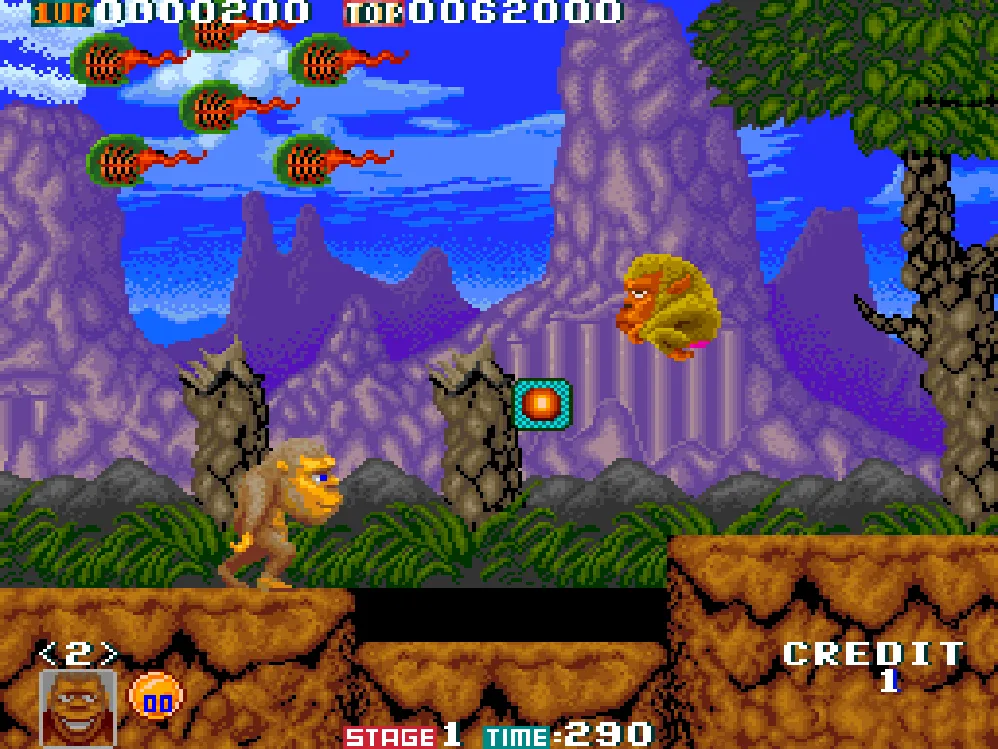
Toki (originally released in Japan as JuJu Densetsu / Legend of JuJu) is set in an ancient world filled with primal jungles, mysterious ruins, and bizarre creatures. The protagonist, Toki, was once a strong tribal warrior living on a South Pacific island, living a peaceful life in nothing but a loincloth.
However, the evil witch doctor Vookimedlo raided the village, kidnapped Toki's beloved Princess Miho, and cast a curse that turned all the islanders into animals. Toki was transformed into an ape—but he did not lose his human spirit. Instead, the curse granted him the special ability to spit energy projectiles from his mouth. Thus, the ape embarked on a journey through jungles, deep-sea caverns, Egyptian temples, frozen mountains, and volcanic zones—with one goal: reach Vookimedlo's Golden Palace, save his love, and regain his human form.
The game's world blends tribal culture, fantasy magic, and ancient technological elements, creating a rugged yet surreal aesthetic. From tropical jungles to underwater caves, Egyptian temples, ice palaces, and volcanoes, the progressive level design was remarkably rare for an arcade game in 1989.
1.2 Development History
Toki was developed by TAD Corporation and co-published by Taito, launching in arcades in 1989. TAD Corporation was founded by former Data East employees, with the company name derived from founder Tadashi "TAD" Yokoyama. The team inherited the eccentric style typical of Data East—if you've played Data East's Karnov (a fire-breathing, projectile-spitting Russian strongman), you can immediately feel the stylistic continuity in Toki's core "spitting" mechanic.
Toki was led by designer Akira Sakuma and debuted in Japanese arcades on December 8, 1989, with a North American release by Fabtek the following February. The game reached #16 on Japan's Game Machine list of most popular table-top arcade games and won a Golden Joystick Award in 1992.
TAD Corporation was only active for about five years before ceasing operations in 1993, with its members moving to Mitchell Corporation (developers of the Pang series). Despite this, Toki's unique charm has endured—in 2009, the French studio Golgoth Studio announced an HD remake. After nearly a decade of copyright negotiations and development, the remake was finally published by Microids in 2018 for Switch, PS4, Xbox One, and PC.
II. Character Profiles
2.1 Toki (JuJu) — The Cursed Ape Warrior
| Attribute | Rating |
|---|---|
| Firepower | ★★★★ (Upgraded) |
| Speed | ★★★ |
| Jump | ★★ (★★★ Upgraded) |
| Difficulty | ★★★ |
- Attack Style: Spits energy projectiles from his mouth—starts as a single shot, upgradeable to a three-way spread, wave beam, or flame breath.
- Special Abilities: Stomp on enemies (can be used as a springboard), charge attack (hold the button to charge for a powerful shot).
- Strengths: Multi-directional ground aiming (diagonal-up, forward), diverse weapon upgrade system, checkpoint resurrection system reduces frustration.
- Weaknesses: Can only shoot horizontally while jumping; weak aerial combat capabilities; slow base movement speed.
- Verdict: Beneath the ape exterior lies a pure action-shooter core. Toki's design is rugged—his head hangs low while walking, his facial expressions while spitting are hilariously exaggerated, and his "Yowch!" scream when hit sounds like a Looney Tunes cartoon—these unique visual and audio designs make him stand out among arcade heroes.
2.2 Princess Miho — The Captive Love
Toki's beloved, kidnapped by Vookimedlo. When the player runs out of lives, the screen shows Miho weeping in despair, begging the player to continue—this "emotional blackmail" Game Over screen is widely discussed in the gaming community for its impact, comparable to the classic continue screen in the arcade version of Ninja Gaiden.
2.3 Vookimedlo — The Evil Witch Doctor
The main antagonist, the mastermind behind kidnapping Miho and cursing the islanders. In some ports, his character is replaced by Bashtar (a translucent giant warrior).
III. Controls
Uses the classic 8-way joystick + 2-button layout:
| Action | Description |
|---|---|
| Move Left/Right | Control Toki's movement on the ground |
| Direction + Attack | Multi-directional aiming—forward, diagonal-up, up |
| Jump + Attack | Can only shoot horizontally while jumping (aerial weakness) |
| Stomp | Land on enemy heads to damage them and use them as a springboard |
| Charge Attack | Hold the attack button to charge and release a powerful shot |
3.2 Weapon Upgrade System
| Upgrade | Effect | Best For |
|---|---|---|
| Three-Way Spread | Fires projectiles in three directions | Crowded enemy scenarios |
| Wave Beam | Fires a piercing energy wave | Linear enemy groups and Boss fights |
| Flame Breath | Spews scorching flames to incinerate enemies | Universal use, most popular |
| Rapid Fire | Significantly increases fire rate | Fast enemies and dense bullet patterns |
| Football Helmet | Blocks one hit from above (Defensive) | Keep for Boss fights |
| Sneakers | Increases speed and jump height | Reaching hidden items, difficult platforming |
One-Hit Kill Rule: In the arcade version, Toki dies from any hit, respawning at the nearest checkpoint and losing all weapon upgrades. Collecting 50 gold coins grants an extra life.
IV. Level Walkthrough & Boss Guide
There are 6 levels in total, each starting with a map screen reminiscent of Ghosts 'n Goblins.
| Level | Setting | Boss | Strategy Tips |
|---|---|---|---|
| 1 | Tropical Jungle | Giant Mechanical Contraption | Master multi-directional shooting; watch for high-ground enemies |
| 2 | Sunken Ship | Giant Aquatic Monster | Buoyancy affects movement; watch for multi-angle attacks |
| 3 | Egyptian Temple | Mummy Pharaoh | Increased density of enemies and traps |
| 4 | Ice Palace | Frost Giant | Slippery ground; use sliding to navigate traps |
| 5 | Volcano | Lava Beast | Precise platforming to avoid lava; fireballs restrict movement |
| 6 (Final) | Golden Palace | Vookimedlo | Memorize spike patterns on minecart tracks; dodge magic spells |
Boss design is a major highlight. The sprites are huge and colorful. Memorable encounters include a giant raisin-like monster that shouts "BURP" to deal damage, and a bizarre boss made of floating limbs with a heart in the center—these absurd designs are part of Toki's unique aesthetic charm.
V. Tips & Advanced Strategy
5.1 Survival Basics
- Maintain Ground Advantage: Toki can only shoot horizontally in the air—stay on the ground whenever possible and use diagonal-up shots to handle aerial threats.
- Use Enemies as Springboards: Many items are placed in high spots. Use enemies as temporary platforms.
- Prioritize Coins: Coins disappear quickly—rush to them immediately after a kill. 50 coins = 1 extra life.
- Patience for Bosses: Every boss has a fixed pattern. Keep your distance, observe the rhythm, and strike during openings. Greed and impatience are your biggest enemies.
- Minecart Anticipation: The Golden Palace minecart section is the hardest part. Practice to memorize spike locations so you can jump proactively rather than reactively.
- Save the Helmet: Keep the Football Helmet for the late game and boss fights—it's the only defense against falling objects.
VI. Trivia & Arcade Legends
6.1 "Going Ape Spit" — The Cleverest Subtitle
The Sega Genesis version of Toki was subtitled "Going Ape Spit." "Go Ape" is an idiom for "going crazy," while "Ape Spit" refers to the core mechanic of the ape spitting projectiles—a clever double entendre widely considered one of the best titles in gaming history.
6.2 The Cancelled Sequel — "Apeshit"
Ocean Software was developing a Toki sequel for the Atari Jaguar codenamed "Apeshit," later renamed "Toki Goes Apespit." It was previewed in several magazines in the winter of 1994 but was ultimately cancelled. Its cancellation remains a sore subject in the retro gaming community.
6.3 Solving the Decade-Long Copyright Maze
In 2009, Golgoth Studio announced an HD remake. Founder Anthony De Sa Ferreira described the search for the rights as an "RPG adventure"—TAD Corporation and Data East had been closed for years, and rights were split among Paon Ltd, G-mode, and Digisoft. After confirming Digisoft as the holder, the project sat for nearly a decade before Microids took over. In 2018, the remake finally arrived with a hand-drawn comic style, featuring art by original Amiga designer Philippe Dessoly (Golgoth 71).
6.4 Visual Ties to Donkey Kong
Critics have long speculated that Rare was inspired by Toki when designing the football-helmet-and-sneaker-wearing Donkey Kong in Donkey Kong Country (1994). There is no official confirmation, but the visual similarities are striking.
6.5 A Pioneer of Cartoonish Sound Effects
Toki used digital sampling in 1989—the "Yowch!" scream when enemies died and the environmental sounds were like a Looney Tunes cartoon. This style was extremely rare in Japanese arcades at the time, giving Toki a unique sonic identity.