I. Game Background
1.1 World Setting
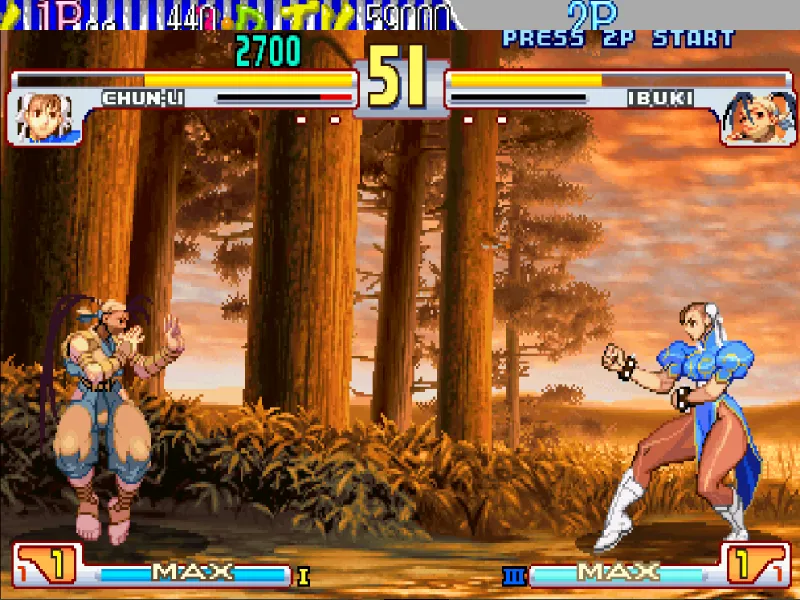
The story of Street Fighter III: 3rd Strike takes place years after the events of Street Fighter II. A mysterious organization known as the "Illuminati" (Secret Society), led by the enigmatic Gill, has emerged with plans to establish a "New World Order" by controlling the world's political and economic lifelines. Gill views himself as the ultimate form of human evolution, possessing the dual powers of fire and ice, with his half-red, half-blue physique serving as a testament to his godhood. To select warriors worthy of challenging him, Gill hosts a new World Warrior tournament, attracting fighters from across the globe.
The game's protagonist, Alex, is a young wrestler from New York who embarks on a path of vengeance after his mentor, Tom, is injured by one of Gill's subordinates. Parallel to this are Ryu's journey in search of the true meaning of fighting, Chun-Li's investigation into the Illuminati's conspiracy, and the individual fates of many other characters. These multiple narrative threads intertwine, culminating in the final showdown against Gill at the Illuminati temple.
1.2 Development History
Street Fighter III: 3rd Strike was developed by Capcom's arcade division and debuted in Japanese arcades on May 12, 1999. It is the third and final version of the Street Fighter III series. The game runs on Capcom's proprietary CPS-3 (CP System III) hardware—the last dedicated arcade board developed by Capcom before the company shifted to Sega's NAOMI platform. The CPS-3 featured a Hitachi SH-2 processor (25MHz), 8x16MB of flash ROM, and supported 32,768 colors at a 384x224 resolution, with up to 1,024 sprites with hardware scaling—making it the pinnacle of 2D fighting game hardware at the time.
Tomoshi Sadamoto served as producer and director. The core team spent about four years polishing the game, establishing the "Parry" system and the "Super Arts Select" system as the two pillars of its design. Regarding the input for parrying, Sadamoto originally insisted on using "back" on the joystick to lower the barrier to entry, but younger team members and internal experts strongly opposed this, arguing it was "too easy and lacked risk." They eventually adopted the "forward" input—a compromise that led to countless legendary moments. The game was ported to the Dreamcast in 2000, followed by releases on PlayStation 2, Xbox 360, and other platforms. As the swan song for the CPS-3 board, 3rd Strike reached the zenith of 2D fighting game depth, visual expression, and competitive play, and is still widely regarded as one of the greatest fighting games of all time.
II. Character Introduction
There are 19 playable characters in this version (excluding Gill, who was added in home console versions), covering both returning favorites and brand-new additions.
| Character | Fighting Style | Description |
|---|---|---|
| Alex | Pro Wrestling/Kickboxing | The protagonist; a power-based melee character with strong throws and rush-down moves. |
| Ryu | Ansatsuken/Karate | The series icon; features reliable "shoto" zoning with Hadoken, Shoryuken, and Tatsumaki. |
| Ken | Ansatsuken/Karate | Features flame-enhanced Shoryuken; incredible pressure and the star of Evo Moment #37. |
| Chun-Li | Chinese Martial Arts | Returns to the SF3 series with high-speed kicks and excellent mid-range zoning. |
| Yun | Chinese Kenpo/Baji Quan | His "Genei Jin" Super Art is one of the best, allowing for devastating pressure combos. |
| Yang | Chinese Kenpo/Mantis | Yun's twin brother; faster but with lower single-hit damage; excels in combos and agility. |
| Dudley | Boxing | An elegant British gentleman boxer known for high-speed jabs and machine-gun blow combos. |
| Makoto | Karate | A new character; a young fighter with explosive power and the highest single-hit damage in the game. |
| Ibuki | Ninjutsu | A young ninja; relies on high-speed movement, kunai zoning, and relentless combo pressure. |
| Elena | Capoeira | An African princess; uses kicks and spins; possesses the only healing Super Art in the game. |
| Oro | Senjutsu | A one-armed hermit with long-range attacks and bizarre, floating pressure capabilities. |
| Sean | Shotokan Karate | Ken's student; similar moves but weaker performance; known for his basketball-themed combos. |
| Hugo | Pro Wrestling | A giant wrestler from Final Fight; his massive size allows for terrifying throw pressure. |
| Urien | Pankration | Gill's brother; focuses on trap-based tactics using his "Aegis Reflector." |
| Necro | Electro-Combat | A Russian cyborg experiment; limbs can stretch for mid-to-long-range attacks. |
| Remy | Savate | A new character; focuses on projectile zoning and anti-air counter-attacks. |
| Twelve | Morphing | A new character; a white bio-weapon that can mimic opponent moves but has very low defense. |
| Q | Unknown | The most mysterious character; wears a metal mask; slow but hits with immense power. |
| Akuma | Ansatsuken/Satsui no Hado | A hidden character; powerful moves like the Shun Goku Satsu, but very low health and no EX moves. |
Final Boss Gill is unlockable in home versions but is typically banned in tournaments. He features full-screen attacks, a resurrection ability (RESURRECTION: a chance to recover about 1/3 health when defeated), and dual fire/ice attributes, making him one of the most oppressive bosses in fighting game history.
III. Controls
3.1 Basic Controls
Street Fighter III: 3rd Strike uses a standard six-button layout, consistent with the Street Fighter II series:
| Button | Function |
|---|---|
| Light Punch | Weak attack, fast startup, used for combo starters or quick pokes. |
| Medium Punch | Moderate power/range, used for combo links and hit-confirming. |
| Heavy Punch | High damage, slower startup, used for combo finishers or punishes. |
| Light Kick | Weak kick, fast, used for close-range pressure and wake-up mix-ups. |
| Medium Kick | Moderate kick, usually good range, suitable for mid-range zoning. |
| Heavy Kick | High damage, some characters use it as an anti-air or combo starter. |
3.2 Parry System and Super Arts
The Parry System is the game's most revolutionary core mechanic. By tapping the joystick forward (for high/mid attacks) or down (for low attacks) at the exact moment an opponent's attack connects (a 6-frame window, approx. 0.1 seconds), you can completely negate the attack—taking no damage, suffering no block stun, and allowing for an immediate counter-attack. Parrying can also be performed in the air. Almost all attacks, except for normal and command throws, can be parried. Parrying consumes no resources and relies entirely on player reaction and prediction, significantly raising the game's competitive ceiling.
Super Arts Select is another core design. Each character has three different Super Arts, and you must choose one before the match. They vary in meter length (1-3 bars), damage, performance, and tactical role. A classic example is Yun's SA3 "Genei Jin," which requires only one bar to unleash a long, oppressive combo, making it one of the highest-rated Super Arts in the game. Chun-Li's SA2 "Hoyokusen" features 2 bars and 15 hits—the very move that was fully parried in Evo Moment #37. Additionally, this game introduced EX Special Moves to the 2D Street Fighter series: consume a portion of your meter to unleash an enhanced version of a special move for more damage, speed, or invincibility. Note that Akuma cannot use EX moves.
IV. Arcade Mode and Boss Strategy
In Arcade mode, players must defeat a series of opponents before facing the final boss, Gill. Key encounters and strategies include:
| Stage | Boss/Opponent | Strategy Tips |
|---|---|---|
| New York Subway | Random | Initial fight; use basic combos to test defense and observe their Super Art choice. |
| African Savannah | Random / Elena | Open stage; Elena uses long-range slides and spins. Keep mid-range and punish after she whiffs. |
| Japanese Dojo | Random / Ryu or Ken | Enclosed stage; watch for projectile zoning. Use the Parry system to neutralize Hadokens. |
| London Platform | Random / Dudley | Boxer relies on fast jabs/machine-gun blows. Parry low and counter with a throw. |
| Underground Arena | Random / Hugo | Giant wrestler with huge throw range. Avoid close-quarters; use mobility and mid-range pokes. |
| Undersea Base | Urien (Mid-Boss) | Focuses on Aegis Reflector traps. If cornered, use parries or vertical jumps to escape. |
| Illuminati Temple | Gill (Final Boss) | Uses fire/ice attacks, full-screen "Seraphic Wing" Super, and resurrection. Use fast low attacks, avoid head-on clashes, and punish his recovery frames. Keep the pressure on after he resurrects. |
The bonus stage is the classic "Car Smash" mini-game—destroy a car within the time limit, a staple test of button-mashing speed and endurance from the arcade era.
V. Gameplay Tips and Advanced Strategy
5.1 Basic Survival Tips
- Learn to Parry Projectiles: Parrying fireballs is zero-risk. No need to jump; parry and immediately gain a counter-attack window.
- Choose the Right Super Art: Pick your SA based on character strengths. Yun's SA3 "Genei Jin" is highly versatile and superior to his other options.
- Use EX Moves Wisely: Don't just save meter for Supers. EX Shoryuken has invincibility frames, making it an excellent tool for anti-air and defensive reversals.
- Air Parry: When predicting an opponent's anti-air move, air-parrying can completely negate damage and allow for a safe landing.
- Throws Cannot Be Parried: Against defensive opponents or bosses, normal and command throws are the best way to break their guard.
5.2 General Boss Fight Rules
Gill has unique patterns in Arcade mode. When waking up, he tends to use close-range attacks or command throws; keeping your distance to observe his patterns is priority number one. When he charges his full-screen "Seraphic Wing," do not try to parry—it is unblockable. You must jump or hit him to interrupt the charge. If Gill triggers his resurrection, adjust your rhythm immediately and don't let the surprise cause a mistake.
VI. Trivia and Arcade Legends
6.1 "Evo Moment #37"—The Moment That Changed Esports
On August 1, 2004, during the losers' semi-finals at Evo 2004 in Pomona, California, Japanese player Daigo Umehara (Ken) faced American player Justin Wong (Chun-Li). In the final round, Daigo had only a sliver of health left when Justin unleashed Chun-Li's SA2 "Hoyokusen" to end the match. In a moment everyone thought was over, Daigo reacted with superhuman precision, parrying all 15 hits within a 0.1-second window, followed by an air-parry of Chun-Li's jumping heavy kick, a 12-hit combo, and a finishing "Shippu Jinraikyaku" (SA3). The crowd erupted. Event organizer Ben Cureton dubbed this "Evo Moment #37." It has over 30 million views and is widely considered the greatest moment in esports history. Justin Wong later admitted that this moment "might have saved the declining fighting game community."
6.2 "Let's Go Justin!"—The Classic Backfire
In the footage of Evo Moment #37, you can clearly hear the crowd chanting "Let's Go Justin!" This cheer, intended for Justin Wong, became one of the most famous memes in the fighting game community after Daigo's comeback, often used to tease "unhelpful" cheering. Today, hearing this chant at any tournament still draws knowing laughter from the crowd.
6.3 The Parry Input Debate
Producer Sadamoto insisted on "back" on the joystick for parrying during early development, arguing it would be easier for beginners to trigger. Younger developers and internal experts strongly opposed this, arguing it was "too easy and zero-risk." Sadamoto eventually compromised, and parrying became "forward"—meaning if you fail, you get hit; if you succeed, you counter. This high-risk design created countless legendary moments. Sadamoto later remarked, "I never got to see what 'back' parrying would have looked like."
6.4 The CPS-3 Board—Capcom's 2D Swan Song
CPS-3 was the last dedicated arcade board developed by Capcom, with only six games released: the Street Fighter III trilogy, JoJo's Bizarre Adventure, and Red Earth. The board used CD-ROMs and expensive flash memory cards to load games, keeping costs high. More critically, once the CPS-3's memory protection battery died, the entire board would become permanently unusable and unrepairable—making surviving CPS-3 units increasingly rare. Historically, the end of the CPS-3 marked the turning point for the arcade industry as it shifted from dedicated hardware to general-purpose platforms.