1.1 World Setting
Golden Axe: The Revenge of Death Adder is the true arcade sequel to Sega's legendary side-scrolling action series. Picking up after the original, the dark lord Death Adder has been resurrected and returns with his dark legion, aiming to conquer the continent of Yuria once again.
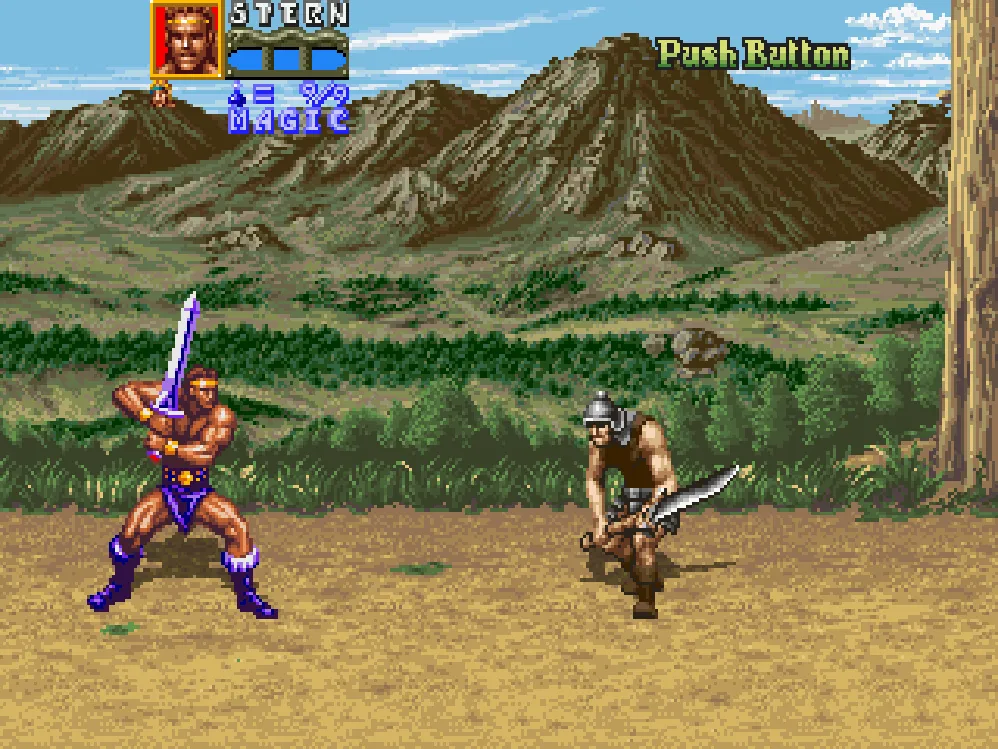
Unlike the original, the previous trio of heroes does not return in their original form—the dwarf warrior Gilius Thunderhead now rides atop the giant Goah to assist in battle, while four new warriors step up to take on Death Adder. Stern Blade, a barbarian swordsman, embarks on a quest for vengeance; Dora, a female centaur, dominates the battlefield with her spear and earth magic; the giant warrior Goah carries Gilius on his back, fighting side-by-side; and the young elf Little Trix uses his pitchfork and agility to weave through enemy lines.
1.2 Development History
Developed by Sega's AM1 division, the game debuted in 1992 on the Sega System 32 arcade board. As Sega's first 32-bit arcade platform, it featured the NEC V60 processor (16.10795 MHz) and cutting-edge sprite scaling and rotation capabilities, allowing for massive, screen-filling enemies and incredibly fluid animations. The screen resolution is 416 x 224 pixels with a 16,384-color palette.
The soundtrack, composed by Tomoyuki Kawamura and Masanori Takeuchi, draws inspiration from the film Conan the Barbarian. According to Japan's Game Machine magazine, it ranked third among table-top arcade cabinets in November 1992. However, for nearly thirty years, it remained an arcade exclusive, never ported to any home console—until its 2020 release on the Astro City Mini and Arcade1Up cabinets.
II. Character Profiles
There are four playable characters. The magic system has been changed to a fixed consumption mechanic—each spell costs a set number of potions rather than increasing in power based on quantity.
Stern Blade—A barbarian swordsman wielding a longsword. He has excellent attack power but is relatively slow. His magic, "Fire Storm," costs 9 potions and summons flames across the entire screen. Ideal for players who prefer a head-on approach.
Dora—The series' first female centaur warrior, using kicks and spear strikes. She has above-average attack power and high speed. Her magic, "Earthquake," costs only 4 potions—the lowest in the game—allowing for frequent use. She is widely considered the best character for solo play. Interestingly, when Dora rides a mount or pulls a lever, her horse legs transform into human legs.
Goah—A giant warrior who carries the dwarf Gilius Thunderhead on his back. Goah handles melee combat while Gilius casts spells. He has the highest attack power but the slowest speed. His magic, "Demon Skull," costs 13 potions and uses black mist to petrify and shatter all enemies on screen; it is the most powerful attack spell.
Little Trix—A young elf with a pitchfork. He is the fastest character but has the weakest attacks. His magic, "Providence," costs 6 potions and summons an apple tree that fully restores all players' health—the only non-offensive healing spell in the series. In multiplayer, he can ride on Goah's shoulders to fight in tandem.
III. Controls
3.1 Basic Controls
The game uses an 8-way joystick and a 3-button arcade layout.
| Action | Button | Description |
|---|---|---|
| Movement | Joystick | 8-way free movement |
| Normal Attack | Button 1 | Press repeatedly for combos |
| Jump | Button 2 | Jump in any direction |
| Cast Magic | Button 3 | Consume fixed potions for unique magic |
| Power Attack | Attack + Jump | High-damage special attack (costs health) |
| Diving Attack | Run + Jump + Down + Attack | Aerial downward strike; usable while mounted |
Compared to the original, new features include a kick to stun enemies and cooperative piledriver throws for massive damage. You can change characters when continuing.
3.2 Branching Paths and Mounts
The game introduces a branching path system. Two forks occur after Stage 2 and Stage 4. The Japanese version requires completing only one path (5 stages total), while the US version requires backtracking to complete the unchosen paths (7 stages total).
The mount system (Bizarrians) is greatly expanded with five types:
| Mount | Attack Style | Power | Found In |
|---|---|---|---|
| Fire Mantis (Green) | Fire breath, bite finisher | Low | Jungle, Town, Castle |
| Combat Mantis (Black) | Melee slashes and throws | Medium | Cave, Forest, Castle |
| Lightning Scorpion (Blue) | Lightning tail sting | Medium | Jungle, Cave, Town |
| Combat Scorpion (Gold) | Hammer strikes and throws | High | Forest |
| Undead Bone Dragon | Explosive fireballs, aerial kick | High | West Gate, Pier |
Mounts can also carry ballistae, flamethrowers, or crossbows. Mounts will flee if the rider is knocked off three times or left unattended.
IV. Stage Walkthrough & Boss Strategy
Stage 1: Jungle—The starting stage where the Green Mantis debuts. Watch out for the Amazon mini-boss's jumping knee strike. The boss, an Ogre leader, wields a mace; steal the Blue Scorpion to counter his charge with lightning.
Stage 2: The Fork—Route A (Slave Cave) requires lanterns for light and features rolling stones/tree traps; Route B (Dark Forest) has campfires that drop up to 4 food items. Both bosses are groups of skeletons with high defense.
Stage 3: Town—The longest stage with four areas. Face Amazons, Cyclopes (with knockdown club attacks), Red Ogre duos, and Scythe Knights.
Stage 4: Second Fork—Route A (West Gate) features the Undead Bone Dragon; Route B (Pier) features Kraken tentacles that break the deck. The bosses are Necromancers who summon skeletons and trees. Focus on minions first.
Stages 5-6: The Return (US Exclusive)—Backtrack to complete previously skipped paths.
Stage 7: Death Adder's Castle—Revisits various bosses. The final boss, Death Adder, has three phases: 1) Dragon Shield (do not use magic, it will be absorbed); 2) Giant Axe with screen-wide shockwaves (magic is safe here); 3) Dragon-riding phase (use hit-and-run tactics). Gilius ends it with a final axe strike.
V. Tips and Advanced Strategy
- Positioning over Output—Attacking from the side or behind is safer than head-on combat.
- Use Kicks for Crowd Control—Kicks stun enemies, allowing you to break up groups.
- Diving Attack Versatility—The aerial dive is perfect for entering or escaping the fray.
- Magic Management—Don't hoard potions; use them decisively as they don't scale with quantity.
- Trix's Apple Tree—In multiplayer, a full-health heal is more valuable than any offensive spell.
- Prioritize Mount Theft—Stealing an enemy's mount grants firepower and denies them mobility.
- Explore the Environment—Check crates, levers, and campfires for items. Don't miss the blue (potions) and green (food) thieves before the stage ends.
VI. Trivia and Arcade Legends
The 30-Year Exclusive—The System 32 hardware was far beyond home console capabilities at the time. Sega opted to develop a completely different Golden Axe II (1991) for the Mega Drive instead of porting this. The 2020 Astro City Mini release was the first official home version.
Gilius's Role—The dwarf from the original game doesn't appear as a standalone character but rides Goah, serving as both a fan-service easter egg and a narrative solution.
Trix & Goah Tandem—In multiplayer, Trix can ride on Goah's shoulders—a rare "character-riding-character" mechanic.
Regional Differences—The Japanese version has 5 stages, 2 players, 2 lives, and 24 energy. The US version has 7 stages, 4 players, 1 life, and 40 energy, plus the "Winners Don't Use Drugs" screen.
Rediscovery—After being forgotten for years, Time Extension named it one of the "25 Best Beat 'em Ups of All Time" in 2023.
Character Swapping—Allowing players to change characters upon continuing was an advanced feature for 1992.