I. Game Background
1.1 World Setting
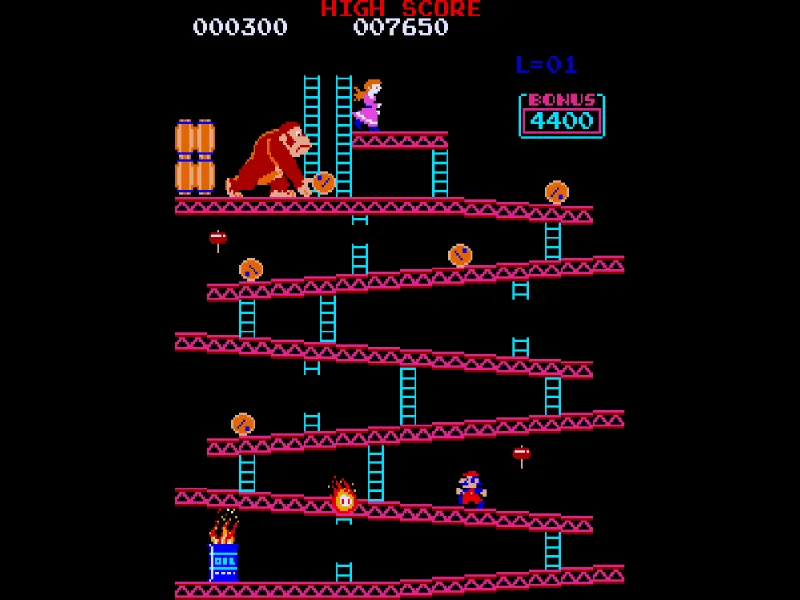
The story of Donkey Kong is simple yet dramatic: a giant ape—Donkey Kong—escapes from a zoo, kidnaps the beautiful Pauline, and climbs to the top of a skyscraper under construction. The brave carpenter Jumpman (later renamed Mario) must climb through obstacles, navigate steel beams, conveyor belts, elevator shafts, and rivet platforms to defeat Donkey Kong and rescue Pauline.
While this "damsel in distress" template is simple, it was the first narrative masterpiece in video game history to use cutscenes to advance the plot. In an era when most games had one-sentence manuals, Donkey Kong used three cutscenes—Donkey Kong grinning, Pauline calling for help, and Donkey Kong falling—to complete a full story arc. Since then, the image of a giant ape kidnapping a heroine has become one of the most recognizable tropes in global pop culture.
1.2 Development History
In 1980, Nintendo made an ambitious push into the North American arcade market with a space shooter called Radar Scope. However, the game was a massive failure in North America, leaving warehouses full of unsold cabinets. Nintendo faced a difficult choice: absorb losses of tens of millions of yen or find a way to turn these unsold machines into something profitable.
Shigeru Miyamoto, a 28-year-old industrial designer at the company, was given this near-impossible task: use the existing hardware to create a game that could save Nintendo's North American business. This was Miyamoto's first time as a game designer; his previous work had primarily been designing the aesthetics of Nintendo's arcade cabinets.
Miyamoto drew inspiration from the "Beauty and the Beast" story, while also referencing the 1933 classic film King Kong and the Popeye comics. He initially planned to make a licensed Popeye game, but after licensing negotiations failed, he decided to create original characters. He drew three A4 pages of design drafts, including the complete game content, character summaries, and about five level sketches.
As for the origin of the name "Donkey Kong," Miyamoto wanted to convey "silly ape" or "stubborn ape"—"Donkey" in American slang implies "silly or stubborn," while "Kong" suggests a gorilla. Other candidate names included Big Kong, Kong on the Run, Kong Chase, City Kong, and Funny Kong.
Nintendo kept the CPU, sound hardware, and monitor of Radar Scope intact, replacing only the ROM chips and graphic data. The entire game content was only about 20KB—much smaller than an average digital photo. Chief engineer Gunpei Yokoi served as the project supervisor, providing critical technical support.
Donkey Kong was released in Japan on July 9, 1981. It hit North America in October of the same year and immediately ignited the arcade market. It was not only Nintendo's first true global hit but also paved the way for the birth of the Nintendo Entertainment System (NES)—the hardware design of which was largely intended to perfectly port Donkey Kong.
II. Character Introduction
2.1 Jumpman / Mario — The Original Hero
| Attribute | Rating |
|---|---|
| Jump Power | ★★★★ |
| Speed | ★★★ |
| Strength | ★★ |
Jumpman was the first game protagonist created by Miyamoto. He had no official name in the Japanese arcade version; the manual referred to him as "Jumpman." In 1982, employees at Nintendo of America named him after their office landlord, Mario Segale. Since then, this mustachioed carpenter in a red hat and red overalls has become Nintendo's mascot and eventually the most famous game character in the world.
Character Design Details: Due to pixel resolution limitations, Miyamoto couldn't draw a mouth—so he added a thick mustache to the carpenter to imply its existence. The hat avoided the need for hair animation. The red overalls made arm movements clearly visible against the dark background.
Core Abilities:
- Jump: The most core and revolutionary mechanic of Donkey Kong. Jumpman can leap between platforms, jump over barrels, and cross gaps.
- Hammer Attack: After picking up the hammer item, he can smash barrels and some obstacles for a few seconds.
- Climbing: Climbing up and down ladders is the primary way to traverse platform levels.
2.2 Pauline — The Original "Damsel in Distress"
| Attribute | Description |
|---|---|
| Status | The first "damsel in distress" in video game history |
| Features | Pink dress, long hair |
| Iconic Line | Shouting "HELP!" in a speech bubble |
Pauline was originally called "Lady." She was later named "Pauline"—a name derived from Polly James, the wife of Nintendo warehouse manager Don James. Her design was inspired by the heroine played by Fay Wray in the King Kong movie—disheveled, messy hair, and high heels. She represents the first "damsel in distress" character in video game history with a clear narrative function.
2.3 Donkey Kong — The Great Villain
| Attribute | Description |
|---|---|
| Size | Occupies a large portion of the screen, composed of 6 Sprites |
| Personality | Mischievous, cunning, mocks the player |
| Signature Moves | Throwing barrels, pounding the ground, smirking when the player fails |
Miyamoto emphasized that Donkey Kong "should not be too evil or repulsive"—he should be a mischievous and clever character. At the start of each level, Donkey Kong carries Pauline to a higher point and then throws barrels and oil drums at the player. When the player fails, he flashes a smug smile—a detail that became one of the game's most iconic images.
III. Controls
3.1 Basic Controls
| Action | Control | Description |
|---|---|---|
| Move Left/Right | Joystick Left/Right | Move horizontally on platforms |
| Climb | Joystick Up/Down | Move up and down on ladders |
| Jump | Button | Jump over obstacles or gaps |
| Hammer Attack | Auto-pickup on contact | Press attack button to swing hammer and smash barrels |
3.2 Core Mechanics
Jump System: Donkey Kong was the first video game to feature "jumping" as a core mechanic. Before this, character movement was limited to horizontal side-scrolling (like Space Invaders) or simple movement (like the tunnels in Pac-Man). Miyamoto's jump—featuring a parabolic trajectory and gravity sensing—defined the "Platformer" genre, becoming the ancestor of all "jump-and-run" games.
Scoring System:
| Scoring Method | Points |
|---|---|
| Jump over a barrel | 100 pts |
| Smash a barrel with hammer | 300 pts |
| Collect items (hat/umbrella/purse) | 300-800 pts |
| Remove a rivet (Level 4) | 500 pts |
| Time bonus (remaining time) | 1 pt per second |
| Extra Life | 7,000 pts |
IV. Level Walkthrough & Strategy
The game contains 4 distinct levels. After completing one cycle (4 levels), the difficulty increases, and the level sequence repeats. Each cycle is called a "Level," representing Donkey Kong climbing 25 meters higher.
Level 1: 25 Meters — Steel Construction Site
| Scene Description | Core Mechanic | Strategy Tips |
|---|---|---|
| Sloped steel beams connected by ladders. Donkey Kong throws barrels from the top | Avoid or jump over barrels rolling down the ramps | This is the first level players encounter and the most iconic scene. Barrels roll down from both sides; the slope direction determines the path. Key Tip: Use the hammer to safely smash barrels, but time it well—the hammer has a duration limit. If you don't want to use the hammer, jump when the barrel is close. Beware that oil drum explosions can knock players away. |
Level 2: 50 Meters — Conveyor Belt Workshop
| Scene Description | Core Mechanic | Strategy Tips |
|---|---|---|
| A five-story factory workshop with conveyor belts carrying cement pans | Conveyor belts affect movement; cement pans can be pushed | The direction of the conveyor belts alternates by level—some move left, some move right. Key Tip: Use conveyor belts to save time. You can stand on cement pans to be transported or push them to crush enemies. Fire enemies appear in this level, moving in fixed, looping paths. |
Level 3: 75 Meters — Elevator Shaft
| Scene Description | Core Mechanic | Strategy Tips |
|---|---|---|
| Vertical elevator shafts with moving platforms and bouncing springs | Use elevators to ascend, avoid bouncing springs | This level is stylistically different, emphasizing vertical movement. Key Tip: The rhythm of the elevators is fixed—observe and memorize their arrival times. Springs bounce up from the bottom; jump to avoid them before they reach your platform. There are no hammers here; rely entirely on jumping skills. |
Level 4: 100 Meters — Rivet Platform
| Scene Description | Core Mechanic | Strategy Tips |
|---|---|---|
| The highest level where Donkey Kong resides, featuring platforms held by rivets | Remove all 8 rivets to make Donkey Kong fall | The final level. Players must walk to each rivet to remove it while dodging barrels and fire enemies. Key Tip: Note that platforms lose support as rivets are removed, causing some to tilt or collapse. Planning the removal order is crucial—prioritize removing rivets in the center to maintain structural stability. Once all rivets are removed, Donkey Kong falls, and Mario reunites with Pauline. |
Difficulty Scaling:
From the 2nd cycle onwards, the game gets harder each round:
- Barrels move faster and appear more frequently
- Some barrels roll diagonally (instead of straight down), making paths harder to predict
- Fire enemies move faster
- Platform gaps may change slightly
- Bonus item locations become trickier
Level 22 — The "Kill Screen"
When a player reaches Level 22 (the 130th stage), a fatal programming error occurs: due to an integer overflow bug, the game's time calculation logic crashes, and the player dies automatically within seconds of entering the level. This "Kill Screen" is the ultimate challenge for Donkey Kong speedrunners. In January 2025, players discovered a special tool-assisted technique that theoretically allows progression past the kill screen—but due to joystick limitations, it is nearly impossible on real arcade hardware.
V. Tips & Advanced Strategy
5.1 Basic Survival
- Master Level 1: Level 1 (25m) is the foundation of the entire game. Mastering barrel rhythm is the starting point for clearing the game.
- The Hammer is a Double-Edged Sword: The hammer can smash barrels, but you cannot climb ladders while holding it—use it cautiously when you need to switch levels quickly.
- Observe Barrel Paths: The slope side determines the barrel's direction. Predicting this saves reaction time.
- Oil Drum Management: Fire from exploded oil drums spreads along platforms; try to fight far away from them.
5.2 Level 4 Rivet Strategy
- Clear the Center First: Center rivets support the main platforms; removing them provides more escape space.
- Save the Corners: Save corner rivets for last; they can serve as temporary safe zones.
- Control Barrel Paths: Be aware of your position when Donkey Kong throws barrels—standing in different areas affects where barrels land.
5.3 High Score Tips
- Wait for the Right Moment: Remaining time is added to your score; delay finishing the level if it's safe to do so.
- Collect All Items: Each level has bonus items (hat, umbrella, purse) hidden high up; collect them all if you aren't rushing.
- Smash Barrels with the Hammer: Smashing a barrel with the hammer grants 300 points, much higher than the 100 points for jumping over one.
5.4 Advanced Knowledge
- Jump Timing: It takes about 4 frames for the jump to reach its peak after pressing the button; timing needs adjustment based on difficulty.
- Climbing Ladders: You cannot attack while climbing—ensure there are no barrels nearby before starting.
- Use Fire Enemies: Fire enemies have fixed paths; use their positions to predict safe zones.
VI. Trivia & Arcade Legends
6.1 The "Donkey Kong" Name Rumor
There is a long-standing myth that the game was supposed to be called "Monkey Kong," but a bad fax transmission caused the name to become "Donkey Kong." This story—while fun—is pure fiction. Miyamoto himself is very clear: he wanted to express "silly and stubborn ape," and "donkey" in American slang carries that exact meaning.
6.2 The Birth of Mario — Pixel Wisdom
Mario's mustache wasn't an aesthetic choice, but a technical compromise. Due to low pixel resolution, it was impossible to draw a mouth, so Miyamoto added a mustache to imply a face. The hat avoided the need for hair animation, and the red overalls made arm movements visible against dark backgrounds. These "designs" that look iconic today were just clever workarounds for technical limitations.
6.3 One Game Saved a Company
The development budget for Donkey Kong was only $267,000. If it had failed, Nintendo's North American ambitions might have ended there. Ultimately, the arcade version sold about 132,000 units globally, with all home ports totaling over 15 million copies and estimated total revenue of $4.4 billion—all starting from sketches on three A4 pages.
6.4 Universal Studios Lawsuit
In 1982, Universal City Studios sued Nintendo, claiming Donkey Kong infringed on the King Kong trademark. In court, Nintendo successfully proved that Universal had previously argued that "the story and characters of King Kong belong to the public domain"—making Universal's claim self-defeating. Nintendo won the case and received $1.8 million in damages. Interestingly, the lawyer who represented Nintendo, John Kirby, later became a legend—Nintendo named the pink hero in Kirby's Dream Land after him and gifted him a $30,000 sailboat named "Donkey Kong."
6.5 The Kill Screen
The Level 22 "Kill Screen" is the most central topic in Donkey Kong speedrunning culture. This bug stems from integer overflow: the game's internal timer exceeds its design limit at Level 22, causing a logic crash. After the rivalry between Billy Mitchell and Steve Wiebe was documented in The King of Kong (2007), the kill screen became one of the most famous programming errors in arcade history.
6.6 "It's on like Donkey Kong"
In 1992, rapper Ice Cube used the phrase "It's on like Donkey Kong" in a song, and it entered the American pop culture lexicon. In 2010, Nintendo officially trademarked the phrase. It is widely used in sports commentary, TV shows, and daily conversation, serving as the ultimate proof of the game's cultural impact.
6.7 The Invention of the D-Pad
The 1982 Game & Watch version of Donkey Kong was the first to feature Nintendo's iconic "D-pad"—an input device invented by Gunpei Yokoi that revolutionized portable gaming controls and became a hallmark of Nintendo hardware for decades.
6.8 Various Ports
Almost every major 1980s gaming platform had a Donkey Kong port. The ColecoVision version was bundled with the console and sold about 2 million copies; the Atari 2600 version was completed independently by Garry Kitchen in 3-4 months and sold 4 million copies in 1982—though it had to cut two levels due to memory limits. The Switch version by Hamster's Arcade Archives series perfectly restores the arcade original, supporting save states and online leaderboards.