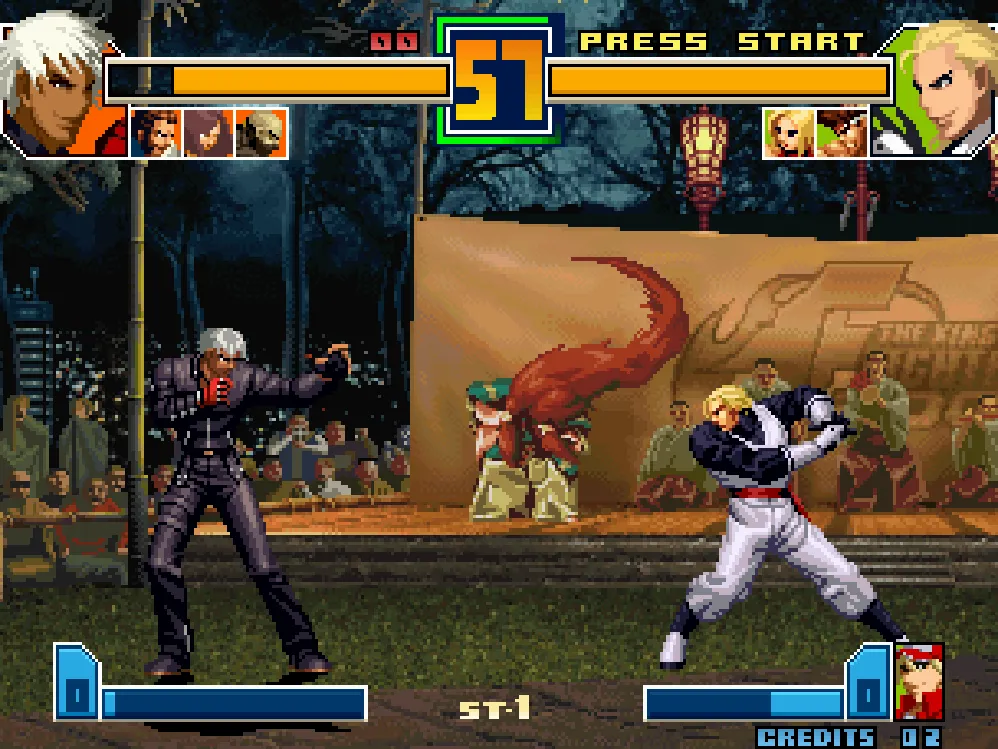
The King of Fighters 2001
1. Game Background
1.1 World Setting
The King of Fighters 2001 serves as the grand finale of the NESTS Saga. The mysterious transnational criminal organization NESTS, introduced in KOF '99, finally faces its day of reckoning after three years of conflict with the world's greatest fighters. NESTS is a super-organization built on cloning technology and genetic modification—they cloned Kyo Kusanagi and created enhanced warriors like K' and Kula, all in a bid to achieve absolute global domination through military technology.
In the previous installment, KOF 2000, the high-ranking NESTS officer Zero activated the "Zero Cannon" satellite to destroy South Town. Although Zero was defeated, his dying words revealed a chilling truth: he was merely a pawn for the true leader of NESTS, Igniz. Zero's rebellion and death were nothing more than a trivial footnote in Igniz's grand plan.
This is where the story of KOF 2001 begins. Igniz—the CEO of NESTS and a man who views himself as a god—decides to personally bring this long-standing game to an end. He announces a new King of Fighters tournament in the name of NESTS, inviting fighters from across the globe to the organization's space station headquarters. It is both a trap and a final ritual for him to be crowned the "God of the New World." Twelve teams from around the world answer the call, unaware that they are heading into a life-or-death battle in outer space.
1.2 Development History
The King of Fighters 2001 is unique in the series—it is the only mainline KOF title developed primarily by a South Korean company. In 2000, the Japanese company SNK declared bankruptcy due to financial difficulties. The core IP of SNK (including the KOF series) was transferred to the Korean game company Eolith. With the assistance of former SNK employees, Eolith released this game in 2001.
This event sparked massive controversy among KOF fans. Many veteran players felt that Eolith's art style deviated from the polish of SNK's "Golden Age," citing disproportionate character portraits, rough background art, and a darker overall color palette. However, objectively speaking, during the chaotic period of SNK's bankruptcy, Eolith's efforts allowed the KOF series to continue, which is an achievement worthy of respect.
The game debuted on the Neo Geo MVS/AES platform in 2001, utilizing the Neo Geo 330MEGS cartridge. It was one of the last mainline KOF titles to use Neo Geo hardware. In terms of systems, KOF 2001 introduced radical innovations: the "Tactical Order System," which allows players to decide the number of active fighters and strikers, and customizable striker modes. While these designs received mixed reviews at the time, they paved the way for the tag-team systems seen in later titles like KOF XI.
2. Character Introduction
Hero Team
| Character | Fighting Style | Power | Speed | Skills | Overall Rating |
|---|---|---|---|---|---|
| K' | Violent Fighting + Crimson Flames | ★★★★☆ | ★★★★☆ | ★★★☆☆ | Series protagonist, strongest output with right-hand flames |
| Maxima | M-1 Fighting + Mechanical Mods | ★★★★★ | ★★☆☆☆ | ★★☆☆☆ | Heavy pressure type, high durability |
| Whip | Whip + Assassination Arts | ★★★☆☆ | ★★★★☆ | ★★★☆☆ | Mid-to-long range control expert |
| Lin | Poison Hand + Assassination Arts | ★★★☆☆ | ★★★★☆ | ★★★★☆ | Leader of the Hizoku, poison-based combos |
- Pros: Balanced lineup; K' and Lin provide high-mobility output, while Maxima acts as a front-line tank.
- Cons: Lacks strong anti-air options; Whip is vulnerable in close-quarters combat.
Japan Team
| Character | Fighting Style | Power | Speed | Skills | Overall Rating |
|---|---|---|---|---|---|
| Kyo Kusanagi | Kusanagi Style + Personal Arts | ★★★★☆ | ★★★★☆ | ★★★★★ | Flames of the Phoenix, king of combos |
| Benimaru Nikaido | Shooting + Personal Arts | ★★★☆☆ | ★★★★★ | ★★★★☆ | Extremely strong electrical control |
| Goro Daimon | Judo + Personal Arts | ★★★★★ | ★☆☆☆☆ | ★★★☆☆ | Strongest grappler, explosive damage |
| Shingo Yabuki | Kusanagi Style (Incomplete) | ★★★☆☆ | ★★★☆☆ | ★★☆☆☆ | Fireless Kyo, comic relief character |
- Pros: Mobility from Kyo and Benimaru, ground pressure from Daimon, and unpredictability from Shingo.
- Cons: Daimon is extremely slow; Shingo lacks fire damage.
Fatal Fury Team
| Character | Fighting Style | Power | Speed | Skills | Overall Rating |
|---|---|---|---|---|---|
| Terry Bogard | Personal Arts + Military Arts | ★★★★☆ | ★★★★☆ | ★★★★☆ | Legendary Wolf, balanced and powerful |
| Andy Bogard | Koppo + Shiranui Ninjutsu | ★★★☆☆ | ★★★★☆ | ★★★☆☆ | High-speed ninja type, aerial advantage |
| Joe Higashi | Muay Thai | ★★★★☆ | ★★★☆☆ | ★★★☆☆ | Explosive power, Hurricane Upper pressure |
| Blue Mary | Joint Locks + Grappling | ★★★☆☆ | ★★★☆☆ | ★★★★☆ | S-tier grappler, master of counters |
- Pros: Close-range burst from Terry and Joe; Mary's counters and command grabs.
- Cons: Andy's damage output was nerfed in KOF 2001.
Psycho Soldiers Team
| Character | Fighting Style | Power | Speed | Skills | Overall Rating |
|---|---|---|---|---|---|
| Athena Asamiya | Psycho Power + Chinese Martial Arts | ★★★☆☆ | ★★★★☆ | ★★★★★ | Full-screen projectile type, versatile powers |
| Sie Kensou | Psycho Power + Chinese Martial Arts | ★★★☆☆ | ★★★★☆ | ★★★☆☆ | Agile, but psychic powers are weakened |
| Chin Gentsai | Drunken Fist | ★★☆☆☆ | ★☆☆☆☆ | ★★★★★ | Master of Drunken Fist, unpredictable moves |
| Bao | Psycho Power | ★★☆☆☆ | ★★★☆☆ | ★★★★☆ | Small stature, tricky character with tiny hitboxes |
- Pros: Athena's full-screen pressure, Bao's small hitbox, and Chin's unpredictability.
- Cons: Chin is very slow; Kensou's powers are nerfed in this title.
Ikari Team
| Character | Fighting Style | Power | Speed | Skills | Overall Rating |
|---|---|---|---|---|---|
| Leona Heidern | Military Arts + Orochi Power | ★★★★☆ | ★★★★☆ | ★★★★☆ | Most stable top-tier character, strong combos |
| Ralf Jones | Military Arts + Personal Strikes | ★★★★★ | ★★☆☆☆ | ★★★☆☆ | One-punch man, high single-hit damage |
| Clark Still | Military Arts + Grappling | ★★★★☆ | ★★☆☆☆ | ★★★★☆ | King of grapplers, close-range pressure |
| Heidern | Military Assassination Arts | ★★★☆☆ | ★★★★☆ | ★★★☆☆ | Commander returns, mid-range cutting attacks |
- Pros: Leona's versatility, Clark's grab chains, and Heidern's cutting control.
- Cons: Ralf and Clark have slow movement, making them struggle against fast characters.
Women Fighters Team
| Character | Fighting Style | Power | Speed | Skills | Overall Rating |
|---|---|---|---|---|---|
| King | Muay Thai | ★★★★☆ | ★★★★☆ | ★★★☆☆ | High-mobility Muay Thai, Tears of Venice |
| Mai Shiranui | Shiranui Ninjutsu | ★★★☆☆ | ★★★★★ | ★★★☆☆ | Queen of the air, fan-toss control |
| Li Xiangfei | Chinese Martial Arts | ★★★☆☆ | ★★★☆☆ | ★★★☆☆ | Solid, standard martial arts character |
| Hinako Shijo | Sumo | ★★★★★ | ★☆☆☆☆ | ★★★☆☆ | New character, small sumo wrestler, strong grabs |
- Pros: Mai's aerial advantage, Hinako's surprising sumo grab damage.
- Cons: Xiangfei lacks standout advantages in this game; Hinako is extremely slow.
Korea Team
| Character | Fighting Style | Power | Speed | Skills | Overall Rating |
|---|---|---|---|---|---|
| Kim Kaphwan | Taekwondo | ★★★★☆ | ★★★★★ | ★★★★☆ | God of Taekwondo, king of aerial combos |
| Choi Bounge | Taekwondo + Small Stature | ★★☆☆☆ | ★★★★★ | ★★★☆☆ | Tiny hitbox, fastest speed |
| Chang Koehan | Taekwondo + Iron Ball | ★★★★★ | ★☆☆☆☆ | ★★★☆☆ | Massive attack range with iron ball |
| May Lee | Taekwondo (New Character) | ★★★☆☆ | ★★★★☆ | ★★★★★ | "Hero Mode" switch—most creative design in the game |
- Pros: Kim's versatility, May Lee's dual-mode switching, Choi's harassment.
- Cons: Chang is extremely slow; May Lee has a complex control scheme.
May Lee—A Model of Dual-Mode Design: May Lee can switch between "Standard Mode" and "Hero Mode." In "Hero Mode," she transforms into a Kamen Rider-like combat form—donning a helmet, gaining a new set of special moves, and completely changing her movement style. She is one of the boldest designs and highest-skill-ceiling characters in the KOF series. Unfortunately, she only appeared as a hidden character in KOF 2002 UM and KOF Neowave thereafter, becoming a "one-hit wonder" deeply missed by fans.
NESTS Team
| Character | Fighting Style | Power | Speed | Skills | Overall Rating |
|---|---|---|---|---|---|
| Kula Diamond | Anti-K' Arts + Ice | ★★★★☆ | ★★★★☆ | ★★★★★ | Ice Maiden, strongest crowd control |
| Foxy | Fencing + Western Sword Arts | ★★★☆☆ | ★★★★☆ | ★★★☆☆ | Thrusting attacks, mid-range control |
| Ángel | Unorthodox Fighting | ★★★★☆ | ★★★★★ | ★★★★★ | "Unchain Circle" system—most complex combo system |
| K9999 | Violence + Mechanical Arm | ★★★★★ | ★★★★☆ | ★★★★☆ | Clone, explosive power |
- Pros: Kula's ice control, K9999's explosive output, Ángel's infinite combo potential.
- Cons: Ángel has a very high barrier to entry; Foxy is vulnerable in close combat.
Ángel—The Unpredictable Combo Machine: Ángel's "Unchain Circle" system allows players to cancel into another move at any point during specific attacks, theoretically offering near-infinite combinations. This means two different Ángel players might execute completely different combo paths. She is widely recognized as one of the hardest characters to master in the entire KOF series, but with the highest rewards.
K9999—The Cursed Clone Warrior: K9999 was an experimental product of NESTS' attempt to clone Kyo Kusanagi—he shares the same origins as K' but is far more unstable. His design (from appearance to abilities to voice acting) clearly draws inspiration from Tetsuo Shima in Katsuhiro Otomo's masterpiece AKIRA. This homage (or imitation) eventually triggered legal disputes, leading SNK to permanently remove K9999 from subsequent titles until his return in KOF XV as the redesigned "Krohnen." K9999's "disappearance" remains one of the most famous copyright controversies in KOF history.
3. Controls
3.1 Basic Controls
| Button | Function |
|---|---|
| A | Light Punch |
| B | Light Kick |
| C | Heavy Punch |
| D | Heavy Kick |
| ←/→ | Move Left/Right |
| ↖/↗ | Jump Direction |
| ↓ | Crouch |
| A+B | Emergency Evasion (Roll) |
| C+D | Blowback Attack |
| →→ | Dash |
| ←← | Backstep |
3.2 Tactical Order System
The biggest system innovation in KOF 2001 is that team composition is left entirely to the player. After selecting characters, players must decide the number of active fighters and strikers—this is the "Tactical Order System":
| Active Fighters | Strikers | Power Gauge Length | Characteristics |
|---|---|---|---|
| 1 | 3 | Longest | Solo fighter, 3 strikers for support |
| 2 | 2 | Longer | Dual mains, 2 strikers |
| 3 | 1 | Medium | Standard configuration |
| 4 | 0 | Shortest | All four fight, no strikers |
Fewer active fighters result in a longer power gauge—meaning the 1F/3S (1 fighter, 3 strikers) mode allows for frequent use of Super Special Moves. Conversely, 4 fighters provide a larger character pool and more tactical options. Both extreme configurations are viable: 1F/3S and 4F/0S are both seen in high-level play.
3.3 Striker System and Wire Damage
Striker Attacks: Press B+C to summon a striker to perform a preset action. Each character's striker move is fixed—such as Terry's Power Charge or Athena's Psycho Ball. Strikers can interrupt opponent attacks, extend your own combos, or provide a defensive barrier in dangerous situations.
Wire Damage: Certain attacks (usually heavy or special moves) will send the opponent flying into the "wall" at the edge of the stage, causing them to bounce back—allowing for follow-up combos. The Wire Damage system significantly expands creative combo potential and is a core element of high-level KOF 2001 play.
Super Canceling: Normal or special moves can be canceled into Super Special Moves (consuming the power gauge). Combined with strikers and Wire Damage, a single combo can span the entire screen.
4. Boss Strategy
4.1 Mid-Boss: Zero (Original Zero)
| Attribute | Description |
|---|---|
| Fighting Style | NESTS Style |
| Height/Weight | 193cm / 88kg |
| Stage | Mid-boss before the finals |
| Location | NESTS Space Station—Command Room |
Combat Characteristics:
- Striker Summoning: Zero's most notable feature is his ability to summon three subordinates as strikers—Krizalid (→+A), Glaugan (→+B), and Ron (→+C). Each has a unique attack pattern; Ron is the most dangerous.
- Lucifer Lasher: A charging attack released after holding A, with very little recovery time.
- Cutting Swallow Mirror Slam: A traditional projectile attack (↓↘→+A/C).
- Slicing Chains of Hades: A Super Special Move (↓↘→↓↘→+A/C).
Strategy: Zero's AI has a fixed pattern for summoning strikers. When Zero jumps to the far end of the screen, he is almost certain to summon a striker—this is the safest time to advance. His close-range grab, "Cannibal Crusher," has a massive hitbox; do not stand in front of him for more than a second. Maintain mid-range distance, poke with projectiles, and rush in for a combo immediately after his striker's animation ends.
4.2 Final Boss: Igniz
| Attribute | Description |
|---|---|
| Fighting Style | NESTS Style |
| Height/Weight | 189cm / 85kg |
| Stage | Final Boss |
| Location | NESTS Space Station—Throne Room |
| Signature Quote | "I am God... No, I am God!" |
Combat Characteristics:
- Chain Blade Transaxial Slice: Long-range whip attack (↓↘→+A/C).
- Chain Blade Sagittarius Slice: Anti-air whip attack (→↓↘+A/C).
- Divine Arrow (Air/Ground): Thrusting attacks (↓↙←+A or C).
- Nega-Genesis: Summons energy pillars from the bottom of the screen (↓↘→+B/D).
- Chaos Tide: Full-screen energy burst (→↓↘+B/D).
- Aedion Blade: Super Special Move (↓↘→↓↘→+A/C)—a giant energy blade sweeping the screen.
- Brutal God Project: MAX Super Special Move (↓↘→↘↓↙←+AC)—Igniz pulls the opponent into an energy field for a multi-hit assault. One of the most spectacular final boss supers in the series.
Strategy: Igniz is widely considered one of the hardest bosses in the KOF series. His AI reads player inputs and reacts within frames—making head-on combat nearly impossible. Core strategies:
- Never jump proactively: Igniz's anti-air (Sagittarius Slice) covers half the screen; jumping is suicide.
- Wait for Nega-Genesis recovery: This is one of the few moves where Igniz has significant recovery frames. When he releases the ground energy pillars, dash in and start a combo.
- Don't get cornered: His whip attacks and Chaos Tide leave almost no room for evasion in the corner. Stay in the center of the stage.
- Use strikers correctly: If you have a striker, summon them the moment Igniz releases Chaos Tide—the striker's invincibility frames can help you dodge the full-screen attack.
- Patience is your only weapon: This is not a fight you can rush. Wait for an opening, execute a combo, and retreat immediately. Greed will cost you.
Igniz's boss theme—a symphony featuring pipe organs and choral elements—is one of the most oppressive tracks in the series, perfectly capturing the paranoia and arrogance of a madman who views himself as a god.
5. Tips and Advanced Strategy
5.1 Basic Survival Tips
- Choose the right configuration: Beginners should start with 3 fighters + 1 striker for a balanced gauge and manageable complexity.
- Strikers aren't insurance: Striker characters can be hit while being summoned. Using them blindly in front of an opponent is just giving away health.
- Wire Damage timing: Opponents can be hit about 12 frames after bouncing off the wall. Too early—you miss; too late—they land.
- Super Cancel economy: Don't waste energy on supers every chance you get—saving a bar for defensive counters is often more valuable.
- Hop attacks: KOF 2001 hop attacks have excellent hitboxes and are the best way to probe and pressure opponents.
- K9999's explosive output: His mechanical arm moves have massive hitboxes—use them to pressure from mid-range without needing to get close.
5.2 Team Recommendations
Beginner-Friendly (3 Fighters + 1 Striker):
- Leona (Main—stable combo performance)
- Terry (Mid—simple and efficient output)
- Kula (Anchor—ice control, strong comeback potential)
- Kim (Striker—excellent rushdown and pressure)
Advanced (1 Fighter + 3 Strikers):
- Ángel (Fighter—extend Unchain Circle combos with strikers)
- Lin + Ralf + Benimaru (Strikers—provide poison, power, and electrical coverage respectively)
5.3 General Boss Rules
- Learn AI patterns, not reactions: NESTS bosses read inputs. You must "trick" the AI rather than out-react it.
- Manage timing against Zero: His striker summoning is his biggest weakness—the recovery frames are your window to attack.
- Mental preparation for Igniz: You will likely lose the first 10 (or 50) matches. This is normal. Every failure is a lesson in his fixed patterns.
- Save energy for defense: Against bosses, the best time to use a MAX Super is when you are being pressured—the invincibility frames can save your life.
5.4 Advanced Trivia
- Ángel's Unchain Circle: The community has documented over 60 combo paths. It's not a "combo" but a "skill tree"—every path is improvised.
- May Lee's Mode Switch: Switching modes (Standard → Hero) during a combo extends damage, but the window is only about 8 frames.
- K9999's "Moon": His signature move is a massive energy wall—a powerful long-range attack with Super Armor, but with huge recovery if blocked.
- NESTS Team synergy: Using Kula, Foxy, Ángel, and K9999 together triggers unique story dialogue, making for one of the most thought-provoking narratives in KOF.
6. Anecdotes and Arcade Legends
6.1 SNK's Bankruptcy and Korean Development
SNK's 2000 bankruptcy was an earthquake in the arcade world. The company that created Fatal Fury, Samurai Shodown, KOF, and Metal Slug collapsed after a series of bad investments. KOF 2001 became the only "Korean-Japanese hybrid" mainline title. Veteran players generally agree: the gameplay is commendable, but the art style couldn't match the original SNK era.
6.2 The End of the NESTS Saga
The NESTS Saga (KOF '99-2001) is the longest story arc in the series. From K's escape as an experiment to Igniz's madness, the three games built the most complete narrative arc in KOF history. Interestingly, the ending isn't a simple "hero defeats villain" story—Igniz activates the space station's self-destruct, turning the escape into a thrilling space crisis.
6.3 The K9999 and AKIRA Copyright Mystery
K9999 is the most famous "missing character" in KOF history. His design—from hair to mechanical arm—was too similar to Tetsuo Shima from AKIRA. SNK removed him from all subsequent titles due to copyright pressure. He only returned in 2022's KOF XV as the redesigned "Krohnen."
6.4 Ángel—Chaos Theory in Fighting Games
Ángel's "Unchain Circle" system holds a unique place in design history. With dynamic cancel networks, the system's depth is so great that even 20 years later, the community is still finding new paths. Players joke: "Playing Ángel isn't learning combos; it's learning a language with a constantly changing grammar."
6.5 Igniz's Pipe Organ
Igniz's boss theme uses pipe organs and choral vocals—rare in fighting games. The organ symbolizes divinity and solemnity, creating a chilling irony when used for a boss who calls himself a god. It is considered one of the most beautiful and terrifying boss themes in KOF history.
6.6 The "Quarter-Gauge" Era
KOF 2001's Tactical Order System led to the "quarter-gauge" phenomenon: when choosing 4 fighters, the gauge is compressed to a quarter of its standard length. This meant MAX Supers were used constantly, turning matches into high-speed explosions of sound and light.
6.7 NESTS Space Station Aesthetics
With a space setting, the station design blends industrial pipes, holograms, and religious symbols—Igniz's throne is a mix of a cathedral and a power plant. This "mechanical divinity" perfectly reflects his arrogance.
6.8 Re-evaluation—An Underrated Innovation
Initially criticized for its art style, KOF 2001 has been re-evaluated over the years. The Tactical Order System is now recognized as a highly original team-building design, and the game is seen as a brave attempt to keep the KOF flame alive during SNK's darkest hour.