Ghosts 'n Goblins — The Philosophy of Gaming's Hardest Action Title
I. Game Background
1.1 The Setting
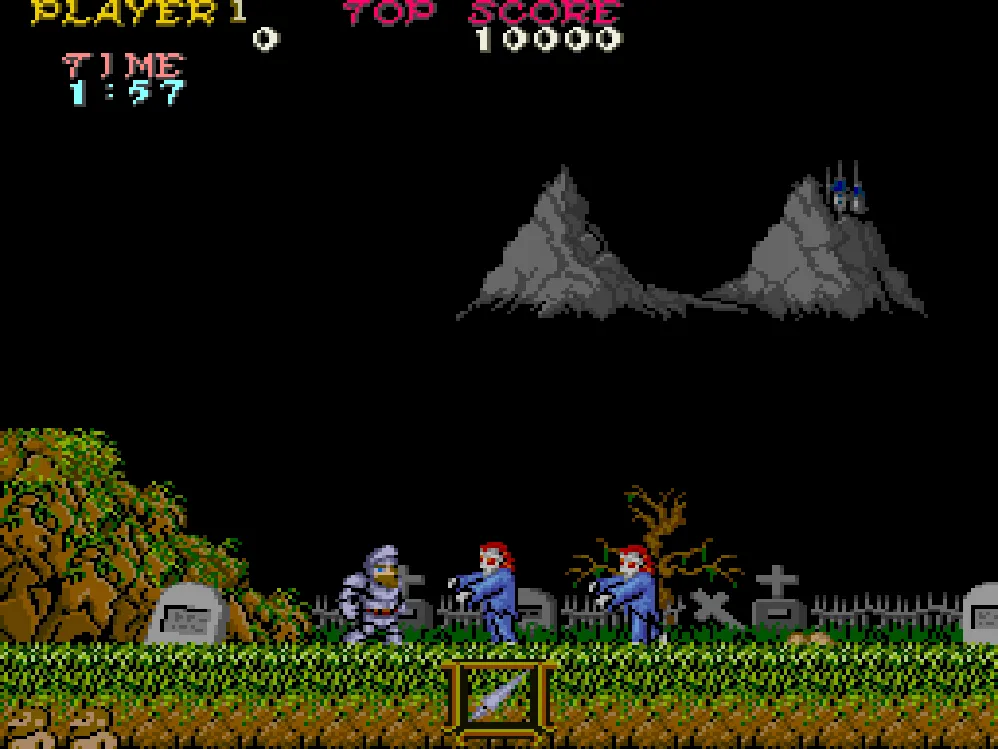
When Sir Arthur and Princess Prin Prin were enjoying a quiet twilight date in the graveyard, no one expected the demonic invasion to strike so suddenly. The sky tore open, the earth trembled, and swarms of Red Arremers descended. Before Arthur could even react, the Princess was snatched away.
Arthur is no "chosen one." He is the kingdom's greatest knight, certainly, but against the legions of the Demon World, even the strongest knight is merely mortal. His armor can withstand a single hit before shattering, revealing the strawberry-patterned boxers the Princess gave him as a "lucky charm." A second hit, and Arthur is reduced to a pile of bones, his soul left waiting for another coin to be dropped.
The mastermind behind the kidnapping is Satan—a grinning, furry demon general. But Satan is not the true ruler. He serves a more terrifying entity: Astaroth, also known as Lucifer, the King of the Demon World. This massive demon, with a face embedded in his chest, lurks in the throne room of the Demon Castle, waiting for any fool brave enough to challenge him.
Arthur’s journey spans six cursed realms—from graveyards crawling with zombies and wildernesses teeming with man-eating plants, to frozen towns and ruins burning with blue ghost-fire; from caves where Red Arremers nest to platforms of floating eyeballs, finally reaching the Demon Castle to face Satan himself. And then—if he thinks he has won—the game tells him: it was all an illusion. A trap set by Satan. Go back and do it all again, with a specific weapon, because only then will it be real.
This is Ghosts 'n Goblins—a game that instills despair into your bones from the very first second.
1.2 Tokuro Fujiwara’s Design Philosophy — "I Made It Difficult on Purpose"
Released by Capcom in 1985, Ghosts 'n Goblins was one of the company's early breakthrough titles. The game was directed and designed by Tokuro Fujiwara—a former Konami employee who would later become one of the godfathers of the Resident Evil series. The programmer was Toshio Arima—the fearsome Red Arremers were named after him ("Arima" -> "Arremer"). The art was handled by Masayoshi Kurokawa, and the music was composed by Ayako Mori.
Fujiwara created Ghosts 'n Goblins and established the most notorious difficulty philosophy in gaming: "Trial and Error." He used a simple, brutal method to tune the difficulty: he would observe playtesters, identify where they weren't getting stuck, and immediately return to the office to remake that section to make it harder. He admitted in a 2009 interview:
"If the testers weren't getting stuck, I had to go back and redo that part."
He would also look for "tricks" players used to avoid death and "quickly block those players who tried to use them." Finally, he added: "Please forgive me."
This sadistic design approach sounds like a scheme to drain player coins, but Fujiwara’s literary interpretation is more profound. He believed that failure in Ghosts 'n Goblins wasn't a punishment, but a dark comedy—the player is the "straight man," the game is the "lunatic," and you drop a coin to see what absurd thing happens next. He designed the game as a cat-and-mouse chase between player and designer—and the designer always wins with a smile at the end.
Along with Commando (1985), Ghosts 'n Goblins is seen as one of the two bullets Capcom fired to reach 8-bit stardom. The arcade version was a smash hit in both Japan and the US, and the NES port sold 1.64 million copies worldwide. Before Mega Man, Street Fighter, and Resident Evil, Ghosts 'n Goblins had already proven Capcom’s absolute dominance in the action genre.
II. Character Profiles
2.1 Arthur — The Knight in Boxers
| Attribute | Description |
|---|---|
| Full Name | Sir Arthur |
| Identity | The kingdom's greatest knight |
| Armored State | Silver armor — shatters after one hit |
| Underwear State | Strawberry-patterned boxers — a "lucky charm" from the Princess |
| Death State | A pile of bones — death upon the second hit |
| Jump Type | Fixed parabolic arc — cannot change direction in mid-air |
| Attack Limit | Max two projectiles at once — must hit or land to attack again |
The Symbolism of Armor and Underwear:
Arthur’s armor is not a renewable resource—once it shatters, it’s gone forever (unless you find a hidden armor reset point). The image of him running through demon-infested wilds in nothing but his boxers is both hilarious and heartbreaking. In 2021, Fujiwara finally solved the 36-year-old mystery: the pattern on the boxers is strawberries, not hearts. The Princess gave them to him as a charm—the strawberry pattern was "probably something the Princess liked." So Arthur isn't wearing "hot pink heart boxers"—it’s a projection of the Princess’s taste. The rugged knight is fully armored on the outside, but deep down, he’s wearing the cute strawberry boxers his fiancée loves—the dramatic tension of the character is complete.
This "full armor to boxers" design has become one of the most recognizable images in video game history. It appears in the Marvel vs. Capcom series (as a playable character) and as an Easter egg in Dead Rising. It is both funny and sympathetic—the hero at his most vulnerable and human moment.
2.2 Weapon System Overview
There are six weapons in the game, all sharing two core limitations: (1) Only two projectiles can be on screen at once; if you’ve thrown two and they haven't landed or hit an enemy, you cannot attack again; (2) Picking up a new weapon immediately replaces your current one—there is no "decline" option.
| Weapon | Attack Pattern | Strength | Notes |
|---|---|---|---|
| Lance/Javelin | Straight line, medium speed | A-Tier | The most balanced default weapon. Reliable and predictable. |
| Dagger/Knife | Straight line, fastest in game | S-Tier | The best weapon in the game. High speed means higher attack frequency. |
| Torch | Short arc, burns on ground | D-Tier | The worst weapon. The fire occupies a projectile slot, preventing continuous attacks. |
| Axe/Hatchet | Upward arc, then falls | C-Tier | Can hit high enemies, but the slow trajectory ruins the rhythm. |
| Sword | Short-range melee | ?-Tier | Rare weapon; its effectiveness is debated. |
| Cross/Shield | Short-range, clears projectiles | B-Tier | The only way to defeat Astaroth; mandatory for the true ending. |
Deep Dive Analysis:
The Lance is Arthur’s default weapon and the baseline for understanding the game's logic. It flies straight at a moderate speed—not too fast, not too slow. Its greatest strength is that it has no surprises. You know exactly how to use it in any level. Its weakness: in scenarios requiring rapid fire (like the swarms of Red Arremers in Stage 3), the fire rate may not be fast enough.
The Dagger is widely considered the best weapon—the community consensus is "the Dagger is the only weapon you actually want." Why? Because one of the core difficulties of Ghosts 'n Goblins is the two-projectile limit. The Dagger is the fastest weapon, meaning it hits or passes enemies in the shortest time, allowing you to attack again sooner. In high-density enemy areas (like Stage 5), the Dagger’s high fire rate is your only hope for survival. If you see a Dagger, pick it up. Experienced players have calculated that you get about 40% more attack opportunities with the Dagger than with the Lance.
The Torch is considered the worst weapon—but its incompetence is so "precise" that you have to suspect it was intentional. It flies in a short arc and leaves a burning flame on the ground. The problem? The burning flame counts as "one projectile on screen"—combined with another thrown torch, you hit the limit and cannot attack until the fire dies. In fast-paced combat, this wait time is fatal. The arc also makes it hard to hit flying enemies. The Torch exists to ask: "Are you sure you want to pick this up?"
The Axe is theoretically useful for high enemies, but it is too slow. As players say: "The axe takes an extra second to land after passing the enemy." That second of delay, while your projectile count is occupied, is enough for an enemy to cross the screen and kill you.
The Cross/Shield (Cross in Japan, changed to Shield in the NES version due to religious censorship, though the text still says "GET A CROSS") is not for daily use—but you cannot finish the game without it. If you reach Astaroth without it, the game displays "GET A CROSS" and forces you back to the start of Stage 5. This design—requiring a specific weapon to finish—remains one of the most controversial "hard requirements" in gaming.
III. Controls
3.1 The Ultra-Minimalist Two-Button System
Ghosts 'n Goblins has only two action buttons, yet it creates infinite ways to die:
| Button | Function | Notes |
|---|---|---|
| A (Attack) | Attack | Throws current weapon straight (Dagger/Lance) or in an arc (Torch/Axe) |
| B (Jump) | Jump | Fixed parabolic jump; direction controlled by stick |
| Left/Right | Move | Fixed walking speed |
| Up | None | No vertical aiming or climbing |
| Down | Crouch | Avoids some high-level attacks |
This layout reveals the core design intent—no complex commands. Attack is attack, jump is jump. You cannot attack in mid-air, charge, dash, roll, or block. You have two actions, and you must use them to handle everything.
3.2 Fixed Jump Arcs — "Every Jump is a Commitment"
Once Arthur’s feet leave the ground:
- Trajectory is locked: The arc is fixed from start to finish; you cannot change direction, distance, or cancel.
- No mid-air mobility: You cannot nudge your landing spot.
- No mid-air attacks: Jumping is purely for movement.
- No cancellation: Once you press jump, you are "committed" to the full duration and path.
Compared to modern platformers (where Mario can turn in mid-air, Celeste can dash), every jump in Ghosts 'n Goblins is an irrevocable bet. This isn't a technical limitation—1985 arcade hardware could handle more. It was Fujiwara’s choice: "Make the player responsible for every decision."
Why this makes it harder:
- You often have to jump toward enemies, and you can't attack or dodge in the air.
- Enemies often wait at your landing spot—and you can't turn back.
- There is a "ledge-grab" physics bug where you can get stuck on the edge of a platform, losing control.
- Red Arremers are specifically designed to punish jumps—they dive-bomb you at the peak of your jump, your most vulnerable moment.
IV. Level Walkthrough & Boss Strategy
4.1 The First Loop — Six Layers of Hell
Stage 1: "The Execution Place"
- Enemies: Zombies, Man-eating plants, "Ghostly Burritos."
- Mid-Boss: Red Arremer — The series' most notorious grunt. Needs 3 hits. It analyzes your movement and dodges, then dive-bombs when you jump. More dangerous than most bosses.
- Boss: Unicorn — Cyclops in red spiked leather. Strategy: Back away while throwing weapons. Low difficulty.
- Aftermath: Pick up the key, screen says "COME IN!!"
Stage 2: "Burning Village / Ice Palace"
- Enemies: Blue Devils, Petit Devils, Big Men (need ~10 hits).
- Time Pressure: High enemy density on stairs. If you get stuck, time runs out and you die instantly.
- Boss: Twin Unicorns — Keep them separated. If they stand together, dodging fireballs is twice as hard.
Stage 3: "The Caves"
- Enemies: Bats, Skeletons, and multiple Red Arremers as regular grunts. This is why Stage 3 is the "hardest level."
- Strategy: Be aggressive. Kill them before they start their evasive AI. Dagger is vital here. There are two hidden armor locations.
- Boss: Purple Dragon — Floating dragon. Shoot the segments of its body to shrink it. The floating head is the final phase.
Stage 4: "Bridge / Over the Abyss"
- Terrain: Floating "eyeball" platforms and rope bridges over lava. Requires precise timing with fire pillars.
- Boss: Dragon — Same as Stage 3.
Stage 5: "Lower Part of the Castle"
- Enemies: Upgraded versions of all previous enemies. A "bottleneck" level. The challenge is psychological—the relentless onslaught of enemies.
- Boss: Satan — Surprisingly comedic. Furry body, wide grin. Relatively easy compared to the level itself.
Stage 6: "Upper Part of the Castle / Throne Room"
- Boss Rush: Defeat all previous bosses, including two Satans.
- The Trap: If you don't have the Cross/Shield, you are sent back to the start of Stage 5. This is the cruelest "soft penalty" in gaming.
- Final Boss: Astaroth/Lucifer — Huge demon with a face on his chest. The chest is his weak point. In the first loop, he is intentionally easy—a trap.
4.2 "This Room is an Illusion" — The Infamous Hoax
After beating Astaroth, the screen says:
"THIS ROOM IS AN ILLUSION AND IS A TRAP DEVISUT BY SATAN. GO AHEAD DAUNTLESSLY! MAKE RAPID PROGRES!"
Note the typos: "DEVISUT" and "PROGRES." These weren't jokes—they were typical of 80s Japanese-to-English translation. But they became legendary. The game isn't just mocking your failure; it’s mocking your expectations of the industry.
4.3 The Second Loop — Deeper Hell
- More enemies: Frequency doubled.
- Faster movement: Red Arremers and Blue Devils are faster.
- Weapon shuffle: Weapons are hidden in new places, forcing you to use unfamiliar gear.
- Mandatory Cross/Shield: You must have it for the final boss.
4.4 The True Final Boss: Astaroth (Form 2)
- Speed: Much faster.
- Fireballs: Frequency doubled.
- Precision: You must hit the face on his chest with the Cross/Shield. The tiny window of opportunity makes this the ultimate difficulty test.
After winning, you get the "True Ending" with more Engrish: "CONGRATURATION," "STRONGHT," "COURAGEOUR." It’s a clumsy but earned conclusion.
V. Tips & Advanced Strategy
5.1 Weapon Ranking
| Rank | Weapon | Priority |
|---|---|---|
| S | Dagger | Pick up immediately |
| A | Lance | Reliable default |
| B | Cross/Shield | Keep for Stages 5-6 |
| C | Axe | Avoid |
| D | Torch | NEVER pick up |
5.2 Survival Rules
- Never turn your back on a Red Arremer.
- Armor is a liability. You're more nervous when you have it, which can lead to mistakes.
- The timer is real. Don't ignore it in the final 30 seconds.
- Hidden armor exists. Memorize the locations.
- The two-projectile limit is the most forgotten constraint.
- The path to the boss is harder than the boss.
- Don't rely on weapon locations in the second loop.
VI. Trivia & Arcade Legends
6.1 The "Trial and Error" Philosophy
Fujiwara’s method of making games harder if testers weren't getting stuck was a product of the arcade era. It wasn't just about coins; it was about creating a specific experience: the moment you laugh after being tricked by the game.
6.2 The Strawberry Boxers
In 2021, Fujiwara confirmed the pattern is strawberries, not hearts. It adds a layer of unexpected tenderness to Arthur—the kingdom's greatest knight fighting in his fiancée's favorite underwear.
6.3 The Meta-Narrative
Kotaku called the "Illusion" message "the meanest thing Capcom ever did." It breaks the fourth wall, with Satan himself mocking the player. It’s a narrative technique that was revolutionary for 1985.
6.4 Red Arremer's Origin
Named after programmer Toshio Arima. He became so popular he got his own spin-off series, Gargoyle's Quest.
6.5 DNA of Dark Souls
While not officially cited, the similarities are striking: commitment to animations, learning through death, and "fair but brutal" design.
6.6 Religious Censorship
The Cross to Shield change in the NES version is a classic example of 80s Nintendo content policy.
FAQ
Q1: Why is it considered one of the hardest games ever?
Q2: Do I really have to play it twice?
Q3: What is the best weapon?
Q4: Can I recover armor?
Q5: Why is the Red Arremer so hard?
Q6: What is the relationship with Ghouls 'n Ghosts?
Q7: How can I play it today?
Q8: Is Arthur based on King Arthur?
Ghosts 'n Goblins is a work that elevates difficulty into a philosophy. It teaches players to "bear the consequences." Every jump is a promise, every weapon pick-up is a bet, and every victory is a true triumph.
Arthur’s strawberry boxers still flutter in the wind, reminding us that even the greatest knight has a vulnerable side. It is a story about continuing to drop coins in a world that doesn't love you back.