Street Fighter II' Turbo: Hyper Fighting
1. Game Background
1.1 World Setting
In 1992, the World Warrior tournament returned. After M. Bison's defeat, the Shadaloo organization did not collapse; instead, it regrouped in the shadows. Led by M. Bison, the Four Heavenly Kings returned to the arena. Unlike the previous "Champion Edition," these four bosses were no longer just CPU-exclusive final challenges—they were now playable characters. This shifted the tournament's landscape: the twelve world warriors were no longer just fighting "good against evil"; every match could now be a civil war among the Kings. The world stage became more open and far more brutal.
Turbo continues the core narrative of Street Fighter II—each character has their own motivation: Ryu seeks the "true path of the warrior," Guile hunts the man who killed his comrade Nash, and Chun-Li gathers evidence against Shadaloo. However, the faster pace of Turbo isn't just a technical upgrade; it creates a sense of "all-out war," as if the entire fighting world has entered a higher intensity of competition due to the arrival of the Four Heavenly Kings.
1.2 Development History
The development of Street Fighter II' Turbo was sparked by an unlikely source: piracy. In early 1992, the Taiwanese company Hung Hsi Enterprise released a bootleg mod called "Rainbow Edition." Based on the Champion Edition board, it added insane features like aerial special moves, multiple fireballs, homing projectiles, and even the ability to switch characters mid-match by pressing Start. While incredibly unbalanced, it became a massive hit in arcades across Asia. Capcom USA design consultant James Goddard admitted in a Polygon interview that playing the "Rainbow Edition" was what prompted him to report to the Osaka headquarters that they "had to release an official update to compete."
Capcom responded in December 1992. The game was released as an "upgrade kit" for the Champion Edition CPS-1 board; arcade operators simply had to swap the ROM chips to upgrade existing cabinets. This strategy lowered costs for operators and allowed Turbo to roll out much faster than a brand-new game. Led by producer Yoshiki Okamoto, with designers Akira Nishitani and Akira Yasuda, and music by Yoko Shimomura and Isao Abe, the original team completed the work in less than a year. Turbo was the final Street Fighter II title on the CPS-1 board, as the sequel, Super Street Fighter II, would migrate to the CPS-2 platform.
2. Character Roster
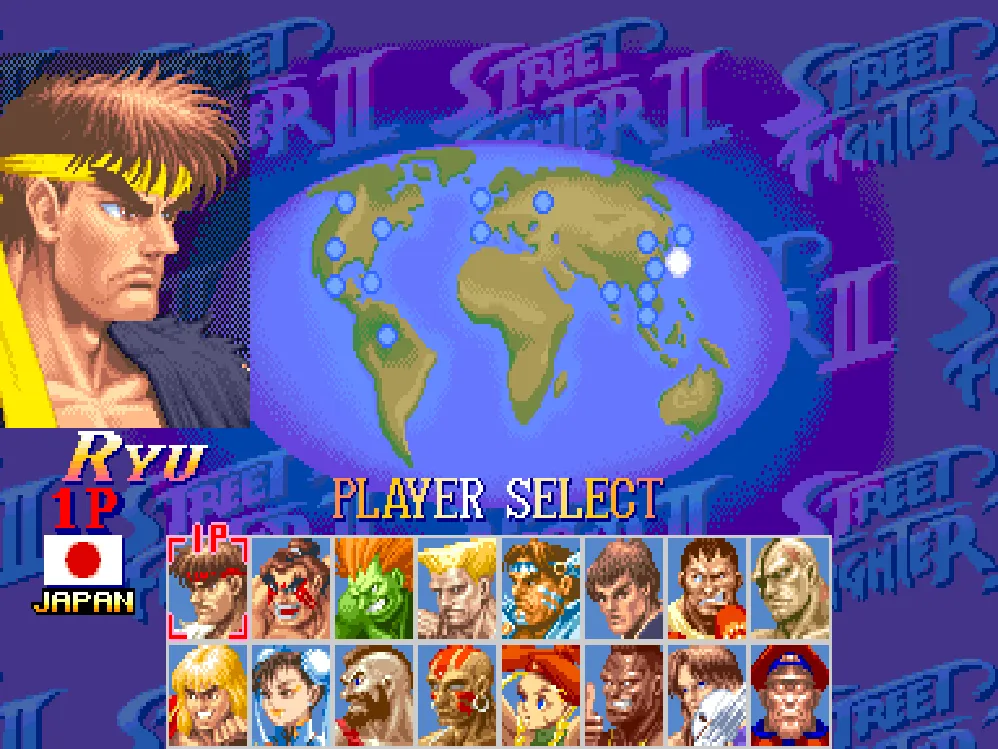
Turbo features all 12 characters, with the four bosses playable in all modes for the first time.
| Character | Nationality | Fighting Style | Signature Moves |
|---|---|---|---|
| Ryu | Japan | Ansatsuken | Hadoken, Shoryuken, Tatsumaki Senpukyaku (New aerial version) |
| Ken | USA | Ansatsuken | Hadoken, Shoryuken, Tatsumaki Senpukyaku (New aerial version) |
| Chun-Li | China | Chinese Martial Arts | Hyakuretsukyaku, Kikoken (New), Aerial Spinning Bird Kick |
| E. Honda | Japan | Sumo | Hyakuretsu Harite, Super Zutsuki, Oicho Nage (New) |
| Blanka | Brazil | Beast Style | Electric Thunder, Rolling Attack, Vertical Rolling Attack (New) |
| Zangief | USSR | Pro Wrestling | Spinning Piledriver, Double Lariat, Banishing Flat (New) |
| Guile | USA | Military Arts | Sonic Boom, Flash Kick |
| Dhalsim | India | Yoga | Yoga Fire, Yoga Teleport (New) |
| Balrog | USA | Boxing | Dash Straight, Dash Upper, Buffalo Headbutt |
| Vega | Spain | Ninjutsu | Flying Barcelona Attack, Scarlet Terror, Backslash |
| Sagat | Thailand | Muay Thai | Tiger Shot, Tiger Uppercut, Tiger Knee Crush |
| M. Bison | Unknown | Psycho Power | Psycho Crusher, Head Press, Devil Reverse |
3. Controls
3.1 Basic Controls
Turbo uses the standard CPS-1 six-button layout:
| Control | Function | Note |
|---|---|---|
| Joystick | Move/Block/Crouch | Hold back to block, hold down to crouch |
| Light Punch | Fast attack | Low damage, used for combos |
| Medium Punch | Balanced attack | Balanced speed and power |
| Heavy Punch | Strong attack | High damage, slow startup |
| Light Kick | Fast kick | Often used for crouching pokes |
| Medium Kick | Balanced kick | Some characters have unique properties |
| Heavy Kick | Strong kick | Usually causes knockdown |
General maneuvers include: Dash (double tap forward), Backstep (double tap back), Throws (direction + Medium/Heavy Punch when close), and Recovery (press attack button when knocked into the air to reduce stun).
3.2 Game Speed System
Turbo's core selling point is the Turbo speed system. You can choose from four speed levels before the game starts:
| Speed Level | Stars | Effect |
|---|---|---|
| Normal | 0 Stars | Same as Champion Edition, good for beginners |
| Turbo 1 | 1 Star | Slightly increased movement and attack speed |
| Turbo 2 | 2 Stars | Tighter window for combo confirmation |
| Turbo 3 | 3 Stars | Extremely high reaction speed and precision required |
Increased speed also changes the input window for special moves—at 3-star speed, the Shoryuken input window is significantly shortened. The SNES version allows unlocking extra speed levels (up to 6) via cheat codes. Most competitive tournaments use 2 or 3 stars.
4. Progression and Boss Strategy
Turbo uses a "12-man loop" format. Each character challenges 11 opponents before facing the Four Heavenly Kings. When playing as a boss, the final match becomes a mirror match or against another character.
| Stage | Opponent | Stage | Strategy Tips |
|---|---|---|---|
| 1-4 | Standard | Home Stage | Use new special moves to pressure |
| 5-8 | Mid-tier | Home Stage | Watch for aerial Tatsumaki and Yoga Teleport |
| 9-11 | High-tier | Home Stage | AI is more aggressive; use blocks and punishes |
| 12 | Balrog | Las Vegas | Crouch block dash punches then punish; jump-ins are effective |
| 13 | Vega | Spain Cage | Use Shoryuken to intercept wall climbs; predict landing spots |
| 14 | Sagat | Thailand Temple | Handle high/low Tiger Shots; jump over projectiles to punish |
| Final | M. Bison | Shadaloo Base | Crouch block Psycho Crusher; punish the long recovery after Head Press |
5. Tips and Advanced Strategy
5.1 Basic Survival Tips
-
Master New Special Move Timing: Ryu and Ken's aerial Tatsumaki can be input during the jump's ascent to change trajectory and confuse opponents. Chun-Li's Kikoken is a slow projectile that pairs well with Hyakuretsukyaku for pressure.
-
Use Speed Differentials: At 3-star speed, dash toward an opponent and stop suddenly to bait an attack, then punish. This is an early form of "shimmying."
-
Boss Strategies: Balrog has zero anti-air; use continuous jump attacks. When Vega climbs the wall, predict his landing for a heavy attack. Sagat is large; close-range throws and cross-ups are highly effective.
-
Defense Over Offense: CPU aggression is higher in Turbo; spamming attacks leads to being punished. Blocking and waiting for openings is the key to clearing the game.
-
Utilize Dhalsim's Yoga Teleport: Input →↓↘+3 Punches/Kicks to teleport forward, ←↓↙+3 Punches/Kicks to teleport back. Use this to dodge projectiles, escape corner pressure, and surprise opponents.
6. Trivia and Arcade Legends
The "Rainbow" Catalyst: The "Rainbow Edition" is one of the few cases in gaming history where a bootleg forced an official update. Capcom adopted its core ideas—increased speed and aerial specials—for the official release. Goddard recalled: "I was stunned when I played the Rainbow Edition and immediately called Osaka to say we had to do something."
Upgrade Kit Strategy: The Turbo ROM upgrade kit cost about $300-$400, a significant investment for arcades. However, coin-op rates increased by over 30% on average, making it an easy decision for operators.
SNES Success: Despite hardware limitations, the SNES version restored the barrel-breaking bonus stage, added announcer voice-overs for country names, and included console-exclusive ending illustrations. With 4.1 million copies sold, it was the 9th best-selling game on the SNES and the best-selling fighting game of its time.
Competitive Pioneer: Turbo is widely recognized as the version that pushed Street Fighter II into the competitive spotlight. Early EVO tournaments focused on the Street Fighter II series, with Turbo as the main event. Even after Super Street Fighter II was released, many core players insisted that the CPS-1 Turbo was the "purest" Street Fighter experience.