I. Game Background
1.1 World Setting
In February 1991, Capcom launched Street Fighter II: The World Warrior on the CPS1 arcade board, a title that struck like lightning and forever changed the history of video games. Before this, arcade fighting games were simple affairs with a joystick and two or three buttons—the original Street Fighter (1987) had experimented with pressure-sensitive buttons but only sold a few thousand units. No one expected the sequel to trigger a global tsunami.
SF2 completely redefined the meaning of "fighting game." Eight characters, each with entirely unique normal moves, special moves, and tactical styles—a level of luxury that was almost unimaginable at the time. After the game became a global phenomenon in arcades, one question was repeatedly asked: Why couldn't players control the four final bosses? Balrog (the boxer), Vega (the clawed assassin), Sagat (the Muay Thai king), and M. Bison (the dictator)—collectively known as the "Four Heavenly Kings"—were only playable by the CPU in the original version.
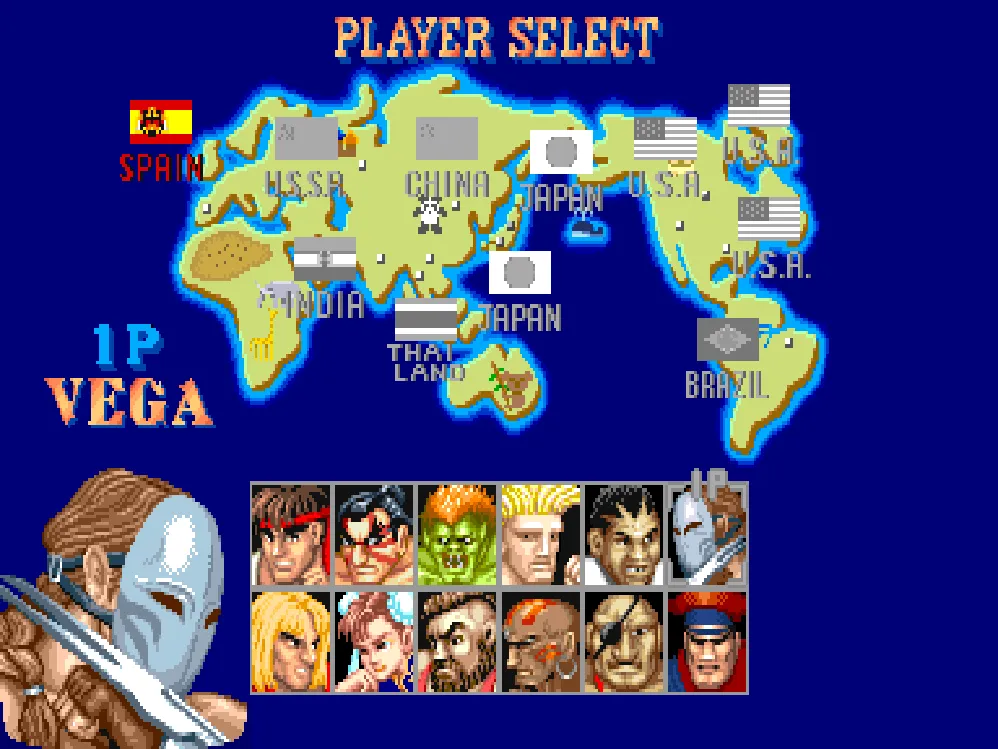
Capcom's response speed was staggering. Just 13 months later, in March 1992, Street Fighter II': Champion Edition debuted at the ACME 1992 arcade show in North America. For the first time, the Four Heavenly Kings became playable, and the restriction against "mirror matches" was lifted, pioneering the concept of same-character battles. The roster jumped from 8 to 12 characters.
The game was directed by legendary producer Yoshiki Okamoto, with design work by Akira Nishitani and Akira Yasuda (pen name AKIMAN). Technically, it still ran on the CPS1 board—a Motorola 68000 CPU @ 10MHz with a Z80 audio coprocessor, 384×224 resolution, and 4096 colors displayed simultaneously. The commercial success of CE was absurd: approximately 140,000 units sold in Japan (at 160,000 yen each, generating 22.4 billion yen / approx. $182 million), over 20,000 in North America, and about 160,000 worldwide. The total arcade coin-op revenue for the entire SF2 series eventually exceeded $2.3 billion.
1.2 The Mystery of the "Dash" Name
The original Japanese title was Street Fighter II Dash (ストリートファイターII ダッシュ), with the prime symbol (') in the logo representing "Dash." In Japanese, "Dash" is often synonymous with an "upgraded" or "enhanced" version—the prime symbol is read as "dash," implying that the title is a direct improvement over the original. In the West, because "Dash" was ambiguous to English speakers, it was changed to the more intuitive "Champion Edition." The Japanese promotional posters featured the Four Heavenly Kings surrounding the burning Street Fighter logo, perfectly conveying the core selling point: "Bosses are now playable."
II. Character Introduction
Champion Edition was the first to make all 12 characters playable—the original 8 plus the Four Heavenly Kings—more than doubling the depth of the roster. Each character possesses completely independent special moves, hitboxes, and tactical styles, which was a massive luxury in terms of hardware resources in 1992.
2.1 Ryu — The Pioneer of the "Hadoken" Style
| Attribute | Rating |
|---|---|
| Attack | ★★★★ |
| Speed | ★★★ |
| Defense/HP | ★★★ |
| Difficulty | ★★ |
- Strengths: The Hadoken is excellent for zoning, the Shoryuken is an invincible anti-air, and the Tatsumaki Senpukyaku can bypass projectiles. His moveset is cohesive, effective at both long and short range.
- Weaknesses: Balanced stats mean no extreme advantages; the recovery frames of his Hadoken and Shoryuken cannot be canceled in CE.
- Verdict: The best choice for beginners and a solid pick for top-tier competitive play. Recommendation: ★★★★★
2.2 Ken — The Fiery Fighting Prodigy
Ryu's fellow disciple and a mixed-race fighting genius. His moves are similar to Ryu's but with subtle performance differences—his Shoryuken has multi-hit flames and higher damage, his Tatsumaki has better combo potential, and his throws have longer range.
- Strengths: Shoryuken deals slightly more damage than Ryu's, and his throw range is wider.
- Weaknesses: Hadoken speed is slightly slower than Ryu's.
- Verdict: The first choice for offensive players; the satisfaction of his Shoryuken combos is unparalleled. Recommendation: ★★★★★
2.3 Chun-Li — The Strongest Woman in the World
An ace Interpol agent and the only character in SF2 with an air throw.
| Attribute | Rating |
|---|---|
| Attack | ★★★ |
| Speed | ★★★★★ |
| Defense/HP | ★★ |
| Difficulty | ★★★ |
Her Hyakuretsukyaku (Lightning Legs) offers top-tier pressure, her Kikoken has a unique trajectory, and her air throw counters jumping opponents. She is fast but has low HP; the risk and reward at high difficulty levels are both extremely high. Recommendation: ★★★★
2.4 Guile — The Sonic Boom Captain
A U.S. Air Force captain and the progenitor and ultimate definition of "charge" characters.
-
Strengths: The Sonic Boom + Flash Kick defensive-counter system is nearly perfect, allowing for long-range zoning without needing to dash forward.
-
Weaknesses: Charge inputs require prediction; lacks offensive pressure and struggles to escape when cornered.
-
Verdict: The strongest representative of the defensive-counter style. Once you master the charge rhythm, he is incredibly difficult to defeat. Recommendation: ★★★★
2.5 E. Honda — The Super Sumo
A Japanese Sumo Yokozuna who enters the fray to prove the power of Sumo to the world. His Hundred Hand Slap provides immense close-range pressure, and his Super Headbutt can pierce through projectiles. He is one of the slowest characters, making him very passive when zoned out. Recommendation: ★★★
2.6 Blanka — The Beast of the Amazon
A wild warrior raised in the Amazon jungle, inspired by the concept of a "non-human fighter." His Electric Thunder has a massive hitbox, and his Rolling Attack is fast and unpredictable. A "beginner killer"—he has a high win rate in low-level play, but his skill ceiling is limited. Recommendation: ★★★
2.7 Zangief — The Red Cyclone
A professional wrestler from the Soviet Union and the most famous grappler in gaming history.
| Attribute | Rating |
|---|---|
| Attack | ★★★★★ |
| Speed | ★ |
| Defense/HP | ★★★★★ |
| Difficulty | ★★★★★ |
His Spinning Piledriver is the strongest single-hit throw in the game. He has the highest HP of any character but lacks projectiles and requires a 360-degree joystick input for his command throws—once mastered, he is a human tank. Recommendation: ★★★
2.8 Dhalsim — The Mysterious Yoga Master
A Yoga master from India who can stretch his limbs for long-range attacks. His Yoga Fire and Yoga Flame are unmatched for zoning, but he has the lowest HP and almost no defensive options when cornered. The most subversive and original character in SF2. Recommendation: ★★
2.9 Balrog — The Tyrant of Iron Fists
One of the Four Heavenly Kings, a pure boxer. In the Japanese version, he was named M. Bison (hinting at Mike Tyson); the US version changed it to Balrog due to legal risks. His Dash Straight is simple and brutal, but he lacks kicks and has very weak aerial capabilities, making him vulnerable to zoning. Recommendation: ★★★
2.10 Vega — The Clawed Beauty
A Spanish noble ninja who wears a metal claw and a mask. A deadly aerial assassin. His wall-climb attacks are unique, and his Flying Barcelona + Izuna Drop combo is flashy and lethal. He has low HP, and his defense drops further once his mask is broken. Recommendation: ★★★
2.11 Sagat — The One-Eyed Tiger
The final boss of the original SF, the Muay Thai emperor who bears a massive scar on his chest from Ryu's Shoryuken. His Tiger Shots (high/low) are excellent for zoning, and his Tiger Uppercut has a massive hitbox. His large size means a larger hurtbox, but his zoning pressure in CE is top-tier. Recommendation: ★★★★
2.12 M. Bison — The Dark Emperor of Psycho Power
The supreme ruler of Shadaloo and the ultimate boss who wields Psycho Power. His Psycho Crusher has top-tier priority and damage, and his Head Press can bypass projectiles. His moves have significant recovery, but his pressure is overwhelming. Recommendation: ★★★★
III. Controls
3.1 Basic Controls
Street Fighter II's six-button layout is one of the most influential control designs in video game history. The six buttons are divided into two rows: the top row for punches, the bottom for kicks:
| Button | Description |
|---|---|
| Jab | Fastest startup, lowest damage, often used to interrupt opponents |
| Strong | Balances speed and damage, core for combos |
| Fierce | Slowest but highest damage, the choice for single-hit confirms |
| Short | Fastest kick, used to start combos |
| Forward | Excellent for mid-range zoning |
| Roundhouse | High damage, long recovery |
An 8-way joystick controls movement and jumping (forward/back for walking and blocking, diagonally up for jumping). This classic six-button layout is still used in Street Fighter 6 today. The CPS1 control panel arrangement also became the hardware standard for arcades.
3.2 The Origin of the Combo System
The most core mechanism in modern fighting games—the "Combo"—was not intentionally designed, but rather a "bug" discovered by the development team during testing: when the interval between two attacks is shorter than the opponent's hit-stun duration, the second hit is guaranteed to land. This discovery completely changed the game's depth and spread from SF2 to the entire video game industry.
3.3 Stun and Throw Systems
CE includes two critical but often overlooked mechanisms:
- Stun System: Characters accumulate hidden "stun points" when hit repeatedly. Reaching the threshold results in 2-3 seconds of total immobility—this is the core window for high-level damage and a turning point in the battle rhythm.
- Throw System: Triggered by Forward + Medium Punch/Kick or specific directions + Heavy Punch, it is the only way to break an opponent's constant blocking. CE readjusted throw range and damage, upgrading them from "niche tools" in WW to a core competitive tactic.
IV. Game Flow and Boss Strategy
Champion Edition's single-player mode consists of 12 matches—the original 8 from WW plus the 4 new Four Heavenly Kings and a mandatory mirror match. As a fighting game rather than a beat-'em-up, the "levels" are 1v1 matches against each character, with stages changing based on the opponent's nationality.
4.1 Strategies for the 12 Opponents
| Opponent | AI Traits & Weaknesses | Recommended Strategy |
|---|---|---|
| Ryu | Prefers mid-range Hadoken zoning | Use Shoryuken/Flash Kick to counter jumps |
| Ken | More aggressive than Ryu, frequent Tatsumaki | Block the Tatsumaki and punish the recovery |
| Chun-Li | Hyakuretsukyaku has a recovery window | Watch for air throws when jumping in |
| Guile | Defensive AI waits for the player to act | Use safe jumps + throws to break his turtle defense |
| Honda | Hundred Hand Slap has a large recovery window | Avoid corner traps, use long-range zoning |
| Blanka | Rolling Attack path is fixed | Block and punish with heavy attacks |
| Zangief | Terrifying close-range throw damage | Use Hadoken to zone, keep mid-to-long distance |
| Dhalsim | Extremely strong long-range zoning | Close the distance quickly, watch for limb pokes |
| Balrog | Dash path is predictable | Punish his landing recovery |
| Vega | Wall-climb landing spot is predictable | Wait for the landing window and use Shoryuken |
| Sagat | Tiger Shot has a fixed rhythm | Jump over projectiles and counter-combo |
| M. Bison | AI is obsessed with Head Press | Predict the landing spot and punish with Shoryuken |
4.2 AI Behavior and Difficulty Curve
CE's AI is essentially a state machine that adjusts behavior based on distance, action type, and historical data. It introduced the prototype of "input reading"—the CPU detects joystick position and button states to "predict" actions. In 1992, this was seen as a way to make AI more "realistic"; modern players call it "cheating."
Difficulty Curve: The first 6-7 matches are relatively passive, while the last 5 (especially the Four Heavenly Kings) see a significant increase in aggression and reaction speed. When a boss's HP drops below 1/4, they enter a "Berserk" mode—attack frequency and priority are significantly boosted. This mechanism was retained and enhanced in subsequent SF2 versions.
V. Tips and Advanced Strategy
5.1 Basic Survival Tips
- Prioritize Counter-Attacks—CE's AI punishes blind aggression. Waiting for the opponent to act and then countering is much safer than attacking first, especially against the Four Heavenly Kings.
- Control Distance, Control Everything—Every character has a different "optimal" fighting distance: Ryu at mid-long, Chun-Li at mid-short, Dhalsim at long. Keep your character in their "golden distance."
- Throw to Break Defense—When an opponent blocks constantly, throwing is the only way to break the stalemate.
- Prevent Stun—Continuous hits accumulate stun points leading to 2-3 seconds of immobility; this is the most fatal window.
- Use Wake-up Invincibility—You have brief invincibility frames when getting up from a knockdown. Input a special move command during the wake-up animation to prevent the opponent from pressuring you.
5.2 Two-Player Strategy
SF2 was the first game to integrate the "Rock-Paper-Scissors" concept into fighting games: Blocking → Throw to break defense, Predicting a throw → Light attack combo, Predicting a light attack → Wait and counter—this three-way cycle is the foundation of fighting game psychology. Mirror matches in CE push victory entirely toward understanding "frame data" and pure psychological warfare.
5.3 Boss Fight Rules
- Every boss has fixed "safe counter windows"—familiarity with AI patterns doubles your kill efficiency.
- Dealing damage to a boss is far less important than "not getting stunned by the boss"—a stun is often the prelude to death.
- Be extra vigilant when a boss's HP drops below 1/4—the "Berserk" mode triggers.
- In mirror matches, if both players use the same special move and trade hits, both are knocked back without taking damage—a subtle detail unique to CE.
5.4 Advanced Trivia
- CE's CPU reads joystick positions and button states, which is why the AI can "predict" every move. This was considered advanced tech in 1992, but modern fighting game design has abandoned this model.
- All SF2 moves have precise frame data—top Japanese players have been manually recording and studying this since 1992, the origin of modern "frame data research" culture.
- Unused "second color" data exists in the game files, proving the dev team was already planning the subsequent Turbo iteration during the CE phase.
VI. Legends and Arcade Lore
6.1 The Name Swap Mystery — The Greatest Localization Chaos
The name swap of the SF2 boss trio is the most famous and persistent confusion in video game localization history. Japanese design: The boxer was named M. Bison ("M" for Mike, "Bison" in Japanese sounds like "Tyson"), a pun honoring Mike Tyson; the clawed fighter was Balrog; the dictator was Vega.
Capcom USA assessed legal risks—Mike Tyson was known for suing those who infringed on his likeness—and decided to cycle the names: Boxer → Balrog, Claw → Vega, Dictator → M. Bison. This perfectly avoided legal trouble (Tyson never sued), but caused a permanent split in the player community—Japanese and Western players use the same names to refer to completely different characters, a classic topic in the community to this day.
6.2 The Rainbow Edition — The Legend of Piracy Changing History
In 1992, the "Rainbow Edition," a modified ROM produced by Taiwan's Hung Hsi Enterprise and distributed by Gamtec, appeared in arcades across Asia and South America. The title screen was changed to a rainbow gradient, and the game content was radically altered: characters could use special moves in the air, most move recovery was canceled, and special moves could be fired repeatedly. It wasn't an official Capcom product, but it proved the feasibility of "canceling recovery + air specials."
Its historical significance: it accelerated the development of the official Street Fighter II Turbo: Hyper Fighting. Capcom USA's James Goddard later admitted in a Polygon interview that the popularity of the Rainbow Edition made Capcom realize the players' hunger for these "illegal" features. The core mechanics of Turbo—special move chains and speed increases—were largely an official response to the Rainbow Edition. "Piracy forcing official updates"—a rarity in gaming history.
6.3 The Sheng Long Hoax — The Greatest April Fool's Joke
In April 1992, the US magazine Electronic Gaming Monthly published a detailed (fake) guide on "How to unlock the hidden character Sheng Long" in their April Fool's issue—claiming that if Ryu and Ken both finished 10 matches without taking damage and ended in a draw, a martial arts master would appear to challenge the player. It was illustrated and extremely convincing.
Countless players wasted coins in arcades trying this non-existent method. In 1994, Capcom introduced the hidden character Gouki (Akuma) in Super Street Fighter II Turbo as an official response and tribute to this legendary joke—the design of requiring specific conditions to fight Gouki was directly inspired by this hoax.
6.4 The Arcade Revenue Myth
The Street Fighter II series generated over $2.3 billion in global arcade coin-op revenue between 1991 and 1994. In Japan, SF2 cabinets required dedicated queuing areas during peak hours; in the US, a CE cabinet cost about $2,500, and operators could recoup the cost within three months. The Japanese arcade industry hit a historical peak of 1.8 trillion yen in 1992, with the SF2 series undoubtedly being the strongest catalyst.
6.5 The CPS1 Hardware Legend
The CPS1 (CP System) was an arcade board architecture launched by Capcom in 1988. It was not only the carrier for SF2 but the cornerstone hardware for the golden age of arcades in the 1990s. It used a dual-CPU architecture (Motorola 68000 @ 10MHz + Z80 @ 3.579MHz for audio), supporting 384×224 resolution and 4096 colors. Its modular design allowed operators to upgrade games by swapping ROM boards, significantly lowering costs.
Beyond the SF2 series, CPS1 also hosted classics like Final Fight, The King of Dragons, Cadillacs and Dinosaurs, and The Punisher. It was retired in 1995, though technical support surprisingly continued until 2015. Its successor, CPS2, directly inherited the dual-CPU architecture design philosophy.