I. Game Background
1.1 World Setting
The story of Street Fighter Alpha 3 takes place on the timeline between the original Street Fighter and Street Fighter II. M. Bison, leader of the Shadaloo empire, initiates the ultimate weapon project, the "Psycho Drive," in an attempt to rule the world through androids, mind control, and biological weapons.
Amidst this crisis, fighters from around the world gather with different motives: Ryu fights to suppress the growing "Satsui no Hado" (Surge of Murderous Intent) within him, a dark power constantly eroding his mind; Ken searches for the missing Ryu, hoping to pull his friend back from the abyss of murderous intent; Chun-Li continues to investigate Shadaloo's crimes, vowing to avenge her father; Guile and Charlie/Nash track Bison deep into enemy territory. This title serves as the finale of the Alpha series, with a plot that leads directly into Street Fighter II, bringing the entire Alpha saga to a satisfying conclusion.
1.2 Development History
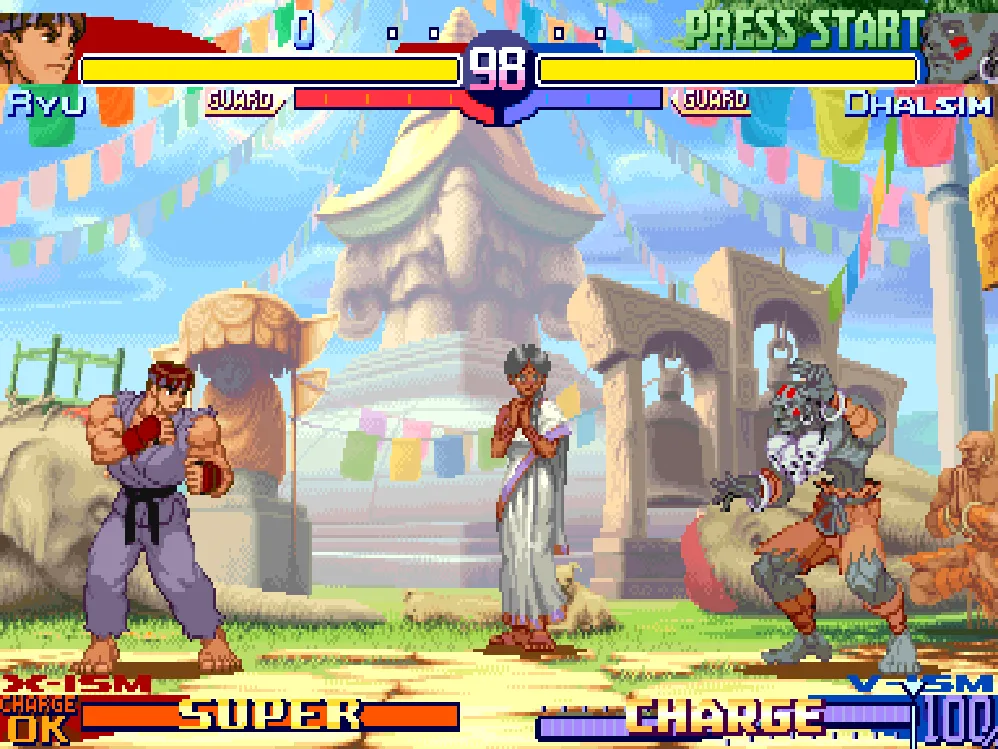
Street Fighter Alpha 3 was released by Capcom in 1998 on the CPS2 (Capcom Play System 2) hardware. It is the third and final installment of the Alpha series (known as "Street Fighter Zero" in Japan).
The first two titles, Alpha (1995) and Alpha 2 (1996), laid a solid foundation for the series—introducing the "Super Combo Gauge" system and the concept of "Original Combos," respectively. Alpha 3 reached the absolute peak of the series in terms of system depth by introducing the revolutionary ISM System, which allows players to choose between three completely different fighting styles—a design that fundamentally changed the dimensions of fighting game gameplay.
The character roster expanded significantly from 18 in Alpha 2 to 28, and it was the first time many characters from the Final Fight series were officially introduced into the main Street Fighter canon. This was also the last mainline Street Fighter title to run on the CPS2 hardware—subsequent sequels like Street Fighter III moved to the more powerful CPS3 board.
Alpha 3 was later ported to multiple platforms: PlayStation (1999), Sega Saturn (1999, Japan only), Dreamcast (1999), Game Boy Advance (2002), and PSP (2006, as Street Fighter Alpha 3 MAX). Each port added extra content, with the PSP version's World Tour mode being the most extensive, even adding guest characters from Final Fight 3 and Darkstalkers.
II. Character Introduction
This game features 28 playable characters, the most in the Alpha series. Below are the main characters available from the start in the arcade version.
2.1 Ryu — The Eternal Wanderer
| Attribute | Rating |
|---|---|
| Attack Power | ★★★★ |
| Speed | ★★★ |
| Skill Variety | ★★★ |
- Strengths: The standard Hadoken + Shoryuken + Tatsumaki Senpukyaku setup remains stable and reliable; the "Shinku Hadoken" Super Combo has excellent hit detection; Original Combos under V-ism are incredibly fierce.
- Weaknesses: Moves are too standard, making them easy for opponents to predict; lacks a dedicated dash/approach move.
- Verdict: A solid, all-around character. Ryu's Hadoken damage under X-ism is extremely high, while V-ism Ryu can pull off some of the longest combos in the game.
2.2 Ken Masters — The Flaming Fighting King
| Attribute | Rating |
|---|---|
| Attack Power | ★★★★ |
| Speed | ★★★★ |
| Skill Variety | ★★★★ |
- Strengths: Shoryuken has better hit detection than Ryu's and can break through aerial blocks; the Flaming Shoryuken has a wide range; strong close-range pressure.
- Weaknesses: Hadoken range is shorter than Ryu's; slightly lower defense.
- Verdict: An offensive character known for close-range pressure and multi-hit Shoryukens. The Flaming Shoryuken is a god-tier move with multi-hit properties, perfect for players who prefer aggressive play.
2.3 Chun-Li — The Strongest Female Fighter
| Attribute | Rating |
|---|---|
| Attack Power | ★★★ |
| Speed | ★★★★★ |
| Skill Variety | ★★★★ |
- Strengths: Fastest speed and excellent normal move hit detection; Hyakuretsukyaku (Lightning Legs) provides strong pressure; Kikoken controls mid-range effectively.
- Weaknesses: Low single-hit damage, requiring multi-hit combos to compensate; lower health pool.
- Verdict: A technical character excelling in speed and control. Her standing heavy punch has incredible reach and is a core tool for anti-air and zoning.
2.4 Sakura Kasugano — Ryu's Biggest Fan
| Attribute | Rating |
|---|---|
| Attack Power | ★★★ |
| Speed | ★★★★ |
| Skill Variety | ★★★★ |
-
Strengths: Light attack combos start up extremely fast; charged Hadoken has multi-hit properties; moves mimic Ryu but with a unique rhythm.
-
Weaknesses: Shoryuken hit detection is significantly weaker than the real Ryu's; low single-hit damage.
-
Verdict: One of the most popular original characters in the Alpha series. She mimics Ryu's moves but incorporates her own style—her Hadoken travels horizontally, and her Shoryuken is only one hit—yet she is highly competitive in actual combat due to her extreme speed and fluid combos.
2.5 Karin Kanzuki — Heir to the Kanzuki Style
| Attribute | Rating |
|---|---|
| Attack Power | ★★★★ |
| Speed | ★★★ |
| Skill Variety | ★★★★★ |
- Strengths: Unique counter system can disrupt the opponent's pressure rhythm; command throws and combo links are tight; heavy punch has long reach.
- Weaknesses: Requires precise prediction of opponent moves to trigger counters; average movement speed.
- Verdict: An original character who debuted in the arcade version of Alpha 3. Her "Ohohoho" laugh and flamboyant high-society aura are matched by her combat capability—successful counters can lead into various powerful follow-ups.
2.6 Cody Travers — The Hero in Prison
| Attribute | Rating |
|---|---|
| Attack Power | ★★★★ |
| Speed | ★★★ |
| Skill Variety | ★★ |
- Strengths: Normal moves have long reach; unique knife-throwing and picking-up mechanic; the "Final Destruction" Super Combo deals staggering damage.
- Weaknesses: Lacks a projectile; average movement speed; some moves are restricted when he doesn't have his knife.
- Verdict: A classic character from the Final Fight series. In this game, Cody is in prison for reasons unknown, and his handcuffs have become his signature look. He can pick up a knife from the ground to significantly boost his attack power—though the knife can be knocked out of his hand.
2.7 Guy — The Bushinryu Ninja
| Attribute | Rating |
|---|---|
| Attack Power | ★★★ |
| Speed | ★★★★★ |
| Skill Variety | ★★★★ |
- Strengths: Extremely fast, with the best dash speed in the game; diverse aerial movement moves; excellent hit detection on rush-down moves.
- Weaknesses: Low single-hit damage; low health.
- Verdict: The 39th successor of the Bushinryu style from Final Fight. His rapid dashes and aerial mobility make him a classic "hit-and-run" character—using speed and changing aerial trajectories to confuse opponents.
2.8 Quick Look at Other Important Characters
| Character | Type | Brief Description |
|---|---|---|
| Zangief | Command Throw | Russian wrestler, highest damage with Spinning Piledriver, but slowest movement |
| Dhalsim | Zoning | Indian Yoga master, limbs can stretch over long distances |
| Guile | Defensive | Sonic Boom + Flash Kick combo remains solid |
| Rose | Psychic | Italian fortune teller, soul power attacks, Bison's polar opposite |
| Balrog (Claw) | Speed | Spanish ninja, claw attacks, wall-climbing moves |
| Sagat | Zoning/Pressure | King of Muay Thai, Tiger Shot has massive hit detection |
| Boxer (Balrog) | Rush-down | Boxer, dash straight punches have strong guard-breaking ability |
| M. Bison | Final Boss | Psycho Power-driven, full-screen attacks and command throws |
III. Controls and Gameplay
3.1 Basic Controls
Alpha 3 uses the classic Capcom six-button layout: Light Punch (LP), Medium Punch (MP), Heavy Punch (HP), Light Kick (LK), Medium Kick (MK), and Heavy Kick (HK).
| Action | Input | Description |
|---|---|---|
| Dash | →→ | Quick forward dash |
| Backstep | ←← | Quick backward evade |
| Throw | Close →/← + MP+HP or MK+HK | Grab and throw the opponent |
| Recovery | Press any two buttons when knocked down | Quick stand-up to avoid wake-up pressure |
| Air Block | Hold ← in the air | Can block aerial attacks, but not low attacks |
| Super Combo | Consume Super Gauge | Rules vary depending on the ISM system |
3.2 The ISM System — Alpha 3's Core Innovation
The ISM system is the defining feature of Alpha 3 and one of the most creative fighting system designs of the Capcom CPS2 era. Players must choose one of three ISMs when selecting a character:
| ISM | Super Gauge | Attack Power | Core Feature | Recommended For |
|---|---|---|---|---|
| X-ism | Single Level | Highest | High single-hit damage, similar feel to SSF2T, no air block | Beginners / Pure offense players |
| A-ism | Three Levels | Medium | Standard Alpha style, Alpha Counters, air block, multi-level Supers | Intermediate / Alpha series veterans |
| V-ism | Two Levels | Lower | Original Combo, highest combo freedom | Experts / Combo enthusiasts |
- X-ism (Simple): Back to basics. Only one level of Super Gauge, can only use Level 1 Supers, but basic moves and special moves have the highest base damage. Suitable for beginners and players who enjoy Super Street Fighter II Turbo style gameplay.
- A-ism (Z-ism): Standard mode. Three-level Super Gauge, can use Level 1 to 3 Supers. The core mechanism is the Alpha Counter—consuming one level of the gauge to cancel the recovery of a normal move to link into a combo. The most balanced ISM.
- V-ism (Variable): Expert mode. Two-level Super Gauge, the main feature is the ability to activate Original Combo mode—within a limited time, you can ignore combo restrictions and freely combine any attacks to create long, creative combos. While base damage is lower, the burst potential of Original Combos can take out fragile characters in one go.
ISM selection is made at the character select screen and cannot be changed mid-match. The same character will have a completely different fighting style depending on the ISM—for example, V-ism Ryu can pull off 40+ hit Original Combos, while X-ism Ryu relies on the high damage of single Shoryukens to pressure opponents.
3.3 Core System Details
- Alpha Counter (Zero Counter): Exclusive to A-ism. Consume one level of the Super Gauge while blocking to launch a counter-attack, pushing the opponent back and creating an opening. A key tool to break an opponent's pressure.
- Original Combo: Exclusive to V-ism. Activate by pressing the same strength punch and kick buttons simultaneously. After activation, all attacks become cancelable for a short time, allowing for creative combo strings.
- Air Block: Available in A-ism and V-ism, allowing players to block aerial attacks. However, air blocking cannot block low attacks, which is a crucial part of the mind game.
IV. Arcade Flow and Boss Strategy
4.1 Arcade Mode Flow
Arcade mode consists of 10 stages:
| Stage | Content | Description |
|---|---|---|
| Stages 1–8 | Regular Matches | Random opponents, difficulty increases gradually |
| Stage 9 | Rival Battle | Opponent determined by character, includes special story dialogue |
| Stage 10 | Final Boss: M. Bison | Ultimate showdown with two forms |
4.2 Rival Battles
Every character encounters a story-related rival in the ninth stage:
| Player Character | Rival | Story Context |
|---|---|---|
| Ryu | Ken | Friendly duel, discussing the Satsui no Hado |
| Chun-Li | M. Bison | Final showdown for her father's death (if not the final boss) |
| Sakura | Ryu | Student challenging the master |
| Karin | Sakura | Fated duel between the heiress and the high school girl |
| Cody | Guy | Final Fight brotherhood battle |
| Guile | Charlie/Nash | Comrades reunited with conflicting ideals |
| Rose | M. Bison | Final confrontation of soul and evil |
4.3 Final Boss: M. Bison Strategy
In Alpha 3, M. Bison is one of the strongest versions in the entire series. He has two forms:
Form 1 (Normal Bison):
- Psycho Shot: Long-range projectile, fast and large hit detection.
- Psycho Crusher: Enveloped in psycho power, rushes forward.
- Command Throw: High-damage grab at close range.
Form 2 (Final Bison):
- Full-screen Super: "Ultimate Psycho Crusher"—a shockwave covering the entire screen, extremely high damage.
- Psycho Field: Constant damage when close.
- All normal moves have significantly increased range.
Strategy Tips:
- X-ism players: Use high-damage single-hit counters; punish Bison with a Shoryuken during his recovery frames.
- A-ism players: Utilize Alpha Counters to link into max-damage combos and interrupt Bison's pressure.
- V-ism players: Activate Original Combo to get close and burst damage, taking him out in one sequence.
- General Rule: Maintain mid-range—too far and you'll be chipped by Psycho Shots; too close and you'll be caught by command throws.
V. Tips and Advanced Strategy
5.1 Basic Survival Tips
- Master Recovery: Press any two buttons the moment you are knocked down to stand up quickly and avoid wake-up pressure. This is the most basic and important defensive skill in Street Fighter.
- Use Alpha Counters: In A-ism, using an Alpha Counter while being pressured can instantly turn the tide. It costs one level of the Super Gauge, but it's worth it.
- Air Blocking isn't everything: Air blocking is great for jump-ins, but low attacks can easily bypass it. Don't get into the habit of holding back in the air.
- Know your ISM damage range: X-ism has high single-hit damage—aim for more hits in neutral; V-ism has low base damage—try to save the gauge for Original Combos.
- Maintain mid-range against Bison: This is the optimal distance against the final boss—too far and you'll be bombarded by Psycho Shots; too close and you'll be grabbed.
5.2 ISM Selection Advice
| Character Type | Recommended ISM | Reason |
|---|---|---|
| Ryu, Ken | V-ism | Original Combos can exceed 40+ hits |
| Chun-Li, Sakura | A-ism | Speed advantage + smooth Alpha Counter combo links |
| Zangief | X-ism | High-damage command throws; one hit can decide the match |
| Cody, Guy | A-ism or V-ism | Balanced characters suit multiple playstyles |
| Beginners | X-ism | Simplest system; learn the basics before advancing |
5.3 General Boss Battle Rules
- Observe Bison's Psycho Field rhythm: His Psycho Shots have a fixed frequency; once you observe the rhythm, you can safely dash in between shots.
- Don't attack head-on when Bison is glowing: Final Bison will release a full-screen Super when he glows; retreat immediately instead of trying to interrupt.
- Use stage distance: Bison's escape ability is weak when cornered; push him to the wall and go all out.
- Save your Super: Don't waste your Super when Bison still has high health—save it for his second form (Final Bison) and unleash it during his recovery frames.
5.4 Advanced Trivia
- CPS2 "Blue Screen of Death": Alpha 3 was a late-era CPS2 title. The battery-backed decryption keys are prone to failure. When the battery dies, the board displays a "Blue Screen of Death." Original Alpha 3 boards in working condition are extremely rare today.
- PSP Hidden Character: Street Fighter Alpha 3 MAX added Ingrid as a hidden character; she was originally designed for Capcom Fighting Jam.
- Japanese vs. US Differences: The Japanese version is titled "Street Fighter Zero 3," while the US version is "Street Fighter Alpha 3." Some character names differ between versions—most famously the rotation of the names "Boxer/Claw/Vega" between the two regions.
- Karin's Hidden Counters: Karin has several extremely obscure counters that require specific conditions—such as inputting commands within a specific frame window to counter projectiles—these are considered high-level techniques even among experts.
VI. Anecdotes and Arcade Legends
6.1 The Birth of the ISM System — A Nearly Deleted Idea
The Original Combo system in V-ism caused heated controversy during internal testing at Capcom. Programmers felt the system was "too powerful and would break the game balance"—in tests, V-ism characters would often take out opponents in one combo with no room for counterplay. It is said that producer Noritaka Funamizu insisted on keeping V-ism, arguing: "Alpha 3 must have a system that makes players feel 'no one can stop me,' even if it breaks the balance." Ultimately, V-ism was kept at the cost of lower defense and base attack power, and the combo freedom it created is still celebrated by fans today.
6.2 Japan vs. US ISM Cultural Differences
In Japanese arcades, V-ism became the absolute mainstream for competitive play. Japanese players were obsessed with the creativity and expressiveness of Original Combos, and arcades were filled with gasps of "I didn't know you could combo that way." In the US, X-ism had more followers—American players preferred pure neutral game mind games and the satisfaction of high single-hit damage. These regional preferences reflect the different orientations of fighting game culture in Japan and the US.
6.3 Cody's Handcuffs — From Hero to Prisoner
Cody was the hero who saved the city in Final Fight, but in Alpha 3, he is behind bars with his hands and feet cuffed. Capcom's official story is: after Final Fight, Cody couldn't adapt to a peaceful life and fell into a cycle of violence, eventually ending up in prison for "excessive self-defense." This dark character arc surprised many Final Fight veterans, but added depth to Cody—he isn't depressed in prison; he treats it as his training ground. This "hero falling into darkness" narrative is quite rare in fighting games.
6.4 The Last CPS2 Street Fighter — The End of an Era
Alpha 3 was the last mainline Street Fighter title on Capcom's CPS2 hardware. Starting with Super Street Fighter II Turbo in 1993, the CPS2 witnessed the golden age of fighting games in the 1990s—from the peak of the SF2 series to the innovations of the Alpha series, and the "arcade wars" with SNK. When Alpha 3 was released in 1998, 3D fighting games (like Tekken 3 and Soul Edge) were already starting to capture market share. As the final CPS2 title, Alpha 3 was the perfect curtain call for this legendary board. The following year, Capcom shifted its focus to the CPS3 and the Street Fighter III series.
6.5 PSP Version Pushing Capacity Limits
The 2006 PSP port, Street Fighter Alpha 3 MAX, is a benchmark for handheld fighting games. It not only includes the full 28-character original roster but also adds four guest characters from Final Fight 3 and Darkstalkers, plus a World Tour mode that fills almost the entire UMD disc. It is said the development team worked incredibly hard on compression, with the final version being less than 1MB shy of the UMD's maximum capacity. Many players still consider this version the "ultimate edition" of Alpha 3.
6.6 Nash's Tragic Story
Nash is Chun-Li's partner and Guile's best friend, appearing as a playable character in the Alpha series. However, in the Street Fighter V timeline, it is revealed that he sacrificed himself after Alpha 3—killed by M. Bison and resurrected as a zombie-like creature through Shadaloo's bio-technology. The depiction of Nash in Alpha 3—a spirited US Air Force lieutenant—was actually setting the stage for his tragic fate. This narrative arc, spanning nearly 20 years, is one of the most poignant character stories in the Street Fighter series.
6.7 The Debate Over the Best CPS2 Fighting Game
In the core fighting game community, the debate over the "best CPS2 fighting game" continues to this day. Super Street Fighter II Turbo, Street Fighter Alpha 3, Darkstalkers, and Marvel Super Heroes vs. Street Fighter are often compared. Supporters of Alpha 3 argue that the ISM system provides unprecedented gameplay depth—the same character can have three completely different playstyles, which is unique in the history of fighting games. Opponents argue that this depth comes at the cost of balance. Regardless, Alpha 3 has almost no rival in the "most creative CPS2 fighting game" category.