I. Game Background
1.1 World Setting
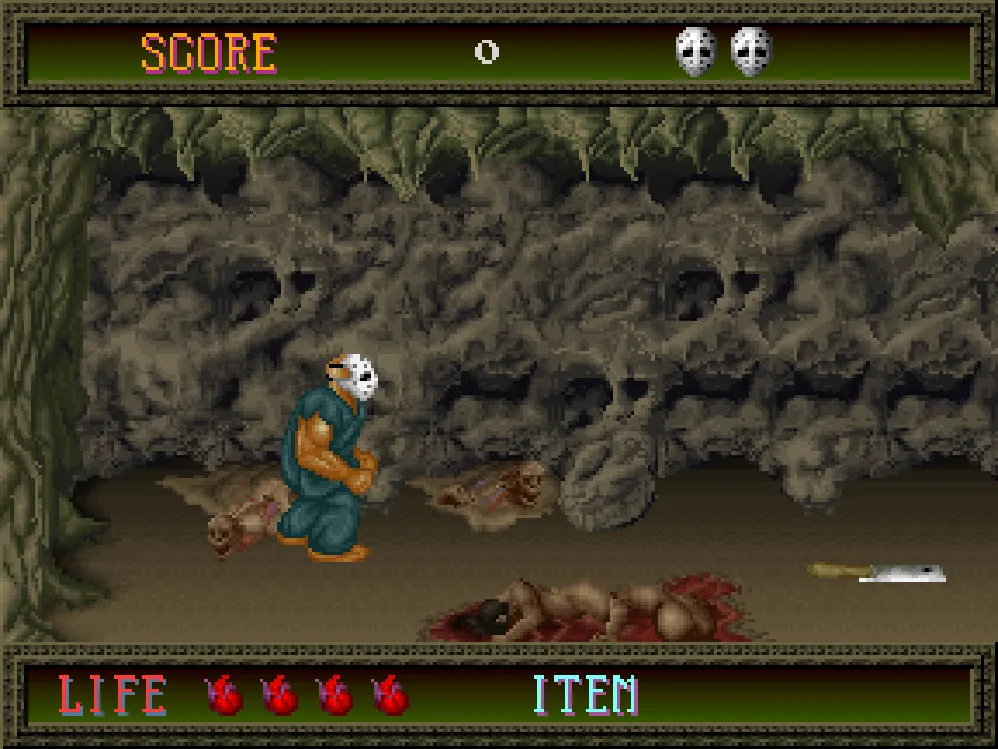
Splatterhouse is a horror-themed side-scrolling arcade game released by Namco in 1988. To many players, it is hailed as "one of the bloodiest and most violent games in arcade history." Long before Mortal Kombat, Splatterhouse was already using pixel art to depict terrifying scenes that sent shivers down players' spines.
The story follows an ordinary college student, Rick Taylor, who, while driving with his girlfriend Jennifer Willis on a stormy night, is forced to seek shelter in a massive, decaying Victorian mansion after a car breakdown. The owner of this mansion is a deranged biochemist, Dr. Henry West, who has been conducting gruesome biological experiments in the basement. Both the doctor and the mansion itself radiate an indescribable, malevolent aura.
Shortly after entering, Jennifer is abducted by an evil force. Desperate to save his love, Rick discovers an ancient tribal mask in a hidden room: the Terror Mask. Upon donning it, Rick is consumed by the mask's dark power, transforming from a regular student into a nearly invincible, violent warrior. The mask grants him superhuman strength and regenerative abilities—but at the cost of his sanity, which is slowly being eroded by the mask's evil will.
From this moment on, Rick Taylor is no longer the gentle student he once was. He swings his fists, seizes enemy weapons, and carves a path through blood and gore to find Jennifer, take down Dr. Henry West, and break free from the curse of the Terror Mask—if he even wants to be free at all.
1.2 Development History
Developed by Namco, Splatterhouse hit arcades in 1988. The game's inspiration is clearly drawn from mid-1980s American horror films—most notably Evil Dead II (1987, featuring a protagonist who also wears a mask and wields a chainsaw against demons), the Friday the 13th series, and classic monster aesthetics. The development team made no secret of their goal: to create a game that would make players scream in the arcade.
Namco utilized high-level pixel art for the arcade hardware of the time, excelling in the depiction of dismemberment, blood splatter, and creature design. However, due to its extreme violence, Splatterhouse faced censorship in several countries. The Japanese version had the gore toned down in certain scenes (such as changing bright red blood to a dark, near-black hue), while the North American version retained most of the violent content.
The game's soundtrack, composed by Namco's internal team, uses the YM2151 synthesizer chip to create an unsettling, horrific atmosphere—low-frequency pulses, sharp violin-like effects, and irregular percussion rhythms build the soundscape of this "Splatterhouse."
Splatterhouse was a massive commercial success and remains one of Namco's most talked-about titles from the late 1980s. It spawned several sequels and remakes, including 1992's Splatterhouse 2 (PC Engine / TurboGrafx-16) and the 2010 high-definition remake Splatterhouse (PS3 / Xbox 360). Yet, the original arcade masterpiece remains unforgettable for its raw, pure aesthetic of violence.
II. Character Profiles
2.1 Rick Taylor — The Gray Area Between Man and Monster
| Attribute | Rating |
|---|---|
| Strength | ★★★★ (★★★★★ with Mask) |
| Speed | ★★★ |
| Defense | ★★★ (★★★★ with Mask) |
| Weapon Proficiency | ★★★★★ |
Background: An ordinary college student with a happy relationship and a simple, fulfilling life. After entering Dr. West's mansion, his life—and his humanity—are completely destroyed.
Terror Mask: When Rick wears this ancient tribal mask, its evil power fuses with his rage—every monster face and every scream from Jennifer fuels the mask's power. In modern cultural analysis, the "Terror Mask" is seen as a symbol of "violent release."
| Form | Ability |
|---|---|
| Human Form | Basic punches and kicks only; nearly helpless against monsters |
| Masked Form | Greatly increased strength; can pick up and wield various weapons |
| Berserk State | Accumulate rage through continuous attacks; damage and attack speed are further boosted |
2.2 Jennifer Willis — The Trapped Princess
Rick's girlfriend. After entering the mansion, she is quickly captured by Dr. West's minions and held on a platform (or altar) in the deepest part of the mansion, becoming part of the doctor's dark experiments. For most of the game, Jennifer's image is limited to that of a "captive," but her fate is inextricably linked to Rick's in the ending.
2.3 Dr. Henry West — The Mad Scientist
The master of the mansion. A scientist with high achievements in frontier biochemistry, his sanity completely collapsed after a lab accident, leading him to conduct inhumane biological fusion experiments in the basement. He stitches animal limbs onto human bodies and injects pure evil into living subjects to create deformed monsters. He is the mastermind behind the mansion's slaughter and the puppet master of the final boss.
III. Controls
3.1 Basic Controls
As a classic 1988 arcade game, Splatterhouse uses an 8-way joystick + 2-button layout:
| Button | Function |
|---|---|
| A | Attack (Punch / Use Weapon) |
| B | Jump |
| →→ + A | Dash attack, knock enemies flying |
| Jump + ↓ + A | Drop kick, deal extra damage to downed enemies |
3.2 Weapon System
One of the most famous features of Splatterhouse is its rich and violent weapon system—various weapons drop from monsters, the background, or treasure chests:
| Weapon | Damage | Description |
|---|---|---|
| Wooden Plank | ★★★ | The most common weapon; long reach, average durability |
| Cleaver | ★★★★ | Melee weapon; fast attack speed, allows for continuous slashing |
| Chainsaw | ★★★★★ | One of the highest-damage weapons—attacks are accompanied by the iconic roar and blood-splatter effects |
| Shotgun | ★★★★ | Mid-to-long-range attack; knocks enemies back, but ammo is limited |
| Iron Pipe | ★★★ | Damage and durability between the plank and the cleaver |
| Rock | ★★ | Ranged throwing weapon; can be thrown three times after picking up |
IV. Walkthrough & Boss Strategy
Splatterhouse consists of 6 stages spanning various areas of the West Mansion.
Stage 1: Entrance Hall & Corridor
| Item | Details |
|---|---|
| Setting | A stormy night; players enter through the front door. The hall is dark, ornate, and covered in moldy wallpaper |
| Flow | Entrance Hall → Main Corridor → Stairs to the basement |
| BOSS | Giant Mutant Guard—A mutant modified by West, twice the size of a human, wielding a large iron hammer |
| Strategy | The first boss is relatively simple—keep your distance to bait the hammer swing, then attack during the recovery window |
Stage 2: Kitchen & Dining Hall
| Item | Details |
|---|---|
| Setting | A massive kitchen and dining hall with blurred family portraits on the walls—they are no longer human |
| Flow | Kitchen → Cold Storage → Dining Hall. Hanging pig legs and butcher knives hint at the source of the "ingredients" |
| BOSS | The Butcher—A bloated, modified monster wielding a giant cleaver and meat hook. He was once the mansion's cook |
| Strategy | The Butcher is surprisingly fast—his horizontal slash has a wide range. Use the dining table as an obstacle and attack while he maneuvers around it |
Stage 3: Garden & Greenhouse
| Item | Details |
|---|---|
| Setting | The mansion's backyard and a dilapidated glass greenhouse. The plants have mutated into predators |
| Flow | Garden → Greenhouse (plants here attack the player) → Fountain Plaza |
| BOSS | Giant Carnivorous Plant—A product of Dr. West's botanical experiments, with teeth-filled petals |
| Strategy | The plant's vine whip has mid-range reach. When it opens its mouth to bite, throw grenades or rocks into its maw |
Stage 4: Library & Laboratory
| Item | Details |
|---|---|
| Setting | Dr. West's library and secret underground lab. Shelves are filled with medieval alchemy and modern biology materials |
| Flow | Library → Lab Corridor → Underground Lab. Failed biological fusions float in glass containers |
| BOSS | The Aggregate—A giant monster made of limbs from failed experiments, with multiple arms and faces |
| Strategy | Boss attacks can come from any direction. Standing in the center of the screen helps predict grab attacks. Attack the "core" (the largest face) for full damage |
Stage 5: Storage Room & Clock Tower
| Item | Details |
|---|---|
| Setting | The passage to the tower area. Hallucinations of a bound Jennifer appear in the background |
| Flow | Climb the spiral staircase to the top. From the height, you can see the whole mansion—an island surrounded by monsters and blood |
| BOSS | Masked Guardian—An elite monster dual-wielding blades; the fastest attacker and mover in the game |
| Strategy | The boss's dash attack is unblockable—watch for the flash in its eyes to predict the direction. The high platforms provide brief respites |
Stage 6: Tower Top & Final Battle
| Item | Details |
|---|---|
| Setting | The circular hall at the top of the tower. Jennifer is tied to the altar. Thunder and lightning rage outside |
| Final BOSS | Dr. West's Final Form—The final state after Dr. West fuses himself with an ancient evil entity. He is no longer human—a giant, deformed monster with tentacles and fire-breathing abilities |
| Strategy | The final battle has two phases. Phase 1: West releases energy projectiles and tentacle whips—dodge the projectiles while attacking his head and heart. Phase 2: The floor begins to collapse; fight on limited platforms. West uses wide-range fire attacks; maneuver behind him to deal damage. After defeating him, the mansion collapses, and Rick rushes to the altar... the ending is open to interpretation |
V. Tips & Advanced Strategy
- The Chainsaw is the best weapon: It provides continuous damage and knockback, making it the top choice for clearing mobs and bosses.
- Don't ignore throwing weapons: Rocks and axes may seem weak against bosses, but they are great for hitting enemies you don't want to get close to.
- Basic punches are a last resort: Without a weapon, the combination of a running dash and a jump-kick is the most effective tactic.
- Utilize environmental props: Decorative elements (flower pots, lamps, paintings) can sometimes drop items when destroyed.
- Violence equals fun: The design philosophy of Splatterhouse is simple—the more violent, the more fun.
VI. Trivia & Arcade Legends
6.1 The DNA of the Terror Mask—A Split IP History
In the 2010 HD remake, the Terror Mask was given more "personality"—it is an evil yet darkly humorous entity that even shares a twisted "friendship" with Rick. But in the 1988 original arcade version, the mask had no lines and no personality—it was purely a tool to make the game more violent. This raw sense of mystery became the original's most memorable trait.
6.2 Censorship Aftermath
Splatterhouse was labeled in several countries due to its extreme violence. The Japanese version required adjustments to background scenes depicting abuse after release. Certain scenes (such as fully depicted severed limbs on the floor) were obscured or modified in later batches.
6.3 Why did the sequel move to home consoles?
After the success of the arcade version, Namco decided to release the sequel, Splatterhouse 2, on the PC Engine (TurboGrafx-16). This decision cost the series its "arcade horror legend" status, but it allowed for more narrative depth and more detailed level design.