I. Game Background
1.1 Setting the Scene
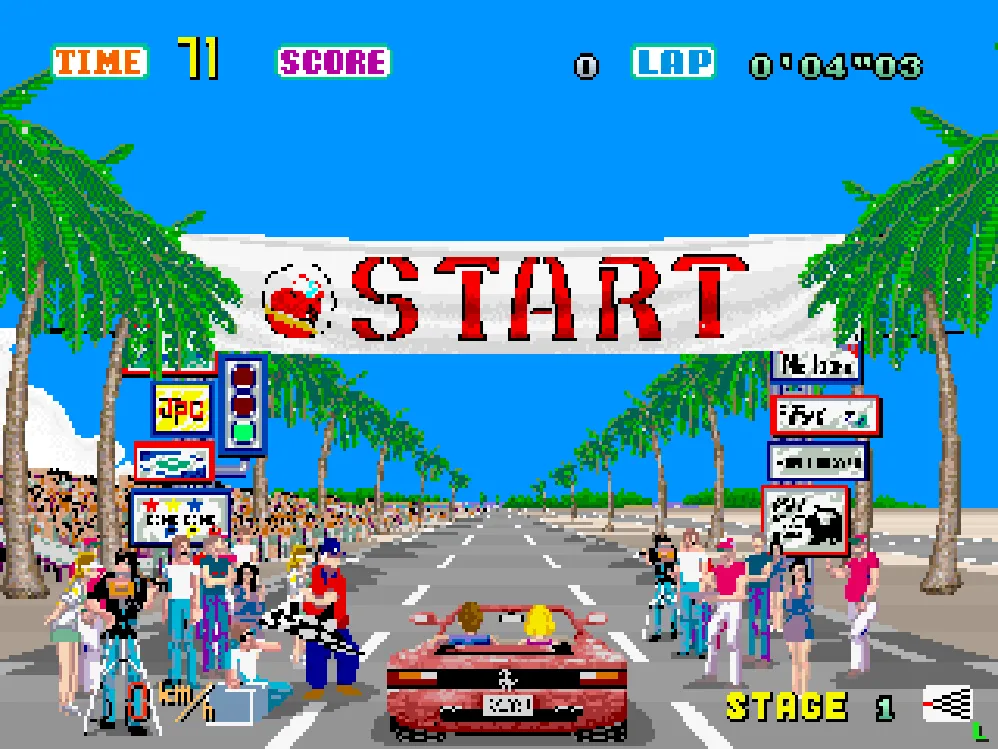
Out Run puts players on a road trip across Europe. You drive a convertible Ferrari Testarossa with a blonde companion by your side, racing through coconut beaches, mountain canyons, deserts, and quaint towns to reach your destination before the timer runs out. There is no grand narrative about saving the world—the only goal is the pure freedom of the drive itself.
Inspired by the 1981 film The Cannonball Run, producer Yu Suzuki explicitly stated that he disliked the vehicle-explosion tropes of arcade games at the time. He wanted players to "feel superior" and enjoy the pure pleasure of driving. This "non-violent, experience-focused" philosophy was unique in 1986, establishing Out Run as the pioneer of "road romanticism."
1.2 Development History
Developed by Sega AM2 under the leadership of Yu Suzuki, Out Run was his third motion-controlled racing game following Hang-On and Enduro Racer. Suzuki's initial concept of a cross-continental American road trip was rejected by Sega president Hayao Nakayama. The team subsequently spent two weeks in Europe, driving a BMW 520 through Monaco, Rome, the Alps, and the French Riviera.
After being captivated by the Ferrari Testarossa on the streets of Monaco, Suzuki decided to make it the star vehicle. With a team of only 4 programmers, 1 sound engineer, and 5 artists, development was completed in 10 months. The game utilized the custom Sega OutRun arcade board, featuring dual 68000 CPUs (12.5MHz) and a YM2151 sound chip. It employed "Super Scaler" hardware sprite-scaling technology to create a pseudo-3D road effect, capable of displaying up to 128 sprites simultaneously.
II. Character Overview
| Element | Description |
|---|---|
| Driver | Unnamed; wearing sunglasses and a casual shirt, representing the player's perspective. |
| Blonde Companion | Your passenger; reacts differently to the destination across the 5 possible endings. |
| Ferrari Testarossa | The true protagonist. A 1984 flagship Ferrari; the convertible version was a custom Sega design (no factory convertible existed). Suzuki simulated the real car's horsepower, torque, gear ratios, and tire physics. |
Out Run lacks a traditional character system, but the Testarossa serves as a "mechanical protagonist" that became a design icon. Notably, the original game was not officially licensed by Ferrari; that partnership only began 17 years later with Out Run 2.
III. Controls and Mechanics
3.1 Basic Controls
| Control | Function |
|---|---|
| Steering Wheel | Precise steering; force feedback included in deluxe cabinets |
| Gas Pedal | Acceleration control |
| Brake Pedal | Deceleration/braking; use with gas for drifting |
| HI/LO Shifter | LO for high-torque starts, HI for high-speed cruising |
| Radio Buttons | Select one of three BGM tracks before starting |
3.2 Driving Mechanics
| Mechanic | Description |
|---|---|
| Shifting | Shift to HI at ~190km/h; shifting too early or late loses acceleration time |
| Drifting | Release gas and tap the brake while counter-steering to enter a controlled slide |
| Collisions | Crashing causes the car to flip and slow down significantly; hitboxes are larger than they appear |
| Route Selection | Forked roads at the end of each stage—Out Run's revolutionary non-linear design |
| Time Management | Reach checkpoints to gain extra time; smart route selection is key to finishing all 5 stages |
IV. Stages and Route Guide
Out Run features 15 unique scenes. Players complete 5 stages (choosing a direction at each fork), resulting in 5 distinct routes and 5 endings.
4.1 Route Branches
| Stage | Left Branch | Right Branch |
|---|---|---|
| Stage 1 | Coconut Beach | — |
| Stage 2 | Gateway | Devil's Canyon |
| Stage 3 | Desert | Alps / Cloudy Mountain |
| Stage 4 | Wilderness / Old Capital | Wheat Field / Seaside Town |
| Stage 5 | Vineyard / Death Valley / Desolation Hill / Autobahn / Lakeside |
4.2 Key Stage Tips
| Stage | Scene | Difficulty | Strategy |
|---|---|---|---|
| 1 | Coconut Beach | Low | Master the steering and shifting rhythm; accelerate fully in LO before shifting to HI |
| 2a | Gateway | Low-Mid | Intense tunnel effects; stay in the center to avoid distractions |
| 2b | Devil's Canyon | Mid | Rock walls obscure vision; anticipate turns, tap brake entering, full gas exiting |
| 3a | Desert | Mid | Mostly straightaways; maintain top speed, watch for oncoming traffic |
| 3b | Alps | High | Dense S-curves; requires precise counter-steering, avoid hard braking in turns |
| 4b | Old Capital | High | Narrowest road; skip drifting in favor of steady, controlled braking |
4.3 The Five Endings
| Ending | Route | Outcome |
|---|---|---|
| A — Vineyard | All Left | The staff greeting you are distracted by a bikini model; the driver is left on the ground |
| B — Death Valley | Mid-Left | The Ferrari engine smokes and parts fall off—the car is totaled, but you made it |
| C — Desolation Hill | Center | The driver summons six girls from a magic lamp; the blonde companion is furious |
| D — Autobahn | Mid-Right | The trophy is awarded to the passenger instead of the driver; the driver is left confused |
| E — Lakeside | All Right | The only "good ending"—the driver receives the trophy and a kiss from the companion |
V. Pro Tips and Advanced Strategy
5.1 Survival Tips
- The Golden Rule of Starting: Full gas at the start; shift to HI at ~190km/h. Too early = no power; too late = wasted time.
- Drifting: Tap the brake for 0.3-0.5 seconds before a turn, counter-steer slightly, and resume gas immediately once the car slides.
- Minimize Collisions: Avoidance is better than impact. The penalty for crashing is far worse than braking. Watch out for trucks and buses.
- Route Strategy: Left routes are shorter but harder; right routes are longer but have fewer turns. Beginners should stick to the right to reach the finish.
- Time Management: If time is plentiful (>30s), play aggressively. If tight (<15s), play it safe and avoid all contact.
5.2 Advanced Trivia
- Hidden Speed Cap: While the speedometer shows ~293km/h, precise shifting can push the car to ~308km/h.
- Regional Differences: The Japanese and International versions have different Stage 3/4 connections; the total number of scenes is the same, but the routes are structured differently.
- Cannonball Engine: An open-source engine released by Chris White in 2014, supporting 60fps, widescreen, and online leaderboards.
VI. Legends and Arcade Lore
6.1 The Unlicensed Ferrari
Out Run was never officially licensed by Ferrari. Sega used the Testarossa design without permission, and Ferrari never took action. The partnership only became official with 2003's Out Run 2. Ironically, OutRun Online Arcade (2010) was later delisted from Xbox Live and PSN due to expired licensing.
6.2 The 20-Year-Old Audio Bug
Arcade boards shipped with a faulty ROM chip (opr-10188.71) where bit 6 was stuck at "1," causing distortion in all percussion samples. This error went unnoticed for two decades until composer Hiroshi Kawaguchi discovered it. The restoration was an archaeological feat—engineers extracted clean data from 8-inch CP/M floppy disks in Sega's archives. The 3DS version was the first to use the corrected audio.
6.3 Naming a Music Genre
French electronic artist Kavinsky named his 2013 debut album OutRun, with cover art paying homage to the game's aesthetic. The 80s visual style of Out Run combined with Kawaguchi's Latin/Caribbean soundtrack became the cornerstone of the "Synthwave" genre—which is often referred to as "Outrun" music. It is one of the few times a video game has defined an entire musical genre.
6.4 One of the Most Expensive Arcades
In 1986, most UK arcades charged 10-20 pence per play; Out Run charged 50 pence. This high price became a status symbol. By early 1987, 18,000 units were shipped globally, reaching 30,000 by 1994 and generating over $100 million in revenue, making it Sega's best-selling cabinet of the 80s.