I. Game Background
1.1 World Setting
The King of Fighters '98 holds a unique position: it is the first entry in the KOF series with no storyline. It wasn't that the plot was cut; it was deliberately omitted. SNK designed this title as a "Dream Match"—a non-canonical, all-star fighting tournament.
Almost every character from KOF '94 through '97 gathers here, not to save the world, seek revenge, or seal away Orochi, but simply for the sake of fighting. This "plotless" design was a conscious creative choice. SNK had just concluded the grand and heavy "Orochi Saga" (KOF '95–'97) in KOF '97—a trilogy that saw Iori Yagami kill his teammates Mature and Vice, the descent of Orochi, and the epic final showdown between Kyo Kusanagi and Iori Yagami. At this narrative peak, SNK chose not to push the story forward immediately, but instead let all characters—including those who had died in the canon (like the Orochi Team)—reunite in a "dream."
This was one of the earliest "all-star brawler" concepts in fighting game history, predating the original Super Smash Bros. The Japanese subtitle, "Dream Match Never Ends," perfectly encapsulates the core philosophy: this is more than just a tournament; it is a love letter from SNK to all KOF players.
1.2 Development History
The King of Fighters '98 was released by SNK in 1998 on the Neo Geo MVS arcade hardware, marking the fifth main entry in the series. After completing the heavy "Orochi Saga," the development team needed a "breather" to prepare for the next narrative arc. They made a bold decision: abandon the plot and pour all their energy into system refinement and character balance.
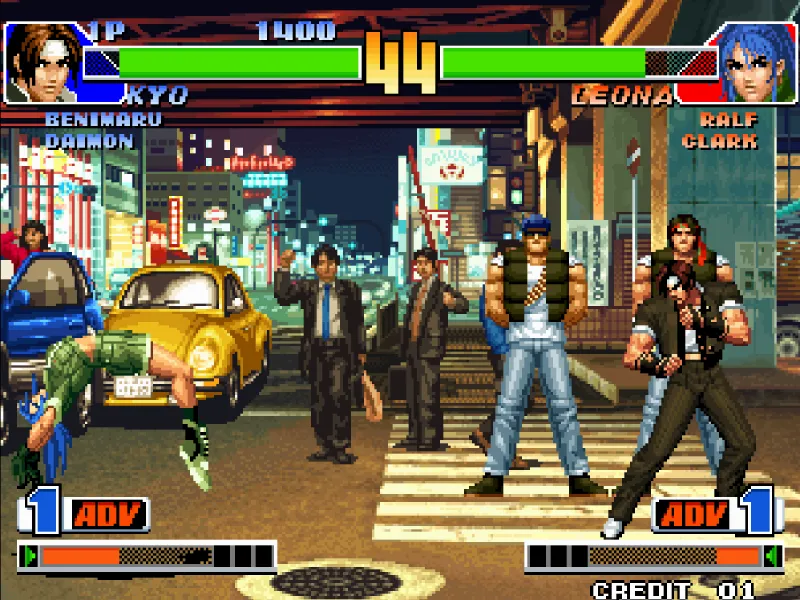
This decision ultimately resulted in the most polished and balanced entry in the KOF series. The game retained the dual-mode system (Advance/Extra) introduced in KOF '97 but significantly improved it—in Advance mode, the MAX state no longer forces you out after a Super Special Move, but lasts until the timer runs out; the manual charge mechanism in Extra mode was also fine-tuned.
The game features 38+ playable characters (including EX variants and hidden characters), spanning the entire roster from KOF '94 to '97. Notably, the American Sports Team (Heavy D!, Lucky Glauber, and Brian Battler) made a strong comeback after missing KOF '97, and the Masters Team (Heidern, Takuma, and Saisyu) joined forces for the first time.
The King of Fighters '98 is widely considered one of the greatest 2D fighting games of all time. In 2008, SNK Playmore released a complete remake, The King of Fighters '98 Ultimate Match, which added more characters, finer balance adjustments, and online play, proving the game's enduring vitality a decade later.
II. Character Introduction
The King of Fighters '98 includes 12 regular teams, 2 single-entry characters, and 1 final boss, totaling 38+ playable characters. Below is the complete team composition and core character analysis.
2.1 Team Overview
| Team | Members | Debut Series |
|---|---|---|
| Hero Team | Kyo Kusanagi, Benimaru Nikaido, Goro Daimon | KOF '94 |
| Fatal Fury Team | Terry Bogard, Andy Bogard, Joe Higashi | KOF '94 |
| Art of Fighting Team | Ryo Sakazaki, Robert Garcia, Yuri Sakazaki | KOF '94 |
| Ikari Warriors Team | Leona Heidern, Ralf Jones, Clark Still | KOF '96 |
| Psycho Soldier Team | Athena Asamiya, Sie Kensou, Chin Gentsai | KOF '94 |
| Women Fighters Team | Chizuru Kagura, Mai Shiranui, King | KOF '96/'97 |
| Korea Team | Kim Kaphwan, Chang Koehan, Choi Bounge | KOF '94 |
| Orochi Team / Awakened | Yashiro/Orochi Yashiro, Shermie/Orochi Shermie, Chris/Orochi Chris | KOF '97 |
| Special Team | Ryuji Yamazaki, Blue Mary, Billy Kane | KOF '97 |
| Yagami Team | Iori Yagami, Mature, Vice | KOF '96 |
| Masters Team | Heidern, Takuma Sakazaki, Saisyu Kusanagi | New Entry |
| American Sports Team | Heavy D!, Lucky Glauber, Brian Battler | KOF '94 |
| Single Entries | Shingo Yabuki, Rugal Bernstein | — |
| Final Boss | Omega Rugal | Single-player only |
2.2 Core Character Deep Dive
Kyo Kusanagi — The Scion of Flame
| Attribute | Rating |
|---|---|
| Attack | ★★★★ |
| Speed | ★★★★ |
| Difficulty | ★★★ |
| Combo Potential | ★★★★★ |
- Strengths: The classic "Ara Gami → Nine Scars → Eight Rust" chain system reaches perfect balance in KOF '98, offering immense pressure; "100-Shiki: Oniyaki" is an excellent anti-air; "Ura 108-Shiki: Orochinagi" has top-tier range and damage.
- Weaknesses: Limited mid-range poking tools; lacks effective escape moves when pressured.
- Verdict: The absolute protagonist of the KOF series. Kyo uses his KOF '95 moveset (switchable via EX mode), and his classic "Final Showdown Art: Mu Shiki" remains one of the most visually stunning Super Special Moves.
Iori Yagami — The Pale Flame
| Attribute | Rating |
|---|---|
| Attack | ★★★★★ |
| Speed | ★★★★ |
| Difficulty | ★★★★ |
| Combo Potential | ★★★★★ |
- Strengths: "Kin 1211-Shiki: Yaotome" has an oppressive hitbox and explosive damage; the "Oniyaki" + "127-Shiki: Aoibana" combo provides top-tier pressure; his jumping heavy kick has an incredibly wide hitbox.
- Weaknesses: Moves have long recovery times, making him vulnerable to counters; not beginner-friendly, requires significant practice.
- Verdict: One of the most popular characters in the series and a staple in competitive play. Iori's performance in KOF '98 is arguably his peak—his close-range pressure and burst damage are still legendary. The fact that Mature and Vice return as "dream warriors" after being killed by Iori perfectly embodies the Dream Match theme.
Orochi Team — The Awakened Power
| Character | Awakened Form | Attribute |
|---|---|---|
| Yashiro | Orochi Yashiro | Power-type → Lightning-based attacks |
| Shermie | Orochi Shermie | Grappler → Enhanced lightning throws |
| Chris | Orochi Chris | Speed-type → Purple flame attacks (Iori style) |
- Strengths: The awakened trio possesses the most unique movesets in the series—Yashiro's lightning throws, Shermie's long-range electricity, and Chris's purple flames are all visually striking.
- Weaknesses: Significantly higher execution barrier in their awakened forms.
- Verdict: The Orochi Team is the most talked-about team in KOF '98. Each member has a normal and awakened form, with the latter using Orochi's power and completely different fighting styles. It implies that, in a sense, Orochi's power still lingers within this "dream."
III. Controls
3.1 Basic Controls
The King of Fighters '98 uses the standard Neo Geo 8-way joystick + 4-button layout:
| Button | Function |
|---|---|
| A | Light Punch |
| B | Light Kick |
| C | Heavy Punch |
| D | Heavy Kick |
| A+B | Forward Roll / Dodge |
| C+D | Blowback Attack |
| B+C | Taunt |
3.2 Dual-Mode System: Advance vs. Extra
KOF '98 retains the dual-mode system inherited from KOF '97, with key improvements:
| Feature | Advance Mode | Extra Mode |
|---|---|---|
| Power Gauge | Fills by attacking/taking damage, max 3 stocks | Manual charge (A+B+C), single gauge |
| MAX Activation | Costs 1 stock to enter MAX, allows MAX Supers | Auto-activates when HP is low (flashing red) |
| MAX Supers | Becomes MAX version automatically in MAX state | Available when HP is low + Gauge is full |
| Post-MAX | Returns to normal state after MAX Super (improved from '97) | No change |
| Evasion | Forward/Backward Roll (Direction + A+B) | Side-step (A+B, stationary) |
| Comeback Bonus | +1 Gauge capacity per lost round (max 5) | Faster charge speed + higher HP threshold for MAX |
| Best For | Aggressive players, combo-heavy playstyles | Defensive players, rhythm-based control |
The dual-mode system gives KOF '98 a strategic depth far beyond its contemporaries. The same character plays differently in each mode, allowing for diverse tactical choices.
3.3 Universal Moves
| Move | Input | Description |
|---|---|---|
| Dash | →→ | Rapid forward dash |
| Backstep | ←← | Rapid backward hop |
| Super Jump | ↙ or ↓ or ↘ then ↖ or ↑ or ↗ | Long-distance jump |
| Hop | Tap ↖ or ↑ or ↗ | Short, fast jump |
| Recovery | A+B when hitting the ground | Quick stand-up to avoid follow-ups |
| Emergency Evasion (Adv) | → + A+B (Roll) / ← + A+B (Backroll) | Short invincibility window |
| Side-step (Extra) | A+B | Short upper-body invincibility |
| Taunt | B+C | Taunt, lowers opponent's gauge |
IV. Strategy and Matchups
Since KOF '98 is a competitive fighting game, this section focuses on "Advanced Tactics" rather than stage walkthroughs.
4.1 Team Composition
KOF '98 uses a 3v3 team mechanic. A balanced team is key to victory:
- Point: Use characters with fast gauge generation (e.g., Benimaru, Athena) to build an early advantage.
- Middle: Use all-rounders (e.g., Kyo, Terry) to handle various situations.
- Anchor: Use high-burst characters (e.g., Iori, Ralf) to utilize the comeback gauge bonus for a potential 1v3 sweep.
4.2 Matchup Overview
| Type | Strong Against | Weak Against |
|---|---|---|
| Zoner (Athena, King) | Rushdown | Anti-air / Reflectors |
| Rushdown (Iori, Clark) | Zoners | Grapplers |
| Grappler (Daimon, Shermie) | Rushdown | Speedsters |
| Speedster (Chris, Choi) | Grapplers | Zoners |
4.3 Omega Rugal Boss Guide
Omega Rugal is the final boss of the single-player mode and one of the most iconic bosses in the series. He is a cybernetic version of Rugal infused with Orochi power.
| Item | Details |
|---|---|
| Key Moves | "Genocide Cutter" (high-speed slash), "Kaiser Wave" (full-screen projectile), "Gigantic Pressure" (aerial grab) |
| AI Weakness | Predictable delay in anti-air reactions; limited defensive options when waking up |
| Recommended | Iori Yagami (Aoibana combos), Goro Daimon (throws ignore defense), Kyo Kusanagi (high damage) |
| Core Strategy | Keep mid-range to bait the Kaiser Wave, then hop over and punish; never rush blindly when he has meter |
V. Tips and Advanced Tactics
5.1 Basic Fighting Tips
- Master the Hop: Hopping (tapping the jump button) combined with heavy attacks is the safest way to apply pressure.
- Muscle Memory for Recovery: Pressing A+B upon hitting the ground is essential to avoid follow-up damage.
- Gauge Management: Don't waste your meter. In Advance mode, keep at least 1 stock for a MAX Super burst window.
- Guard Cancel: Inputting a roll while blocking consumes 1 stock to cancel block stun and counter-attack.
- Throw Mix-ups: Use normal or command throws on an opponent's wake-up to force them to guess your next move.
5.2 Advanced System Tips
- MAX Activation Cancel: In MAX state, you can cancel the recovery of normal moves into a MAX activation, leading into a Super for massive damage.
- Comeback Strategy: Intentionally losing the first round with a small amount of meter can grant you a higher gauge capacity for the next round.
- EX Character Utility: EX Kyo (KOF '95 version) has different properties on moves like "Kototsuki Yo," which can be advantageous in specific matchups.
- Advance vs. Extra Nuance: Extra mode lacks the forward roll but has the side-step (upper-body invincibility), which is highly effective against high-hitting attacks.
5.3 Multiplayer Tips
- Character Carry-over: After defeating an opponent, you keep your current character (with partial HP recovery) while the opponent switches. A good player can sweep an entire team.
- Gauge Carry-over: Remaining meter carries over to the next round. If you win the first round with full meter, you start the next round with a massive advantage.
5.4 Versions and Platforms
- Neo Geo MVS: Original arcade version, the competitive standard.
- Neo Geo AES: Home console version, added practice and survival modes.
- Neo Geo CD: Added cutscenes and special endings.
- KOF '98 Ultimate Match (2008): The definitive remake with added bosses, balance tweaks, and online play. Still a staple in global tournaments.
VI. Trivia and Arcade Legends
6.1 A Romantic Decision on the Brink of Bankruptcy
In 1998, SNK faced severe challenges: the rise of 3D games and the aging Neo Geo hardware. Choosing to abandon the plot to focus entirely on gameplay was a "non-commercial" but quintessentially "SNK-style" romantic decision. It proved that when you focus on making a game "fun," players will notice.
6.2 The American Sports Team's Comeback
After being cut from KOF '95 and '97, the American Sports Team returned in KOF '98 with significantly improved performance. They represent the "Dream Match" spirit: on this stage, everyone is a star.
6.3 Shingo Yabuki — Kyo's Biggest Fan
Shingo is Kyo's self-proclaimed disciple. His moves are clumsy imitations of Kyo's, but his "Shingo Kick" became surprisingly effective in KOF '98 due to its unpredictable trajectory.
6.4 Rugal's "Ultimate Form"
Omega Rugal was designed to be the ultimate KOF boss. His "Kaiser Wave" covers the screen, and his "Genocide Cutter" is so fast it has caused countless players to smash their arcade sticks in frustration.
6.5 The Origin of "Mu Shiki"
Kyo's MAX Super, "Mu Shiki," is named after the Zen concept of "Mu" (Nothingness). It represents a technique so perfect it transcends the very concept of a "move."
6.6 Why is KOF '98 Still Played Today?
It found the perfect balance between a massive 38+ character roster and deep, controllable mechanics. It remains the gold standard for competitive 2D fighting games.
FAQ
Q1: Does KOF '98 have hidden endings?
Q2: How do I select EX characters?
Q3: Can I play as Omega Rugal?
Q4: What is the difference between KOF '98 and KOF '98 Ultimate Match?
Q5: Which character is best for beginners?
Q6: Is Advance or Extra mode stronger?
Q7: Are there infinite combos in KOF '98?
Q8: How can I play the authentic KOF '98 at home?
- Steam / PS4 / Xbox / Switch: Purchase *The King of Fighters '98 Ultimate Match* or *ACA NeoGeo: The King of Fighters '98*.
- Neo Geo Mini / Arcade Stick Pro: Official SNK hardware with the game pre-installed.
- Emulators: Use FinalBurn Neo or MAME to load the Neo Geo ROM.