1. Game Background
1.1 World Setting
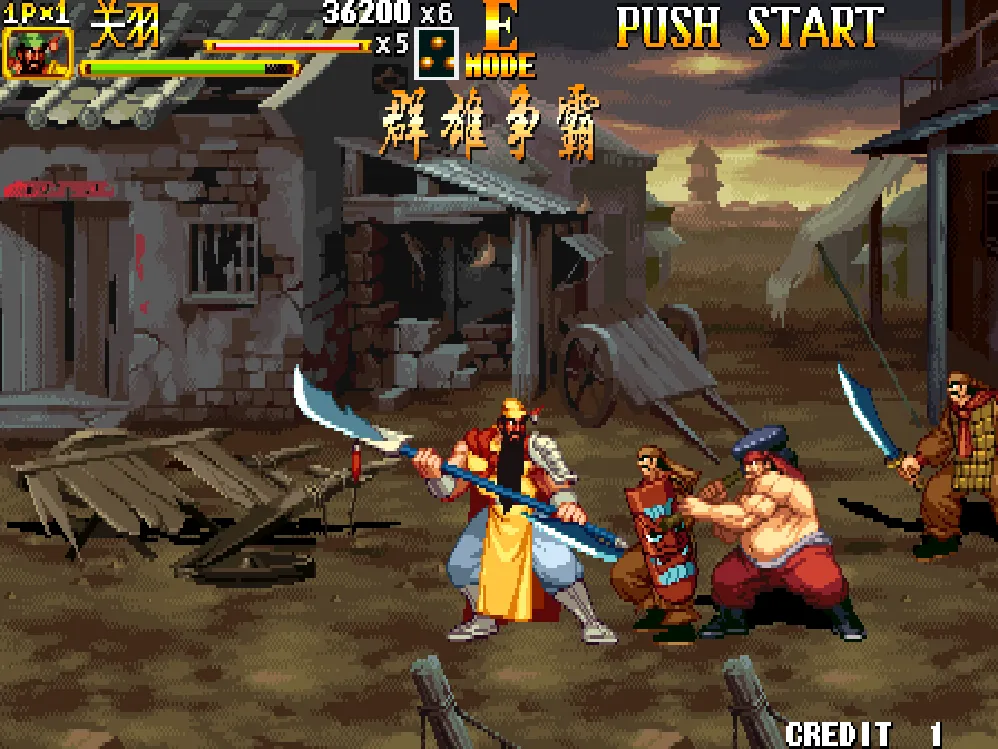
The game's plot is faithfully rooted in Luo Guanzhong's Romance of the Three Kingdoms, spanning the historical timeline from the Yellow Turban Rebellion to the tripartite division of China. Players take on the roles of legendary warriors, participating in iconic battles such as Guandu, Red Cliffs, and Yiling, recreating epic combat scenes on a side-scrolling arcade battlefield. Unlike linear beat-'em-ups, Knights of Valour 2 features a branching level design where player choices dictate the path forward, and specific character combinations can even trigger unique hidden storylines and endings.
Beyond combat, the game is deeply infused with the history and culture of the Three Kingdoms era. The stage design draws inspiration from period-accurate architecture, from the ornate halls of the Luoyang Palace to the dense fleet of warships at the Red Cliffs. The art team put immense effort into recreating this era of heroes. The item system is packed with legendary artifacts—the Green Dragon Crescent Blade, the Serpent Spear, Zhuge Liang's repeating crossbow, Sun Tzu's Art of War, and more—each tied to classic tales from the original novel. For fans of the Three Kingdoms, collecting these legendary items is a major motivation in itself.
1.2 Development History
Knights of Valour 2 was released in 2000 by the Taiwanese company IGS (International Games System) and stands as a milestone in the history of original Chinese arcade games. At a time when Japanese developers dominated the market, the IGS team interpreted the Three Kingdoms theme from a Chinese perspective, which was rare for the era. The game ran on IGS's proprietary PolyGame Master (PGM) hardware, a system based on the Motorola 68000 CPU capable of supporting large character sprites, rich colors, and multi-layered parallax scrolling.
The "Plus" version released in 2001—also known as "Nine Dragons"—significantly expanded upon the original. It added multiple playable characters, numerous special moves, hidden level branches, and balance adjustments. The Nine Dragons version became the most common sight in Asian arcades and is remembered by many as the "definitive" Knights of Valour 2. Its popularity in Chinese-speaking regions was phenomenal; between 2000 and 2005, almost every arcade in China featured a Knights of Valour cabinet. It was the only original Chinese game of that era capable of competing head-to-head with Japanese arcade giants, truly earning the title of "China's #1 Arcade IP."
2. Character Introduction
| Character | Weapon | Characteristics |
|---|---|---|
| Guan Yu | Green Dragon Crescent Blade | Wide attack range, high single-hit damage, slightly slower movement |
| Zhang Fei | Serpent Spear | Heavy impact, diverse throwing techniques, strong close-quarters combat |
| Zhao Yun | Spear | Speed-based character, fluid combos, piercing dash attacks |
| Ma Chao | Spear | Sharp moves, rich aerial combos, ideal for jump-attack specialists |
| Huang Zhong | Bow | The only dedicated ranged character, high crowd-control efficiency, weaker melee survivability |
| Kongming (Zhuge Liang) | Fan | Magic-based character, can cast fireballs, lightning, and other spells |
| Diaochan | Dual Swords/Ribbons | Agile character, fast movement, flashy aerial combos |
Each character features an independent move list and combo system, including basic attacks, special moves, super moves, and hidden super moves. There is no absolute "best" character; they are designed to suit different player styles.
3. Controls
3.1 Basic Controls
| Action | Input | Description |
|---|---|---|
| Movement | 8-Way Joystick | Move freely across the battlefield |
| Attack | A Button | Basic attack; press repeatedly for combos |
| Jump | B Button | Jump; use with directional keys to control distance |
| Special Move | C Button | Consume energy to unleash special techniques |
| Item Use | D Button | Use equipped items (weapons, bombs, potions, etc.) |
3.2 Combo and Item System
The core combat of Knights of Valour 2 is built on two intertwined systems: combos and items. For combos, the game isn't just about mashing the A button; it requires precise timing to link "Basic Attack—Special Move—Super Move." Advanced players can chain ground attacks into aerial combos, draining a boss's health bar in seconds. The item system adds a layer of pre-battle strategy—players can collect and swap weapons, armor, consumables, and treasures between stages. Certain hidden treasures (like the Art of War or Taiping Jing) can unleash screen-clearing magic, while fire bombs and smoke screens provide tactical control over the battlefield.
4. Level Flow and Boss Strategy
| Stage | Campaign/Scene | Boss | Strategy Tips |
|---|---|---|---|
| Stage 1 | Yellow Turban Rebellion | Zhang Jiao/Zhang Bao/Zhang Liang | The brothers appear in sequence. Focus on Zhang Jiao first to stop his magic; use Guan Yu's sweep to knock back multiple enemies. |
| Stage 2 | Hulao Pass | Lu Bu | Lu Bu has high damage and strong combos. Don't fight head-on; use Zhao Yun's speed to flank him. |
| Stage 3 | Battle of Guandu | Yan Liang/Wen Chou | They appear together. Focus fire to take them out one by one; dodge Yan Liang's charge. |
| Stage 4 | Changban Slope | Xia Hou Dun | Use Zhuge Liang's long-range magic. Melee characters must watch out for his spinning slash. |
| Stage 5 | Battle of Red Cliffs | Cao Cao | Cao Cao has multiple forms, each with different attack patterns. Save your items for this fight. |
| Hidden | Wuzhang Plains | Sima Yi | Unlocked only under specific conditions. Drops top-tier loot but is extremely difficult. |
5. Tips and Advanced Strategy
5.1 Survival Tips
- Clear minions before the boss. Trash mobs will interfere during boss fights. Ensure the area is clear before triggering the boss.
- Master basic aerial combos. Learn at least one "3-hit basic + rising slash + aerial combo" sequence; this is the foundation for all advanced play.
- Don't hoard items. Many beginners save fire bombs and potions until the end. The game provides enough replenishment; use them when the situation gets tough.
- Master the dodge rhythm. Double-tapping the joystick allows for a quick backstep or dodge, which is vital for avoiding boss combos.
- Coordinate in co-op. One player should draw the boss's attention and create openings, while the other focuses on damage and item usage.
6. Trivia and Arcade Legends
IGS vs. Piracy
The success of the Knights of Valour series in Asia had a massive downside: the proliferation of pirated boards. Because the PGM hardware was relatively easy to replicate, most Knights of Valour 2 cabinets in Chinese arcades were actually bootlegs. IGS tried to fight back with encryption chips and system updates, but pirates always found a way. Ironically, while piracy hurt IGS's revenue, it accelerated the game's popularity, turning it into a cultural icon of an era.
The Hidden Character Myth
In the Plus/Nine Dragons version, rumors persisted for years that players could unlock "Lu Bu" using a secret joystick code. Countless players spent hours inputting complex commands, but in the official version, there is no playable Lu Bu mode. This rumor likely stemmed from fan-made ROM hacks, but the original Nine Dragons version does not feature him.
A Special Connection
As a game developed by a Taiwanese company, the Knights of Valour series created a unique cultural bridge. When players in mainland China skillfully controlled Guan Yu or Zhao Yun, they might not have known that the move names and voice acting were designed in an office in Taipei. Yet, the pride of playing "a Three Kingdoms game made by our own people" was a precious part of the arcade culture of that time.