I. Game Background
1.1 Setting the Scene
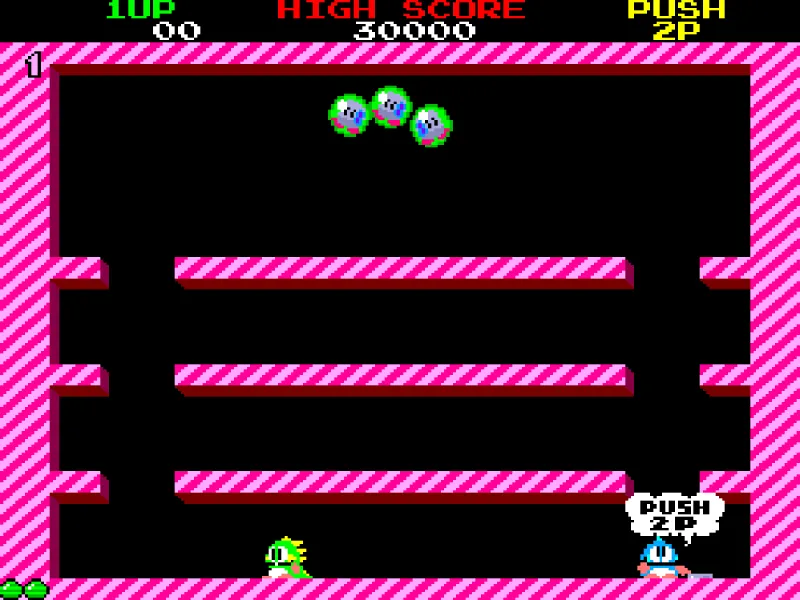
Deep within a monster-infested cave, two boys named Bub and Bob are kidnapped by the evil Super Drunk and cursed, transforming them into small, bubble-blowing dinosaurs. Their girlfriends are also imprisoned at the very bottom of the cave. To regain their human forms and save their loved ones, the brothers must descend through 100 monster-filled levels, trapping enemies in bubbles and eliminating them along the way.
The game takes place in a deep "Cave of Monsters," where each level is a fixed-screen platform stage. The visual theme evolves as you descend, shifting from lush green meadows to complex structures filled with invisible air currents and narrow passages. The 100th floor is the lair of the final boss, Super Drunk. Only by playing in two-player co-op and completing the "Super Mode" can you uncover the family secret behind the curse.
1.2 Development History
Bubble Bobble was released in arcades by the Japanese company Taito in 1986. It is the most famous work of designer Fukio Mitsuji (also known as MTJ). At the time, Mitsuji felt Taito's arcade offerings were uninspired and was determined to revitalize the company with a fresh, cooperative game. He chose the "bubble" mechanic from over 100 proposals for a unique reason: he believed bubbles would attract female players, whereas Japanese arcades at the time were almost exclusively male-dominated.
Mitsuji intentionally designed the game as a two-player co-op experience, which was an anomaly in the 1980s arcade scene dominated by competitive games. Some enemies were inherited from Taito's 1984 game Chack'n Pop, and the adorable dinosaur protagonists became one of the most recognizable duos in gaming history. Unfortunately, the original source code was lost in 1996, meaning all subsequent home console ports had to be created via reverse engineering. Despite this, the game was ported to almost every major platform, including the NES, Game Boy, and Amiga, and spawned classic sequels like Rainbow Islands and Parasol Stars.
II. Character Guide
| Character | Color | Description |
|---|---|---|
| Bub | Green | Player 1's bubble dragon; lively personality, the older brother |
| Bob | Blue | Player 2's bubble dragon; Bub's younger brother |
| Zen-Chan | Green | The first enemy encountered; a wind-up block creature that deals contact damage |
| Mighta | White | A hooded ghost-like enemy that rolls stones along the ground |
| Monsta | Purple | A floating whale-like monster that moves diagonally and bounces off walls |
| Pulpul | Pink | A flying enemy with a propeller; extremely fast, appears after level 20 |
| Banebou | Green | A spring-like bouncy enemy; moves very quickly, appears after level 30 |
| Hidegons | Red | A flame-shaped enemy that shoots fireballs, appears after level 40 |
| Drunk | Blue | An enemy that throws bottles that bounce off walls, appears after level 50 |
| Invader | White | A tribute to Space Invaders; fires lasers, appears after level 60 |
| Skel Monsta | White | An invincible pursuer that appears when time runs out; can only be defeated by rare items |
| Super Drunk | Giant | The final boss on level 100; scatters bottles, requires 100 hits from lightning bubbles |
III. Controls and Mechanics
3.1 Basic Controls
| Key | Function |
|---|---|
| Arrow Keys (Left/Right) | Move the character left or right |
| Arrow Key (Down) | Crouch to avoid enemy attacks |
| Jump Key | Jump; can land on bubbles to perform double or infinite jumps |
| Bubble Key | Blow a bubble to trap enemies |
| Arrow Key + Bubble Key | Control the direction of the bubble shot |
3.2 Bubble Mechanics and Item System
Bubbles are the core of the game. Once an enemy is trapped, they float for a few seconds. Touch the trapped enemy to pop the bubble and turn them into food items like fruit or cake for points. Popping multiple enemies at once yields higher scores and rarer rewards.
The item system is incredibly rich, with items appearing as floating objects in the stage:
- Candies: Blue increases bubble speed, red increases range, yellow enables rapid-fire.
- Umbrellas: Yellow skips 3 levels, purple skips 5, red skips 7—essential for speedrunning.
- Rings & Lamps: Rings provide bonus points for jumping/killing/walking; lamps grant multiple effects simultaneously.
- Shoes: Increase movement speed for the remainder of the game.
- Crosses: Trigger full-screen elemental attacks (fire, water, or lightning).
- Magic Potions: Instantly eliminate all enemies and allow you to collect score items for 30 seconds.
- Special Bubbles: Fire bubbles spray flames, water bubbles wash away enemies, and lightning bubbles pierce across the screen.
Another key mechanic is collecting EXTEND letters: Letter bubbles appear occasionally; collect E, X, T, E, N, D to gain an extra life and skip the current level.
IV. Level Progression and Boss Strategy
| Level Range | Stage Characteristics | Enemies | Strategy Tips |
|---|---|---|---|
| Levels 1-10 | Beginner platforms, open layout | Zen-Chan | Master bubble shooting and bubble-jumping to find your rhythm |
| Levels 11-25 | Layered platforms, narrow paths | Mighta, Monsta | Avoid rolling stones; use the "Kiss" technique—shoot and pop at close range for instant kills |
| Levels 26-40 | Hidden doors, air currents | Pulpul, Banebou | Secret doors appear at levels 20 and 30 with zero deaths; predict Banebou's fast jumps |
| Levels 41-60 | Narrow paths, deep platforms | Hidegons, Drunk | Secret door at level 40 hints at boss tactics; zero deaths at level 50 skips to 70 |
| Levels 61-99 | High enemy count, dense platforms | Invader, Drunk | Keep moving to avoid Invader lasers; enemies break free in under a second |
| Level 100 | Final Boss stage | Super Drunk | Must use lightning potions; normal bubbles are useless. Single-player/death triggers "Bad Ending" |
Note: If you stay too long, the invincible Skel Monsta will appear to hunt you down. Your only escape is to clear the level quickly.
V. Tips and Advanced Strategy
- Master the Bubble Jump: Jump on your own bubbles to reach higher ground. Repeatedly jumping on bubbles allows for infinite vertical ascent—a core skill.
- Use the "Kiss" Technique: Shoot a bubble and pop it immediately upon contact with an enemy to skip the waiting time. Essential for later levels.
- Prioritize Special Bubbles: Fire, water, or lightning bubbles can clear a screen instantly. The direction depends on which way you are facing.
- Zero-Death Hidden Rooms: Reach levels 20, 30, and 40 without dying to enter secret rooms; zero deaths at level 50 skips directly to 70.
- Score Matching: If both players' scores end in the same digit, all remaining bubbles turn into food items after the last enemy is defeated.
- EXTEND Letters First: Always prioritize collecting letter bubbles for extra lives and level skips.
- Keep Moving in Late Game: From level 60 onwards, enemies break free very quickly. Keep jumping and shooting bubbles to create a moving barrier.
- Cooperative Roles: One player clears the screen while the other collects items. The final boss requires coordinated use of lightning potions.
VI. Trivia and Arcade Legends
The Mystery of the Lost Source Code: The original arcade source code was lost in 1996. Every official port since has been a "legal hack" created via reverse engineering—a rarity in the gaming industry.
Not Random, but Causal: Item drops seem random but are determined by complex internal counters. The game tracks steps taken, bubbles blown, and jumps made from the moment it boots up. Once a threshold is reached, the corresponding item appears. Experts can "summon" specific items by controlling their actions.
Hidden Room Puzzles: The walls of the secret rooms in levels 20, 30, and 40 feature unique symbols. These can be deciphered; one reads: "If you want to regain your true love, you must help each other to the end"—hinting that a single player cannot see the true ending.
From Couple's Game to Family Tragedy: Fukio Mitsuji designed Bubble Bobble to attract couples to arcades, but the plot is surprisingly dark. In the "Super Mode" true ending, the final boss, Super Drunk, is actually Bub and Bob's parents—controlled by the same dark force. The brothers must end the threat themselves.