I. Game Background
1.1 Setting the Scene
The story of Armored Warriors (known in Japan as Powered Gear: Strategic Variant Armor Equipment) is set in the year 2281. After a 50-year interstellar war, the United Earth Government and the Principalities of Raia finally signed a ceasefire. However, just one year later, the Raian capital of Melkide was lightning-struck and occupied by an unidentified armed force.
Under the guise of a "humanitarian mission," Earth quickly dispatched an armored mobile unit. But the unit's true mission went far beyond rescue—the top brass of the United Earth Government intended to use this crisis to eliminate the unknown enemy while simultaneously annexing all of Raia into Earth's territory. The "Variant Armors" (VA) piloted by the players—revolutionary mechs capable of swapping arms, legs, and weapon modules in real-time on the battlefield—were the core weapons of this secret conquest plan.
1.2 Development History
Armored Warriors was developed by Capcom and released on October 24, 1994, on the CPS-2 (Capcom Play System 2) arcade board. The game was directed by legendary producer Yoshiki Okamoto (known for Street Fighter II and Final Fight), with a soundtrack composed by Takayuki Iwai.
1994 was the golden age of the Capcom CPS-2 board, which saw the birth of classics like Street Fighter Alpha, Alien vs. Predator, and Darkstalkers. At a time when the side-scrolling beat 'em up genre was thought to have "reached its limit," Armored Warriors carved out a new path with its unprecedented real-time part-swapping system—mecha arms, legs, and weapons could be scavenged directly from destroyed enemies and installed on the fly. This system injected a level of strategic depth and visual satisfaction never before seen in the genre.
The mecha designs from this game were later reused by Capcom in the 1995 fighting game Cyberbots: Full Metal Madness—a mecha fighting game featuring the Variant Armors from Armored Warriors. It remains one of the few instances in Capcom's history where a beat 'em up "fed back" into a fighting game.
In 2018, the game was included in the Capcom Beat 'Em Up Bundle for Nintendo Switch, PlayStation 4, Xbox One, and PC, allowing a new generation of players to experience this long-underrated CPS-2 mecha classic. In 2023, Time Extension listed it among the "Best Beat 'Em Ups of All Time."
II. Mecha and Character Introduction
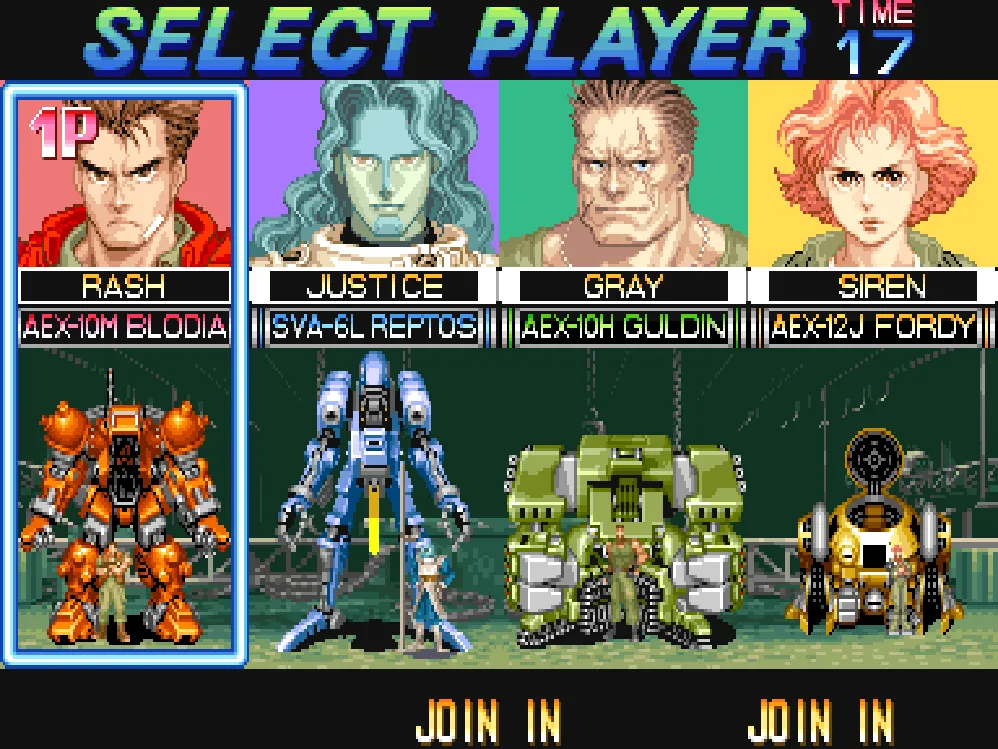
What makes Armored Warriors unique is that players don't just choose a "character," but a "mecha model"—and its combat capabilities depend entirely on the parts you swap in real-time on the battlefield.
2.1 Variant Armor (VA) Models
| Mecha | Type | Starting Gear | Characteristics |
|---|---|---|---|
| AEX-08J "Guldin" | Balanced | Standard Arm + Standard Leg + Rifle | The most well-rounded base model. A top choice for beginners. |
| AEX-12M "Sieg" | Power | Heavy Arm + Heavy Leg + Cannon | Heaviest armor and highest single-hit damage. Slowest movement speed. |
| AEX-10L "Blodia" | Speed | Light Arm + High-Speed Thruster Leg + SMG | Fastest speed and highest combo density. Lowest defense. |
| AEX-02F "Jin Saotome" | Melee Specialist | Combat Arm + Jump-Boost Leg + No Handheld Weapon | Best melee performance—features a unique punch-and-kick combo system, distinct from the weapon-focused style of other mechs. |
2.2 The Real-Time Part-Swapping System—Core Gameplay
Armored Warriors' most revolutionary feature: after destroying enemy mechs, their arms, legs/thrusters, and handheld weapons scatter on the ground as individual parts. Players can walk over them to pick them up and install them instantly—on the battlefield, you could be using a standard rifle one second and a massive cannon scavenged from a boss the next.
| Part Type | Attribute Impact | Examples |
|---|---|---|
| Arms | Melee attack style, combo performance, melee damage | Drill Arm (multi-hit pierce), Electric Arm (area stun), Giant Hammer Arm (one-hit smash) |
| Legs | Movement speed, jump height, dash distance, evasion | Tank Treads (max defense + slowest speed), Thruster Legs (hover + high-speed dash), Jump-Boost Legs (max jump height) |
| Main Weapon | Ranged attack style | Rifle (balanced fire), Shotgun (short-range spread), Cannon (high single-hit damage), Laser (piercing), Flamethrower (continuous burn) |
| Sub-Weapon | Support attack / Special effects | Missiles (homing, low damage), Landmines (delayed explosion), Shield (frontal defense) |
2.3 Tactical Thinking
The charm of this system lies in on-the-fly tactical decision-making: facing a wall of ranged enemies? Swap to a suppression weapon and heavy armor to tank the damage. Facing a speed-type boss? Equip thruster legs and a drill arm for high-speed pursuit. Surrounded by mobs? Grab a hammer and a shotgun to clear the screen.
It's not about "which gear is the strongest"—it's about "what does the current battlefield need?" Every part swap is a strategic judgment call.
III. Controls
3.1 Basic Controls
Uses the standard CPS-2 layout of an 8-way joystick + 3 buttons:
| Button | Function |
|---|---|
| A (Attack) | Melee punch/kick (depends on arm part) + Fire handheld weapon |
| B (Jump) | Jump (height and distance depend on leg part) |
| C (Special) | Special attack—consumes energy gauge |
| A + B | Panic Move—screen-clearing attack, consumes a small amount of HP |
3.2 Core Combat Mechanics
Part Pickup: Stand over a part left behind by a destroyed enemy and press Down to equip it. Installation is instantaneous—no menus required—taking only a second from "seeing the part" to "being fully equipped."
Team-up Change: In multiplayer, two players standing together can press the Special button simultaneously to unleash a powerful joint attack—far exceeding the damage and range of individual special moves.
Mission Constraints: Each stage has specific victory conditions, including time limits, ammo limits (some heavy weapons have limited shots), and minimum kill requirements. This means you can't just "turtle" through—you must maintain an aggressive pace.
IV. Stage Walkthrough & Boss Guide
There are 7 stages in total, spanning various war zones on the planet Raia.
| Stage | Setting | Objective | Boss | Strategy Tip |
|---|---|---|---|---|
| 1 | Raia Border | Break through defenses, min. 30 kills | Heavy Artillery Mech | Intro stage. Get familiar with the part-swapping system—this stage provides all basic weapon and arm types to experiment with. |
| 2 | Occupied Ruins | Cross the city in under 5 minutes | High-Speed VA | Speed-type boss—you'll need thruster legs to keep up. Use a shotgun for burst damage at close range. |
| 3 | Underground Base | Ammo limit—conserve heavy weapons | Multi-Rocket Mech | Ranged suppression boss. Use cover to dodge rockets, then swap to a drill arm to rush in while it reloads. |
| 4 | Desert Battlefield | Min. 50 kills—the mob swarm test | Giant Tank-Tread VA | Heavy frontal armor—flank it to attack the tread joints. Use a laser cannon to pierce the front armor. |
| 5 | Sky Fortress | Time limit + high-density bullets | Flying VA | Flying boss makes ground melee ineffective—swap to anti-air weapons (homing missiles + long-range rifle). Hovering is key here. |
| 6 | Enemy HQ | Elite enemies—maximize part efficiency | Dual Bosses—two high-speed VAs | The hardest stage. In co-op, split the bosses; solo, use the invincibility frames of your panic move to take them down one by one. |
| 7 (Final) | Orbital Platform | No limits—go all out | Final Boss: Orbital Cannon VA—triple threat (lasers, missiles, melee) | Multi-phase boss—each destroyed module triggers a new attack pattern. Save your best parts for the final form. Reveals the Earth government's true colors. |
V. Tips and Advanced Strategy
5.1 Survival Tips
- Always be swapping: This isn't a game where you find one "best build" and stick with it. Every new area changes the enemy types and bullet patterns—your gear should change accordingly. Destroy an enemy → check the drop → decide if it's better than what you have.
- Legs dictate your playstyle: Thruster legs = high-mobility hit-and-run; Tank treads = stationary tanking; Jump-boost legs = aerial suppression. Choose your legs first, then build your arms and weapons around them.
- Ammo management is vital: Heavy weapons like cannons and flamethrowers have limited ammo. Wasting them on mobs means you'll be stuck with a basic rifle for the boss. Keep an eye out for ammo refills.
- Arm + Weapon synergy: Drill Arm + Shotgun = close-range burst (drill for stun, shotgun for damage); Hammer Arm + Cannon = heavy-hitting long-range combo. Look for synergy, not just individual stats.
- Save your Panic Move (A+B): It provides screen-clearing damage and brief invincibility. Don't waste it just to look cool—save it for when you're surrounded by 5+ enemies.
5.2 Co-op Tips
- Define roles: One player acts as the tank (heavy armor/treads) to soak damage, while another provides support (thruster legs/ranged weapons). A third player (if applicable) can use a combat arm to weave in and out for melee damage.
- Use Team-up moves on bosses: Save your joint attacks for when a boss is below 30% HP to finish them off quickly and avoid a war of attrition.
- Don't fight over parts: Parts are visible to everyone. Communicate—"I need those treads"—to avoid two players rushing for the same item.
5.3 Advanced Trivia
- Cyberbots connection: The mecha designs were reused for the 1995 fighting game Cyberbots: Full Metal Madness. If you like the look or feel of a specific mech here, it's likely a playable character in Cyberbots.
- CPS-2 glory: Armored Warriors is one of the few side-scrolling mecha games on the CPS-2 board. It fully utilized the board's color palette and parallax scrolling, making it one of the most visually stunning arcade games of 1994.
VI. Trivia and Arcade Legends
6.1 From Beat 'Em Up to Fighter—A Rare IP Flow
In Capcom's history, the flow from Armored Warriors to Cyberbots is extremely rare. Usually, fighting game characters are added to beat 'em ups (like Street Fighter characters in Final Fight). Armored Warriors did the reverse: mecha designs were extracted from a beat 'em up to create a dedicated fighting game. This only happened once in Capcom's history.
6.2 Part Swapping—1994's "Roguelike" elements?
The real-time part-swapping system reminds modern players of "builds" in Roguelike games—adjusting your playstyle based on random drops. While the term "Roguelike" wasn't common in 1994, Armored Warriors was one of the earliest explorations of "dynamic equipment building" in the beat 'em up genre.
6.3 Yoshiki Okamoto's Mecha Passion
Producer Yoshiki Okamoto, famous for Street Fighter II and Final Fight, was a huge mecha fan. In Armored Warriors, he tried to fuse the "combo depth" of fighting games with the "spectacle" of beat 'em ups. While it didn't reach the commercial heights of Final Fight or Alien vs. Predator, it is considered by core fans to be Okamoto's most experimental work in the genre.