I. Game Background
1.1 Setting the Scene
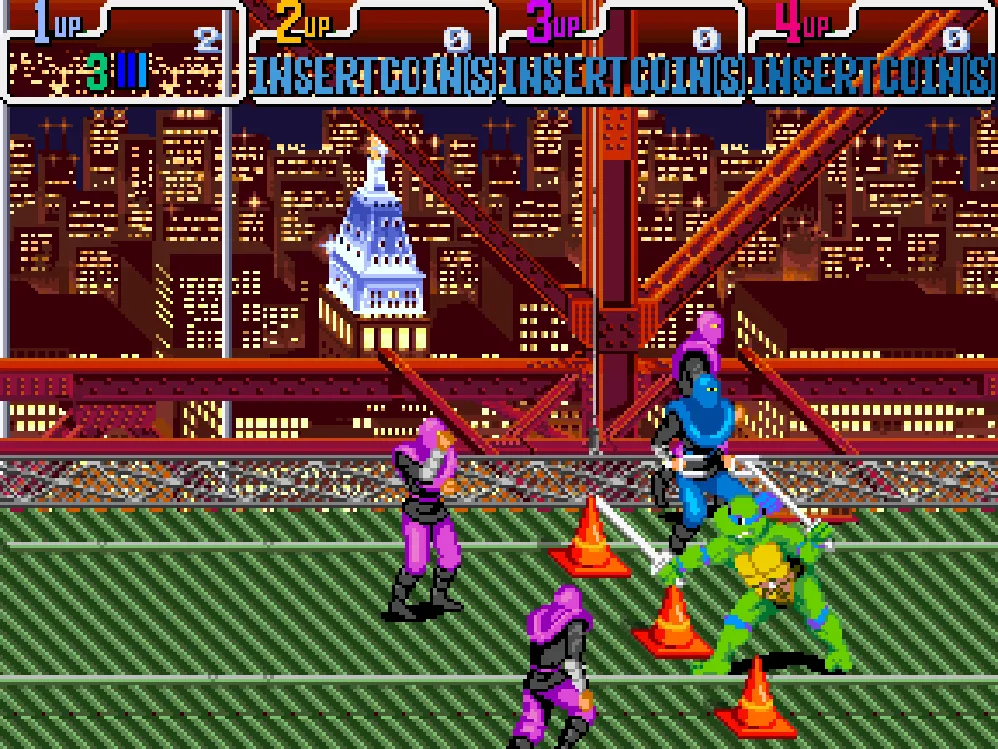
Teenage Mutant Ninja Turtles: Turtles in Time sends New York's favorite mutant turtles on an adventure through the ages. The story begins on an ordinary night while the Turtles are watching the news in the sewers. Suddenly, Shredder appears on screen, hijacking the broadcast to teleport the Statue of Liberty into a mysterious time rift. Without hesitation, the four Turtles leap into the vortex, embarking on a chase that spans millions of years.
Their journey begins in the prehistoric era, travels through 17th-century pirate ships and the 19th-century Wild West, and culminates in a high-tech city in the year 2099. In every era, Shredder deploys his Foot Clan to stop them. The game perfectly blends sci-fi time travel with the Turtles' signature humor, with each era featuring creative, detailed level designs that make the journey from the age of dinosaurs to the future feel truly unique.
1.2 Development History
Developed and published by Konami in 1991, Turtles in Time is the official sequel to the 1989 arcade hit. Konami significantly upgraded the game engine and visual fidelity, utilizing a more refined beat-'em-up system. The core concept of time travel allowed the developers to give each level a distinct visual style and enemy roster—a highly ambitious design for an arcade game at the time.
Most notably, the Super Nintendo (SNES) port, released in 1992, became a massive commercial success, selling over a million copies. While the SNES version made some compromises in graphics and on-screen enemy counts, it added exclusive content and levels while retaining the iconic "throwing enemies at the screen" mechanic. Its massive success cemented Turtles in Time as the most influential entry in the TMNT series and one of the best beat-'em-ups of the 16-bit era.
II. Character Profiles
Each Turtle has different attack speeds and ranges. Choose the one that fits your playstyle:
| Character | Weapon | Specialty |
|---|---|---|
| Leonardo | Twin Katanas | Balanced speed and range; the most well-rounded choice for beginners. |
| Michelangelo | Nunchucks | Fastest attack speed but shorter range; great for close-quarters combos. |
| Donatello | Bo Staff | Longest attack range; excellent for crowd control. |
| Raphael | Twin Sais | Highest damage output but slightly slower; perfect for heavy hits. |
All four Turtles can perform signature moves like flying kicks, slides, and throws. Each Turtle has a unique combo rhythm; Leonardo’s combos are the smoothest, while Donatello’s staff strikes can knock back enemies from multiple directions. Part of the fun is experimenting with how each Turtle performs across the game's varied stages.
III. Controls
3.1 Basic Controls
| Button | Function |
|---|---|
| D-Pad (8-way) | Move character |
| Attack | Normal attack; press repeatedly for combos |
| Jump | Jump; can be used for flying kicks |
| Attack + Jump | Special attack (consumes a small amount of health) |
3.2 Throwing Enemies at the Screen—The Signature Move
Turtles in Time's most iconic feature is the ability to throw enemies at the screen. After grabbing a Foot Soldier, hold the direction toward the screen (downward) and press the attack button. The Turtle will slam the enemy directly into the "screen," triggering a comic-book-style "POW!" effect and a shockwave. It’s visually satisfying and damages multiple enemies in the path. This "breaking the fourth wall" mechanic makes players feel like the enemies are being thrown right at them. The SNES version even features more animation frames for this move than the arcade original.
IV. Level Guide & Boss Strategy
| Level | Time/Setting | Boss | Strategy Tip |
|---|---|---|---|
| 1 | Modern NYC | Cement Man | Dodge his cement spray and close in while he reloads. |
| 2 | Prehistoric | Rocksteady | Watch out for dinosaurs; clear the minions before focusing on the boss. |
| 3 | 17th Century | Slash | Slash is fast; avoid head-on collisions. |
| 4 | Wild West | Leatherhead | Use barrels and cover to avoid gunfire. |
| 5 | Future 2099 | Tech Foot Soldiers | Keep moving on the hoverboard; don't stay near the edges. |
| 6 | Tech City | Tokka & Rahzar | Two bosses at once; focus fire on one at a time. |
| Final | Time Base | Super Shredder | High damage and range; keep your distance and use flying kicks. |
The prehistoric level is a standout: the Turtles must fight Rocksteady while dodging T-Rexes charging from the background. The future level introduces hoverboards and shifting architecture, packed with cyberpunk-inspired visuals.
V. Tips & Advanced Strategy
5.1 Survival Tips
- Use Throws Frequently: Normal attacks take time to defeat enemies, but throws can clear the screen instantly. Throwing a soldier at the screen is the most efficient way to manage crowds.
- Flying Kicks are Safe: A jumping flying kick is the safest way to initiate combat.
- Avoid Corners: Getting pinned to the edge of the screen is dangerous. Always try to stay toward the center.
- Protect Your Pizza: Pizza power-ups are your lifeline. Don't pick them up if your health is full.
- Boss Focus: During the Tokka & Rahzar fight, coordinate with your partner to focus on one boss at a time to avoid being overwhelmed.
- SNES Exclusive: The Tech City level in the SNES version is longer and more complex than the arcade version; save your health for the final boss.
VI. Trivia & Arcade Legends
6.1 The Origin of the Screen Throw
Legend has it that the "throw at the screen" mechanic was a happy accident. A programmer accidentally assigned the wrong coordinate value to a thrown enemy, causing it to fly toward the camera instead of the ground. The team loved the effect and decided to polish it, adding the comic-book visual flair. It became one of the most satisfying attack animations in gaming history.
6.2 The (Pseudo) Science of Time Travel
While the game's time travel isn't exactly scientifically accurate, the attention to detail in each era is incredible. Foot Soldiers riding dinosaurs, pirates in 17th-century gear, and robotic cows in the Wild West—these fun, anachronistic touches make the time-travel theme feel cohesive and charming.
6.3 The SNES Legacy
When the SNES version of Turtles in Time launched in Japan, it sold over 500,000 copies in its first week, eventually surpassing 2 million units worldwide. It faithfully captured the arcade experience while adding a VS mode and an exclusive level. The voice samples and music quality were superb for the SNES sound chip, especially the iconic "Big Apple, 3 AM" opening. It remains a collector's favorite today.
6.4 The Terrifying Super Shredder
Super Shredder is the final boss in both versions and remains one of the most difficult encounters in childhood gaming memories. Twice the size of a normal enemy and glowing with mutagenic energy, his attacks can drain half your health in one hit. The fight is designed to instill fear, forcing players to face a truly formidable opponent at the end of their journey.