1. Game Background
1.1 World Setting
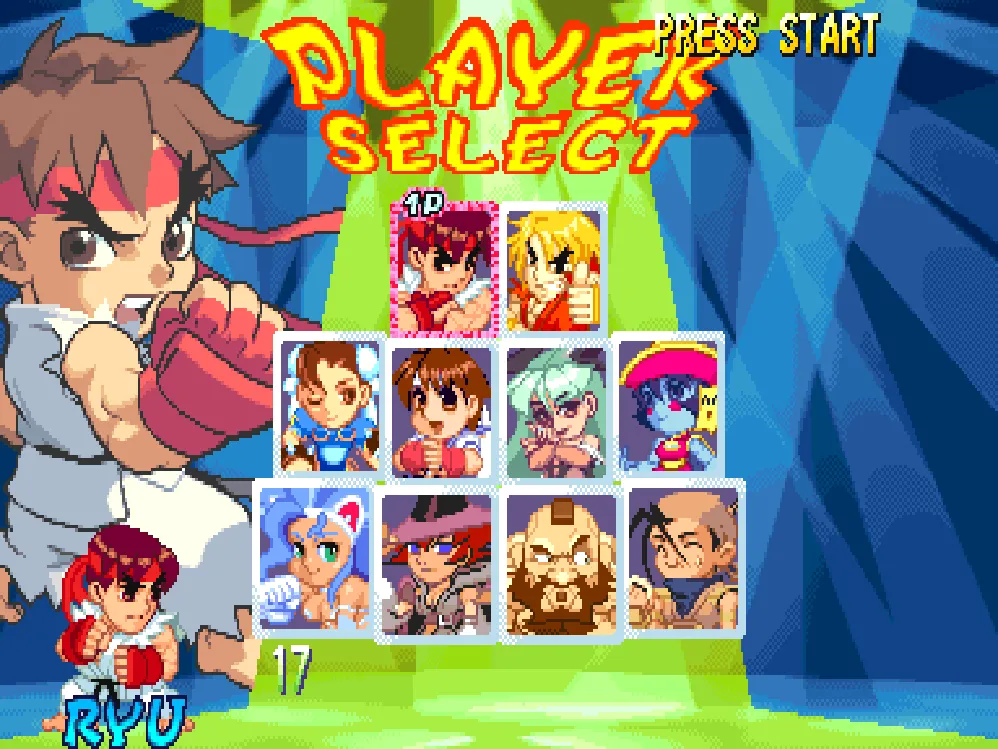
Super Gem Fighter Mini Mix (known in Japan as Pocket Fighter) is a 2D fighting game released by Capcom in 1997 for the CPS-2 arcade system. The game features all characters rendered in a cute, "super deformed" (SD) chibi style, creating a lighthearted and humorous atmosphere. The story revolves around magical gems that grant the holder's wishes—12 characters from franchises like Street Fighter, Darkstalkers, Warzard (Red Earth), and Street Fighter III embark on a journey to collect them for their own unique reasons.
Each character has a hilarious motive: Ryu wants the gems to improve his martial arts; Ken wants to use them to find a beautiful woman for afternoon tea; Chun-Li chases Felicia, mistaking the cat-woman for a rare animal escaped from the zoo; and Morrigan, jealous of Chun-Li's beauty, wants to prove she is the most charming woman of all. These whimsical settings run throughout the game, contrasting sharply with the serious tone of traditional Street Fighter titles—it's less of a "fighting game" and more of a Capcom-themed costume party.
1.2 Development History
This title originated as an experimental project after Capcom used SD character designs in Super Puzzle Fighter II Turbo. In a 2022 interview, producer Shuhei Matsumoto noted that the game was long underestimated by players and expressed his hope that re-releases would allow a new generation to discover it.
The game simplified Capcom's traditional six-button layout to four buttons and introduced the unique Gem Collection System: hitting opponents causes them to drop colored gems, which can be collected to temporarily power up special moves. This design creates a combat rhythm and strategy distinct from any other fighting game.
It debuted in arcades in September 1997 and was ported to the PlayStation and SEGA Saturn in 1998. It was included in the 2006 PS2 release Street Fighter Alpha Anthology and was re-released in 2022 as part of the Capcom Fighting Collection, which added online play.
2. Character Roster
There are 12 playable characters from four major Capcom fighting series.
2.1 Core Character Quick Stats
| Character | Origin | Attack | Speed | Difficulty | Treasure Motive |
|---|---|---|---|---|---|
| Ryu | Street Fighter | ★★★★ | ★★★ | ★ | Seek the path of martial arts |
| Ken | Street Fighter | ★★★★ | ★★★★ | ★★ | Find an elegant tea party companion |
| Chun-Li | Street Fighter | ★★★ | ★★★★★ | ★★ | Capture the "escaped animal" Felicia |
| Sakura | Street Fighter | ★★★ | ★★★★ | ★★ | Become Ryu's apprentice |
| Zangief | Street Fighter | ★★★★★ | ★★ | ★★★ | Invite Felicia to a Russian tour |
| Morrigan | Darkstalkers | ★★★★ | ★★★★ | ★★ | Prove she is the most beautiful/powerful |
| Felicia | Darkstalkers | ★★★ | ★★★★★ | ★★★ | Pursue a show business career |
| Lei-Lei | Darkstalkers | ★★★ | ★★★ | ★★★★ | Find a part-time job |
| Tessa | Red Earth | ★★★★ | ★★★ | ★★★ | Find Lei-Lei's magic staff |
| Ibuki | Street Fighter III | ★★★ | ★★★★★ | ★★★ | Find the missing Sakura |
Hidden Characters:
- Dan Hibiki: From Street Fighter Alpha, looking to recruit students for his new dojo. A comedic character with an extremely short Hadouken.
- Akuma: From Street Fighter, seeking a new place to train. A "glass cannon" character with high damage but very low health.
While each character's moveset is simplified compared to their original games, the gem-enhancement system allows for rich combo variations. Morrigan and Felicia retain signature skills like flight and transformation, while Tessa from Red Earth serves as many players' first introduction to that cult-classic series.
3. Controls and Systems
3.1 Basic Controls
The game uses a revolutionary four-button layout, distinct from Capcom's traditional six-button setup:
| Button | Function |
|---|---|
| Punch | Light/Heavy punch; press repeatedly for Flash Combos |
| Kick | Light/Heavy kick |
| Special | Special moves; combine with directions for different effects |
| Taunt | Taunting; some characters' taunts have actual gameplay effects |
General command: P+K cancels an opponent's Flash Combo follow-up; hold the Special button to charge, and release to hit the opponent, forcing them to drop a large amount of gems.
3.2 Gem Collection and Skill Enhancement
This is the core system—and what fundamentally sets this game apart from other fighters:
Gem Types: Hitting opponents causes red, blue, and yellow gems to drop. Each color corresponds to an independent three-level gauge (Lv1 to Lv3) at the bottom of the screen. Collecting gems of the same color increases the power of the corresponding special move—at max level, the range, hit count, and visual effects are significantly enhanced.
Gem Sizes: Small, medium, and large—larger sizes provide more energy. Occasionally, a rainbow-colored "Mega Gem" appears, boosting all energy levels at once.
Time Limit: Gems are temporary—you must use them quickly, or the boost will automatically disappear. You cannot hoard gems for the "perfect moment"; you must make split-second decisions.
Gem Stealing: Use the Special button combined with directional inputs to force opponents to drop their gems. The higher their energy level, the more gems they drop. If you are hit by such an attack, press Back+S to recover.
4. Game Modes and Strategy
This is a pure fighting game without a traditional story mode, utilizing a classic arcade single-elimination tournament format. The seventh match is always against a hidden character (Dan or Akuma), while others are randomly paired.
Ending Animations
Each character has a unique, hilarious ending: Ryu trips on a banana peel during his training journey; Chun-Li writes a report at the police station after failing to catch Felicia; Tessa is even turned into a penguin. These endings are lighthearted and humorous, contrasting with the serious tone of typical fighting games.
Core Strategies
- Continuous Collection: Use punch/kick combos to collect gems and spend them immediately—hoarding is a waste.
- Prioritize Blue Gems: Blue usually corresponds to a character's primary offensive special move; upgrading it significantly increases output efficiency.
- Gem Stealing: Use charged Special attacks to steal the opponent's reserves—weakening them while strengthening yourself.
- Flash Combo Starters: Follow a punch with more punches or kicks to trigger a four-hit combo, accompanied by costume-change effects. This is the most reliable way to start an attack.
5. Trivia and Arcade Legends
5.1 Flash Combo Costume Changes
One of the game's most famous features is the costume-change animation during Flash Combos. During the four-hit combo, characters transform into other Capcom icons—Chun-Li might dress as Jill from Resident Evil, while Felicia might turn into Mega Man. Ryu is the exception—he only adds different accessories. Fans call this the "Ultimate Capcom Fan Service."
5.2 Background Easter Eggs
Every stage is packed with cameos from other Capcom characters. You can see Leo from Red Earth in Tessa's stage, and many other pixel-art Easter eggs are hidden throughout the game. All are hand-drawn with exquisite detail.
5.3 A Reputation Reversal
In 1997, initial reviews were polarized—GameSpot gave it a 3.5/10, calling it "too simple," while GamePro gave it a 4.5/5. In 2011, Complex magazine ranked it as the 42nd "Best Fighting Game of All Time." The 2022 release of the Capcom Fighting Collection brought a wave of positive reviews from new players—what was once criticized as "simple" is now seen as "easy to pick up and fun."
5.4 Pachinko Crossover
When the Japanese company SANKYO developed the Fever Street Fighter II pachinko machine, they reused the SD pixel assets from this game for the five Street Fighter characters—a testament to the artistic value of these designs.