1.1 World Setting
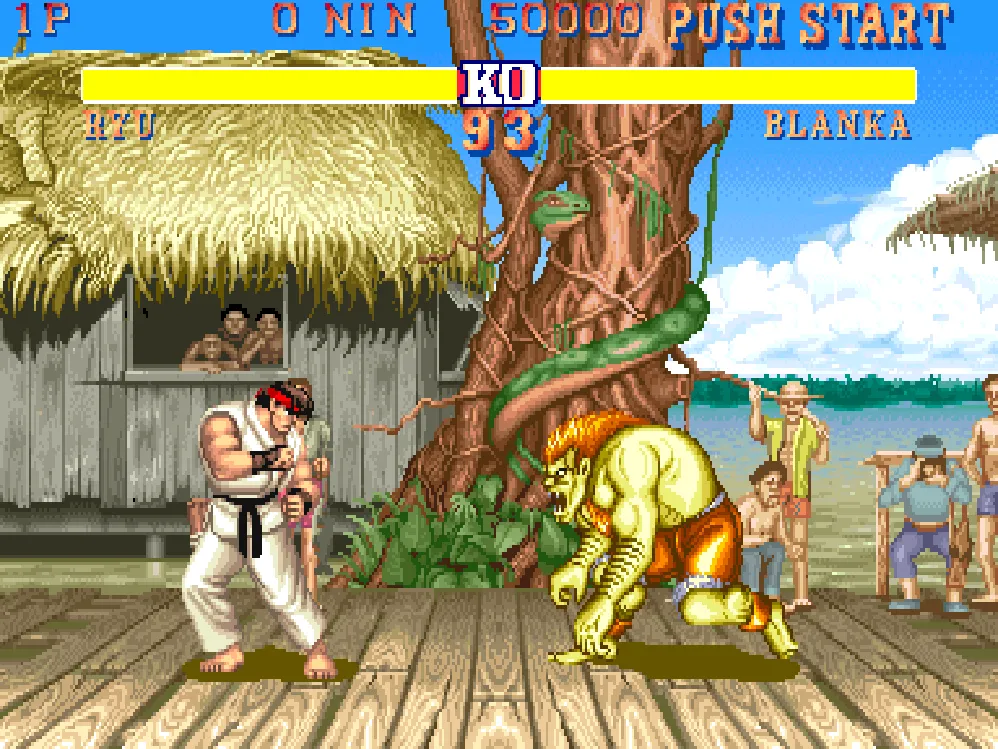
The 1991 World Warrior tournament brought together eight of the globe's top martial artists. They shared a single goal: to defeat the mysterious warlord M. Bison and claim the title of "World's Strongest." Standing between the challengers and the final boss were not only the other seven fighters, but also the three "Grand Masters" of Shadaloo: the boxer Balrog, the clawed ninja Vega, and the original Street Fighter champion, the one-eyed Muay Thai king, Sagat.
While the story of Street Fighter II: The World Warrior is straightforward, its world-building is masterful. The eight playable characters hail from eight different nations (Japan, USA, China, Brazil, India, USSR, Spain/UK, Jamaica), each rooted in authentic martial arts—from Shotokan Karate to Sumo, Chinese Kenpo to military combat, Muay Thai to Yoga. This respect for global martial arts culture is a key reason why SF2 transcended the "fighting game" genre to become a cultural phenomenon.
1.2 Development History
Street Fighter II: The World Warrior began location testing in Japanese arcades on February 6, 1991, and was officially released on March 7. The game was led by legendary Capcom producer Yoshiki Okamoto, with Akira Nishitani as director and lead planner, Akira Yasuda (pen name AKIMAN) on character design, and renowned composer Yoko Shimomura creating the iconic soundtrack. The development team consisted of about 35–40 people, took two years to complete, and had a budget of approximately $2.45 million.
Technically, the game was revolutionary. SF2 ran on Capcom's CPS1 hardware: a Motorola 68000 CPU @ 10MHz, a Z80 audio coprocessor, 384×224 resolution, and 4096 colors on screen. But the hardware alone doesn't explain its magic—the true breakthrough was in the game design. Each of the 8 playable characters possessed completely unique normal moves, special moves, hitboxes, throw ranges, and tactical styles—a level of luxury almost unimaginable in game design at the time. The CPS1 hardware's flexible memory allocation—with Ryu taking 8Mbit and Zangief taking 12Mbit—allowed each character to receive visual resources matching their complexity.
Commercial success started from a humble beginning: SF2 wasn't an instant hit in Japan, as early arcade players were accustomed to playing solo and ignored the versus mode. It wasn't until the authoritative Japanese arcade magazine Gamest detailed the depth and fun of the "versus gameplay" that the wave of coin-op queues swept across the country. Ultimately, the entire SF2 series sold over 200,000 arcade boards worldwide, with home console versions selling over 15 million copies, generating over $10 billion in total revenue—making it one of the three highest-grossing titles in gaming history. The SNES version alone sold over 6.3 million copies, holding the Capcom single-software sales record for two decades.
II. Character Profiles
The World Warrior roster features 8 playable characters and 4 CPU-exclusive bosses. This is the "primal form" of the SF2 roster—all subsequent versions expanded upon this foundation.
2.1 Ryu — The Eternal Wanderer
| Attribute | Rating |
|---|---|
| Attack | ★★★★ |
| Speed | ★★★ |
| Defense/HP | ★★★ |
| Difficulty | ★★ |
- Style: Ansatsuken (Shotokan Karate)
- Strengths: Strong zoning with Hadouken, invincible anti-air Shoryuken, and Tatsumaki Senpukyaku to bypass projectiles. A perfectly balanced design, serving as the ultimate template for the "standard protagonist" in fighting games.
- Weaknesses: No extreme advantages; moves have high recovery in WW.
- Verdict: A versatile character suitable for both beginners and top-tier competitive play. Recommendation: ★★★★★
2.2 Ken — The Raging Master of the Fist
- Style: Ansatsuken (Ryu's training partner)
- Strengths: Shoryuken has multi-hit flame properties for higher damage; greater throw range. More aggressive than Ryu.
- Weaknesses: Hadouken startup is slightly slower than Ryu's.
- Verdict: The top choice for players who crave offensive pressure. Recommendation: ★★★★★
2.3 Chun-Li — The Strongest Woman in the World
| Attribute | Rating |
|---|---|
| Attack | ★★★ |
| Speed | ★★★★★ |
| Defense/HP | ★★ |
| Difficulty | ★★★ |
- Style: Chinese Martial Arts
- Strengths: Top-tier pressure with Hyakuretsukyaku (Lightning Legs), fastest movement speed, and highest vertical jump.
- Weaknesses: Low HP, lacks an invincible anti-air special move.
- Verdict: The pinnacle of speed-based pressure. Recommendation: ★★★★
2.4 Guile — The Unyielding Soldier
- Style: Military Combat
- Strengths: The Sonic Boom + Flash Kick defensive system is near-perfect—zoning from afar with projectiles while covering the air with the Flash Kick. The pioneer and definitive master of charge-based characters.
- Weaknesses: Charge moves require anticipation; lacks proactive offensive tools.
- Verdict: The master of defensive counter-play. Recommendation: ★★★★
2.5 Blanka — The Wild Beast of the Jungle
- Style: Feral Combat (Capcom original)
- Strengths: Massive hitbox on electricity; rolling attacks are fast and unpredictable. A "beginner killer."
- Weaknesses: Moves are easily predicted at high levels; rolling attacks have massive recovery if blocked.
- Verdict: A powerful weapon for newcomers. Recommendation: ★★★
2.6 Zangief — The Red Cyclone
| Attribute | Rating |
|---|---|
| Attack | ★★★★★ |
| Speed | ★ |
| Defense/HP | ★★★★★ |
| Difficulty | ★★★★★ |
- Style: Professional Wrestling
- Strengths: The Spinning Piledriver is the highest-damage single throw in WW, with spectacular visual impact. Highest HP in the game.
- Weaknesses: Slowest movement, no projectiles, must fight at close range. The 360-degree joystick input is brutal on arcade sticks.
- Verdict: The ultimate weapon for experts—once you master the art of closing the distance, you become a human tank. Recommendation: ★★★
2.7 E. Honda — The Pride of Sumo
- Style: Sumo
- Strengths: Terrifying close-range pressure with the Hundred Hand Slap; the Sumo Headbutt can bypass projectiles to close the gap. High HP.
- Weaknesses: Slow movement; almost helpless when zoned out from a distance.
- Verdict: A favorite for power-oriented players. Recommendation: ★★★
2.8 Dhalsim — The Yoga Flame
- Style: Yoga Combat
- Strengths: Unrivaled long-range zoning with Yoga Fire; limbs that stretch make it extremely difficult for opponents to get close. The most subversive character design in SF2.
- Weaknesses: Lowest HP; extremely vulnerable once cornered. His sliding movement is fast but operates on a completely different logic than other characters.
- Verdict: Highly unconventional—requires a completely different mindset to master. Recommendation: ★★
The Four Grand Masters (CPU Exclusive)
In WW, these four characters are CPU-controlled only and cannot be selected by players—a restriction not lifted until the 1992 Champion Edition:
- Balrog (Boxer): A pure power-based boxer. His Dash Straight is devastating, but he lacks kicks.
- Vega (Claw): An aerial assassin with a metal claw and vanity mask. Can climb walls and launch surprise attacks from above.
- Sagat (King): The final boss of the original SF, bearing a massive scar from Ryu's Shoryuken. His Tiger Shots provide immense zoning pressure.
- M. Bison (Dictator): The supreme ruler of Shadaloo, an evil warlord who wields "Psycho Power." The mastermind behind the entire tournament.
III. Controls and Gameplay
3.1 Basic Controls
SF2's six-button, two-row layout is one of the most influential control designs in video game history and remains the foundation for all 2D fighting games:
| Button | Attack Type | Description |
|---|---|---|
| Jab | Punch (Light) | Fastest startup, lowest damage, best for interrupting opponents |
| Strong | Punch (Medium) | Balanced speed and damage, core for combos |
| Fierce | Punch (Heavy) | Slowest but highest single-hit damage |
| Short | Kick (Light) | Fastest kick, often used to start combos |
| Forward | Kick (Medium) | Excellent for mid-range zoning |
| Roundhouse | Kick (Heavy) | High damage, long recovery, high risk/high reward |
8-way Joystick: ← → for walking and blocking, ↖↗↙↘ for jumping, ↓ then ↑ for charge-based specials. Forward + Medium Punch/Kick for throws.
3.2 Move List
| Special Move | Input | Character | Description |
|---|---|---|---|
| Hadouken | ↓↘→ + P | Ryu, Ken | Projectile |
| Shoryuken | →↓↘ + P | Ryu, Ken | Invincible anti-air |
| Tatsumaki | ↓↙← + K | Ryu, Ken | Spinning kick (can be used in air) |
| Sonic Boom | ←(charge)→ + P | Guile | Projectile (charge) |
| Flash Kick | ↓(charge)↑ + K | Guile | Anti-air kick (charge) |
| Lightning Legs | K (mash) | Chun-Li | Multi-hit kicks |
| Kikoken | ←(charge)→ + P | Chun-Li | Projectile |
| Electricity | P (mash) | Blanka | Electric discharge |
| Rolling Attack | ←(charge)→ + P | Blanka | Horizontal roll |
| Piledriver | 360° + P | Zangief | 360° command throw |
| Hand Slap | P (mash) | E.Honda | Multi-hit slaps |
| Headbutt | ←(charge)→ + P | E.Honda | Horizontal charge |
| Yoga Fire | ↓↘→ + P | Dhalsim | Projectile |
| Yoga Flame | ←↙↓↘→ + P | Dhalsim | Close-range fire |
3.3 The Combo System — A Bug That Changed Gaming History
The cornerstone of modern fighting games—the "Combo"—was not in the design document; it was an accidental bug. Capcom combat designer Noritaka Funamizu noticed while testing the car-smashing bonus stage: "It's possible to land a second hit while the opponent is in a hit-stun animation, and a third..." The team decided to keep this accidental discovery as a "hidden feature" rather than fixing it.
Just like that, starting from a single programming bug in SF2, the combo system eventually reshaped the design language of the entire video game industry.
IV. Progression and Boss Strategy
As a fighting game, the "levels" in WW are 1v1 matches against each character. The single-player mode has a fixed flow: fight the 7 other characters in a semi-random order, then challenge the Four Grand Masters.
4.1 Opponent Strategies
| Opponent | Nationality/Stage | AI Traits & Counter |
|---|---|---|
| Ryu | Japan | Prefers mid-range Hadoukens — jump over and punish with Shoryuken |
| Ken | USA | More aggressive than Ryu, frequent Tatsumaki approaches |
| Chun-Li | China | Extremely fast; her Lightning Legs have a huge recovery window if blocked |
| Guile | USA | Ultimate defensive AI — use safe jumps and throws to break his turtle |
| Honda | Japan | Massive recovery after a blocked Hundred Hand Slap |
| Blanka | Brazil | Fixed rolling attack path — block and punish |
| Zangief | USSR | Never let him get close — keep distance with constant Hadoukens |
| Dhalsim | India | Close the distance quickly; watch out for his long-range anti-air pokes |
| Balrog | USA | Dash paths are linear and predictable |
| Vega | Spain | Wall-climb landing spots are fixed — stand ready and punish |
| Sagat | Thailand | Tiger Shot rhythm is fixed — jump over and counter |
| M. Bison | Thailand | Head Press has a brief recovery window upon landing |
4.2 WW AI Characteristics
By today's standards, the AI in WW is quite primitive—it is purely state-machine driven and lacks the notorious "input reading" found in later versions like Champion Edition. This means CPU opponents do not "predict" your inputs but act according to fixed patterns. In fact, once you learn the AI's behavior, the single-player mode is easier than in later versions. However, this makes WW the most "fair" entry in the series—the CPU's reaction speed does not exceed human physiological limits.
V. Tips and Advanced Strategy
5.1 Basic Survival Tips
- Master the "Fireball/Dragon Punch" (Zoning) — Ryu and Ken's Hadouken + Shoryuken combo is the most fundamental offense/defense system in WW. Hadouken forces the opponent to jump; Shoryuken waits for them in the air.
- Throws are Underrated — Throws in WW deal high damage and cannot be blocked, making them the only way to break through a defensive turtle.
- Control the Distance — There is no "special move cancel" mechanic in WW; every move has uncancelable recovery frames. Distance management is more important than button-mashing speed.
- Vertical Jumps are Safe — Vertical jumps in WW are faster than diagonal jumps and allow you to change direction before landing.
- Utilize the "Stun" System — Taking consecutive hits builds up a hidden stun meter. Once it hits the threshold, the character is incapacitated for 2-3 seconds. This is the only window to land maximum damage.
5.2 Versus Play — The True Core of SF2
SF2 wasn't an instant hit in Japan because early players were used to solo play and ignored the versus mode. It wasn't until Gamest magazine detailed the depth of the "versus gameplay" that the queues appeared. The fun of SF2 lies in its perfect Rock-Paper-Scissors system: Blocking beats Attacks → Throws beat Blocking → Attacks beat Throws. No single strategy is invincible—once two players understand this cycle, the match becomes a pure psychological battle.
5.3 Boss Fight Rules
- Among the Four Grand Masters, Balrog is the easiest—keep your distance and punish his dash.
- Vega's wall-climb looks scary, but his landing spot is fixed—stand in the right spot and wait for him.
- Sagat's Tiger Shots are frequent but have a fixed rhythm—once you learn the jump timing, he is easier than Guile.
- M. Bison's Head Press and Psycho Crusher have massive hitboxes—it's better to block and wait for the recovery window than to risk a counter-attack.
5.4 Advanced Trivia
- Guile's "Sonic Boom infinite" exists but is extremely difficult—it requires frame-perfect charge timing and is almost impossible in real matches.
- Throw ranges and priorities vary by character—Zangief has the largest throw range.
- There is no "teching" or "quick rise" in WW—once knocked down, you must wait for the natural wake-up animation.
- Ryu and Ken's Shoryuken performance is nearly identical in WW—the real differences were only amplified in CE.
VI. Legends and Arcade Lore
6.1 The Birth of the Combo System
When Noritaka Funamizu accidentally discovered that multiple hits could land consecutively in the car bonus stage, he didn't see it as a bug to be fixed, but as a new gameplay possibility. The team decided to keep this "accidental feature"—they likely didn't realize that this decision would change the course of the entire industry. From the car stage in SF2, the combo system expanded to almost every action game, from Mortal Kombat to Devil May Cry, Bayonetta, and the Batman: Arkham series.
6.2 Name Swapping — A Localization Classic
Capcom's Japanese team named the boxer M. Bison—"M" for Mike, and "Bison" (pronounced "Baison" in Japanese) as a nod to Mike Tyson. Capcom USA, fearing legal action from Tyson, decided to rotate the names: the Japanese M. Bison became Balrog, the Japanese Balrog became Vega, and the Japanese Vega became M. Bison. This created a lasting divide in the community, with players using different names depending on their region.
6.3 The "Sheng Long" Hoax
In April 1992, Electronic Gaming Monthly published an April Fools' guide on "How to unlock the hidden character Sheng Long," claiming that if Ryu and Ken fought to a draw 10 times without taking damage, a master named Sheng Long would appear. The article was so convincing that countless players wasted coins trying this impossible method. Capcom eventually responded to this famous joke by adding the hidden character "Gouki" (Akuma) in 1994's Super Street Fighter II Turbo.
6.4 Arcade Culture
SF2's success in Japan wasn't just about the game; it was about the social space it created. The "queue culture"—crowds watching, coins placed on the machine to signal "next game," and the "loser leaves" rule—became a global phenomenon. Iconic arcades like Sunnyvale Golfland in the US, Hey in Akihabara, and Trocadero in London became meccas for fighting game players because of SF2.
6.5 The Unsung Heroes — Cut Fighters
Two characters were cut during development: a Spanish bullfighter (which influenced Vega) and an American amateur wrestler. The bullfighter was merged into the Vega concept, and the wrestler was dropped because Zangief's pro-wrestler identity was already unique enough. These designs only exist in AKIMAN's private sketchbooks.
6.6 The Soundtrack
Yoko Shimomura's soundtrack is a milestone in video game music. Each character has a theme that captures their nationality—Chun-Li's Chinese melodies, Zangief's Soviet march style, Blanka's Brazilian jungle drums, and Dhalsim's Indian sitar scales. Isao Abe also composed iconic tracks like Sagat's theme and the "New Challenger" screen, which remains one of the most recognizable sounds in arcade history.
6.7 25 Million Players
According to a 1994 industry survey, SF2 had reached an astonishing level of penetration in the US—an estimated 25 million Americans had played it at least once. With a population of 260 million at the time, nearly 10% of the country had experienced the game, a figure higher than the viewership of any Hollywood blockbuster that year.