I. Game Background
1.1 Story Setting
The story is set within the Marvel Universe. Spider-Man's arch-nemesis, Kingpin—the crime lord of New York's underworld—has acquired a mysterious magical artifact known as the "Sorcerer Stone." This ancient relic possesses immense power; if it falls into the wrong hands, it could mean the destruction of New York City.
Spider-Man, your friendly neighborhood superhero, learns of Kingpin's plan and springs into action. However, he soon discovers that he is up against more than just the Kingpin. Doctor Doom, the dictator of Latveria and a genius in both magic and technology, also covets the power of the Sorcerer Stone. Doom has tracked down Venom—the alien symbiote with a deep-seated hatred for Spider-Man—and used the power of the Sorcerer Stone to enhance Venom's abilities, aiming to wipe Spider-Man out for good.
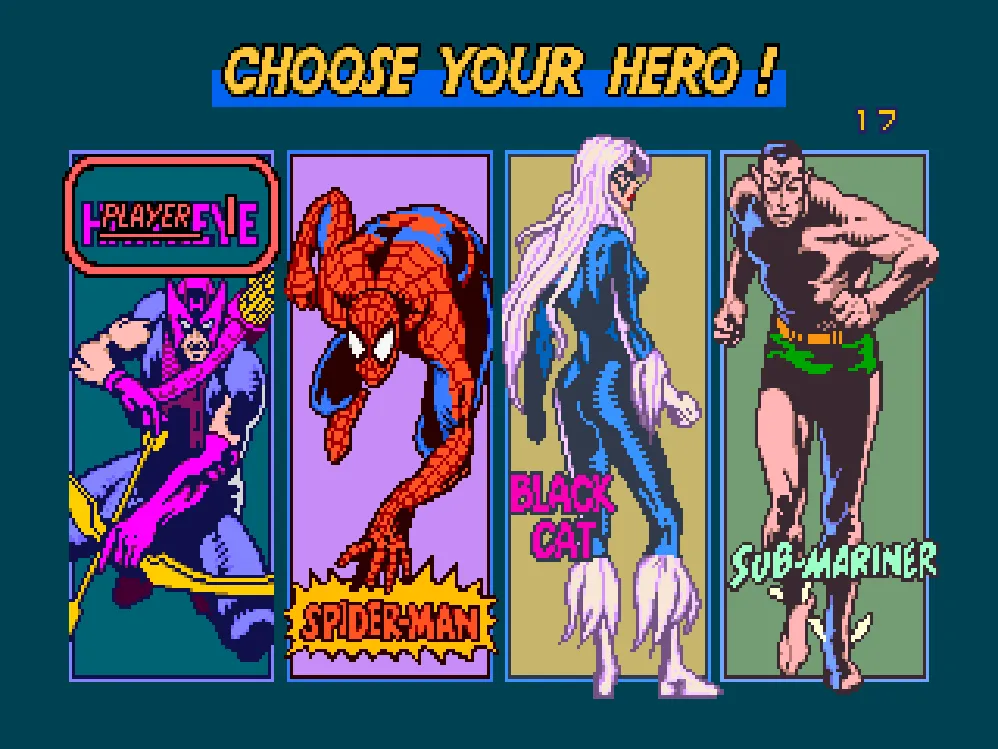
Facing such a powerful alliance, Spider-Man knows he cannot win alone. He recruits three of his most trusted allies: Black Cat, a master thief with incredible agility and feline instincts; Sub-Mariner, the King of Atlantis, possessing superhuman strength and aquatic powers; and Hawkeye, the Avengers' ace archer. The four heroes set out from the streets of New York, tracking Kingpin and Doctor Doom across the Atlantic to Doom's fortress in Europe.
1.2 Development History
Spider-Man: The Video Game was released by Sega in September 1991, utilizing the Sega System 32 arcade board. It is a classic developed by Sega's AM1 team, designed by Roppyaku Tsurumi, with a soundtrack composed by Kazuhiko Nagai.
The game's most notable selling point is its support for up to 4-player simultaneous co-op—an extremely rare feature for a 1991 beat-'em-up. At the time, most beat-'em-ups only supported 2 players (like Captain Commando or Warriors of Fate) or 3 players (like Teenage Mutant Ninja Turtles). This title allowed four players to join the fun on a single cabinet. Even more impressive is that each of the four characters features unique attack styles and move sets—Spider-Man's web shots, Black Cat's claws, Sub-Mariner's hydro-electric shocks, and Hawkeye's archery—providing four distinct combat systems in one game.
The Sega System 32 board holds a unique place in Sega's hardware history; it was the final board in the System series before Sega shifted entirely to the Model series' 3D rendering technology. System 32's pride and joy was the Sega Super Scaler chipset, which could scale large numbers of 2D sprites in real-time. In Spider-Man: The Video Game, this technology is used perfectly: when the game transitions from side-scrolling beat-'em-up mode to platforming mode, the camera "zooms out" (shrinking characters to show the full view) and then "zooms in" (restoring characters to large size for combat)—a dynamic effect that left countless players in 1991 arcade halls stunned.
II. Character Profiles
Spider-Man (Peter Parker)
| Attribute | Rating |
|---|---|
| Strength | ★★★★☆ |
| Speed | ★★★★★ |
| Skills | Web Swing, Web Shot, Spider-Sense |
| Difficulty | ★★☆☆☆ |
- Background: Peter Parker, a high school student who gained extraordinary powers after being bitten by a radioactive spider. His abilities include spider-strength, wall-crawling, web-shooting, and a "Spider-Sense" that warns him of danger.
- Normal Attack: Rapid and versatile punch-and-kick combos.
- Special Move (Consumes HP): Fires a powerful web shot for area-of-effect damage, or leaps into the air to stomp on enemies.
- Trait: The smoothest character to control—he offers the best overall balance of jump height and movement speed among the four.
Black Cat (Felicia Hardy)
| Attribute | Rating |
|---|---|
| Strength | ★★★☆☆ |
| Speed | ★★★★★ |
| Skills | Claw Attack, Grappling Hook, Super Agility |
| Difficulty | ★★★☆☆ |
- Background: Felicia Hardy, who inherited her father's "Cat" identity. She has no true superpowers but has achieved superhuman agility and balance through rigorous training.
- Normal Attack: Claw slashes—faster attack speed than Spider-Man's, though individual hits deal less damage.
- Special Move (Consumes HP): Uses a grappling hook to leap to the top of the screen for a full-screen attack, or unleashes a claw storm in front of her.
- Trait: The fastest attacker. When facing large groups of fast-moving enemies, Black Cat's rapid combos can knock them all down before they can react.
Sub-Mariner (Namor)
| Attribute | Rating |
|---|---|
| Strength | ★★★★★ |
| Speed | ★★★☆☆ |
| Skills | Hydro-Electric Blast, Flight, Super Strength |
| Difficulty | ★★★☆☆ |
- Background: Namor, the King of Atlantis. A hybrid of human and mutant, he possesses the ability to move freely on land and underwater, with strength far exceeding that of a normal human.
- Normal Attack: Giant punches infused with underwater power—the highest single-hit damage of the four characters.
- Special Move (Consumes HP): Releases a Hydro-Electric Blast—a shockwave of high-pressure water mixed with electrical energy from his hands.
- Trait: The strongest but slowest character. Perfect for players who prefer a "one-punch-per-enemy" brawler style.
Hawkeye (Clint Barton)
| Attribute | Rating |
|---|---|
| Strength | ★★★☆☆ |
| Speed | ★★★★☆ |
| Skills | Archery, Trick Arrows |
| Difficulty | ★★★★☆ |
- Background: Clint Barton, the genius archer of the Avengers. While he has no superpowers, his breathtaking marksmanship has earned him a place in the world of superheroes.
- Normal Attack: Ranged archery—the only ranged attacker among the four. Shooting enemies from a safe distance is Hawkeye's core tactic.
- Special Move (Consumes HP): Fires special arrows—explosive or multi-shot—covering a wide area.
- Trait: The most unique playstyle. Hawkeye's ranged advantage is highly efficient for "kiting" enemies, though his melee defense is weak if he gets surrounded.
III. Controls
3.1 Basic Controls
| Input | Action |
|---|---|
| 8-Way Joystick | Movement |
| Attack (A) | Normal Attack—Each character has unique animations and hit detection |
| Jump (B) | Jump—Used to clear terrain obstacles in platforming sections |
| Attack + Jump | Special Move—Consumes HP to unleash a powerful character-specific attack |
3.2 Dynamic Camera System
One of the most impressive technical features of Spider-Man: The Video Game is its dynamic camera system. The game switches freely between two perspectives:
- Beat-'em-up Mode: Standard side-view, with characters displayed at normal scale for close-quarters combat.
- Platforming Mode: The camera zooms out, shrinking characters to a mini-size for a long-distance view—players must cross platforms, avoid traps, and reach the exit.
- Camera Transition: When characters return from a platforming section to a combat zone, the camera zooms back in, restoring the characters to their full size.
This "beat-'em-up + platforming" dual-mode design was a very avant-garde attempt for a 1991 game, allowing for much richer level design possibilities.
3.3 HP and Special Move System
- Each character has an independent HP bar.
- Special moves consume HP (rather than magic or energy bars).
- The lower your HP, the riskier it is to use special moves—meaning they are a "last resort" rather than a primary weapon.
- Defeated enemies drop health items; managing these items is key to clearing the game.
IV. Level Flow and Boss Guide
The game consists of 4 acts and 16 levels. Here are the main stages and boss encounters:
Act I: New York Streets
Setting: Spider-Man swings through the skyscrapers of NYC, tracking Kingpin's criminal network.
Key Levels:
- New York Dock Warehouses—A smuggling hub for the Kingpin's gang.
- Subway Tunnels—Fighting Kingpin's henchmen in the dark underground.
- Kingpin's Headquarters—Fighting from the ground floor all the way to the top-floor office.
| BOSS | Description | Strategy |
|---|---|---|
| Kingpin | A massive, obese, yet agile crime lord with high attack power. | Kingpin's attack speed is faster than his size suggests. Use ranged attacks (Hawkeye's arrows, Spider-Man's webs) to chip away at his health from a safe distance; do not engage in close combat. |
Act II: Venom's Nest
Setting: After defeating Kingpin, Spider-Man discovers that Venom and Doctor Doom are the true masterminds. Doom has used the Sorcerer Stone to enhance Venom's power.
Key Levels:
- Abandoned Chemical Plant—Venom's lair, littered with black symbiote fragments.
- Industrial Zone—Navigating automated machinery and swarms of symbiote monsters.
| BOSS | Description | Strategy |
|---|---|---|
| Venom | Spider-Man's dark mirror—possessing spider-powers but far more brutal. Eddie Brock's symbiote is infused with the Sorcerer Stone's power. | Venom is as fast as Spider-Man and has a longer reach with his tendrils. Hawkeye is recommended—ranged arrows can safely suppress Venom and keep him from grabbing you with his tendrils. |
Act III: The Laboratory
Setting: Tracking Doctor Doom's route through Europe, the heroes encounter various supervillains and experimental monsters. This facility is Doom's research base.
Key Levels:
- Doctor Octopus's Lab—Traps created by reality-warping experimental equipment.
- Electro's Generator Room—A high-voltage electric field environment.
- Underground Passages—The Lizard's sewer hunting ground.
Boss Lineup:
| BOSS | Description | Strategy |
|---|---|---|
| Doctor Octopus | A genius scientist with four mechanical tentacles. | Each tentacle can attack independently. Destroy the tentacles first—without them, Doc Ock is just an old man. |
| Electro | Max Dillon, who can manipulate electrical energy. | Electro's attacks are primarily scattered lightning. Moving horizontally is more effective than jumping—the vertical hit detection of the lightning is larger than the horizontal. |
| Lizard | Dr. Connors' reptilian genetic mutant form. | Lizard crawls on walls and attacks from unexpected angles. Don't give him too much space to maneuver. |
Act IV: Doctor Doom's Castle
Setting: The heroes finally track Doom to his fortress in Europe. They must cross defensive barriers, traps, and experimental creatures to face him.
Key Levels:
- The Castle Gate guarded by Scorpion.
- The Training Grounds guarded by Sandman.
- The Towers patrolled by Green Goblin and Hobgoblin.
Boss Lineup:
| BOSS | Description | Strategy |
|---|---|---|
| Scorpion | A mad warrior with a mechanical scorpion tail. | The tail's piercing attack has a massive hitbox and deals high damage. Stay above or behind him—the area directly in front of the tail is the most dangerous. |
| Sandman | Flint Marko—an elemental enemy who can turn his body into sand. | Sandman scatters into sand when hit and reforms elsewhere. Don't chase him—wait for him to reform into his full shape before attacking. |
| Green Goblin / Hobgoblin | Norman Osborn/Hobgoblin riding a glider and throwing pumpkin bombs. | Their pumpkin bombs create burning zones on the ground. Don't stay in one spot for more than 2 seconds. |
| Doctor Doom | Final Boss—The dictator of Latveria, the pinnacle of magic and technology. | Doom has multiple attack methods: energy blasts, summoning shields, and teleportation. The biggest challenge is his shield, which periodically blocks attacks. Use everyone's special moves in rapid succession the moment the shield drops. |
V. Tips and Advanced Strategy
5.1 Basic Survival Tips
- HP Management: Special moves consume HP—this is the game's biggest double-edged sword. Save HP before boss fights; don't waste it clearing minor enemies.
- 4-Player Co-op—Strength in Numbers, Weakness in Visibility: The screen gets crowded in 4-player mode. Teammates' sprites may block your view, making it hard to see enemy attack cues. Keep good spacing—don't crowd the same side of the screen.
- Strategic Value of Ranged Characters: Hawkeye is the most unique of the four. His ranged attacks allow him to output damage from a safe distance while teammates distract enemies. In 4-player co-op, Hawkeye should always stay in the back.
- Patience in Platforming: When the camera zooms out, character collision boxes also shrink. Don't panic during platforming sections—observe the gaps carefully; rhythm is more important than speed.
5.2 Character Selection Advice
| Scenario | Recommended Character |
|---|---|
| Solo Play | Spider-Man—Most balanced and easiest to pick up |
| 2-Player | Spider-Man + Black Cat—Speed and agility combo |
| 3-Player | Spider-Man + Sub-Mariner + Hawkeye—Damage + Crowd Control + Ranged |
| 4-Player | All characters—Each covers a specific tactical role |
5.3 General Boss Rules
- Almost every boss has "recovery frames" after an attack—observe their patterns, don't trade hits, and attack during the recovery window.
- High-risk, high-reward special moves: One special move deals damage equal to 3-4 normal attacks, but the HP cost might kill you in the next hit—use special moves to finish off a boss when they have 1/5 HP left.
- Teamwork: Two players draw fire, while the other two attack from behind. Don't have all four players stand in the same direction—the boss's sweep attacks will damage everyone at once.
5.4 Advanced Knowledge
- Spider-Man's Web Swing: In some levels, the web swing isn't just for movement—it can also serve as an attack under certain conditions.
- Sub-Mariner's Hydro-Electric "Cheat": His special move not only deals high damage but also has brief invincibility frames—you can use it to "tank" through a boss's lethal attack.
- Hawkeye's Stealth Advantage: His ranged attacks have a hidden advantage in some platforming sections—he can clear enemies in the next area from a safe distance.
VI. Trivia and Arcade Legends
6.1 4-Player Co-op—The 1991 Super Party Game
In 1991, arcade games supporting 4 players were rare. Aside from Spider-Man: The Video Game, only a few titles like Capcom's Captain Commando (also 4 players) and Konami's X-Men (6 players) existed. Sega's decision to include 4-player co-op wasn't just a "tech demo"—it was a "business strategy." In arcades, 4 players dropping coins simultaneously meant double the revenue of a 2-player game. The sight of four players fighting side-by-side at a Spider-Man cabinet became one of the most iconic scenes in 1991 arcades.
6.2 The Mystery of Namor and Hawkeye
Why are Namor and Hawkeye in a Spider-Man game? This has puzzled Marvel fans for over 30 years. The most logical explanation: when Sega obtained the Marvel license, they applied for a "Marvel Universe Character Pack" rather than a "Spider-Man solo license." Marvel's licensing strategy in the early 90s was relatively loose—as long as it didn't involve core events or storylines, characters could be rented in bundles. Thus, Hawkeye and Namor—two characters who weren't A-listers at the time but were recognizable enough—became beneficiaries of Sega's "bundled license."
6.3 The Tragic Fate of No Ports
As a high-quality beat-'em-up, the fate of Spider-Man: The Video Game is heartbreaking—it was never ported to any home console. For nearly two decades, from 1992 to 2010, the game could only be played on original arcade cabinets. As arcades closed one by one, physical copies were lost. Today, finding a working Spider-Man cabinet is a luxury. The only way to play is via the MAME emulator—the ROMsets are named "spidey" (US) and "spideyj" (Japan).
6.4 System 32's Super Scaler
Sega's System 32 board and its Super Scaler chipset were the technical foundation for the game's dynamic camera. This chipset could scale 2D sprites in real-time at any ratio while maintaining a smooth 60 FPS. Sega had previously showcased similar scaling in Super Hang-On and Space Harrier, but in Spider-Man, it was used to "seamlessly switch between beat-'em-up and platforming modes" rather than to create "fake 3D terrain"—a creative application of scaling technology.
6.5 Spider-Man's Philosophy of Sound
In 1991, voice acting for game characters was still a luxury. Spider-Man: The Video Game did not use voice—all plot was delivered via text boxes at the bottom of the screen and cutscenes. Spider-Man's "onomatopoeia"—"THWIP" (the sound of web-shooting)—appeared on screen as text. This "textualized sound effect" approach was criticized by some media as "too sparse," but for the Sega development team, prioritizing gameplay over voice acting was the right choice.
6.6 Venom's Sorcerer Stone
The plot point of Doctor Doom using the "Sorcerer Stone" to enhance Venom was an original story created by the Sega team—it never appeared in any Marvel comic storyline. Sega's reason for this in 1991 was practical: they needed a logical explanation for "why the final boss is Doctor Doom and not Venom" and "why Venom is stronger than in the comics." This strategy of "original story expansion based on licensed IP" was quite common in 90s licensed game development.
6.7 "Games Most Likely To Save The Universe" Award
In its November 1991 review, the UK magazine Sinclair User awarded Spider-Man: The Video Game, along with Captain America and the Avengers (Data East) and Captain Commando (Capcom), the "Games Most Likely To Save The Universe" award. While the name is hyperbolic, the joint recognition of these three highly similar 4-player co-op games confirms that 1991 was indeed the golden age of 4-player beat-'em-ups.
6.8 The Regret of No Sequel
Spider-Man: The Video Game never received a sequel. This wasn't because it sold poorly—in fact, it performed excellently in Western arcades. The real reason was that Sega shifted entirely to 3D arcade games after 1992. When Sega released another Spider-Man game in the late 90s (the 1999 Spider-Man: The Arcade Game on Sega NAOMI—actually made by another company), the original four heroes never reunited in the arcades again.