I. Game Background
1.1 World Setting
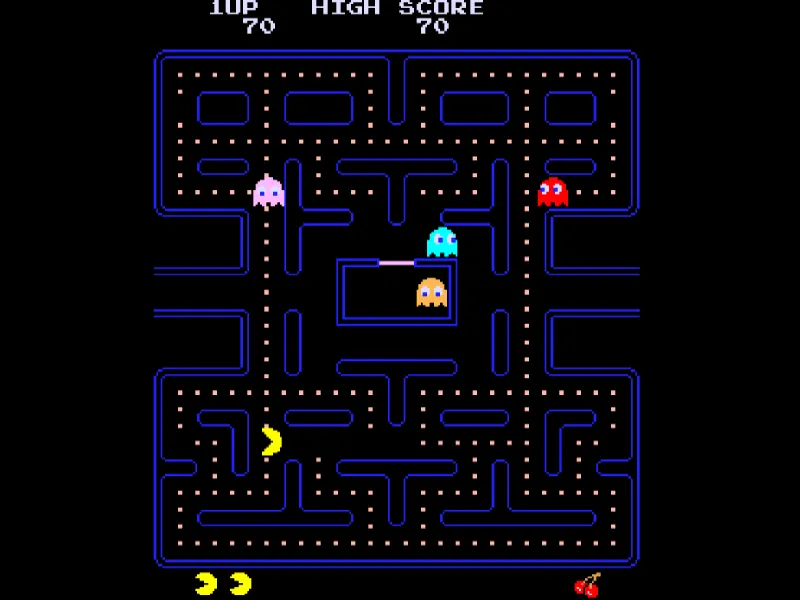
Inside a maze enclosed by blue walls, a yellow, circular creature tirelessly devours white dots. Its world is simple: eat all the dots in the maze to advance to the next level. However, four ghostly enemies—Blinky, Pinky, Inky, and Clyde—roam the maze, attempting to capture this gluttonous yellow hero. Four large "Power Pellets" are scattered in the corners of the maze; consuming one instantly turns the tide, causing the ghosts to turn deep blue and flee in panic, while Pac-Man gains the temporary ability to counter-attack.
There is no complex plot, no damsel-in-distress narrative—Pac-Man created a miniature universe that captivated the world with minimalist design. The core "eat or be eaten" loop, combined with ghost AI that gives each enemy a unique personality, gives this seemingly simple maze infinite replayability.
1.2 Development History
On May 22, 1980, the Japanese game company Namco first installed an arcade cabinet called "Puck-Man" in a Shibuya, Tokyo arcade. Developed under the guidance of 25-year-old designer Toru Iwatani, the game's initial concept was simple yet revolutionary: to create a non-violent game.
In 1979, Japanese arcades were dominated by shooters like Space Invaders, and the clientele was almost exclusively young men. Iwatani believed that bringing women and couples into arcades was the key to industry growth. His entry point was equally simple: "women like to eat sweets." Thus, the concept of a game centered around "eating" was born.
As for the origin of Pac-Man's classic shape, the most popular legend involves pizza: Iwatani looked at a pizza with a slice missing, and that missing-piece circle inspired his character design. Iwatani himself admitted in later interviews that this was "only partially true." Another confirmed inspiration came from the Japanese kanji "口" (kuchi, meaning mouth)—by rounding and simplifying the square character, he arrived at that iconic shape.
Namco invested eight developers into the game over the course of about a year and five months. In October 1980, North American publisher Midway introduced it to the U.S. market and made a crucial decision: changing the name from "Puck-Man" to "Pac-Man" (see Chapter 6). This decision changed gaming history.
By 1982, Time magazine featured Pac-Man on its cover, claiming it was "more popular than Madonna." By the 1990s, the total global revenue of Pac-Man arcade cabinets exceeded $2.5 billion (in currency value at the time), making it one of the most profitable arcade games in history.
II. Character Introduction
2.1 Pac-Man
Pac-Man has no superpowers and no weapons. His only ability is to eat—dots, Power Pellets, fruit, and ghosts. Yet, this "character that is just a mouth" became one of the most recognizable icons in video game history.
Throughout the level, Pac-Man is always in motion, with the player controlling his direction via the joystick. His movement speed is actually slightly slower than the chasing ghosts, making it impossible to escape purely by speed—players must utilize the maze structure and Power Pellets to survive.
2.2 The Ghost Gang
These four ghosts are Pac-Man's true rivals and the key to why this game surpassed all other maze games of its era. Toru Iwatani designed unique AI tracking algorithms and personalities for each ghost, an unprecedented design in 1980:
| English Name | Japanese Name | Nickname | Color | Tracking Strategy | Personality |
|---|---|---|---|---|---|
| Blinky | Oikake | Shadow | Red | Directly tracks Pac-Man's current position | Aggressive and persistent; once he locks on, he never lets go |
| Pinky | Machibuse | Speedy | Pink | Targets 4 tiles ahead of Pac-Man | Doesn't chase from behind; tries to ambush from the front |
| Inky | Kimagure | Bashful | Cyan | Uses Blinky's position for a mirrored reflection | Most unpredictable; behavior is the most complex |
| Clyde | Otoboke | Pokey | Orange | Chases when >8 tiles away; flees to corner when <8 tiles | The "pretend-to-not-care" actor; suddenly leaves when close |
Their Japanese nicknames perfectly summarize their behavior patterns—"Chaser," "Ambusher," "Fickle," and "Feigner." This differentiated AI design makes every encounter with the ghosts feel completely different. Players must learn to quickly identify ghost colors and predict their next move.
Three Behavior Modes:
- Chase: Each ghost follows its specific algorithm to track Pac-Man for about 20 seconds.
- Scatter: Ghosts stop chasing and return to their fixed corners of the maze for about 7 seconds.
- Frightened: Triggered when Pac-Man eats a Power Pellet; ghosts turn deep blue and wander randomly, becoming edible.
The Ghost House, located in the center of the maze, is the spawn point and the location where ghosts respawn after being eaten. Ghosts do not die permanently—after being eaten, they turn into a pair of eyes, float back to the house, and return to their original form to continue the chase.
2.3 Fruit Bonuses
Fruit items appear periodically below the center passage. Eating them grants extra points. The types of fruit upgrade as levels progress:
| Level | Fruit | Points |
|---|---|---|
| 1 | Cherry | 100 |
| 2 | Strawberry | 300 |
| 3-4 | Orange | 500 |
| 5-6 | Apple | 700 |
| 7-8 | Melon | 1,000 |
| 9-10 | Galaxian | 2,000 |
| 11-12 | Bell | 3,000 |
| 13+ | Key | 5,000 |
Fruit appears only twice per level and has a limited duration. For high-score challenges, timing and path planning for fruit collection are essential.
III. Controls
3.1 Basic Controls
Pac-Man features one of the simplest control schemes in arcade history—using only a 4-way joystick with no buttons:
| Action | Function |
|---|---|
| Joystick ↑ | Move Up |
| Joystick ↓ | Move Down |
| Joystick ← | Move Left |
| Joystick → | Move Right |
Pac-Man moves continuously in the current direction without needing the player to hold the stick. Direction changes occur when Pac-Man reaches the next intersection—inputting the direction early allows him to turn the moment he reaches the corner. This "pre-input turn" mechanism is a core skill for high-level players.
3.2 Maze Layout
The standard maze is a symmetrical rectangular space, 28 tiles wide by 31 tiles high (excluding the Ghost House area). Key elements include:
- 240 Regular Dots: Scattered throughout the maze; clear them all to finish the level.
- 4 Power Pellets: Located near the four corners; larger than regular dots, they allow you to counter-attack ghosts for 6-8 seconds.
- Tunnels: Located on the left and right sides; Pac-Man exits one side and appears on the other. Ghost speed is halved while in the tunnel.
- Ghost House: Located in the center; the spawn and respawn point.
- Fruit Spawn Location: The passage directly below the Ghost House.
3.3 Difficulty Progression
Pac-Man's difficulty scales through several dimensions:
- Increased Chase Time: As levels progress, Chase mode lasts longer and Scatter mode shorter. After level 18, Scatter mode disappears entirely.
- Decreased Power Pellet Duration: In early levels, the effect lasts about 8 seconds; in later levels, it drops to about 1 second. From level 19, ghosts no longer turn blue (they only reverse direction).
- Increased Ghost Speed: Base movement speed increases as levels progress.
- Fruit Changes: Fruit types rotate every 1-2 levels; high-value fruit only appears later.
IV. Level Flow and High-Score Strategy
4.1 Level Structure and Pacing
Pac-Man theoretically contains 256 levels, all using the same maze layout (a testament to the game's minimalist design). The goal remains the same: eat all 240 dots and 4 Power Pellets while avoiding capture.
Visual changes occur only in the cut-scenes after levels 3, 5, and 9. These short, humorous interactions between Pac-Man and the ghosts are widely considered the first cut-scenes in video game history.
4.2 The Perfect Game: 3,333,360 Points
A "Perfect Game" is the ultimate achievement in the Pac-Man competitive scene. To reach the maximum score of 3,333,360, a player must:
- Eat all dots in all 256 levels (including the remaining dots in level 256).
- Eat all 4 ghosts in every level (during every Power Pellet duration).
- Collect both fruit bonuses in every level.
- Lose zero lives throughout the entire run.
This score is not a round number because the right side of the screen in level 256 is corrupted by a bug, making some dots unreachable—the remaining edible dots add up exactly to this total.
On July 3, 1999, American player Billy Mitchell completed the first recorded perfect Pac-Man game at an arcade in Laconia, New Hampshire. The feat took about 6 hours and was recognized by Twin Galaxies and Guinness World Records.
4.3 The Level 256 Bug (Kill Screen)
Level 256 is Pac-Man's famous "Kill Screen," an unplayable level caused by hardware limitations. It is one of the earliest and most famous bugs in gaming history.
Cause: Namco programmers used an 8-bit unsigned integer to store the level number (0-255). When a player clears level 255, the counter overflows back to 0. The game attempts to draw the fruit and configuration for "Level 0." Since no data exists for Level 0, the right half of the screen is filled with random garbage characters—including letters, symbols, and "fake dots" that cannot be eaten.
Result: About 120 normal dots remain on the left side, while the right side is a wall of unpassable code. Once the player eats the accessible dots on the left, the remaining dots are unreachable, and the game freezes. This marks the end of Pac-Man. The entire challenge from level 1 to the level 256 freeze takes about 5-6 hours of continuous play.
V. Tips and Advanced Strategy
5.1 Basic Survival
- Pre-input turns are essential: Press the next direction before reaching an intersection. Pac-Man will turn automatically the moment he hits the corner. This is 1-2 frames faster than waiting, which is the difference between life and death against fast ghosts.
- Tunnels are your escape route: Ghosts slow down in tunnels, while Pac-Man does not. Use them to create distance when cornered.
- Stay away from the Ghost House: Newly respawned ghosts enter Chase mode immediately. Don't linger there without a Power Pellet.
- Learn "clearing" routes: Competitive players use pre-set "patterns" to clear all dots efficiently.
- Don't get greedy with Power Pellets: In early levels, you can usually eat 3-4 ghosts. Don't risk your life for the 4th. Safety comes before points.
5.2 Utilizing Ghost Behavior
- Use the Scatter window: The first few seconds of each level are in Scatter mode. This is the best time to clear the center of the maze.
- Identify Blinky's position: Blinky is the fastest ghost (entering "Cruise Elroy" mode after a certain number of dots are eaten). Always keep an eye on the red ghost—it is the biggest threat.
- Clyde's 8-tile rule: The orange ghost turns back to its corner when within 8 tiles of you. Use this to safely clear its area.
- Tunnel standoff: If two ghosts approach from both sides, dive into the tunnel. You'll gain a crucial speed advantage.
5.3 Power Pellet Timing
- Don't eat them immediately: Clear the maze during the initial Scatter mode, then trigger the pellet when ghosts are in Chase mode to maximize counter-attack efficiency.
- Wait for ghosts to group up: Eating 3-4 ghosts at once provides the highest point return (doubling from 200 to 1600 per ghost).
- Don't rely on them in high levels: From level 19, they don't turn ghosts blue. They only serve to make ghosts reverse direction, buying you a second to escape.
5.4 Advanced Trivia
- Ghosts won't enter "Up" passages: There are two specific spots above the Ghost House where ghosts cannot move upward—use these as temporary safe zones.
- "Cruise Elroy" mode: When few dots remain, Blinky speeds up significantly. This is the hardest part of the "endgame cleanup."
- Invincibility glitch: If Pac-Man and a ghost enter the same tile under specific frame-perfect conditions, the game registers them as "missing" each other. This is extremely rare and mostly seen in TAS (Tool-Assisted Speedrun) videos.
- Grouping technique: Expert players "herd" ghosts together during Power Pellet duration, as they tend to cluster in Frightened mode.
VI. Curiosities and Arcade Legends
6.1 The Pizza Truth: Deconstructing the Myth
"Iwatani saw a pizza with a slice missing and had a flash of inspiration"—this is the most famous origin story in gaming. However, Iwatani has clarified in many interviews that this is "only partially true."
In reality, Pac-Man's design had multiple influences. Besides the pizza legend, Iwatani pointed to the Japanese kanji "口" (mouth) as a major inspiration. Additionally, the German word "Puck" and the Japanese onomatopoeia "paku paku" (the sound of a mouth opening and closing) provided inspiration for the name and design.
6.2 The Name Crisis: From Puck-Man to Pac-Man
The original Japanese name was "Puck-Man," derived from "paku paku." When Namco licensed the game to Midway for North America, a serious problem emerged: arcade vandalism was common. Management feared that the "P" on the cabinet would easily be scratched into an "F," turning the game name into an obscene word. Namco founder Masaya Nakamura made the call to change it to "Pac-Man," which sounded similar while eliminating the risk of vandalism.
6.3 The Perfect Score Controversy: The Billy Mitchell Legend
Billy Mitchell is one of the most controversial figures in arcade history. In 1999, he completed the first recorded perfect Pac-Man game. However, in 2018, Twin Galaxies found evidence that some of his high-score videos were recorded using MAME emulators rather than original hardware. They stripped his records and banned him. In 2020, Guinness unexpectedly reinstated his records, citing a lack of conclusive evidence of cheating. Mitchell remains banned from Twin Galaxies, and the debate over the "true" record holder continues.
6.4 Pac-Man Fever: When Games Hit the Charts
In late 1981, musical duo Buckner & Garcia wrote a song about the game after seeing crowds line up to play it. "Pac-Man Fever" was released in December 1981 and reached #9 on the Billboard Hot 100 in March 1982. It was the first video game-themed pop song to enter the mainstream charts.
6.5 The Accidental Queen: The Origin of Ms. Pac-Man
Ms. Pac-Man, often considered superior to the original, wasn't created by Namco. It started as an unauthorized modification kit called "Crazy Otto" developed by MIT students at General Computer Corporation (GCC). Midway bought the design and released it as an official sequel. It became one of the best-selling arcade games in U.S. history.
6.6 The 100-Yen Crisis: An Economic Phenomenon
In 1980, Pac-Man was so popular in Japan that it caused a shortage of 100-yen coins. So many coins were locked inside arcade machines that the Japanese Ministry of Finance had to accelerate the minting of new coins to keep up with circulation needs.
6.7 Google Doodle: The Most Expensive "Slacking Off" Event
On May 21, 2010, Google celebrated Pac-Man's 30th anniversary with its first interactive Doodle. RescueTime estimated that global users spent about 4.8 million hours playing it, resulting in an estimated $120 million in lost productivity. Due to its popularity, the Doodle was permanently archived.